



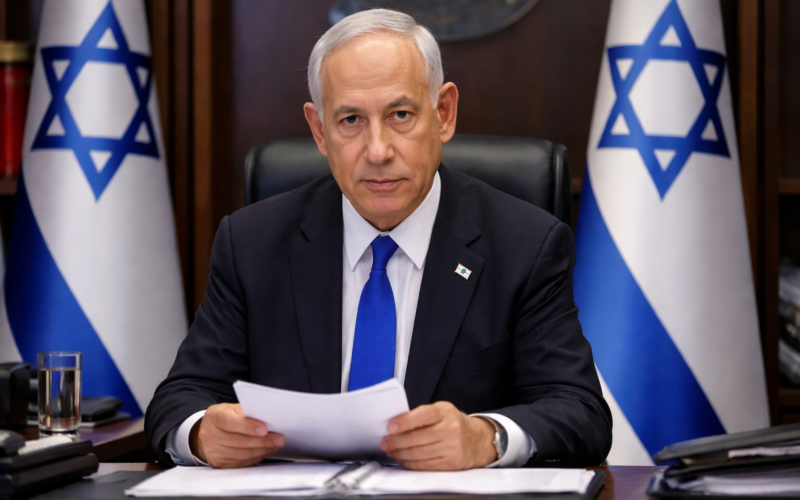
Israeli Prime Minister Benjamin Netanyahu will seek re-election in Israel’s next national vote, setting up a politically charged contest shaped by the October 7, 2023 Hamas attack, wars in Gaza, Lebanon and Iran, and visible tension with United States President Donald Trump.
The Likud Party confirmed on June 10, 2026 that Benjamin Netanyahu would run again, after Donald Trump publicly raised uncertainty over whether the Israeli prime minister wanted to continue in office. The election has not yet been formally scheduled, but Israel’s next national ballot is due no later than October 27, 2026.
The announcement places Benjamin Netanyahu at the centre of Israel’s most consequential election cycle since the October 7, 2023 attack, which became the country’s worst security failure and triggered the war in the Gaza Strip. Benjamin Netanyahu is also campaigning after a turbulent term marked by mass protests, a right-wing coalition, continued fighting in multiple theatres and intensifying public debate over Israel’s strategic dependence on the United States.
The political problem for Benjamin Netanyahu is clear. His party has confirmed he will run, but polls have repeatedly indicated that his governing bloc may struggle to secure a parliamentary majority. A June 2026 Israel Democracy Institute survey found that 61% of Israelis believed Benjamin Netanyahu should not run in the next Knesset elections, while 35% believed he should.
Why has Benjamin Netanyahu’s re-election decision become a test of Israeli wartime politics?
Benjamin Netanyahu’s decision to seek another term turns Israel’s next election into a direct test of whether wartime leadership can outweigh public anger over the October 7, 2023 attack and the prolonged conflicts that followed. The Likud Party is presenting continuity as a strength, while opponents are framing the vote as a long-delayed reckoning over security, accountability and national direction.
Benjamin Netanyahu returned to power in December 2022 at the head of the most right-wing government in Israel’s history. Since then, Israel has faced mass domestic protests, the Gaza war, renewed fighting in Lebanon, and a wider regional conflict involving Iran. Those developments have made the prime minister’s record inseparable from the national security debate.
For Benjamin Netanyahu, the campaign offers a chance to argue that Israel needs experienced leadership during an unstable regional moment. For his critics, the same instability reinforces the argument that Israel requires political change after years of polarisation and security failure. That tension makes the coming election less a routine parliamentary contest and more a referendum on how Israelis judge the balance between survival, deterrence and accountability.
The election is also institutionally significant because it will be the first national vote since the October 7, 2023 Hamas attack. That means security credibility, coalition discipline and the future structure of Israeli governance are likely to dominate the campaign far more than standard economic or social-policy arguments.
How has Donald Trump’s public uncertainty complicated Benjamin Netanyahu’s election positioning?
Donald Trump’s public uncertainty over whether Benjamin Netanyahu would run again has added an unusual external dimension to Israel’s election politics. Benjamin Netanyahu has long presented his relationship with Donald Trump as a strategic asset, but recent public friction has complicated that narrative at a sensitive moment.
The United States remains Israel’s closest and most important external ally. For Israeli voters, the prime minister’s ability to manage Washington is not a symbolic issue. It affects military support, diplomatic protection, Iran policy, Lebanon strategy and the broader regional security environment.
Recent tension between Donald Trump and Benjamin Netanyahu has centred partly on Israeli military action in Lebanon and United States efforts to pursue diplomacy with Iran. Donald Trump has pushed for restraint in some areas while continuing to describe the broader United States and Israel relationship as strong. That mix gives Benjamin Netanyahu room to claim that the alliance remains intact, but it also gives opponents room to question whether the Israeli prime minister still has the same influence in Washington.
The political risk for Benjamin Netanyahu is that the United States relationship has become a campaign issue rather than a guaranteed advantage. If Donald Trump is seen as limiting Israeli freedom of action, Benjamin Netanyahu could face criticism from right-wing voters who want firmer military policy. If Benjamin Netanyahu is seen as ignoring United States pressure, he could face criticism from voters who worry about diplomatic isolation and strategic overreach.
Why do Israeli polls make the next Knesset election unusually difficult for Likud Party?
Israeli polling has created a difficult backdrop for the Likud Party because the issue is not only whether Benjamin Netanyahu can remain the largest right-wing figure. The harder question is whether Benjamin Netanyahu can assemble a viable governing majority in the 120-seat Knesset.
Polls have repeatedly suggested that Benjamin Netanyahu’s coalition could fall short of a parliamentary majority. The Israel Democracy Institute survey added a sharper personal dimension by showing that 61% of Israelis believed Benjamin Netanyahu should not run again, against 35% who believed he should. Among Jewish respondents, 57% said he should not run, while 39.5% said he should. Among Arab respondents, 83% said he should not run, while 11% said he should.
Those figures matter because Israeli politics is coalition-based. A party can remain influential and still fail to form a government if allied factions do not cross the majority threshold. Benjamin Netanyahu has survived repeated political crises before, but the polling picture suggests that personal durability alone may not be enough.
The Likud Party also faces pressure from disputes inside the governing camp. An ultra-Orthodox Jewish faction that has traditionally been close to Benjamin Netanyahu pushed for an early election after a dispute over a law that would exempt members of its community from mandatory military service. That draft issue has become more politically sensitive because Israel’s military has warned of being overstretched after prolonged conflict.
How could opposition fragmentation shape the race against Benjamin Netanyahu’s coalition?
The opposition’s opportunity is substantial, but not uncomplicated. Naftali Bennett and Yair Lapid have joined forces through the party called Together, creating a more direct electoral vehicle against Benjamin Netanyahu. The alliance matters because both men have previously helped remove Benjamin Netanyahu from power and represent different parts of the anti-Netanyahu electorate.
Naftali Bennett, a former prime minister from the right, can compete for voters who want security-focused politics without Benjamin Netanyahu’s leadership. Yair Lapid, a centrist former prime minister and opposition leader, speaks to secular and middle-class voters angered by the burden of tax, military service and coalition concessions to ultra-Orthodox parties.
Yet the opposition still faces a structural challenge. Polling has suggested that opposition parties may struggle to form a parliamentary majority unless they cooperate with Arab parties. Some opposition leaders have ruled out such an arrangement, which could leave the anti-Netanyahu bloc short of power even if Benjamin Netanyahu’s bloc also falls short.
That fragmentation is one reason Benjamin Netanyahu remains politically competitive despite weak polling. Israel has already experienced repeated inconclusive elections, including five ballots in less than four years before the 2022 vote. If neither camp can form a stable coalition, Benjamin Netanyahu could remain a central figure even in a weakened political position.
Why does the October 7, 2023 security failure remain central to Israel’s political contest?
The October 7, 2023 Hamas attack remains central because it directly challenged Benjamin Netanyahu’s long-standing claim to be Israel’s most reliable security leader. The attack led to the war in the Gaza Strip and reshaped Israel’s domestic politics, military planning and foreign relationships.
Since the attack, Benjamin Netanyahu has faced criticism over accountability, hostage policy, military strategy and the inability to convert battlefield gains into a broader strategic settlement. The wars involving Hamas, Hezbollah and Iran have kept security at the centre of the public agenda, but they have also extended the period in which voters assess whether the government has restored deterrence or merely prolonged crisis.
Benjamin Netanyahu’s supporters are likely to argue that Israel needs continuity until its enemies are weakened and its regional deterrence is rebuilt. His opponents are likely to argue that the same conflicts show why new leadership is required. Both arguments will be powerful because Israeli voters are not judging a single event. They are judging a sequence of security shocks, military responses and diplomatic constraints.
This is why the election is likely to be framed around more than Benjamin Netanyahu’s personal future. It will test how Israeli society wants to distribute military obligations, how much deference Israel should give to the United States, how Israel should manage Lebanon and Iran, and whether the political order built around Benjamin Netanyahu can survive another national crisis.
What are the key takeaways from Benjamin Netanyahu’s re-election decision in Israel?
- Benjamin Netanyahu will seek re-election in Israel’s next national vote after the Likud Party confirmed his decision on June 10, 2026, following public uncertainty raised by United States President Donald Trump.
- Israel’s next national election has not yet been formally scheduled, but the ballot is due no later than October 27, 2026, making the coming campaign the first since the October 7, 2023 Hamas attack.
- The election will test Benjamin Netanyahu’s claim to security leadership after wars in the Gaza Strip, Lebanon and Iran, as well as continued public scrutiny over Israel’s worst security failure.
- The Israel Democracy Institute survey found that 61% of Israelis believed Benjamin Netanyahu should not run in the next Knesset election, while 35% believed he should run again.
- Benjamin Netanyahu’s governing bloc faces polling pressure because Israeli governments require a parliamentary majority in the 120-seat Knesset, and repeated surveys have suggested his coalition may fall short.
- Naftali Bennett and Yair Lapid have joined forces through Together, creating a broader opposition vehicle, but the anti-Netanyahu camp may still face coalition arithmetic challenges after the vote.
- The ultra-Orthodox military service exemption dispute has added pressure to Benjamin Netanyahu’s coalition, because the issue combines religious politics, military manpower and resentment over unequal national obligations.
- Donald Trump’s public uncertainty has complicated Benjamin Netanyahu’s campaign messaging because the Israeli prime minister has long presented his relationship with the United States president as a core strategic advantage.
Discover more from Business-News-Today.com
Subscribe to get the latest posts sent to your email.