





The United States and Iran have moved into a sharper military confrontation after an exchange of strikes around the Strait of Hormuz, raising the risk that a fragile diplomatic track could be overwhelmed by battlefield escalation, maritime disruption and renewed nuclear pressure.
The latest flare-up intensified on June 10, 2026, after United States President Donald Trump warned that the United States would strike Iran again very hard, following Iranian missile and drone attacks on United States-linked bases in Jordan, Kuwait and Bahrain. Iran said the attacks were retaliation for United States strikes on Iranian targets near the Strait of Hormuz.
The exchange followed the reported downing of a United States Army Apache helicopter near the Strait of Hormuz. United States Central Command said United States forces had carried out self-defence strikes on Iranian air defence sites, ground control stations and surveillance radar facilities near the strategic waterway. The two Apache crew members were rescued and were reported to be stable.
The immediate military damage appeared contained on the American side, with a United States official saying there was no significant damage and no harm to United States personnel. Yet the political and strategic consequences are far broader. Iran said it would reassess diplomatic engagement with Washington, while Qatar continued mediation efforts aimed at preventing a wider breakdown.
Why has the United States and Iran military exchange around the Strait of Hormuz deepened regional risk?
The United States and Iran confrontation has become more dangerous because the latest strikes are no longer limited to one bilateral theatre. Iran said it targeted United States bases in Jordan, Kuwait and Bahrain, expanding the operational geography of the confrontation across Gulf and regional security nodes.
Jordan said its military intercepted five missiles launched toward al-Azraq, while Kuwait and Bahrain activated air defences against hostile aerial targets. Bahrain hosts the headquarters of the United States Navy’s regional fleet, while Kuwait houses major United States military facilities, making any Iranian strike claim in those countries strategically sensitive even when damage is limited.
The United States position is that the strikes on Iranian targets were a proportional response to the downing of the Apache helicopter and recent attacks on United States forces and commercial ships. Iran’s position is that United States actions around the Strait of Hormuz amount to repeated violations of the environment needed for talks. That gap matters because both sides are still presenting military escalation as defensive conduct.
Iran’s Foreign Ministry spokesperson Esmaeil Baghaei said Tehran would reassess diplomatic engagement with Washington after the overnight clashes. His stated position was that any diplomatic process requires a minimum stable environment. That formulation signals that Iran is not formally abandoning diplomacy, but is linking the future of negotiations to the military tempo around the Strait of Hormuz.
Donald Trump has taken a harder public line, saying Iran had taken too long to negotiate a deal and would now have to pay the price. United States Secretary of War Pete Hegseth also warned that Iran would be unwise to challenge the United States further. The official United States security posture is therefore combining active military response with pressure for a deal.
For Gulf states, the immediate risk is that air defence alerts, intercepted missiles and maritime enforcement operations could become routine rather than exceptional. That would leave Jordan, Kuwait, Bahrain, Oman and other regional actors managing the consequences of United States and Iran decisions without controlling the central negotiation.
How are Qatar mediation efforts being tested by United States and Iran military escalation?
Qatar’s mediation role has become more important because the latest military exchange has not fully closed the diplomatic channel. A Qatari delegation travelled to Tehran after consultations with Washington, indicating that back-channel diplomacy remained active even as United States and Iranian forces exchanged attacks.
The challenge for Qatar is that the negotiating agenda is no longer just about a ceasefire or immediate military restraint. Donald Trump wants Iran to end restrictions on shipping through the Strait of Hormuz and provide nuclear assurances that prevent Iran from developing a nuclear weapon. Iran denies seeking a nuclear weapon and wants sanctions relief, access to frozen assets and recognition of its control over the strait.
These demands show why a quick settlement remains difficult. The United States is treating the Strait of Hormuz as a global shipping and energy security issue. Iran is treating the strait as a sovereignty and leverage issue. Qatar’s diplomatic space depends on whether both sides can accept a formula that reduces attacks without forcing either government to appear to retreat under pressure.
The mediation track is also complicated by parallel conflicts. Fighting between Israel and Iran-backed Hezbollah militants in Lebanon continued as the United States and Iran confrontation intensified. Israeli airstrikes in southern Lebanon reportedly killed at least 13 people, while Hezbollah claimed fresh attacks against Israeli forces. The wider regional environment therefore remains combustible even beyond the Strait of Hormuz.
This regional layering is what makes the current moment more serious than a single exchange of fire. A United States strike near Hormuz, an Iranian response against regional bases, Israeli strikes in Lebanon and nuclear oversight pressure in Vienna are all now feeding into the same diplomatic calculation. One theatre can destabilise the others.
Why does the International Atomic Energy Agency vote add pressure to nuclear diplomacy with Iran?
The International Atomic Energy Agency’s 35-nation Board of Governors added a second pressure point by passing a United States-backed resolution requiring Iran to declare its remaining enriched uranium stocks and allow inspectors to verify them. The timing is significant because the resolution came within hours of the latest United States and Iran military exchange.
The resolution was pushed by the United States, Britain, France and Germany. It passed with 21 votes in favour, three against and 10 abstentions. Russia, China and Niger opposed the text. Iran rejected the move as political and argued that the United States was trying to convert the consequences of military strikes into a case against the Islamic Republic of Iran.
The core issue is the fate of Iranian enriched uranium after earlier attacks badly damaged or destroyed Iranian uranium enrichment facilities. The International Atomic Energy Agency has not been able to verify the full status of material that was produced before those attacks. The agency estimated that Iran had 440.9 kilograms of uranium enriched up to 60 percent before the first Israeli strikes in June 2025, a level close to weapons grade if further enriched.
Iran says it does not seek a nuclear weapon. Donald Trump has said any peace deal must ensure Iran cannot develop one. The International Atomic Energy Agency resolution therefore puts the nuclear file back at the centre of the military crisis, even as diplomats are trying to stabilise the ceasefire and maritime situation.
The political consequence is clear. Iran may see the resolution as pressure coordinated with military action, while the United States and European governments may see Iranian non-disclosure as a barrier to any credible deal. That mismatch could make nuclear verification both the necessary pathway to a broader settlement and the issue most likely to derail it.
How are oil markets and maritime security reacting to the Strait of Hormuz escalation?
Oil markets quickly reflected the renewed war risk. Brent crude futures rose to around $94 a barrel, while United States West Texas Intermediate crude moved above $91 a barrel during the latest trading reaction. The price move came as United States and Iran tensions coincided with tighter United States crude inventories.
The United States Energy Information Administration said United States crude inventories fell by 7.2 million barrels to 426.5 million barrels in the week ended June 5, compared with expectations for a 4 million-barrel draw. Inventories in the United States Strategic Petroleum Reserve were at their lowest level since August 2023.
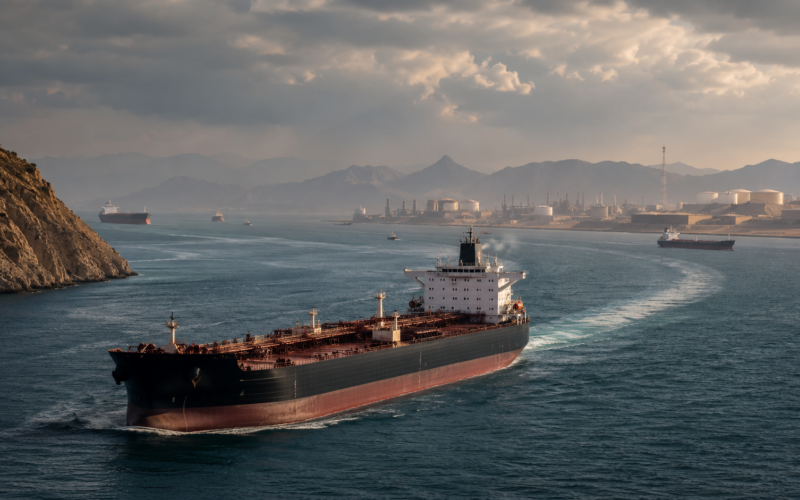
The Strait of Hormuz remains central to the oil market reaction because it normally carries about a fifth of the world’s crude oil and liquefied natural gas. Iran has continued to restrict most shipping through the waterway, while Washington has imposed its own blockade of Iranian ports and energy exports. Even limited flows through the strait can cap panic, but persistent disruption keeps a geopolitical risk premium in crude prices.
Maritime enforcement has also raised direct humanitarian and diplomatic concerns. Three Indian seafarers remained missing after an attack on the oil products tanker Settebello off the coast of Oman, while 21 other Indian mariners were rescued. India’s foreign ministry condemned the attack on the commercial vessel and said its embassy in Oman was coordinating with Omani authorities during the search and rescue operation.
That tanker incident adds another layer to the Strait of Hormuz crisis. The confrontation is no longer only about state-to-state military signalling. It is also affecting commercial crews, insurance risk, shipping routes and countries whose citizens work aboard vessels in contested waters. For India and other maritime labour-supplying countries, the escalation has become a direct citizen-safety issue.
What happens next if United States and Iran diplomacy remains open but military pressure continues?
The most important near-term question is whether the United States and Iran can prevent tactical military exchanges from collapsing the mediation track. Qatar’s continued involvement suggests that diplomacy is not dead, but the public messaging from Washington and Tehran is hardening.
Donald Trump is demanding a meaningful deal that addresses shipping through the Strait of Hormuz and nuclear assurances. Iran is resisting pressure that it sees as military coercion and political escalation. The International Atomic Energy Agency is demanding verifiable information on enriched uranium. Gulf states are activating air defences. Oil markets are pricing in disruption.
That combination leaves the crisis in a dangerous middle zone. Neither side appears to have fully closed the door to talks, but both sides are using military and economic pressure to improve their negotiating position. In such a setting, miscalculation becomes the largest risk. A failed interception, a strike causing casualties, a tanker incident with wider national exposure or a nuclear oversight dispute could quickly narrow the space for compromise.
For policymakers, the central issue is not whether another round of talks can be arranged. The harder question is whether talks can produce a framework strong enough to restrain attacks, reopen maritime flows, restore nuclear inspection credibility and reassure regional states at the same time. That is a much higher bar than a temporary pause in fire.
What are the key takeaways from the United States and Iran escalation around the Strait of Hormuz?
- The United States and Iran exchanged military actions around the Strait of Hormuz after the reported downing of a United States Army Apache helicopter, with United States Central Command saying it struck Iranian air defence, radar and ground control targets.
- Iran said it launched missile and drone attacks on United States bases in Jordan, Kuwait and Bahrain in response to United States strikes, while Jordan, Kuwait and Bahrain activated air defence systems during the regional escalation.
- United States President Donald Trump warned that Iran had taken too long to negotiate a deal and said the United States would attack Iran again very hard unless a meaningful agreement emerged.
- Iran’s Foreign Ministry spokesperson Esmaeil Baghaei said Tehran would reassess diplomatic engagement with Washington after the clashes, while Qatar continued mediation efforts by sending a delegation to Tehran after consultations with Washington.
- The International Atomic Energy Agency’s 35-nation Board of Governors passed a United States-backed resolution requiring Iran to declare its enriched uranium stocks and allow inspectors to verify them without delay.
- Oil markets reacted to the escalation, with Brent crude and United States West Texas Intermediate crude rising as United States crude inventories fell sharply and shipping through the Strait of Hormuz remained constrained.
- India said three Indian seafarers were missing after an attack on the tanker Settebello off Oman, while 21 Indian mariners were rescued and search and rescue coordination continued with Omani authorities.
- The crisis now links military escalation, nuclear verification, energy markets, Gulf air defence readiness and commercial shipping safety, making the United States and Iran negotiations more complex than a simple ceasefire discussion.
Discover more from Business-News-Today.com
Subscribe to get the latest posts sent to your email.


