




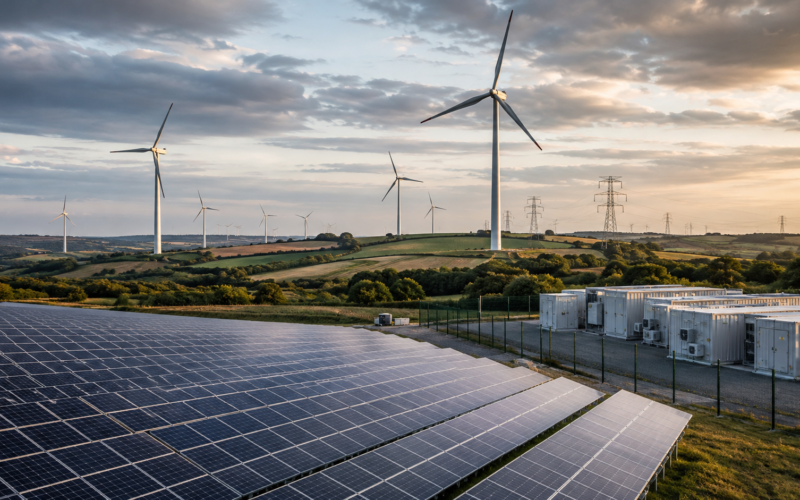
TotalEnergies SE (Euronext Paris: TTE; NYSE: TTE) has agreed to sell a 50% interest in a largely developed 1.2GW European renewable energy portfolio to an insurance account managed by KKR & Co. Inc. (NYSE: KKR). The wind and solar assets, located across Germany, Spain, France and Poland, carry a combined enterprise value of approximately €1.8 billion. TotalEnergies will retain the remaining 50% interest, continue operating the assets and remain responsible for marketing electricity not already sold to third parties. The transaction extends the French energy group’s strategy of monetising mature renewable projects while preserving operating control, although the ultimate value created will depend on the undisclosed cash proceeds and how effectively the released capital is redeployed.
The KKR TotalEnergies renewable assets deal is expected to close during 2026, subject to customary conditions. Neither company disclosed the purchase price for KKR’s interest, the portfolio’s debt, the individual projects included or the expected accounting gain for TotalEnergies. Those omissions matter because the reported €1.8 billion figure is an enterprise valuation for the entire portfolio, not the cash amount KKR will pay for its 50% economic interest.
Strategically, the transaction is less about TotalEnergies reducing its commitment to renewable power and more about accelerating capital turnover. The company is retaining exposure to future cash flows, maintaining its operating role and bringing in long-duration institutional capital after much of the development risk has already been removed. KKR, meanwhile, gains access to a geographically diversified European power portfolio without having to assemble and develop each asset independently.
Why is TotalEnergies selling half of a 1.2GW renewable portfolio instead of retaining full ownership?
TotalEnergies has increasingly treated renewable development as a capital recycling platform rather than a collection of assets that must remain wholly owned indefinitely. The group develops, finances and derisks projects, then sells minority or equal interests to institutional investors once the assets have reached a more mature stage. It retains sufficient ownership and operating responsibility to capture recurring power-market value while freeing capital for new construction, acquisitions and flexible-generation infrastructure.
This model can improve capital efficiency because the early development and construction phases generally require substantial expenditure before projects begin generating dependable cash flow. Selling a 50% stake after those risks have declined allows TotalEnergies to crystallise part of the value created during development without fully surrendering future earnings. The approach also shares exposure to operating performance, power prices, weather conditions and refinancing requirements with an external investor.
TotalEnergies has said its Integrated Power strategy is designed to achieve attractive profitability while allowing the company to divest stakes of up to 50% in operational and derisked renewable assets. Similar transactions have already been completed in France, Portugal and Greece, where TotalEnergies retained half of the relevant portfolios and continued operating or marketing their electricity.
The financial tension is that repeated farm-downs can make reported renewable capacity growth look stronger than the corresponding growth in net economic ownership. The physical capacity of the European portfolio will not disappear after the transaction, but TotalEnergies’ economic interest will be reduced to 50%. Investors therefore need to assess Integrated Power through net production, cash flow, returns on invested capital and realised disposal gains, rather than relying exclusively on gross gigawatt figures.

What does the €1.8 billion portfolio valuation reveal about KKR’s renewable investment?
The €1.8 billion enterprise value equates to approximately €1.5 million per megawatt across the 1.2GW portfolio, based on Business News Today calculations. That is a portfolio-level valuation and should not be interpreted as the equity purchase price. Enterprise value can include project debt and other financial obligations, meaning the cash received by TotalEnergies could differ materially from a simple 50% share of the headline valuation.
The implied value per megawatt is higher than several recent TotalEnergies European renewable farm-downs. A 604MW Portuguese portfolio sold at an implied enterprise value of €550 million, or roughly €0.91 million per megawatt. A 424MW Greek portfolio was valued at €508 million, equivalent to about €1.20 million per megawatt, while a 270MW French portfolio carried an enterprise value of €265 million, close to €0.98 million per megawatt.
The comparison suggests the new European portfolio may contain a more valuable mix of assets, stronger contractual arrangements, more favourable market exposure or a different debt structure. However, TotalEnergies and KKR have not provided enough asset-level information to determine the exact reason for the higher implied valuation. Differences in project age, technology, capacity factors, subsidy arrangements, power purchase agreements and national electricity markets can make simple megawatt comparisons misleading.
The valuation nevertheless gives TotalEnergies a useful external benchmark for the value embedded in its renewable development pipeline. If the company can repeatedly construct assets at a cost below the valuations achieved through partial disposals, the model could generate development margins while preserving a continuing share of operating income. The critical test is whether disposal proceeds are reinvested into projects capable of producing comparable or better risk-adjusted returns.
Why does an insurance account managed by KKR fit the economics of European renewable assets?
The buyer is not described as KKR’s corporate balance sheet or a conventional short-duration private equity fund. It is an insurance account managed by KKR, suggesting that the assets are being matched with capital seeking long-dated and potentially predictable returns. Renewable infrastructure can suit insurance capital because operating assets may generate cash flows over several decades, particularly when part of their output is supported by contractual or regulated arrangements.
The portfolio also offers geographic diversification across four significant European electricity markets. Germany, Spain, France and Poland have different generation mixes, regulatory frameworks, power-price dynamics and renewable development conditions. That diversification can reduce dependence on the performance of one national market, although it also introduces additional regulatory and operational complexity.
Electricity from the portfolio will either be sold to third parties or marketed by TotalEnergies. This creates a blend of contracted and market-facing exposure rather than a purely fixed-return infrastructure profile. KKR’s ultimate returns will therefore depend on the quality of existing commercial agreements, the proportion of merchant electricity exposure, operating availability and TotalEnergies’ effectiveness as power marketer and asset operator.
KKR’s infrastructure platform had approximately US$107 billion in assets under management as of March 31, 2026, giving it sufficient scale to absorb transactions of this size without excessive concentration. The firm’s total assets under management reached approximately US$796 billion during the second quarter, while quarterly inflows were reported at US$34 billion, supported by demand for real assets and infrastructure strategies.
The transaction also extends an existing relationship between the two companies. In September 2025, KKR-managed insurance vehicles and accounts acquired a 50% interest in a 1.4GW TotalEnergies solar portfolio in North America. That portfolio was valued at US$1.25 billion, while TotalEnergies retained the remaining interest and continued operating the assets.
A repeat transaction can lower execution friction because the companies have already negotiated governance, operating and reporting arrangements for jointly owned renewable assets. It may also indicate that both parties view the earlier structure as replicable across jurisdictions. The European transaction is not merely a one-off sale but another step toward a broader institutional partnership around mature clean-energy infrastructure.
How does the KKR deal fit TotalEnergies’ changing European power strategy?
TotalEnergies is simultaneously concentrating its renewable portfolio and expanding its exposure to flexible electricity generation. In July 2026, the group agreed to sell its distributed solar generation activities across seven European countries, representing approximately 170MW of installed capacity. TotalEnergies said the exit would allow it to focus on utility-scale solar and wind assets, where greater project size can provide stronger operating and development economies.
The group has also expanded in flexible power through its acquisition of a 50% interest in EPH’s Western European power-generation platform. That transaction added exposure to more than 14GW of operating or under-construction generation capacity and a further development pipeline, while reducing TotalEnergies’ expected annual capital expenditure through an all-share structure.
These decisions point to a more integrated power model. TotalEnergies is not attempting to own every renewable asset outright. Instead, it is combining utility-scale wind and solar development, electricity marketing, flexible generation and partial infrastructure ownership. Renewable output can supply low-carbon electricity, while flexible generation can help address periods when wind and solar production is insufficient.
The strategic logic is compelling, but execution remains complicated. Value creation depends on correctly timing asset sales, maintaining disciplined construction costs, managing merchant electricity exposure and integrating renewable generation with flexible power and customer supply. A poorly priced farm-down could surrender too much future upside, while excessive retention of mature projects could constrain the capital available for higher-return developments.
Does the transaction improve TotalEnergies’ balance sheet and capital-allocation position?
TotalEnergies entered the transaction from a comparatively resilient financial position. The company reported approximately US$6 billion of adjusted net income and US$9.8 billion of cash flow during the second quarter of 2026. Management also identified deleveraging as a priority, with gearing reported at 13%, while approving a second-quarter interim dividend of €0.90 per share, up 5.9% from the comparable distribution.
The KKR transaction could support that balance-sheet discipline by converting part of a developed asset portfolio into cash without requiring TotalEnergies to exit the assets completely. The company could apply proceeds to debt reduction, shareholder distributions, renewable construction or further expansion of its Integrated Power platform.
However, the precise financial benefit cannot yet be quantified. TotalEnergies has not disclosed the equity value, net cash proceeds, transaction gain, portfolio earnings or expected reduction in capital employed. It is therefore too early to conclude that the deal will materially alter group leverage or earnings.
Business News Today’s assessment is that the transaction should be viewed primarily as an efficiency measure within TotalEnergies’ electricity business rather than as a group-level balance-sheet event. The portfolio is meaningful within renewable power, but relatively modest compared with the scale of TotalEnergies’ global operations and cash generation. The strategic signal may be more important than the immediate financial contribution.
What are TotalEnergies and KKR share prices signalling about investor sentiment?
TotalEnergies shares closed at €75.96 in Paris on July 29, 2026. Based on available historical prices, the stock was almost unchanged over the preceding five sessions but approximately 11.7% above its June 30 close. Its reported 52-week range was €49.24 to €81.34, placing the shares closer to the upper end of that range before the transaction announcement.
During August 3 trading, TotalEnergies shares were down by around 2.2% alongside weaker European energy stocks as oil prices declined. That broader sector movement makes it difficult to isolate any market reaction to the KKR transaction. The renewable portfolio deal is also unlikely to be large enough by itself to determine the daily valuation of a group whose earnings remain heavily influenced by oil, gas, refining and global commodity prices.
KKR shares closed at US$101.43 on July 31, up approximately 2.1% over five trading sessions and around 8.1% from the July 2 close, according to Business News Today calculations. The shares remained approximately 33% below their 52-week high of US$152.10, with the reported 52-week range extending down to US$82.67.
Sentiment toward KKR has improved from its recent lows, helped by strong fundraising and growth in fee-related earnings, but the valuation still reflects caution surrounding markets, asset realisations and the wider alternative-investment cycle. The European renewable acquisition represents a modest deployment relative to KKR’s infrastructure and group-wide assets under management, so investors are more likely to judge the firm through fundraising momentum, management fees, investment performance and capital deployment across its full platform.
For TotalEnergies, the market question is whether Integrated Power can become a material and consistently profitable counterweight to the company’s hydrocarbon businesses. Renewable farm-downs can demonstrate portfolio value, but investors will ultimately require evidence that retained power earnings and reinvested proceeds are generating durable returns.
What must happen before the TotalEnergies and KKR renewable transaction closes?
The transaction is expected to complete during 2026 after satisfaction of customary closing conditions. The announcement did not identify specific regulatory approvals, financing requirements or national reviews, although a portfolio spanning four European jurisdictions could require several administrative and contractual steps.
The most important future disclosure will be the financial detail. Investors need the cash proceeds, debt transferred or retained, accounting gain and contribution of the portfolio to TotalEnergies’ earnings. Asset-level information would also help establish whether the €1.8 billion valuation reflects operating projects, late-stage developments, contracted revenues or a greater degree of merchant power exposure.
TotalEnergies is scheduled to hold its Investor Day on September 28, 2026, followed by third-quarter results on October 29. Those events could provide a broader update on Integrated Power capital allocation, renewable portfolio monetisation and the group’s post-transaction investment priorities.
The transaction strengthens TotalEnergies’ ability to recycle capital while preserving operational influence over a significant European renewable portfolio. KKR gains a long-duration infrastructure position supported by an experienced operator and exposure to four major electricity markets. What remains unresolved is whether the undisclosed proceeds and retained earnings will produce returns superior to full ownership.
The next measurable proof point will not simply be regulatory completion. It will be evidence that TotalEnergies can convert the released capital into faster growth, stronger cash generation or lower leverage without weakening the long-term earnings potential of its Integrated Power business.
Key takeaways from KKR’s investment in TotalEnergies’ European renewable portfolio
- An insurance account managed by KKR will acquire a 50% interest in a largely developed 1.2GW European wind and solar portfolio.
- The assets are located across Germany, Spain, France and Poland and have a combined enterprise value of approximately €1.8 billion.
- TotalEnergies will retain a 50% interest, continue operating the assets and remain involved in electricity marketing.
- The €1.8 billion enterprise value is not the disclosed cash purchase price for KKR’s stake.
- The implied portfolio valuation is approximately €1.5 million per megawatt, above several recent TotalEnergies European renewable farm-downs.
- The transaction extends TotalEnergies’ strategy of recycling capital from derisked projects while retaining operating exposure.
- KKR and TotalEnergies previously used a similar structure for a 1.4GW North American solar portfolio.
- The financial impact remains uncertain because cash proceeds, project debt, earnings contribution and any accounting gain were not disclosed.
- Closing is expected during 2026, subject to customary conditions.
- The central test is whether TotalEnergies redeploys the released capital at returns exceeding those surrendered through the partial disposal.
Discover more from Business-News-Today.com
Subscribe to get the latest posts sent to your email.