




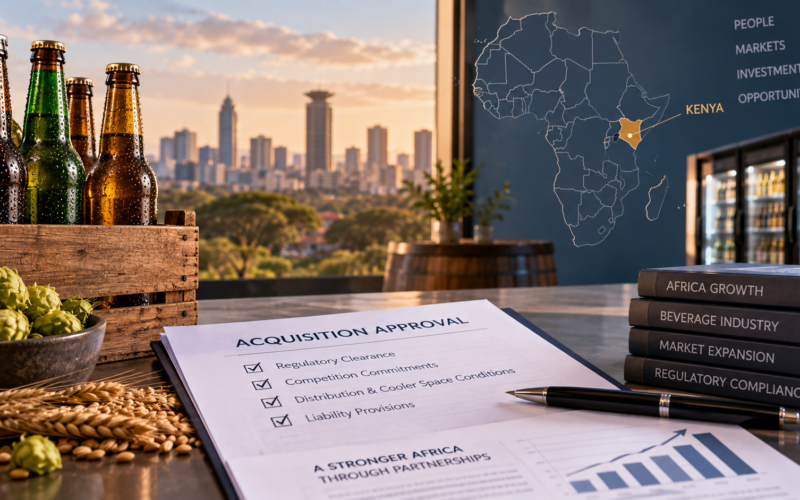
Diageo plc (LSE: DGE; NYSE: DEO) has cleared a major regulatory hurdle in its planned $2.3 billion sale of a 65% stake in East African Breweries PLC to Japan’s Asahi Group Holdings Ltd. after Kenya’s competition authority approved the transaction with conditions. The approval requires the merged business to reserve at least 20% of refrigeration and cooler space at relevant retail outlets for products that do not belong to East African Breweries or Asahi, while adequate funds must also be reserved for outstanding liabilities and continuity obligations. The transaction includes Diageo’s Kenyan interests and represents a major step in the British drinks group’s broader reshaping of its African exposure, although regulatory clearance should not be confused with final transaction completion. For Asahi, East African Breweries provides immediate scale across one of Africa’s most established beer markets rather than requiring years of greenfield distribution development. Diageo shares traded around 1,603 pence on September 11, roughly 3% below the previous week’s level and about 9% lower than a month earlier.
Why is Kenya requiring 20% of retail cooler space to remain available to competing beverage brands?
Cold display space is an important competitive asset in African beverage markets because chilled beer and soft drinks are often purchased for immediate consumption. A brewer that controls refrigerators inside bars, shops and other outlets can influence which products customers see and which competing suppliers can keep cold. The regulator is therefore treating refrigeration access as part of market competition rather than merely a piece of retail furniture.
Requiring at least 20% of cooler space to be available to non-EABL and non-Asahi products is intended to prevent the enlarged supplier from converting its distribution scale into an overwhelming visibility advantage. The condition is particularly relevant because Asahi is not simply purchasing one brand. It is acquiring control of an established brewing and distribution platform with deep retailer relationships.
The rule could modestly reduce the commercial benefit Asahi receives from its acquired refrigerator estate. A cooler supplied or serviced by the company cannot necessarily be filled entirely with its highest-margin products, limiting exclusivity. However, access to the remaining 80% still provides substantial control, while the acquired route-to-market infrastructure remains strategically valuable.
Smaller beverage companies could benefit disproportionately from the condition because physical visibility is often one of their largest barriers. A consumer cannot choose a rival beer that is unavailable or warm while EABL products occupy every refrigerated position. Competition policy in this case is therefore attempting to preserve practical access rather than relying only on theoretical brand choice.
Why is East African Breweries strategically attractive to Asahi despite economic volatility in the region?
Asahi already operates in mature beer markets where population growth and per-capita consumption provide limited structural expansion. East Africa offers a different demographic profile, with younger populations, urbanisation and long-term growth in formal consumer markets creating potential for greater beverage penetration over time.
East African Breweries also gives Asahi an established operating platform rather than a speculative entry. The business has brands, brewing assets, distribution and institutional knowledge built over many decades across Kenya and neighbouring markets. Buying that infrastructure reduces the time required to understand excise taxes, route-to-market structures, local sourcing and consumer preferences.
The acquisition can also diversify Asahi geographically. Japan and several developed international markets face slower demographic growth, making emerging consumer economies strategically valuable even when near-term volatility is higher. The trade-off is exposure to currency movements, inflation, tax policy and political risks that are generally greater than in developed markets.
Beer affordability will be especially important. Higher excise duties can push legal products beyond the budgets of some consumers and strengthen informal or illicit alcohol markets. Asahi therefore needs growth to come from a combination of volume, premiumisation and operational efficiency rather than simply raising prices whenever costs increase.
The $2.3 billion purchase price indicates that the buyer is paying for an established franchise rather than a cheap emerging-market option. Long-term success requires East African Breweries to produce enough cash growth to compensate for the higher risk attached to the region.
Why is Diageo willing to exit control of a major African brewer?
Diageo has been simplifying its portfolio and seeking to concentrate capital where management believes it can generate stronger returns. Selling a controlling stake in East African Breweries creates a substantial inflow of cash that can strengthen the balance sheet and provide flexibility at a time when global spirits demand remains uneven.
The transaction also reduces exposure to an operating model that involves substantial local beer manufacturing, distribution infrastructure and regulatory complexity. Diageo’s global strengths are often most visible in premium international spirits brands, where asset ownership and route-to-market structures can be different from running large regional brewing systems.
Exiting control does not mean Africa has ceased to matter as a beverage market. The decision is better understood as an allocation of ownership capital rather than a judgement that consumers across the continent have unattractive long-term prospects. Diageo can choose to focus its corporate resources on businesses where it sees stronger strategic fit.
The challenge is opportunity cost. East African Breweries has established brands and infrastructure that would be difficult and expensive to recreate if Diageo later wanted similar exposure. Selling gives up future participation in that ownership value once Asahi takes control.
That makes the transaction price important. A $2.3 billion consideration needs to compensate Diageo not only for current earnings but for surrendering long-term optionality in several growing consumer markets. Investors will ultimately judge the sale by how effectively proceeds are used elsewhere.
How do the regulator’s liability conditions change the closing risk for Asahi?
Kenyan regulators have required sufficient funds to be reserved for outstanding liabilities and to support continuity of supplies, services and small-business relationships. Local reporting has discussed reserve requirements potentially reaching as much as KES15 billion, or roughly $116 million, depending on the obligations ultimately addressed.
These conditions matter because acquisitions can create uncertainty for distributors, suppliers and other counterparties when ownership changes. Regulators are attempting to make sure the transaction does not improve returns for the buyer by leaving unresolved obligations behind or destabilising businesses dependent on the EABL ecosystem.
Asahi therefore needs to treat liabilities as part of the economic purchase price even when they are not included in the $2.3 billion headline consideration. Reserves reduce the amount of cash that can be moved freely after closing and may delay some of the financial benefits associated with ownership.
The deal has already faced legal friction, including a challenge involving distributor Bia Tosha that was dismissed earlier in 2026. The regulatory approval reduces one of the largest remaining uncertainties but does not erase the possibility of continuing litigation or implementation disputes.
This is why the distinction between approval and completion matters. Asahi has crossed a major regulatory gate, but actual control and financial consolidation depend on the remaining transaction conditions and final settlement.
What could Asahi do with EABL that Diageo was less willing to pursue?
Asahi’s strategic priorities are heavily oriented toward beer and adjacent beverage categories, making EABL more central to its portfolio logic than it may have been inside a company increasingly focused on global spirits. That alignment can influence capital allocation because manufacturing, packaging and beer innovation may receive greater management attention under an owner for whom brewing is a defining capability.
Procurement and brewing expertise could create efficiencies, although local raw materials, regulations and distribution mean the East African system cannot simply be folded into an Asian or European network. Asahi can still bring process knowledge, global supplier relationships and technology that may improve yields and factory productivity.
Premiumisation provides another possibility. Growing middle-class consumers can support more differentiated beers and adult beverages when disposable income rises, allowing EABL to expand beyond volume-led mainstream categories. Asahi’s international portfolio and brewing expertise may help develop products for those segments.
The company must nevertheless respect local brand equity. East African beer consumers have longstanding relationships with domestic and regional labels, and replacing those identities with international brands would risk destroying the very consumer loyalty Asahi is paying to acquire.
The best integration may therefore be invisible at the front end. Manufacturing, capital allocation and technical capabilities can change while the customer continues buying familiar products through familiar outlets.
Why is Diageo’s share-price weakness important to the strategic interpretation of the sale?
Diageo shares were around 1,603 pence on September 11 compared with 1,657 pence on September 4, representing a decline of roughly 3.3%. Against approximately 1,766 pence a month earlier, the stock has fallen more than 9%.
The shares remain materially below the upper end of their 52-week range. Investor concerns extend beyond the EABL transaction and include weak global spirits demand, consumer moderation, balance-sheet priorities and uncertainty around the timing of a meaningful recovery across premium alcohol categories.
A successful EABL disposal can help by bringing in significant cash and simplifying the portfolio, but the transaction cannot solve the wider demand problem. Diageo still needs its retained brands and core markets to generate stronger organic growth if the valuation is to recover sustainably.
The market will therefore focus on what happens to the proceeds. Debt reduction can lower financial risk, while investment behind faster-growing brands can improve future revenue. Capital returned to shareholders could support valuation differently but would provide less operating growth.
The sale becomes strategically successful only when the value realised from the asset is redeployed more productively than continued ownership would have been.
What are the key takeaways from Kenya approving Asahi’s $2.3 billion EABL acquisition?
- Kenya’s competition authority has approved Asahi Group Holdings’ proposed acquisition of Diageo’s 65% stake in East African Breweries.
- The transaction is valued at approximately $2.3 billion.
- The approval represents a major closing milestone but does not by itself mean the transaction has completed.
- The combined business must make at least 20% of relevant retail refrigeration space available to competing beverage products.
- Regulators also imposed conditions covering outstanding liabilities and continuity for suppliers and other businesses.
- Asahi gains an established East African brewing and distribution platform rather than needing to build market entry organically.
- Diageo receives significant capital while reducing direct exposure to a complex regional beer operation.
- Currency, excise duties, affordability and regulation remain important risks for Asahi after closing.
- DGE has fallen roughly 9% over one month, showing that investors remain focused on broader strategic and operating pressures.
- The ultimate value of the deal depends on Asahi growing EABL profitably while Diageo redeploys the sale proceeds effectively.
Discover more from Business-News-Today.com
Subscribe to get the latest posts sent to your email.


