




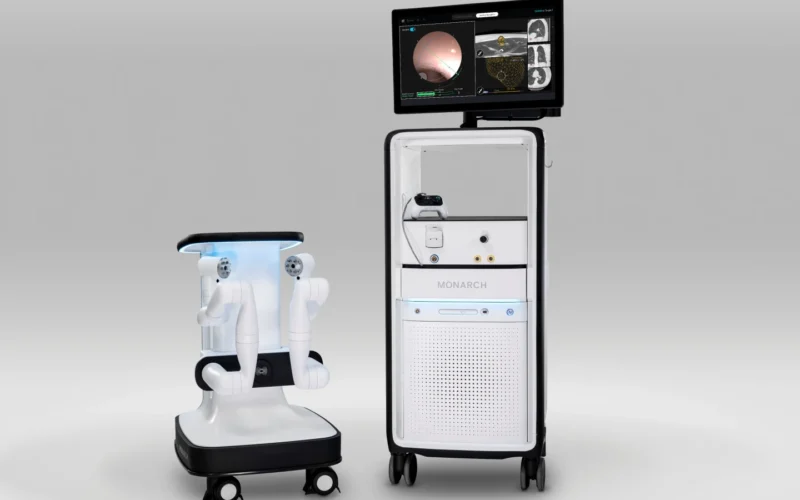
Johnson & Johnson (NYSE: JNJ) has received U.S. Food and Drug Administration 510(k) clearance for MONARCH QUEST 3, the newest software upgrade to its robotically assisted bronchoscopy platform. The August 17, 2026 clearance adds artificial intelligence-powered nodule segmentation, improved registration and navigation, a new 3D Compass visualization feature and broader compatibility with mobile and fixed cone-beam computed tomography systems. MONARCH QUEST 3 represents the fourth major software launch for the platform in approximately 18 months, showing how Johnson & Johnson is treating bronchoscopy robotics increasingly as a continuously updated software, imaging and navigation ecosystem rather than a static capital-equipment platform.
The regulatory terminology is important. MONARCH QUEST 3 received FDA 510(k) clearance rather than a new drug-style FDA approval, reflecting the regulatory pathway applied to the software update. The commercial significance comes from the attempt to improve one of robotic bronchoscopy’s most persistent technical challenges: the divergence between a lung nodule’s location on a pre-procedure CT scan and its actual location after anesthesia, ventilation and procedural positioning alter the patient’s anatomy.
What does MONARCH QUEST 3 change during robotic bronchoscopy?
MONARCH already provides continuous visualization as physicians navigate through the airways toward pulmonary targets and perform biopsies under direct vision. QUEST 3 adds AI-powered nodule segmentation intended to generate more accurate nodule boundaries during pre-procedure planning, while improvements to registration and navigation are designed to help the system maintain orientation as anatomy changes. A new 3D Compass overlay links the physician’s joystick control to patient anatomy, providing another visual reference when positioning the bronchoscope.
The update also expands compatibility with commonly used mobile and fixed cone-beam CT infrastructure. That may be commercially important because hospitals that already own compatible imaging equipment can potentially use existing assets rather than invest in an entirely proprietary imaging stack around the bronchoscopy robot. Better imaging integration can also help clinicians verify where the catheter and target actually sit during the procedure, which is central to managing CT-to-body divergence.

Why is CT-to-body divergence a major problem in lung nodule biopsy?
Pre-procedure CT imaging provides the virtual map used to plan navigation, but the lungs do not remain geometrically identical once a patient moves from diagnostic imaging into an anesthetized bronchoscopy procedure. Breathing mechanics, ventilation, atelectasis and positional changes can move or distort lesions relative to their original CT coordinates. A system can therefore navigate accurately according to the map while still arriving short of the actual lesion.
For robotic bronchoscopy developers, that makes navigation only part of the problem. The commercial and clinical competition increasingly involves integrating real-time or near-real-time imaging, software registration and confirmation technologies so physicians can adapt to changing anatomy. Johnson & Johnson’s focus on cone-beam CT compatibility and registration improvements reflects that shift from simply reaching peripheral airways to confirming that the biopsy tool is actually aligned with the intended target.
How does artificial intelligence fit into MONARCH QUEST 3?
The AI component begins before the bronchoscope enters the patient. MONARCH QUEST 3 uses AI-assisted nodule segmentation to help identify and define the boundary of a pulmonary nodule during planning, reducing the amount of manual contouring required from the clinician. Johnson & Johnson presents the feature as a way to generate more accurate boundaries with a single click, although the software remains a clinical support tool rather than an autonomous diagnostic system.
MONARCH QUEST 3 also incorporates Polyphonic for MONARCH, part of Johnson & Johnson’s broader digital ecosystem. Polyphonic allows procedural volume information and video to be organized centrally so clinicians and teams can review cases and collaborate. Strategically, that moves the value proposition beyond the robotic hardware itself toward data, procedural learning and software-driven workflow, areas that could become increasingly important as robotic platforms compete on installed-base utilization rather than simply system placement.
Why is Johnson & Johnson updating MONARCH so frequently?
The company has released four significant MONARCH software updates over roughly 18 months. Rapid iteration matters because robotic bronchoscopy is still an evolving category where imaging integration, navigation algorithms, workflow and physician confidence can change adoption rates even without replacing the underlying robot. Software updates can potentially extend the useful life of installed hardware while giving hospitals additional functionality without requiring a new capital purchase.
Competition also raises the development tempo. The robotic bronchoscopy market includes platforms such as Intuitive Surgical Inc.’s Ion and Noah Medical’s Galaxy, while conventional navigational bronchoscopy and other biopsy techniques remain alternatives. Johnson & Johnson consequently has to demonstrate that MONARCH’s software and imaging improvements translate into operational advantages, reliable lesion access and clinically useful tissue acquisition rather than merely adding more digital features.
Does MONARCH QUEST 3 materially change the Johnson & Johnson investment case?
Johnson & Johnson is far too diversified for one bronchoscopy software clearance to materially determine group earnings, but the update is relevant to the company’s larger medtech robotics strategy. MONARCH now sits alongside the newly authorized OTTAVA robotic surgical system and Johnson & Johnson’s broader digital-surgery ambitions, giving the company several platforms around which software, procedural data and connected technologies can develop. Johnson & Johnson described QUEST 3 as part of a continuing innovation cycle rather than an isolated product release.
Johnson & Johnson shares closed at approximately $267.37 on August 21. Market data showed the stock had gained about 1.9% since the MONARCH announcement and roughly 29% since the beginning of 2026, although the much larger Innovative Medicine and MedTech businesses mean those movements cannot reasonably be attributed to QUEST 3 alone. The more meaningful indicator will be whether MONARCH upgrades increase procedure volumes, system utilization and competitive positioning across interventional pulmonology.
Discover more from Business-News-Today.com
Subscribe to get the latest posts sent to your email.

