




Manipal Health Enterprises has taken a 2.45 lakh square foot multi-speciality hospital building in Yelahanka, Bengaluru, on a long-term lease of nearly 30 years, with the total rental commitment estimated at about ₹816.1 crore after scheduled escalations. The transaction strengthens the hospital operator’s presence in Bengaluru, where rising income levels, northward urban expansion, insurance adoption and demand for tertiary healthcare are reshaping private hospital capacity planning. The deal is strategically relevant because healthcare providers are increasingly using long-tenure leases to expand faster without tying up capital in full land and building ownership. For Manipal Health Enterprises, the Yelahanka facility could become an important northern Bengaluru node if the company can convert real estate access into clinical scale, patient volumes and operating leverage.
Why does Manipal Health’s Yelahanka hospital lease matter for Bengaluru’s private healthcare market?
Manipal Health Enterprises’ Yelahanka hospital lease matters because Bengaluru’s healthcare market is no longer concentrated only around older central and eastern corridors. North Bengaluru has been expanding rapidly through airport-linked development, residential growth, technology parks, education hubs and infrastructure-led migration. That makes Yelahanka a more strategically relevant healthcare catchment than it may have been a decade ago, especially for a hospital operator seeking long-term patient access across a growing metropolitan region.
The size of the lease also matters. A 2.45 lakh square foot multi-speciality hospital building is not a small neighbourhood clinic or a routine outpatient expansion. It suggests a facility designed to support multiple departments, inpatient services, diagnostics, operating theatres, emergency care and specialist treatment lines. For a hospital chain such as Manipal Health Enterprises, this kind of asset can expand referral depth and reduce dependence on a limited number of legacy locations.
The broader implication is that private healthcare growth is moving closer to real estate strategy. Hospital operators need high-quality buildings, long operating visibility, zoning suitability, parking, ambulance access, medical gas systems, power backup and space for future clinical expansion. In that sense, the Yelahanka lease is not just a property deal. It is a capacity decision in a city where healthcare demand is becoming more distributed, more specialised and more competitive.
How could the 30-year lease structure change Manipal Health’s capital allocation strategy?
The nearly 30-year lease structure gives Manipal Health Enterprises long-term operating visibility without requiring outright ownership of the hospital asset. This matters because hospital expansion is capital intensive. Operators need to invest in equipment, doctors, nursing staff, technology systems, intensive care infrastructure, diagnostics and brand-building even before full utilisation is reached. Leasing a ready or near-ready hospital building can reduce upfront real estate burden and redirect capital toward clinical capability.
A long lease can also help a hospital chain secure location control in a high-growth micro-market. Healthcare assets need stability because patient trust, doctor recruitment and referral networks build over time. A short lease would not support that kind of operating model. A three-decade tenure gives Manipal Health Enterprises enough horizon to develop specialty centres, improve occupancy and integrate the facility into its wider Bengaluru network.
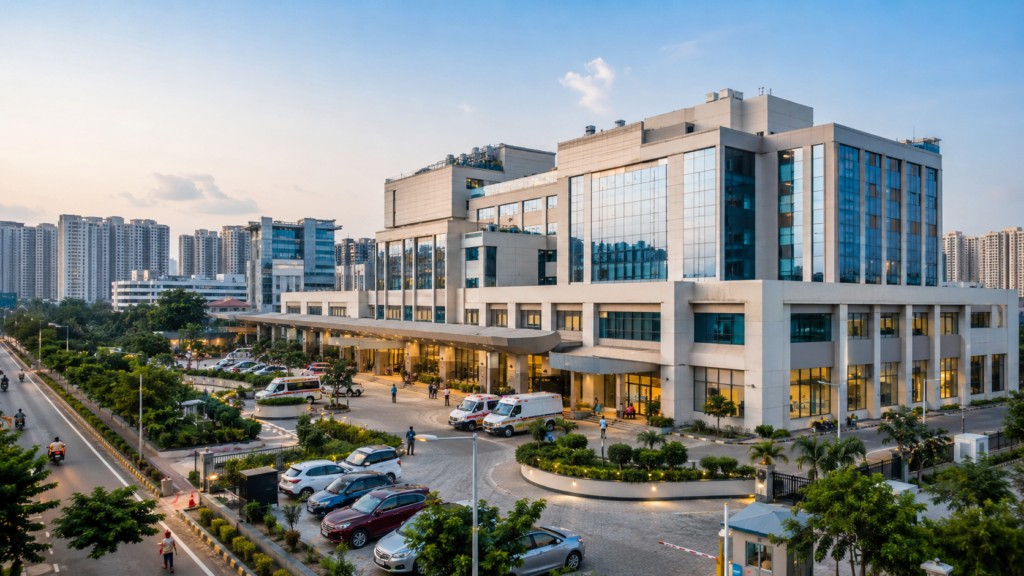
However, the structure also creates fixed obligations. An estimated ₹816.1 crore rental outgo over the lease period means the facility must generate sustained patient volumes and profitable service lines. If utilisation ramps slowly or if competition intensifies, lease economics can become a drag. The model therefore gives flexibility on ownership, but it does not remove execution risk. Rent is wonderfully patient. It waits every month.
Why is Yelahanka becoming more attractive for hospital infrastructure investment?
Yelahanka is becoming more attractive because northern Bengaluru has moved from peripheral expansion to a more mature urban growth corridor. Airport connectivity, new residential clusters, commercial development, education institutions and improved road access have increased the area’s relevance for healthcare providers. As population density rises, demand for emergency care, maternity services, oncology, cardiology, orthopaedics, neurology, diagnostics and chronic disease management tends to grow with it.
Hospital operators also look at catchment gaps. Established locations in central Bengaluru may already have strong private healthcare supply, but new growth corridors often need tertiary and multi-speciality capacity. A hospital in Yelahanka can potentially draw patients from northern Bengaluru, Devanahalli, Hebbal-linked corridors and airport-side residential zones. That gives the location a broader catchment than the immediate neighbourhood.
There is also a strategic timing issue. Real estate costs and suitable healthcare-ready buildings can become harder to secure once a corridor fully matures. By entering through a long-term lease now, Manipal Health Enterprises may be positioning itself ahead of a longer demand curve. The risk is that real estate optimism runs faster than clinical utilisation. The opportunity is that early capacity in a high-growth corridor can become difficult for rivals to replicate later.
What does the deal say about competition among Indian private hospital chains?
The Manipal Health Enterprises lease reflects a wider competitive trend among Indian private hospital chains, where expansion is increasingly being shaped by network density, specialty depth and micro-market access. Large hospital groups are not only competing on brand recall. They are competing on where they can build referral networks, capture insured patients, offer complex procedures and retain doctors across multiple facilities.
Bengaluru is especially competitive because it combines high-income urban patients, corporate insurance coverage, medical tourism potential, a technology workforce and strong demand for advanced care. Hospital chains with multiple nodes across the city can route patients more effectively, distribute specialties across locations and build stronger doctor ecosystems. Manipal Health Enterprises already has historical depth in Bengaluru, and the Yelahanka lease could help extend that footprint into a growth corridor.
The competitive pressure will not be limited to other multi-speciality hospitals. Bengaluru’s healthcare market includes single-specialty hospitals, diagnostic chains, day-care surgery centres, home healthcare providers and digital-first platforms. A large hospital asset must therefore be positioned carefully. It must offer enough specialist depth to justify its scale, while also remaining accessible for routine and emergency care. In healthcare, size helps only when patients believe the capability justifies the commute.
How could the lease affect Bengaluru’s healthcare real estate and institutional investment market?
The transaction reinforces the growing importance of healthcare as a real estate asset class. Hospitals require long leases, specialised infrastructure and stable operators, which can make them attractive to institutional property owners if the tenant profile is strong. A nearly 30-year lease by Manipal Health Enterprises gives the landlord long-term rental visibility, while giving the operator operational control in a growth corridor.
This type of deal could encourage more healthcare-ready asset development in Indian cities. Developers may increasingly design buildings for hospitals, diagnostics, senior care, rehabilitation and life sciences support functions rather than only offices, malls or residential projects. Bengaluru, with its demand depth and medical talent base, is likely to remain one of the more attractive markets for such assets.
However, healthcare real estate is not easy to repurpose. A hospital building requires specialised approvals, compliance standards, clinical infrastructure, fire safety, infection control design, biomedical waste systems and patient-flow planning. Developers cannot simply label a commercial building as healthcare infrastructure and expect it to work. The Manipal Health Enterprises lease may therefore strengthen interest in purpose-built healthcare assets, but it will also highlight the execution demands of the category.
What are the financial and operational risks in Manipal Health’s Bengaluru expansion?
The biggest financial risk is utilisation ramp-up. A large multi-speciality hospital needs patient volumes across inpatient, outpatient, emergency, diagnostic and surgical services to support operating economics. If the facility takes longer than expected to reach optimal occupancy, fixed lease and staffing costs could pressure profitability. Hospitals are not plug-and-play assets. They need doctors, referrals, equipment, processes and community trust.
The second risk is talent availability. Bengaluru has a strong medical ecosystem, but specialist doctors, nurses, technicians and hospital administrators are in high demand. Manipal Health Enterprises will need to recruit and retain clinical talent while integrating the new facility into its wider network. A building can be leased quickly. A trusted clinical team takes longer.
The third risk is competitive intensity. North Bengaluru’s growth story will attract other healthcare providers. If rivals expand aggressively in nearby catchments, pricing, doctor retention and patient acquisition costs could rise. Manipal Health Enterprises has brand advantages, but healthcare competition is local and service-sensitive. Patients remember both outcomes and waiting times, sometimes with equal emotional force.
Why does this expansion matter for India’s broader hospital infrastructure cycle?
The Yelahanka lease matters beyond Bengaluru because it reflects how India’s private hospital sector is expanding through a mix of owned assets, leased buildings, acquisitions and brownfield growth. Demand for private healthcare is rising because of urbanisation, insurance penetration, chronic disease burden, medical technology adoption and higher expectations around quality care. However, hospital operators must expand carefully because large facilities require heavy operating investment before returns mature.
The deal also shows how healthcare infrastructure is becoming more institutionalised. Private equity, sovereign funds, pension capital and large hospital platforms are increasingly shaping the sector. Manipal Health Enterprises’ backing by institutional investors gives it the financial flexibility to pursue long-term expansion, but also raises the bar for returns, governance and disciplined execution.
India still faces significant gaps in hospital capacity, especially in high-quality tertiary and quaternary care. Large cities need more advanced facilities, while smaller cities need broader access. Deals such as the Yelahanka lease show one path to scaling capacity in dense urban markets. The challenge is to make expansion commercially viable without making healthcare less affordable. That balance will define the next phase of India’s hospital infrastructure cycle.
How should industry watchers track whether the Yelahanka hospital lease succeeds?
The first signal will be the clinical launch profile. Industry watchers should track which specialties Manipal Health Enterprises prioritises at the Yelahanka facility, whether it builds centres of excellence and how quickly key departments become operational. A hospital’s positioning is shaped early by the specialties it chooses to lead with.
The second signal will be patient volumes and occupancy. Even without detailed public disclosure, market watchers can assess hiring, doctor onboarding, department launches, patient outreach and referral activity. Strong utilisation will indicate that the location is capturing real demand rather than simply adding capacity to a map.
The third signal will be network integration. The facility’s success will depend on whether it complements Manipal Health Enterprises’ existing Bengaluru operations rather than duplicating them inefficiently. If the Yelahanka hospital becomes a northern Bengaluru hub feeding and receiving referrals across the network, the lease could strengthen the company’s citywide platform. If it operates in isolation, the strategic value may be weaker.
Key takeaways on what Manipal Health’s Bengaluru hospital lease means for healthcare infrastructure
- Manipal Health Enterprises’ 2.45 lakh square foot Yelahanka lease signals a major capacity push in northern Bengaluru’s growing healthcare market.
- The nearly 30-year lease gives Manipal Health Enterprises long-term location control while avoiding full upfront ownership of the hospital real estate asset.
- The estimated ₹816.1 crore rental commitment means the facility must achieve strong utilisation to support long-term operating economics.
- Yelahanka is becoming more attractive for hospital infrastructure because of airport-linked growth, residential expansion and rising demand across northern Bengaluru.
- The deal reflects a wider shift in Indian healthcare, where large hospital chains are using real estate strategy to capture high-growth urban catchments.
- Competition in Bengaluru’s private healthcare market is likely to intensify as multi-speciality hospitals, specialty chains and diagnostics providers chase the same patient base.
- Healthcare real estate could attract more institutional interest if long-tenure operators continue signing large leases in fast-growing metro corridors.
- The biggest operational risks include slow occupancy ramp-up, specialist doctor recruitment, nurse availability, clinical integration and local competitive pressure.
- The transaction shows how institutional capital-backed hospital groups are scaling through long-term leases, acquisitions and network density.
- The success of the Yelahanka facility will depend on specialty mix, patient volumes, referral integration and Manipal Health Enterprises’ ability to turn real estate access into clinical value.
Discover more from Business-News-Today.com
Subscribe to get the latest posts sent to your email.