JAMS Software has launched JAMS Incident Management, a standalone on-call alerting and escalation platform that marks one of the clearest signs yet that the newly independent software company intends to expand beyond its traditional enterprise job-scheduling franchise. The September 1 launch follows the July introduction of JAX, an artificial-intelligence agent embedded inside JAMS Scheduler, and JAMS MCP, a Model Context Protocol connector that allows external AI tools to interact with JAMS automation environments. Together, the products give JAMS three connected layers spanning workload execution, AI-assisted troubleshooting and human incident response, creating the outline of a broader IT operations and orchestration platform. The strategy is commercially significant because JAMS separated from Fortra in June 2025 with backing from PSG, 2ndWave Software and employees, giving management an independent mandate to accelerate product development after years inside a larger software portfolio. The unresolved question is whether a company with more than 850 established workload-automation customers can use that installed base to compete effectively in incident management against much larger platforms while simultaneously persuading new customers to adopt JAMS outside its historic scheduling niche.
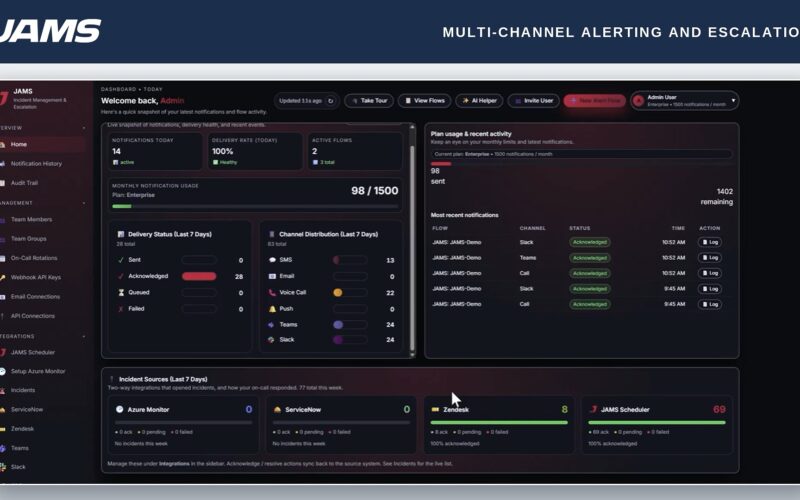
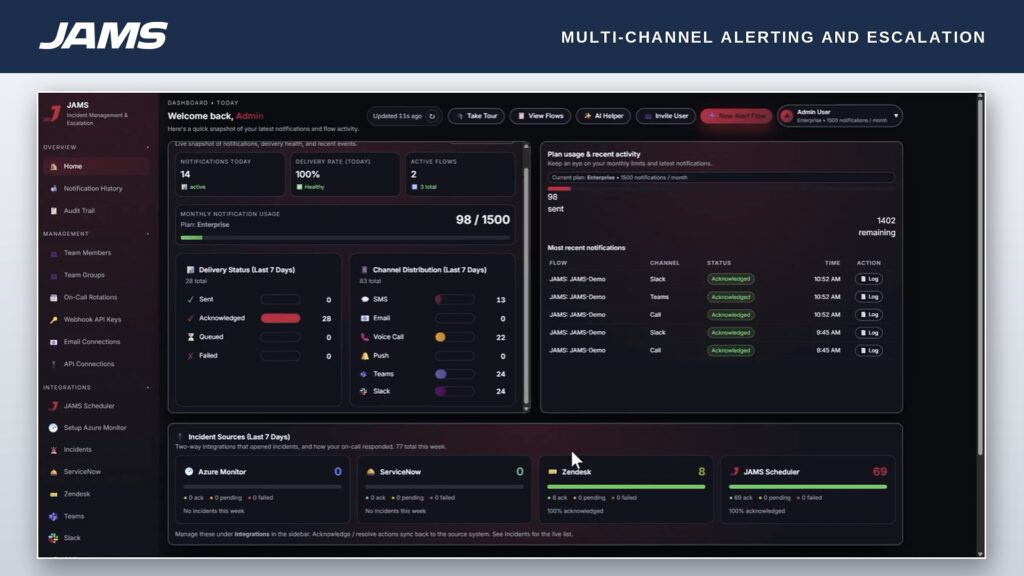
JAMS Incident Management is generally available after an early-access period that began August 1. The product ingests alerts through email, webhooks, REST APIs and prebuilt integrations, then sends notifications through voice calls, SMS, push notifications, email, Microsoft Teams and Slack until someone in the designated on-call rotation acknowledges the incident. JAMS has also linked the new platform directly with JAMS Scheduler, allowing a failed scheduled job to create an incident automatically and enabling an operator to restart the failed job directly from a phone call or text message. The integration creates a closed operational loop from automation failure to human escalation and potential remediation, although JAMS is deliberately selling Incident Management as an independent product that does not require JAMS Scheduler.
Why does JAMS Incident Management represent a bigger strategic shift than simply adding on-call alerts?
JAMS has historically been associated with enterprise job scheduling and workload automation rather than the broader incident-response market. Its core scheduler has existed since 1987 and is designed to coordinate scheduled and event-driven jobs across environments including Windows, Linux, UNIX, IBM i, z/OS and OpenVMS. Customers use the platform to centralize workflows that may otherwise be distributed across SQL Server, PowerShell, cloud data services, enterprise applications and custom scripts.
Incident Management moves JAMS one step downstream from executing those workflows into responding when something breaks. A scheduler can detect that a batch process failed, but the operational problem is not solved until the appropriate employee receives the alert, acknowledges responsibility, diagnoses the failure and restores the process. By adding on-call schedules, escalation policies and multi-channel notifications, JAMS is attempting to capture more of that response chain rather than handing the incident to an unrelated platform.
The native integration illustrates the commercial logic. A critical JAMS Scheduler job that misses an expected service level can automatically trigger JAMS Incident Management, which then escalates through the on-call roster until someone acknowledges the event. The operator can subsequently restart the job from the notification channel rather than logging into multiple systems. That architecture potentially reduces response time while giving JAMS another product to sell into organizations already dependent on the scheduler for business-critical processes.
The larger opportunity comes from making Incident Management independent. JAMS can now pursue DevOps teams, site reliability engineers, service desks and IT operations groups that have never purchased JAMS Scheduler. If those customers later need more sophisticated workload orchestration, the incident product becomes a potential entry point into the broader portfolio rather than merely an add-on sold to the existing customer base.
How aggressive is JAMS Software’s $6-per-user pricing compared with established incident-management platforms?
JAMS is entering the market with pricing designed to reduce the barrier to trial. The company offers JAMS Incident Management free for teams of up to five users without a time limit or credit card requirement. The Starter tier costs $6 per user per month when billed annually for teams of up to 25 users, while Professional costs $16 per user per month for up to 50 users. Enterprise pricing is negotiated separately.
At the maximum Starter size, a 25-person team would pay $150 per month before applicable communication allowances or other contractual considerations. A 50-user Professional deployment would cost $800 per month based on the published per-user rate. JAMS includes on-call scheduling and escalation policies inside the paid plans rather than offering those capabilities as separately priced modules.
Publicly posted PagerDuty pricing provides a useful, although not perfectly equivalent, comparison. PagerDuty currently offers its own free tier for up to five users, while its Professional incident-management plan is listed at $21 per user per month when billed annually and its Business tier at $41. The products differ substantially in integrations, workflow depth, artificial intelligence, analytics and enterprise capabilities, so the figures should not be treated as like-for-like comparisons. JAMS nevertheless appears to be deliberately positioning itself below established paid incident-management price points rather than attempting to match market leaders feature for feature immediately.
That pricing strategy could matter because on-call alerting is a relatively easy software category for smaller engineering teams to understand and trial. Organizations do not necessarily need to conduct the lengthy infrastructure migration associated with replacing an enterprise scheduler. A team can route alerts into the system, configure schedules and determine quickly whether escalation works reliably enough for production use.
The low entry price also gives JAMS a potential land-and-expand route. A small service desk could initially adopt Incident Management independently, then move into more advanced integrations or eventually JAMS Scheduler if its automation environment becomes more complex. Conversely, an existing scheduler customer could add Incident Management without procuring an entirely different vendor for after-hours escalation.
Could Atlassian’s Opsgenie shutdown create an unusually favorable customer-acquisition window for JAMS?
The timing of the launch coincides with disruption in the incident-management market. Atlassian stopped selling standalone Opsgenie subscriptions in June 2025 and plans to end support for the product on April 5, 2027. Existing customers are being directed toward Jira Service Management or Compass, meaning every remaining standalone Opsgenie deployment needs either to migrate within Atlassian’s portfolio or select another provider before the shutdown.
That does not mean JAMS will automatically inherit Opsgenie customers. Atlassian has built migration tooling and has powerful enterprise relationships through Jira, Confluence and Jira Service Management, while competing incident-response vendors will also pursue customers evaluating alternatives. JAMS Incident Management is additionally much newer and therefore lacks the operating history of long-established products.
The transition nevertheless creates a rare switching event. Incident-response systems can become deeply embedded through schedules, escalation rules, integrations and operational habits, reducing the frequency with which customers voluntarily replace them. A forced product retirement changes that dynamic because customers already need to reassess architecture, pricing and migration effort.
JAMS could appeal particularly to organizations that want straightforward on-call alerting without adopting a wider IT service-management suite. Its pitch is deliberately narrower: ingest an alert, identify the responsible person, keep escalating until someone acknowledges it and maintain an auditable record through resolution. Management has positioned that simplicity as a response to what it considers increasing feature complexity and higher costs in established platforms.
The Opsgenie transition therefore gives JAMS a limited period in which a meaningful population of incident-management customers is unusually open to alternative products. Evidence of successful customer migration, rather than the existence of the market opportunity itself, will determine whether JAMS can capitalize on that window.
Why did JAMS launch JAX and JAMS MCP just weeks before entering incident management?
JAX and JAMS MCP address the other half of the operational problem. Incident Management is designed to ensure a human receives an alert when something fails, while JAX and JAMS MCP are intended to help that person understand and act on the failing automation more quickly.
JAX is embedded directly in the JAMS Web Client. Users can ask natural-language questions about jobs, inspect running processes, troubleshoot failures, retrieve instructions and perform selected operational actions. JAMS says answers to product questions are grounded in its documentation and checked against a built-in glossary rather than generated solely from a language model’s general knowledge.
JAMS MCP provides a different interface to the same underlying environment. Instead of requiring users to work inside JAMS, the Model Context Protocol connector allows AI development tools including Cursor, Visual Studio Code with GitHub Copilot, Claude Code, Claude Desktop and Codex to query jobs and manage runs through natural language. An engineer investigating a failed workflow can therefore interact with JAMS while remaining inside the development environment already being used.
The combination starts to connect automation, diagnosis and escalation. JAMS Scheduler runs the workflow. JAX or an MCP-connected assistant can help an operator investigate what happened. JAMS Incident Management can locate and notify the human responsible for resolving the problem. If management continues integrating those layers, JAMS could evolve from a scheduler into a wider operational control plane around enterprise automation.
That would increase the addressable market but also increase competitive intensity. JAMS would move closer to categories occupied by BMC Software, Redwood Software, PagerDuty, Atlassian and other automation or IT-operations vendors rather than remaining concentrated on enterprise scheduling.
How is JAMS trying to make enterprise AI safer than an unrestricted autonomous agent?
The most differentiated part of the JAX strategy is not simply adding a conversational interface. JAMS has designed the product around an explicit control model intended to address enterprise concerns about giving AI access to production automation.
Every JAX or JAMS MCP action operates with the permissions of the signed-in user. There is no separate privileged AI account capable of bypassing existing authorization policies. Read operations can proceed freely, while write actions require explicit user approval before execution. Operations are also logged, and changes made through the JAMS API appear in the normal audit trail.
The current capability set remains deliberately constrained. JAX can find jobs, inspect failures, submit jobs, create folders and manage running jobs through actions including hold, release, reschedule and cancel. JAMS says the present release does not allow the AI to edit or delete the underlying job, folder, schedule or agent definition. AI-assisted creation of complete jobs and workflows from natural-language descriptions remains on the development roadmap.
Customers also control which language model powers JAX. They can connect commercial providers or run a local model entirely inside their own network. JAMS says it does not train models on customer data and that organizations choosing a local model can keep operational information inside their own infrastructure.
That design is particularly relevant for workload automation because schedulers may have visibility into sensitive systems including databases, enterprise-resource-planning applications, financial processes and production infrastructure. Giving an autonomous AI unrestricted credentials to such environments would create substantial security and governance concerns. JAMS is instead pursuing a human-in-the-loop model in which AI assists diagnosis and execution but does not receive authority beyond the operator already using the system.
Is there a contradiction between JAMS criticizing “AI hype” in incident management while launching AI products itself?
JAMS’ messaging around the two releases creates an interesting distinction. When launching Incident Management, the company said it had built the product after experiencing other incident-management platforms it considered overly complicated and burdened by unnecessary artificial-intelligence features. Yet only weeks earlier, JAMS had launched two AI products of its own.
The positions are not necessarily contradictory. JAMS appears to be arguing for selective AI rather than AI embedded in every stage of incident response. Incident Management focuses on the deterministic problem of finding the correct human and escalating until that person responds. JAX is deployed where generative AI may have greater utility, such as interpreting job failures, locating relevant documentation and translating natural-language requests into controlled automation actions.
That product philosophy could help JAMS differentiate itself if enterprise customers become more skeptical of software vendors adding AI surcharges or agentic features without measurable operational benefits. JAX and JAMS MCP are currently included with JAMS Web without a separate licence, SKU or per-AI-call charge. JAMS Scheduler itself has a published Core starting price of $833 per month when billed annually, with unlimited executions rather than per-job usage charges.
The strategy places pressure on JAMS to demonstrate that its AI actually reduces troubleshooting effort. Natural-language interfaces are becoming increasingly common across enterprise software, making their existence alone unlikely to provide durable differentiation. Evidence such as lower mean time to resolution, faster onboarding of new operators or reduced reliance on a small number of scheduling experts would make a stronger commercial case.
Why does JAMS’ June 2025 separation from Fortra matter to the pace of product expansion?
JAMS operated inside Fortra for several years after HelpSystems, which later became Fortra, acquired MVP Systems Software in 2018. Fortra subsequently shifted its strategic focus increasingly toward cybersecurity and sold JAMS in June 2025 to PSG in combination with 2ndWave Software. The transaction also included Skybot, another workload-automation platform.
JAMS now operates independently under chief executive Peter Hegland and is owned by PSG, 2ndWave Software and employees. The company has identified product innovation, market expansion, research and development and stronger orchestration capabilities as priorities under the new ownership structure.
The sequence since separation supports that strategy. JAMS introduced a modernized Web Client and REST API, expanded integrations across cloud and data-orchestration environments, shipped JAX and JAMS MCP with version 7.9 in July 2026 and has now launched an entirely new incident-management product. JAMS has also said it was positioned as a Niche Player in the 2026 Gartner Magic Quadrant for Service Orchestration and Automation Platforms, reinforcing management’s effort to compete in a broader orchestration category rather than only legacy job scheduling.
Private ownership gives JAMS room to invest without the quarterly disclosure requirements facing a public software company, but it also limits financial visibility. The company describes itself as profitable but does not disclose revenue, annual recurring revenue, growth rates, customer retention or R&D spending. Outside observers therefore cannot yet determine how quickly the 850-plus customer base is expanding or whether the new products are producing material incremental revenue.
PSG’s involvement suggests an emphasis on growth. The investment firm has backed numerous software companies and has substantial experience supporting acquisitions and expansion strategies. JAMS has not announced an acquisition-led growth program since becoming independent, however, and the strongest evidence to date points toward internally developed product expansion.
Can JAMS convert 850 scheduler customers into a broader recurring software platform?
The existing customer base is the most obvious distribution advantage behind the new strategy. More than 850 organizations already rely on JAMS to run automated workloads, giving the company an audience that understands the operational consequences of failed jobs and missed service levels. Those customers represent a natural starting point for Incident Management because the new platform solves a problem directly adjacent to the scheduler.
Cross-selling would also increase revenue per customer without requiring JAMS to win an entirely new enterprise scheduling replacement. Workload-automation migrations can be complicated because organizations may have thousands of jobs, dependencies and scripts accumulated over years. Adding an incident-response product to an existing JAMS environment should generally involve less operational disruption than replacing the scheduler itself.
JAX and MCP potentially deepen that relationship further by increasing how many employees interact with the automation platform. JAMS historically may have been administered by specialized operations teams. Natural-language interaction could make job information accessible to developers, service-desk personnel and other employees who understand business processes but are less familiar with scheduler-specific interfaces.
Incident Management could broaden that user population again. On-call responders may include application teams, infrastructure specialists, database administrators and site reliability engineers who do not normally administer JAMS. Every additional user increases awareness of the wider platform and potentially creates another internal advocate for broader adoption.
The risk is that JAMS spreads product development too widely. Enterprise workload automation is itself a competitive category requiring continual investment across cloud services, data platforms, operating systems, security and observability. Building a credible incident-management platform creates another integration burden and places JAMS against specialized competitors with much larger ecosystems. Management will need to show that the new products reinforce the core scheduler rather than diverting resources from it.
What will show whether JAMS Software is becoming an IT operations platform rather than remaining a niche scheduler?
The first measurable proof point is adoption of JAMS Incident Management outside the existing scheduler customer base. If most users simply add the product to existing JAMS deployments, the launch can still increase customer value and retention, but it would remain principally an extension of the scheduler franchise. Winning standalone DevOps, service-desk and site-reliability teams would demonstrate that JAMS has created a second independent route into enterprise accounts.
A second measure will be conversion from the free tier into paid Starter, Professional and Enterprise deployments. The free five-user plan reduces friction, but recurring revenue depends on teams expanding beyond small deployments and finding enough value in integrations, scheduling and escalation capabilities to justify paid adoption.
The third proof point is whether JAX and JAMS MCP change operational behavior rather than becoming demonstration features. Growth in AI-assisted job submissions, failure diagnosis or workflow creation would show that natural-language orchestration is becoming part of normal JAMS usage. Management’s planned expansion into AI-assisted workflow creation could increase the value of the platform further if the approval and permission model remains effective as the AI gains more capabilities.
Finally, the company needs to convert its independence into faster customer and revenue growth. JAMS separated from Fortra specifically to operate as a focused orchestration company, and within 15 months it has launched AI interfaces and entered incident management. The pace of product development is visible; the underlying economics are not.
JAMS Software is therefore moving through an important strategic transition. JAMS Scheduler remains the anchor, with a history stretching back to 1987 and more than 850 customers, but the company is building new layers around what happens before and after a scheduled job fails. JAX and JAMS MCP help operators investigate and act on automation through natural language, while JAMS Incident Management ensures the correct human receives the alert and stays accountable through resolution. If those products generate cross-selling, attract standalone customers and eventually converge into a coherent orchestration and incident-response platform, the 2025 separation from Fortra could prove to have created substantially more than an independent job-scheduling vendor.
What are the key takeaways from JAMS Software’s Incident Management, JAX and MCP expansion?
- JAMS Software launched JAMS Incident Management on September 1, 2026, following an August early-access period.
- The product sends alerts through voice, SMS, push, email, Microsoft Teams and Slack and escalates through on-call rotations until someone acknowledges the incident.
- JAMS Incident Management works independently but integrates natively with JAMS Scheduler, including the ability to create incidents from failed jobs and restart jobs from certain notifications.
- Pricing starts with a free plan for five users, followed by Starter at $6 per user per month and Professional at $16 when billed annually.
- The launch comes as Atlassian prepares to shut down standalone Opsgenie on April 5, 2027, creating a potential migration opportunity across the incident-management market.
- JAMS launched JAX and JAMS MCP in July, bringing natural-language AI interaction into enterprise workload automation.
- JAX operates with the signed-in user’s permissions, requires confirmation for write actions and can run using a local AI model inside the customer’s network.
- JAMS MCP allows tools including Cursor, GitHub Copilot, Claude Code, Claude Desktop and Codex to interact with JAMS automation through Model Context Protocol.
- JAMS separated from Fortra in June 2025 and is now independently owned by PSG, 2ndWave Software and employees.
- More than 850 customers use JAMS Scheduler, giving the company an installed base from which it can cross-sell incident management and AI-assisted orchestration.
Discover more from Business-News-Today.com
Subscribe to get the latest posts sent to your email.