Why did James Bay Minerals move to acquire the Shafter Silver Project and what are the exact terms of the deal investors should know?
James Bay Minerals Limited (ASX: JBY) has unveiled its boldest step yet in transforming from a Canadian-focused lithium explorer into a North American precious metals developer. On October 2, 2025, the company announced a binding agreement to acquire 100 percent of the high-grade Shafter Silver Project in Presidio County, Texas. The deal is valued not only for its upfront cash commitments but also for the installed mine and processing infrastructure estimated at more than US$150 million. This acquisition positions James Bay Minerals, which will be renamed Black Bear Minerals under the ASX code BKB, as one of the few ASX-listed companies to hold a significant silver project on U.S. soil.
The acquisition terms involve an upfront payment of US$9.5 million in cash upon completion and a further US$8.5 million in deferred consideration over two years. The deferred payment may be satisfied in shares, subject to shareholder approval and a floor price of A$0.70 per share, or else settled entirely in cash if conditions are not met. In addition, the Shafter Silver Project carries a two percent Net Smelter Return royalty on all payable metals, ensuring Aurcana Silver Corporation, the vendor, maintains a financial interest in the project’s future production. Funding for the acquisition and follow-on exploration will be provided by a two-tranche A$30 million equity placement managed by Canaccord Genuity. This placement was strongly supported by domestic and offshore institutions, demonstrating broad investor appetite for exposure to U.S. precious metals assets at a time when silver prices are again in focus.
How significant is the Shafter Silver Project’s historical production and resource estimate compared with other North American silver mines?
The Shafter Silver Project is not a grassroots exploration play. It is a partially permitted underground mine with a substantial production history and a significant NI 43-101 compliant foreign mineral resource estimate. According to a 2015 Canadian technical report, the project holds 17.57 million ounces of silver at an average grade of 289 grams per tonne, broken down into measured, indicated, and inferred categories. While this estimate has yet to be reclassified under JORC 2012 standards, it forms the foundation of James Bay Minerals’ development plans. Historically, the Presidio Mine, part of the Shafter district, produced 35.15 million ounces of silver between 1883 and 1942 at an extraordinary average grade of 521 grams per tonne. More recently, Aurcana Silver briefly restarted production in 2012 and 2013, adding 134,557 ounces before closing due to low silver prices.
What makes the Shafter Silver Project attractive from an infrastructure perspective and how much is already in place on site?
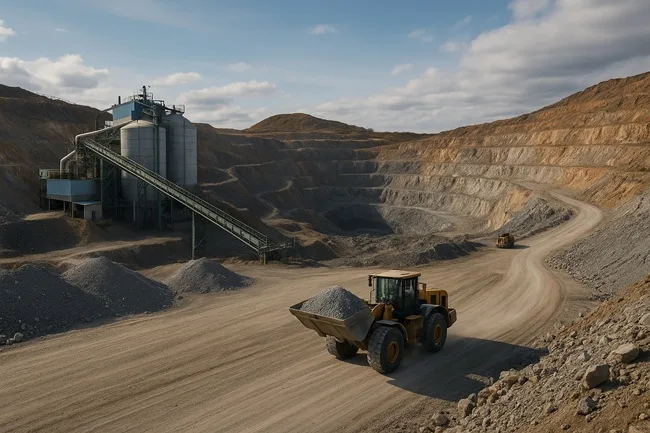
The project’s value is amplified by its infrastructure. In 2012, new facilities were constructed, including a 3,000-tonne-per-day processing plant, refinery, warehousing, administrative offices, a laboratory, and a Merrill-Crowe recovery plant. The site also benefits from a 69 kV utility-owned power line connected to an on-site substation, alongside full and unencumbered water rights. These features significantly reduce the lead time and capital intensity required to restart production compared with projects that would need to build such assets from scratch. For investors, this infrastructure effectively de-risks the path to development by cutting years off the project pipeline.
How does James Bay Minerals plan to advance Shafter in the next 24 months and when can investors expect a JORC resource estimate?
James Bay Minerals has outlined a two-year exploration and development program for Shafter. Beginning in late 2025, the company will commence surface mapping, geochemical sampling, and extensional drilling aimed at verifying historical data and expanding the known mineralised footprint. Infill and verification drilling will provide the confidence necessary to produce a maiden JORC 2012 mineral resource estimate. At the same time, the company plans to investigate shallow, open-pit potential that could complement underground mining. Work will also include metallurgical and bulk density test programs, a detailed dilapidation study of processing facilities, and maintenance of required permits. Collectively, this body of work is designed to support scoping and feasibility studies that could allow for a mine restart by 2027.
How does the Shafter acquisition align with James Bay Minerals’ Nevada Independence Gold Project and overall U.S. growth strategy?
The acquisition also strengthens James Bay Minerals’ broader U.S. portfolio. Alongside Shafter, the company owns the Independence Gold Project in Nevada, which hosts 1.37 million ounces of gold resources, including 984,000 ounces at 6.67 grams per tonne in the skarn zone. Nevada, consistently ranked among the top mining jurisdictions in the Fraser Institute’s global survey, provides strong permitting advantages and proximity to infrastructure. With these dual U.S. holdings, James Bay Minerals now balances its Canadian lithium exploration assets with precious metals projects in Tier-1 American jurisdictions. The diversification is designed to capture both the energy transition demand story through lithium and the traditional precious metals investment narrative via gold and silver.
What leadership changes at James Bay Minerals signal its transition into Black Bear Minerals and a U.S. silver-gold developer?
To lead this next phase, the company has appointed Dennis Lindgren as Chief Executive Officer. Lindgren, formerly Director of Strategy and Business Development at Alcoa, brings experience in critical minerals strategy, governance, and environmental compliance. His background in U.S. resource development aligns with the company’s new focus on silver and gold assets within American borders. In tandem, Andrew Dornan, co-founder and former Executive Chairman, will transition into the role of Corporate Consultant, while Matthew Hayes will assume the Executive Chairmanship. Both Hayes and Dornan will personally subscribe for A$500,000 each in the equity placement, signalling board-level confidence in the acquisition’s potential.
How are institutional investors reacting to the Shafter Silver Project acquisition and what does recent share price performance suggest?
Institutional sentiment around the announcement has been notably supportive. The placement was heavily oversubscribed, reflecting strong appetite for exposure to high-grade silver projects in North America. Investors appear encouraged by the company’s trajectory, particularly given that James Bay Minerals’ shares have delivered a 531 percent return over the past year, recently trading at A$1.01 with a market capitalisation exceeding A$100 million. Analysts suggest that successful conversion of the Shafter foreign resource into a JORC-compliant estimate would be a key milestone, potentially unlocking a re-rating toward mid-tier silver producer valuations. The installed infrastructure, coupled with favourable U.S. tax and royalty regimes—Texas private land carries no state royalty and only a 21 percent corporate tax burden—further bolsters the project’s economics compared to peer jurisdictions in Mexico, Chile, or Argentina.
What risks and opportunities should investors consider as James Bay Minerals transitions into Black Bear Minerals with dual U.S. assets?
Nevertheless, investors should also weigh the risks. The resource remains classified under Canadian NI 43-101 standards, and the process of validation and conversion to JORC compliance will take 12 to 24 months of work. Restarting a historic mine is capital-intensive and can surface unforeseen technical or environmental challenges. The two percent NSR royalty could moderately impact margins in a lower silver price environment. Moreover, global silver prices, which have historically shown volatility, will play a defining role in determining whether Shafter can sustain profitable production once operational.
Despite these risks, James Bay Minerals’ acquisition of the Shafter Silver Project represents a strategic pivot that aligns closely with U.S. federal policy trends. Washington has been increasingly vocal about securing domestic supplies of critical and strategic minerals, and silver is playing an expanding role in electronics, renewable energy, and industrial applications. With projects in Nevada and Texas, James Bay Minerals—or Black Bear Minerals, once the rebrand is complete—positions itself as a dual-asset developer in Tier-1 U.S. jurisdictions at a time when investors are actively seeking exposure to both gold and silver.
Discover more from Business-News-Today.com
Subscribe to get the latest posts sent to your email.