

Why are governments and investors suddenly treating gallium as a strategic metal on par with battery minerals, and what changed after export controls and supply shocks since 2023?
For decades, gallium remained an industrial afterthought—an obscure by-product quietly recovered during aluminium and zinc refining. It rarely appeared in mining company presentations or critical-minerals lists. But by 2025, gallium has become one of the most watched elements in global supply-chain strategy. Governments, semiconductor firms, and investors now regard it as a cornerstone of next-generation electronics and national security.
The turning point came in 2023, when China, which controls more than 95 percent of global refined gallium output, imposed export licensing rules on gallium and germanium. Those rules, followed by additional curbs in 2024, instantly tightened international supply, triggered sharp price rises, and forced policymakers to confront how concentrated the world’s gallium sources had become. The United States Geological Survey later described the move as the clearest demonstration of “critical mineral chokepoint risk” since the 2010 rare-earth embargo. Within months, gallium’s status shifted from obscure by-product to strategic resource—earning a place alongside lithium, cobalt, and rare earth elements on government priority lists across the United States, Europe, Japan, and Australia.
The lesson was clear: the semiconductor and clean-tech industries, already stretched by silicon-wafer shortages and geopolitical competition, could not afford another single-supplier dependency. As export restrictions persisted into 2025, analysts began comparing gallium’s supply-risk profile to that of cobalt in the mid-2010s—a material once considered too niche to matter until battery demand transformed its economics.
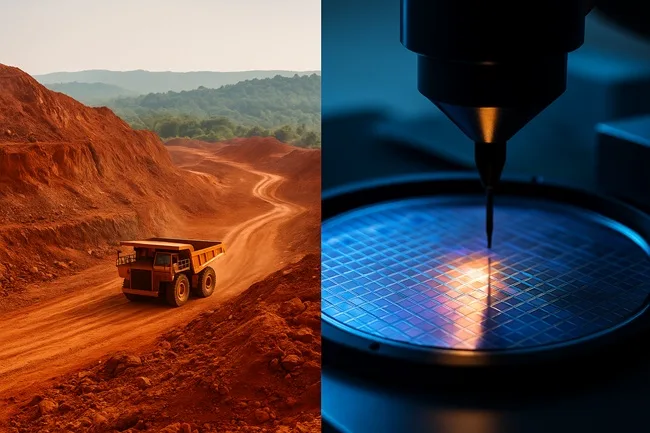
What makes GaN and GaAs so valuable for next-generation semiconductors and power electronics?
Gallium’s renaissance is being driven not by the metal itself but by its compounds—chiefly gallium nitride (GaN) and gallium arsenide (GaAs). These belong to the “III-V” semiconductor family and outperform silicon in specific, high-growth applications.
GaN offers a wide bandgap, enabling higher voltage tolerance, faster switching, and superior thermal efficiency. It allows engineers to design smaller, lighter, and more energy-efficient devices—traits vital for electric-vehicle onboard chargers, fast smartphone adapters, data-center power systems, and high-frequency telecom equipment. Meanwhile, GaAs has become indispensable in optoelectronic and radio-frequency devices, powering laser diodes, radar modules, satellite communications, and 5G/6G base stations.
Together, GaN and GaAs account for the vast majority of gallium demand worldwide. As consumer and industrial electronics evolve toward faster data transmission and higher power density, these compounds are displacing conventional silicon components. Manufacturers like Infineon Technologies, Navitas Semiconductor, and NXP have already integrated GaN into power electronics lines, while defence and aerospace players rely on GaAs for radar and missile-guidance systems.
In short, gallium sits at the convergence of clean energy, digital infrastructure, and national security—a trifecta that ensures long-term policy attention and capital allocation.
How did China’s export licensing reshape the global gallium market?
The introduction of China’s export licensing regime in August 2023 was an administrative act with disproportionate market consequences. Overnight, exporters required government approval to ship gallium abroad, leading to weeks-long delays and temporary shortages in Japan, South Korea, and the United States. By early 2024, the international spot price of high-purity gallium had more than doubled, while Chinese domestic prices diverged sharply due to internal subsidies and retained inventories.
For Western policymakers, the episode underscored the fragility of a supply chain built on a single jurisdiction. The European Union classified gallium as “strategic” under its Critical Raw Materials Act in 2024, while the United States added it to the Defense Production Act priority list. Japan, which imports nearly all of its gallium, launched public-private programs through the Japan Organization for Metals and Energy Security (JOGMEC) to co-fund recovery projects in friendly countries.
By 2025, the geopolitics of gallium mirrored the early days of rare-earth diversification a decade earlier—complete with stockpiling measures, bilateral cooperation agreements, and rapid feasibility studies at alumina refineries across allied economies.
Where is non-Chinese gallium supply emerging, and how are alumina refineries leading diversification efforts?
Since gallium is rarely mined directly, most new supply initiatives focus on recovery from alumina refineries or zinc circuits. This approach requires far less capital than building a standalone mine and leverages existing industrial infrastructure.
In Canada, Rio Tinto and Indium Corporation achieved a breakthrough at the Vaudreuil alumina refinery in Saguenay, Québec, successfully extracting primary gallium from process streams using proprietary separation technology. In Australia, Alcoa of Australia began a feasibility study with Japan Australia Gallium Associates—a joint venture backed by JOGMEC and Sojitz Corporation—to integrate gallium recovery into an existing Western Australian refinery. Both programs have been designated priority projects by their respective governments, reflecting strategic urgency rather than short-term commercial gain.
Across the Atlantic, the European Union has financed early-stage feasibility work in Hungary and Germany under its European Raw Materials Alliance, while Kazakhstan and South Korea have announced pilot projects using modified alumina processing lines. These initiatives, though modest in scale, represent a coordinated attempt to rebuild redundancy into a supply chain that had grown dangerously centralized.
Why is Brazil suddenly part of the conversation, and what does Brazilian Rare Earths’ Amargosa discovery reveal about new supply potential?
Brazil’s rise in the critical-minerals narrative has been rapid. Long known for its iron-ore dominance, the country is now positioning itself as a multi-commodity supplier of rare earths, bauxite, and gallium. The most significant development came in October 2025, when Brazilian Rare Earths Limited (ASX: BRE) announced its maiden JORC-compliant resource for the Amargosa Bauxite-Gallium Project in Bahia.
The resource outlined 568 million tonnes of bauxite grading 29.8 percent total available alumina, including 98 million tonnes of direct-ship ore and 191 million tonnes of beneficiated product at over 40 percent alumina. Embedded within the deposit is an estimated 27 million kilograms of contained gallium—making Amargosa one of the largest known gallium endowments outside China.
What makes the project particularly attractive is its logistics advantage. The Port of Enseada, located about 160 kilometres from the site, offers an existing export route for direct-shipping ore, while the partially completed FIOL Railway and Porto Sul terminal promise scalable bulk transport once commissioned. Investors interpret this phased approach as a sign that Brazilian Rare Earths can generate near-term revenue from bauxite while retaining long-term optionality from gallium recovery.
For Brazil, Amargosa marks the beginning of a broader strategic shift—leveraging its alumina sector not just for aluminium feedstock but for entry into the semiconductor and high-tech materials market.
What are the key technical and economic challenges to scaling gallium production outside China?
The first challenge is technological. Extracting gallium from Bayer liquor requires specialized solvent-extraction and purification circuits capable of achieving semiconductor-grade purity. Even small impurities can render material unusable for GaN or GaAs manufacturing. While pilot programs in Canada and Australia have demonstrated viability, scaling to industrial volumes will require years of optimization and capital expenditure.
The second challenge lies in economics. Because gallium is a by-product, its output depends on alumina or zinc production rates. During market downturns, when host operations cut throughput, gallium supply can fall regardless of price incentives. That cyclicality complicates long-term contract planning for chipmakers seeking stable inputs.
Finally, environmental compliance and permitting remain sensitive issues. Integrating new chemical circuits into legacy refineries introduces waste-stream management complexities and community engagement requirements. These factors make the road to diversified gallium supply a gradual one—likely measured in half-decade increments rather than immediate surges.
How are markets, investors, and policymakers preparing for gallium’s decade-long demand curve?
Analysts agree that gallium demand will rise steadily through 2030, driven by GaN’s penetration into EV power electronics, renewable-energy inverters, and data-center infrastructure. Market projections suggest that global gallium consumption could double within five years, with Western economies capturing an increasing share of downstream manufacturing.
In capital markets, gallium exposure is still rare. Most investors access it indirectly through diversified miners like Rio Tinto or emerging explorers such as Brazilian Rare Earths. However, boutique funds focused on critical-minerals diversification are beginning to view gallium as an under-appreciated component of the semiconductor value chain—particularly for investors seeking exposure to electrification and AI hardware without the volatility of lithium or cobalt.
Policymakers, meanwhile, are pursuing industrial strategies to de-risk supply. The United States has included gallium under its Defense Production Act grants, while Europe and Japan are co-financing recycling programs to recover gallium from LEDs and photovoltaic waste. These measures are building a more distributed ecosystem that reduces dependence on any single country.
What might gallium’s global market look like by 2030, and who stands to benefit?
By the end of the decade, the most probable scenario is a patchwork of regional gallium hubs anchored to existing alumina production centers in Canada, Australia, and Brazil, complemented by smaller recovery operations in Europe and Japan. China will remain the dominant producer, but its share of global supply is expected to fall steadily as new refineries come online elsewhere.
If this diversification unfolds as planned, gallium could follow a trajectory similar to rare earths—where the combination of government incentives, private investment, and technological innovation transforms a monopolized resource into a distributed market. For countries like Brazil, the payoff extends beyond mining revenues; it strengthens trade positioning in the global semiconductor race. For companies such as Brazilian Rare Earths Limited, the upside lies in being early to a supply chain that is rapidly climbing the strategic-materials priority ladder.
Ultimately, gallium’s transformation from forgotten by-product to strategic mineral underscores how technological revolutions can redraw the periodic table of economic importance. The metal’s ability to link mining, clean energy, and advanced computing ensures that its newfound relevance will not fade anytime soon.
Discover more from Business-News-Today.com
Subscribe to get the latest posts sent to your email.