



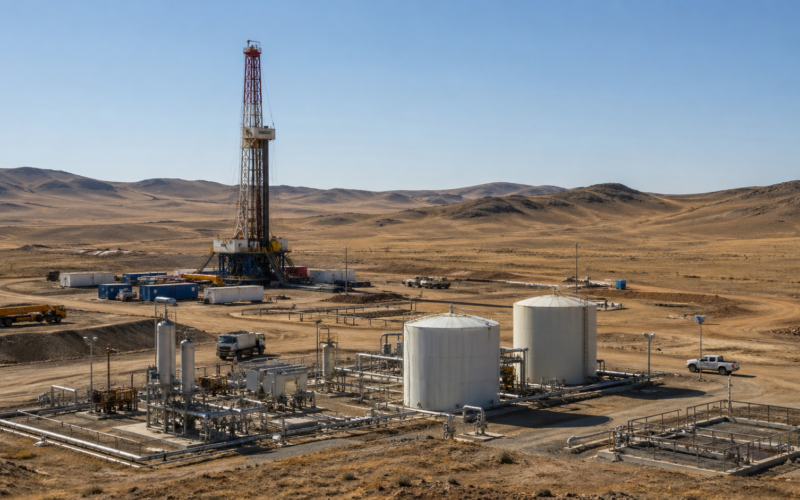
Jade Gas Holdings Limited (ASX:JGH) has secured approval from Mongolia’s Mineral Resources and Petroleum Authority for the appraisal report covering its TTCBM Project, moving the company into the next phase of its long-running attempt to commercialise coal-bed methane in Mongolia. The approval enables the company to begin the formal process of reserve booking and registration with the Mongolian Minerals Council, after which Jade Gas Holdings Limited expects to submit its Plan for Development of Operations and later pursue a gas production licence. The milestone is strategically important because the TTCBM Project is being positioned as a potential domestic gas supply source for transport, mining and industrial power users in a country still heavily exposed to coal and imported liquid fuels. For investors, the announcement shifts the story from exploration promise toward regulatory execution, project finance and commercial offtake discipline.
Why does Jade Gas Holdings’ TTCBM appraisal approval matter for Mongolia’s gas production ambitions?
The approval of the appraisal report is not the same as a production licence, but it is a meaningful step in the regulatory chain that determines whether Jade Gas Holdings Limited can move from proving up a resource to building a commercial field development. The company said the approval confirms completion of the key appraisal phase and establishes the commerciality of the discovery, which gives the project a clearer basis for reserve booking, development planning and eventual exploitation licence submission. That distinction matters because many early-stage energy projects can generate excitement during exploration, but only a smaller number survive the procedural, technical and funding hurdles required to become operating assets.
For Mongolia, the project sits at the intersection of energy security, industrial development and environmental transition. Jade Gas Holdings Limited is targeting coal-bed methane resources within the Tavantolgoi XXXIII unconventional oil basin, a location tied to one of Mongolia’s most significant mining and industrial regions. If the company can convert the TTCBM Project into a producing gas operation, the immediate opportunity is not just selling gas into an abstract market, but supplying heavy transport, mining operations and industrial users that already face fuel-cost and reliability pressures.
The timing is also important because Mongolia’s energy system still depends heavily on coal-fired power and imported fuel products. Jade Gas Holdings Limited has framed its strategy around compressed natural gas and liquefied natural gas pathways that could reduce diesel reliance in the South Gobi and support cleaner fuel use in transport and power. That does not make coal-bed methane a pure clean-energy story, but it does make it a transition-fuel story in a market where energy substitution may be more practical than overnight electrification.

How does reserve booking change the investment case for Jade Gas Holdings Limited?
The next major step is reserve booking with the Mongolian Minerals Council, which would formally recognise the TTCBM Project’s gas reserves under Mongolia’s mineral and petroleum reporting framework. Jade Gas Holdings Limited said the proposed reserve booking relates to a minimum economic project analysis covering only 4.2 square kilometres and production from one coal seam, even though the wider project area contains three to six known gassy seams. That is a crucial detail because the initial reserve process appears designed to satisfy the regulatory pathway rather than define the full theoretical upside of the wider acreage.
For investors, that creates a two-layer interpretation. The conservative reading is that reserve booking will initially validate only a modest portion of the project and should not be treated as proof of full-field economics. The more constructive reading is that Jade Gas Holdings Limited may be deliberately sequencing the project through a minimum economic case first, allowing it to unlock the development pathway without overcommitting capital before regulatory certainty improves. In small-cap energy, discipline matters. A staged licence pathway can be boring, but boring can be beautiful when the alternative is spending too much too early.
The company’s Red Lake Development Area map in the announcement highlights a 60-square-kilometre development area, 165 core holes, 28 wells with gas content measurement, an average total coal thickness of 100 metres, an average gas-bearing coal interval of 37 metres and an estimated coal mass of 7 billion tonnes. Those figures give the project scale context, although the market will still need reserve conversion, production test confidence and cost clarity before treating the asset as bankable development rather than prospective geology.
What could the Plan for Development of Operations reveal about the TTCBM Project’s economics?
After reserve booking acknowledgment, Jade Gas Holdings Limited expects to submit the Plan for Development of Operations for the TTCBM Project. This document is likely to become the next major information point for investors because it is expected to define the technical scope, infrastructure design, production forecasts and environmental management commitments. In plain English, the Plan for Development of Operations is where the project starts to look less like a geological thesis and more like an execution plan.
The company has outlined a Phase 1 development concept involving up to 175 wells, structured as a moderate-scale modular development focused on supplying liquefied natural gas to the local transport network, with optional supply to mining operations and industrial power users. The broader field development contemplates approximately 800 wells and a potential project life of more than 30 years. That long-duration profile is attractive on paper, but it also raises the usual questions around drilling productivity, surface infrastructure cost, water handling, gas processing, logistics, offtake agreements and regulatory approvals.
The modular approach could be strategically sensible because it allows Jade Gas Holdings Limited to avoid betting everything on a single large-scale buildout before market demand and reservoir performance are fully proven. Local liquefied natural gas supply to transport and industrial users may also offer a practical first commercial market because it can align production growth with specific demand corridors. However, the commercial case will depend heavily on whether gas can be delivered at a price that competes with diesel and coal-linked alternatives while still supporting returns on field infrastructure.
Why are commercial discussions and project financing now central to the ASX:JGH story?
Jade Gas Holdings Limited said it continues to hold positive commercial discussions with domestic and international partners, energy buyers and infrastructure providers seeking involvement in the TTCBM Project across different participation structures. That language signals that the company understands the next stage is not only regulatory. It must also prove that the project can attract capital, counterparties and infrastructure support.
For a small-cap energy company, this is where the opportunity and risk widen at the same time. A project with clear regulatory momentum can attract more serious attention from offtakers and financiers, especially if it aligns with national energy priorities. At the same time, reserve booking and development planning will expose the project to tougher scrutiny around economics, construction timelines, funding dilution and execution capacity. Investors may like milestones, but lenders and strategic partners usually prefer models, permits, contracts and contingency plans.
Chief Executive Officer and Managing Director Chris Newport said indirectly that the regulator’s approval represented a significant endorsement and further de-risked the TTCBM Project at a critical point in the company’s transition toward development. He also indicated that the appraisal phase had given Jade Gas Holdings Limited a deeper understanding of the project’s technical and commercial value, with the next focus being reserve booking and submission of the Plan for Development of Operations. That message is consistent with the company’s broader positioning, but the market will now expect the follow-through to become more concrete.
How is the market pricing Jade Gas Holdings Limited after the Mongolia approval milestone?
Jade Gas Holdings Limited remains a micro-cap energy stock, so investors should treat price movements with some caution. The Australian Securities Exchange showed Jade Gas Holdings Limited at $0.051 with a market capitalisation of about $91.72 million and a daily move of 6.25 percent in the cited market snapshot. Other market data providers showed the stock trading around the $0.05 level, with MarketIndex indicating a 52-week range of $0.022 to $0.055 and a one-year return of about 40.54 percent.
That price context suggests the market had already started to attach more value to Jade Gas Holdings Limited before the appraisal approval, helped by recent momentum around project development and capital raising activity. The stock reportedly touched a 52-week high of AUD 0.051 in mid-April 2026 after the company completed a A$1.8 million placement to support development activities, including reserve booking, production licensing and commercialisation work at the Red Lake gas field.
The sentiment picture is therefore cautiously constructive, but not risk-free. A rising share price can reflect improved confidence, but in micro-cap resource equities it can also magnify expectations before the hard milestones arrive. For Jade Gas Holdings Limited, the next re-rating catalyst is unlikely to be another broad statement of intent. Investors will want proof of reserve registration, a credible development plan, clearer funding architecture and evidence that prospective buyers or partners are willing to move beyond discussions into binding commercial commitments.
What are the biggest execution risks as Jade Gas Holdings Limited moves toward gas production licensing?
The biggest near-term risk is that regulatory progress slows between appraisal approval, reserve booking, Plan for Development of Operations approval and exploitation licence submission. The company’s announcement makes clear that the approval pathway remains sequential, which means each stage must be completed before the next can fully unlock. In a frontier-style gas development, that structure can provide clarity, but it can also stretch timelines if technical, environmental or administrative requirements take longer than expected.
The second risk is capital intensity. A Phase 1 drilling campaign of up to 175 wells, plus surface facilities and liquefied natural gas infrastructure, will require funding beyond the typical comfort zone of many micro-cap exploration companies. Jade Gas Holdings Limited may be able to reduce this burden through partnerships, staged infrastructure and offtake-linked financing, but the terms of any funding will matter. Shareholders will be watching whether the company can secure capital without excessive dilution or loss of strategic control.
The third risk is commercial conversion. Supplying local transport, mining operations and industrial power users sounds logical because those markets have identifiable fuel demand. However, end users will need confidence in reliability, pricing, infrastructure availability and regulatory support. The company’s asset is in a strategically relevant region, but gas does not sell itself. Even in energy-hungry markets, customers usually need certainty before switching fuel systems, vehicle fleets or industrial processes.
Could the TTCBM Project reshape Mongolia’s domestic energy transition strategy?
If Jade Gas Holdings Limited executes successfully, the TTCBM Project could become an important test case for whether Mongolia can develop domestic gas as a transition fuel alongside its existing coal-heavy energy base. The company has argued that its projects could help improve Mongolia’s energy independence, support future energy demand growth, improve the energy mix and deliver environmental and health benefits. Those outcomes are plausible, but they depend on scale, economics and substitution.
The project’s location near mining and transport demand is the strategic hook. Mongolia does not need a theoretical gas resource sitting far away from demand centres. It needs commercially deliverable energy that can serve users with real fuel requirements. That is why the company’s focus on liquefied natural gas for local transport and optional supply to mining and industrial power users is more compelling than a vague national gas narrative.
Still, the project should be viewed as an evolving development story rather than a completed transition solution. Coal-bed methane can reduce reliance on higher-emission fuels in certain use cases, but it also brings methane management, environmental assessment and social licence considerations. The stronger investment case for Jade Gas Holdings Limited will emerge if the company can show that environmental approvals, field design, customer demand and financing all point in the same direction. Until then, the TTCBM Project is promising, but the scoreboard is still mid-innings.
Key takeaways on what Jade Gas Holdings Limited’s TTCBM approval means for investors and Mongolia’s energy sector
- Jade Gas Holdings Limited has moved from appraisal validation toward the formal reserve booking stage, making the TTCBM Project more investable than a pure exploration concept.
- The approval from Mongolia’s Mineral Resources and Petroleum Authority strengthens the regulatory pathway, but it does not yet equal a production licence or full commercial sanction.
- The proposed reserve booking covers only a small portion of the project area and one coal seam, which makes the first reserve milestone procedural, conservative and strategically useful.
- The Plan for Development of Operations could become the next major catalyst because it should clarify field design, production forecasts, infrastructure needs and environmental commitments.
- The Phase 1 concept of up to 175 wells suggests Jade Gas Holdings Limited is pursuing modular development rather than an immediate full-field buildout.
- The broader 800-well, 30-year development concept gives the project long-term scale, but it also increases scrutiny around capital intensity and execution risk.
- Commercial discussions with buyers, infrastructure providers and partners are now critical because project financing will likely determine the speed and quality of development.
- ASX:JGH has already seen improved market attention, with the stock trading near the upper end of its 52-week range, which raises expectations for tangible follow-through.
- Mongolia’s demand for cleaner domestic fuel gives the TTCBM Project strategic relevance, particularly in transport, mining and industrial power markets.
- The next phase will test whether Jade Gas Holdings Limited can convert regulatory momentum into reserves, funding, offtake and an eventual gas production licence.
Discover more from Business-News-Today.com
Subscribe to get the latest posts sent to your email.