

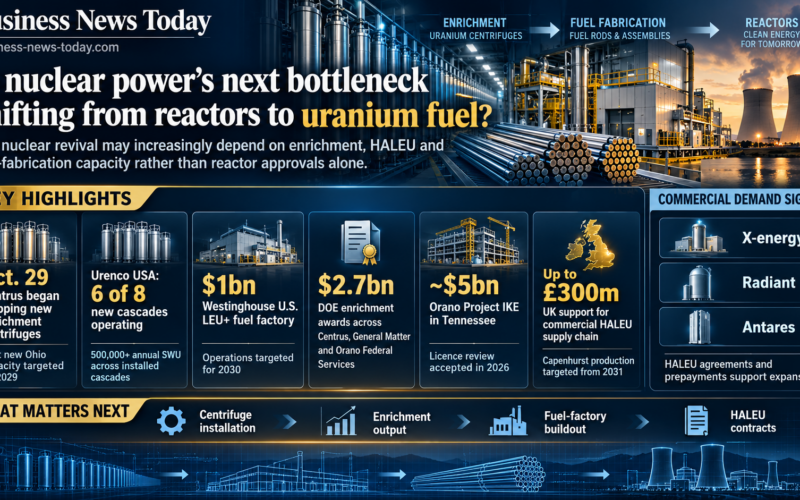
The global nuclear revival is beginning to expose an industrial constraint that receives far less attention than reactor approvals, construction costs or electricity demand. Existing plants can be uprated, shuttered reactors can restart and advanced reactors can secure customers, but every one of those projects ultimately depends on a specialised fuel cycle capable of converting uranium into material that can actually be loaded into a reactor. Enrichment centrifuges, qualified fuel-fabrication plants, conversion capacity and supplies of advanced fuels such as high-assay low-enriched uranium are therefore becoming strategic infrastructure in their own right.
Fresh developments across Centrus Energy Corp. (NYSE American: LEU), Urenco USA, Westinghouse Electric Company and Orano indicate that the Western nuclear industry is responding with a manufacturing cycle stretching from centrifuge production to finished nuclear fuel. Centrus has begun shipping newly manufactured centrifuges from Tennessee to its Ohio enrichment operation, Urenco USA has brought six new cascades into production in New Mexico, Westinghouse is investing approximately $1 billion in a new U.S. LEU+ fuel factory, and Orano is advancing a roughly $5 billion enrichment facility in Tennessee.
Government support is reinforcing that investment. The U.S. Department of Energy has awarded $2.7 billion of enrichment task orders across Centrus, General Matter and Orano Federal Services, while the United Kingdom is helping finance a commercial HALEU supply chain at Urenco’s Capenhurst site.
The developing structural question is therefore no longer simply whether the world can build enough reactors. It is whether enrichment and fuel-manufacturing capacity can expand quickly enough to supply existing fleets, reactor uprates and emerging advanced-reactor technologies at the same time.
Why can a nuclear-power revival become constrained long before a new reactor runs out of uranium?
Nuclear fuel begins with mined uranium, but possessing uranium resources is only the first stage of a much more specialised industrial chain. Uranium must be converted into a suitable chemical form, enriched so the concentration of fissile uranium-235 meets reactor requirements and then fabricated into fuel assemblies or other qualified fuel forms.
That makes enrichment fundamentally different from raw uranium supply. A utility may have access to mined material but still face a bottleneck if there is insufficient enrichment capacity to transform it into usable reactor fuel on the required schedule.
The issue becomes more complicated as reactor technologies diversify. Most existing commercial light-water reactors generally use conventional low-enriched uranium, while several advanced-reactor designs are expected to require high-assay low-enriched uranium, commonly known as HALEU, enriched to higher concentrations below the threshold used for weapons material.
LEU+ creates another layer of demand between conventional fuel and HALEU. Westinghouse is positioning the higher-enrichment fuel as a way to support longer fuel cycles and reactor uprates while serving future reactor programmes.
The result is that the emerging nuclear market does not need merely more enrichment. It needs different enrichment products, additional fabrication capability and supply chains qualified for different reactor technologies.
Why does Centrus shipping new centrifuges matter more than another nuclear factory announcement?
Centrus reached a tangible manufacturing milestone on October 29 when its Oak Ridge, Tennessee facility completed and began shipping the first new centrifuge built for the company’s planned enrichment expansion in Ohio. The machines will be grouped into cascades at Centrus’ American Centrifuge Plant, with the first additional capacity currently expected to come online in 2029.
That distinction matters because centrifuge manufacturing is itself a highly specialised industrial capability. Centrus restarted centrifuge manufacturing activity in Oak Ridge in December 2025 and announced a $560 million programme in January 2026 to modernise and expand the site into a higher-rate manufacturing operation capable of producing thousands of centrifuges.
The company says it has also assembled a domestic supply chain covering the components needed for the expansion. In October, Centrus completed its acquisition of Westerman Holdings, a manufacturer that supplies centrifuge casings and other critical components, bringing an important supplier deeper inside the group.
This is vertical integration in response to a strategic bottleneck. Rather than depending entirely on outside capacity for crucial centrifuge components, Centrus is attempting to control more of the manufacturing chain required to increase enrichment output.
The expansion is designed to serve several markets simultaneously. Centrus plans capacity for conventional low-enriched uranium used by today’s reactor fleet, HALEU for advanced reactors and enrichment services relevant to national-security requirements.
Is commercial demand for HALEU finally emerging alongside government funding?
One of the strongest arguments against viewing HALEU solely as a government-created market is that reactor developers are beginning to sign commercial supply contracts.
Centrus signed a definitive agreement with X-energy in August covering both low-enriched uranium and HALEU enrichment services expected to support initial Xe-100 small modular reactor deployments and TRISO-X fuel production. X-energy agreed to make prepayments that support Centrus’ domestic enrichment-capacity programme.
In September, Centrus announced another multi-year HALEU agreement with Radiant for multiple Kaleidos microreactors, with deliveries expected to begin before the end of the decade. The arrangement again includes customer prepayments supporting domestic enrichment expansion.
A separate September agreement with Antares Nuclear covers HALEU supply for advanced-reactor projects including space and national-security applications, with deliveries also planned before the end of the decade and prepayments supporting additional capacity.
Those agreements remain dependent on successful reactor development and Centrus’ own expansion programme. They nevertheless demonstrate that the demand signal is moving beyond policy documents and into contractual relationships between fuel suppliers and reactor developers.
That matters because enrichment plants require enormous upfront capital and long planning horizons. Long-term customer commitments can help justify investment in manufacturing capacity before the reactors consuming the fuel are fully deployed.
How quickly is Urenco USA adding enrichment capacity that is already operating?
Urenco USA provides important counterevidence to the idea that Western enrichment expansion exists only on paper. On October 8, the company began production from the sixth of eight new centrifuge cascades being installed at its National Enrichment Facility in New Mexico.
Those six cascades can collectively produce more than 500,000 separative work units annually. Urenco’s current programme is adding 700,000 SWU of new capacity between 2025 and 2027, with the seventh cascade expected later in 2026 and the eighth planned for spring 2027.
The existing U.S. facility has annual capacity of roughly 4.3 million SWU and can meet approximately one-third of current U.S. low-enriched uranium demand, according to Urenco. The company ultimately wants U.S. production capacity above 7 million SWU.
A much larger second expansion is also planned. Urenco expects to begin construction in 2029 on additional plant capacity representing 2.1 million SWU, with the first new cascades expected to enter production in 2032 and further additions continuing through 2036.
The timelines illustrate both sides of the Signal. Enrichment capacity is genuinely increasing, which could ease the constraint. But building substantial new capacity takes years, while nuclear restarts, data-center power agreements and reactor programmes are already accelerating demand expectations.
Why is Westinghouse investing $1 billion in fuel fabrication rather than enrichment?
Enrichment is only one stage of the nuclear fuel cycle. Enriched material still needs to be converted into reactor-qualified fuel before utilities can use it.
Westinghouse highlighted that downstream requirement on October 21 when it announced an approximately $1 billion investment in South Carolina to build what it described as the first fleet-scale nuclear fuel factory constructed in the United States in more than 50 years.
Construction is already underway at the company’s Columbia Fuel Fabrication Facility, with operations targeted for 2030. The factory is designed around commercial-scale production of LEU+ fuel.
Westinghouse expects LEU+ to support operating-reactor uprates and longer-term deployment of its AP1000 technology. The strategic implication is that the nuclear revival could create incremental electricity output from the existing reactor fleet before entirely new plants are completed, but those uprates may themselves require a different fuel-manufacturing infrastructure.
Fuel qualification also creates barriers that ordinary industrial products do not face. Reactor fuel must meet stringent technical, regulatory and safety requirements, meaning additional enrichment capacity cannot simply be substituted instantly for finished fuel fabrication.
The emerging fuel cycle therefore contains multiple potential bottlenecks. Expanding one part of the chain may expose limitations in the next.
Why is the U.S. government spending $2.7 billion to rebuild enrichment capacity?
The United States has historically depended heavily on imported enrichment services, including supply associated with Russia. That dependence has become strategically uncomfortable as Washington attempts to expand nuclear generation while reducing reliance on Russian enriched uranium.
The Department of Energy has consequently created programmes designed to establish additional domestic LEU and HALEU capability. It plans to allocate $2.7 billion toward enrichment infrastructure.
In January 2026, the Department finalised a $900 million task order with Centrus subsidiary American Centrifuge Operating to create domestic HALEU enrichment capacity. General Matter received a separate $900 million HALEU award.
Orano Federal Services received another $900 million task order focused on expanding domestic conventional low-enriched uranium production. The awards are milestone based, making actual execution rather than simply the award value important.
The programme demonstrates why fuel capacity has become an energy-security issue rather than merely an upstream nuclear-industry concern. Existing reactors need dependable conventional enrichment, while many advanced reactors require a fuel product that currently lacks a mature Western commercial supply chain.
Government policy is attempting to build both markets at once.
Could Orano create another major U.S. enrichment centre in Tennessee?
Orano’s Project IKE could materially expand the competitive landscape if it reaches operation. The company is developing an approximately $5 billion uranium enrichment facility near Oak Ridge, Tennessee.
The project received the $900 million Department of Energy task order in January. Orano completed its licensing submission to the U.S. Nuclear Regulatory Commission in March, and the regulator accepted the application for an accelerated review in May.
The project remains in licensing and therefore should not be treated as operating capacity. Construction, regulatory review and commissioning still lie ahead.
Orano says the facility is intended to begin supplying enriched uranium during the early 2030s. Its importance lies partly in diversification because the project would add another major domestic source rather than expanding only the existing Urenco and Centrus footprints.
That creates an emerging competition among different enrichment technologies and corporate structures. The U.S. strategy appears deliberately designed to avoid replacing dependence on foreign enrichment with dependence on a single domestic supplier.
Why is Europe also building HALEU capacity rather than relying on the United States?
The fuel-cycle problem is not uniquely American. Advanced reactors being developed in Europe and elsewhere also require reliable access to suitable enrichment services.
The United Kingdom is supporting creation of a commercial HALEU supply chain at Urenco’s Capenhurst site with up to £300 million of government support across the broader programme. An initial £196 million award supports Urenco’s commercial enrichment capability, with co-funding taking investment in that element to around £400 million.
Commercial-scale HALEU production is targeted from 2031. Urenco says the planned facility could initially produce up to 27 tonnes of HALEU annually and has the potential for additional expansion.
The strategic motivation is unusually clear. The British government has said Russia currently represents the only commercial source of HALEU, making diversification essential if Western advanced-reactor programmes are to avoid creating another concentrated energy dependency.
This connects nuclear fuel policy directly with energy security. A country can approve an advanced reactor domestically yet remain dependent on an external supplier for the material required to operate it.
What does Centrus Energy’s stock performance say about investor expectations?
Centrus Energy provides the clearest publicly traded proxy among the companies directly involved in the emerging U.S. enrichment buildout. The shares closed at $110.55 on October 29, down 1.27% for the session despite the announcement that the first new expansion centrifuge had begun shipping.
The short-term move should not be interpreted as rejection of the enrichment thesis. Centrus shares had risen from $98.44 on October 26 to $111.97 by October 28, a gain of nearly 14% in two sessions before the latest announcement.
The broader October picture has been considerably more volatile. The stock closed at $127.01 on October 15, meaning it had fallen about 13% by October 29 despite the renewed late-month recovery.
That volatility suggests investors are balancing an unusually strong structural opportunity against substantial execution and valuation uncertainty. Centrus has a $900 million Department of Energy HALEU award, growing customer contracts and a multibillion-dollar expansion opportunity, but new enrichment capacity will take years to commission and remains dependent on capital investment, programme execution and future reactor demand.
The investment case therefore rests increasingly on capacity conversion rather than nuclear enthusiasm alone. Investors will need evidence that manufacturing milestones eventually become installed cascades, enrichment output and durable customer revenue.
Could the nuclear fuel bottleneck disappear before advanced reactors need the material?
Yes. That is the strongest challenge to the Signal.
Urenco already has new capacity operating, Centrus has moved into centrifuge manufacturing, Orano is advancing another large plant and governments are supporting competing enrichment providers. Westinghouse is simultaneously expanding downstream fabrication.
Advanced-reactor deployment could also proceed more slowly than developers currently expect. If reactor construction, licensing or customer adoption slips into the 2030s while enrichment factories arrive on schedule, supply could catch up before fuel becomes the binding constraint.
HALEU requirements can also differ materially between reactor designs. Not every new nuclear project needs HALEU, while conventional reactor expansion can continue using lower-enrichment fuel.
The resulting market may therefore fragment rather than experience one universal shortage. Conventional LEU, LEU+, HALEU and specialised fuels could each develop different supply-demand balances.
This is precisely why the Signal should be framed as an emerging industrial-capacity race rather than an inevitable fuel crisis.
What would prove nuclear fuel has become the next major constraint on nuclear growth?
Actual enrichment output is the first indicator to watch. Urenco completing all eight cascades in its current U.S. expansion and Centrus installing newly manufactured centrifuges into operating Ohio cascades would demonstrate that planned capacity is converting into production.
Centrus’ 2029 target for its first expansion capacity will be particularly important. Delays would strengthen concerns that specialised centrifuge manufacturing and installation remain difficult to scale.
Project IKE provides another measurable test. Completion of Nuclear Regulatory Commission review, construction milestones and eventual financing decisions will determine whether Orano’s approximately $5 billion facility becomes a genuine new domestic source.
The advanced-fuel market should be judged through contracts rather than announcements. Additional HALEU agreements involving prepayments, firm delivery schedules and multiple reactor developers would strengthen the argument that demand is becoming commercial rather than speculative.
Westinghouse’s South Carolina fuel factory provides the downstream test. Construction progress, LEU+ qualification and the targeted 2030 operating date will indicate whether fabrication capacity can expand alongside enrichment.
The ultimate confirmation would be reactor developers reserving enrichment and fuel capacity years ahead of deployment in the same way data-center developers increasingly secure electricity before completing their facilities. That would demonstrate that fuel availability has become part of project bankability rather than a procurement issue addressed near the end of reactor construction.
The nuclear renaissance is therefore becoming an industrial supply-chain story as much as an electricity story. Reactors remain the visible assets, but the ability to operate them depends on a far smaller group of highly specialised facilities manufacturing centrifuges, enriching uranium and fabricating qualified fuel.
The Western response is now substantial. Billions of dollars are flowing into new capacity, operating cascades are coming online and advanced-reactor companies are beginning to sign long-term contracts.
But those investments also expose how narrow the existing supply base has become. Nuclear power can only expand as quickly as its fuel cycle allows.
The next bottleneck in the nuclear revival may therefore sit nowhere near a reactor site. It may be inside the enrichment plants and fuel factories that determine whether newly built nuclear capacity has anything to burn.
Discover more from Business-News-Today.com
Subscribe to get the latest posts sent to your email.