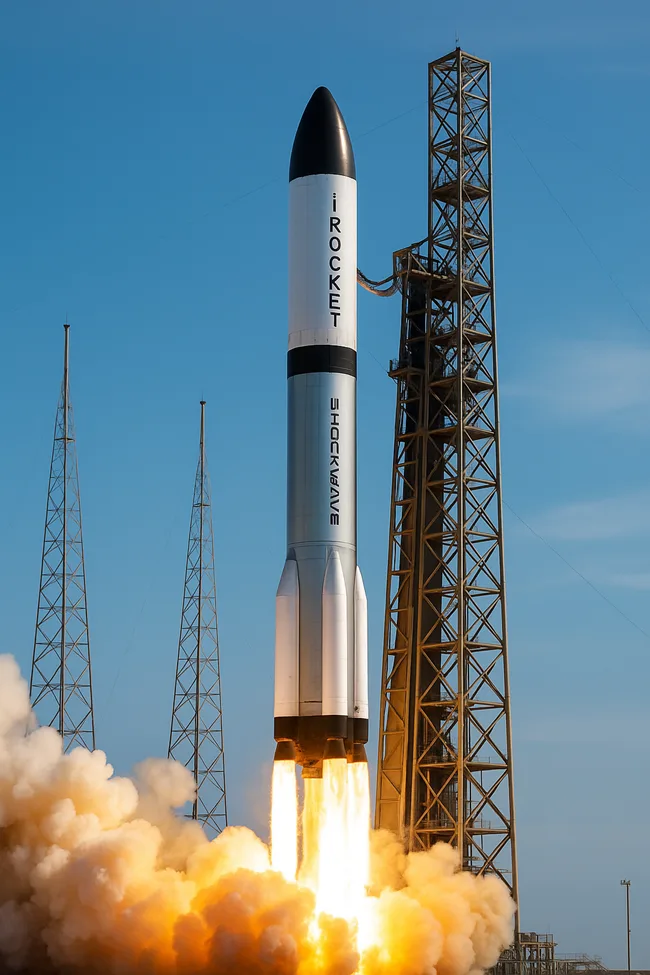
How could iRocket’s reusable rocket and SRM technology redefine global launch economics and secure defense market share over the next decade?
Innovative Rocket Technologies Inc., known as iRocket, has announced a definitive merger agreement with BPGC Acquisition Corp., a special purpose acquisition company sponsored by former U.S. Secretary of Commerce Wilbur Ross. The transaction, valued at $400 million pre-money equity, is expected to close in the fourth quarter of 2025, after which the combined entity will list on Nasdaq under the name iRocket Technologies Inc. The deal signals increasing investor confidence in reusable rocket systems and solid rocket motor (SRM) technology as the global space economy heads toward a projected $1.8 trillion valuation by 2035.
Institutional investors interpret this merger as a vote of confidence in iRocket’s proprietary technology and its early traction in defense-aligned launch services. With over $1 billion in letters of intent and memorandums of understanding already signed with commercial and national security customers, analysts suggest that iRocket could emerge as a credible alternative to legacy launch providers. Favorable geopolitical tailwinds, defense modernization budgets, and a rapidly expanding small satellite market—expected to see 58,000 launches by 2030—are creating strong market conditions for rapid, reusable launch capabilities.
What makes iRocket’s reusable rocket strategy distinct from partially reusable or expendable systems in today’s launch market?
iRocket’s Shockwave launch vehicle is designed with 100 percent reusability in mind, a step beyond partially reusable platforms currently dominating the market. Its patented MACH-i Landing Engine technology, fueled by liquid oxygen and methane, enables lower thermal stress, longer engine life, and reduced refurbishment costs. By committing to turnaround times of less than 24 hours, iRocket aims to replicate the operational cadence of aviation, where rockets can be reconditioned, reloaded, and relaunched multiple times in rapid succession.
Analysts view this as a potential inflection point for the economics of low Earth orbit (LEO) access. Whereas traditional expendable systems incur significant cost per launch, iRocket’s approach could lower per-mission costs while scaling launch frequency to meet the needs of satellite constellations, defense reconnaissance, and on-demand tactical missions. This fully reusable model also aligns with commercial operators’ shift toward responsive space missions, which require high-cadence launches at a fraction of legacy costs.
The company’s propulsion systems are also modular, designed for integration with in-orbit services such as debris mitigation, satellite repositioning, and lunar resupply missions. Institutional investors see this as an additional revenue stream that could extend beyond launch contracts, making iRocket competitive not only as a launcher but also as a propulsion technology provider in the emerging orbital services economy.
Can iRocket’s defense partnerships and SRM development secure it a stable revenue base in the near term?
While commercial satellite operators represent a large future market, iRocket’s immediate traction appears heavily defense-focused. The company has secured a $1.8 million Tactical Funding Increase (TACFI) contract and an $18 million Cooperative Research and Development Agreement with U.S. defense agencies, including the U.S. Space Systems Command and the Air Force Research Lab. Institutional investors highlight that these relationships provide early revenue visibility and credibility in a segment where reliability and national security alignment are paramount.
In addition to reusable rockets, iRocket is expanding its solid rocket motor production, targeting the $100 billion SRM market for boosters, missiles, and interceptors. This diversification could hedge against the volatility of the commercial launch sector, offering consistent demand from defense customers. Analysts expect SRM production to gain further momentum amid rising geopolitical tensions and increased government budgets for missile defense and responsive launch capabilities.
How does the merger strengthen iRocket’s financial capacity and operational scaling plans?
The $400 million merger with BPGC Acquisition Corp. provides iRocket with a significant financial runway to transition from development-stage engineering to high-volume production. Institutional sentiment indicates that this infusion of capital will be critical to scaling engine manufacturing and SRM production while maintaining promised cost efficiencies.
BPGC Management LP, which specializes in industrial and special situations investments, brings strategic expertise and operational governance. Its partners, with over $700 million in assets under management, have a track record in scaling industrial technologies globally. The planned board composition, including aerospace leaders such as former Rolls Royce CTO Paul Stein and former Northrop Grumman Space Systems president Blake Larson, is expected to strengthen investor confidence, particularly among institutional stakeholders seeking exposure to space technology with defense and commercial applications.
However, analysts caution that execution risk remains high. Moving from prototype development to reliable, high-frequency launch operations will require significant operational discipline. Scaling to meet commercial and defense cadence while preserving reusability economics will be the ultimate test for iRocket’s business model.
What do institutional investors expect from iRocket’s post-listing performance and long-term trajectory?
Market watchers expect iRocket’s near-term revenue to remain defense-dominated, with commercial launch services ramping up as the company demonstrates its 24-hour turnaround capability. Institutional investors see significant upside if iRocket succeeds in reducing per-mission costs while maintaining reliability, positioning it as a competitive alternative to existing reusable launch providers.
The longer-term growth trajectory hinges on its ability to capture commercial LEO constellations and expand propulsion services for in-orbit operations. Analysts believe that iRocket’s technology, if proven at scale, could secure a strategic position in the global launch market, particularly for rapid, low-cost deployments essential to satellite constellations and defense applications. However, delays in meeting operational targets or cost overruns could weigh on post-listing investor sentiment.
Still, with global space access rapidly transitioning toward rapid-turnaround and fully reusable launch systems, iRocket’s unique combination of 100 percent reusability, modular propulsion technology, and established defense partnerships positions it as one of the most closely monitored emerging players in the new space economy. Analysts note that its end-to-end approach—from the patented MACH-i Landing Engine to its Shockwave vehicle’s 24-hour relaunch capability—directly targets the inefficiencies of legacy expendable and partially reusable systems. By offering cost-effective, on-demand access to low Earth orbit and scalable solid rocket motor production for defense, iRocket could play a pivotal role in shaping future launch economics. If the company delivers on its operational and financial promises post-listing, it could secure long-term contracts across defense, commercial, and orbital servicing segments, carving out a meaningful share of the $1.8 trillion space economy projected for 2035 while influencing how governments and private operators plan satellite constellation deployments and tactically responsive space missions.
Share this:
Discover more from Business-News-Today.com
Subscribe to get the latest posts sent to your email.