

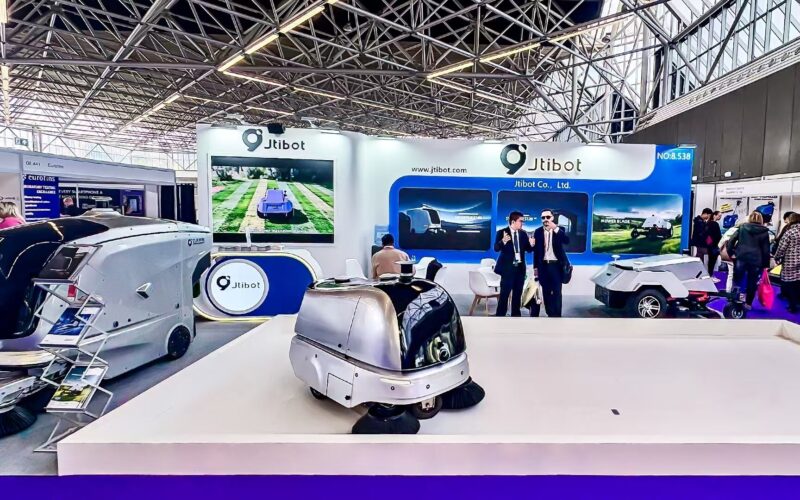
Jtibot has used Interclean Amsterdam 2026 to push its autonomous outdoor sweeping technology deeper into Europe’s facility management market, positioning the company for distribution partnerships and broader regional deployment. The company showcased an AI-driven outdoor sweeper designed for environments larger than 10,000 square metres, targeting industrial campuses, municipal areas, commercial parks and large institutional sites where manual cleaning remains labour-intensive. The announcement matters because outdoor cleaning automation is moving from a novelty category into a more serious operational tool for facilities that need predictable coverage, lower labour dependency and measurable efficiency gains. Jtibot also said it is in the final stage of a fleet procurement agreement valued at approximately $1.4 million, giving the company an early commercial proof point as it courts European partners.
Why is Jtibot using Interclean Amsterdam 2026 to accelerate European market expansion?
Jtibot’s decision to use Interclean Amsterdam 2026 as a launchpad for European expansion is strategically logical because the event sits at the intersection of cleaning equipment, facility management, sustainability and robotics procurement. For autonomous cleaning companies, trade shows are not just branding exercises. They are where distributors, site operators, municipal buyers and facility management companies compare whether robotic systems can handle real-world operating constraints rather than controlled demonstration environments.
The European opportunity is attractive because facility operators are under pressure from several directions at once. Labour availability remains a persistent issue in cleaning and maintenance services, especially for repetitive, physically demanding and outdoor tasks. At the same time, customers are asking for cleaner, safer and better-maintained environments across campuses, business parks, logistics facilities, airports, transport nodes and municipal spaces. That creates a natural opening for autonomous systems that can handle recurring work while allowing human teams to focus on supervision, exception handling and higher-value tasks.
Jtibot’s emphasis on environments larger than 10,000 square metres is important because the economics of outdoor cleaning robotics improve when the operating area is large, repetitive and relatively predictable. A small courtyard does not justify complex automation. A university campus, industrial park, municipal plaza or manufacturing facility, however, can create enough recurring cleaning demand to support fleet deployment. That distinction matters because many service robots fail commercially when vendors target use cases where automation is technically interesting but financially weak.
How does Jtibot’s autonomous outdoor sweeper fit into the changing economics of facility management?
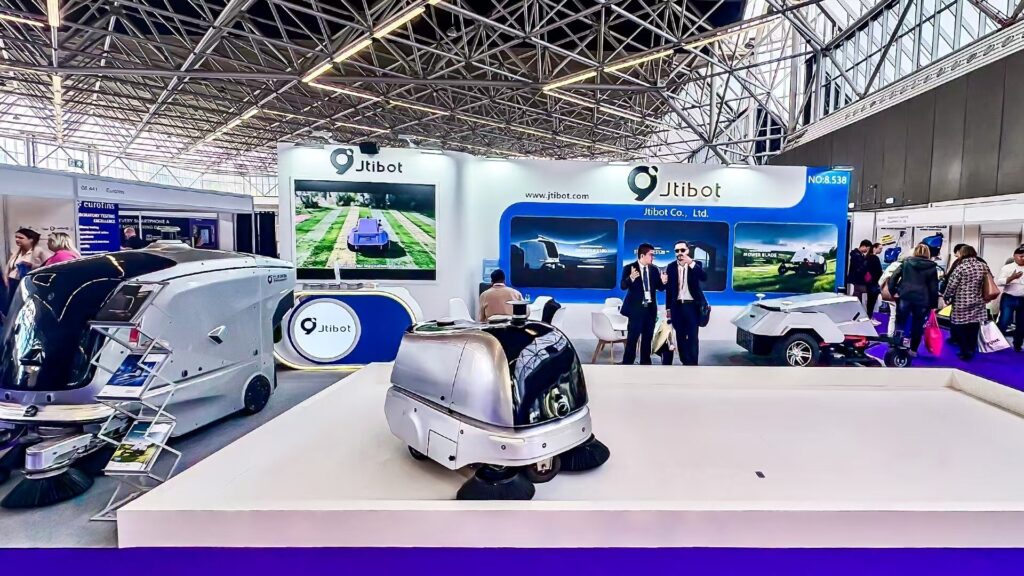
The central business case for Jtibot’s outdoor sweeper is not that robots are fashionable. It is that large-area maintenance is becoming harder to manage through conventional staffing and equipment models alone. Traditional sweepers require operators, scheduling discipline, maintenance routines and management oversight. Autonomous systems aim to compress that model by turning some repetitive coverage into software-managed activity, with people still needed for supervision, site adaptation and service assurance.
This does not mean human labour disappears. Jtibot’s own positioning is built around human-machine collaboration, and Vice President Steven has framed the company’s goal as empowering workers rather than replacing them. That is a sensible message for Europe, where adoption of automation often depends as much on labour relations, safety expectations and procurement culture as on hardware specifications. Buyers are more likely to accept robotics when the technology is presented as a way to reduce repetitive strain, improve consistency and support stretched teams rather than as a blunt labour substitution tool.
For facility management providers, the appeal lies in standardisation. A robot that can map a route, avoid obstacles, return for charging and provide operational data can potentially turn cleaning from a largely manual schedule into a more measurable service layer. That could help contractors defend margins in a sector where customers often demand higher service levels without accepting unlimited cost increases. The humour, if one can call it that, is that cleaning robots may end up being less about shiny automation and more about the least glamorous phrase in operations: cost-to-serve discipline.
Why are autonomous outdoor sweepers becoming more relevant for industrial, municipal and campus environments?
Outdoor sweeping is a more complex robotics challenge than indoor floor cleaning because the environment is less controlled. Outdoor areas involve uneven surfaces, weather changes, pedestrians, vehicles, leaves, dust, debris, curbs, ramps and unpredictable obstacles. A robot operating in a warehouse corridor faces a different risk profile from one working around a public plaza or a university campus. That is why outdoor autonomous cleaning has taken longer to mature than indoor commercial cleaning robotics.
Jtibot’s focus on industrial-grade hardware and AI-driven navigation suggests the company is targeting environments where the cleaning route is repeatable but not static. A campus, commercial park or municipal site may have daily traffic patterns, seasonal debris changes and occasional obstructions. In those settings, autonomy is useful only if the machine can adapt without constant human intervention. Otherwise, the robot becomes a very expensive machine that still needs babysitting, which is not exactly the productivity revolution facilities managers are hoping for.
The most promising deployments are likely to come from sites where cleaning is frequent, measurable and operationally visible. Industrial parks may value cleaner outdoor environments for safety and compliance reasons. Municipal authorities may use autonomous sweepers to support public cleanliness without expanding headcount. Universities and business campuses may see them as part of a broader smart facilities strategy. In each case, the customer is not buying a robot for the sake of robotics. The customer is buying coverage, predictability and labour leverage.
What does the $1.4 million fleet procurement pipeline signal about Jtibot’s commercial traction?
The approximately $1.4 million fleet procurement agreement is a meaningful signal because autonomous cleaning vendors need to move beyond demonstration momentum. Robotics companies can attract attention at exhibitions, but the harder test is whether buyers commit to fleet purchases, integration work, maintenance support and operational change. A procurement pipeline of that size does not yet prove scale, but it does suggest Jtibot is finding customers willing to evaluate autonomous sweepers as practical assets rather than experimental gadgets.
The fleet angle is especially important. A single machine can be a pilot. Multiple machines imply the buyer is thinking about site-wide deployment, operating standards and return on investment. Fleet procurement also creates potential recurring revenue opportunities through service, software, maintenance, fleet management and replacement cycles. For Jtibot, proving that one buyer can justify a fleet-level commitment would strengthen its case with distributors and facility management partners across Europe.
The risk is that fleet procurement can also expose execution gaps faster than a pilot. Hardware reliability, spare parts availability, response times, software updates, safety performance and training all become more visible once machines enter daily operations. In Europe, distributors will also care about after-sales infrastructure, certification requirements, data handling and insurance considerations. Jtibot’s next phase therefore depends not only on selling machines, but on building the operational backbone needed to keep those machines productive in the field.
How could European distributors shape Jtibot’s route to market for cleaning robotics?
European distributors could be central to Jtibot’s expansion because facility management buyers often prefer local service relationships over direct procurement from unfamiliar overseas robotics vendors. Cleaning equipment is not a pure software sale. Customers need installation support, route planning, training, maintenance, replacement parts and accountability when machines fail. A strong distributor network can reduce buyer hesitation by giving local operators a familiar channel for support.
For Jtibot, the challenge is selecting partners that understand both traditional cleaning equipment and robotics-based service models. A distributor that only knows conventional machines may struggle to sell autonomy as an operational transformation. A robotics-only partner may lack access to established cleaning and facility management buyers. The best route to market may come from partners that can translate robotic capability into practical service economics for airports, campuses, municipalities, logistics centres and industrial facilities.
The competitive implication is that Europe may not simply reward the best robot on paper. It may reward the vendor with the most credible deployment ecosystem. Autonomous cleaning companies will need to combine hardware performance, software reliability, local service support and financing flexibility. That creates an opening for Jtibot if it can move quickly, but it also raises the bar. European expansion is not a booth-to-revenue conveyor belt. It is a distribution, support and trust-building exercise.
Why does Jtibot’s ESG positioning matter for facility management buyers in Europe?
Jtibot’s ESG framing is not just decorative language. In Europe, large commercial and public-sector buyers increasingly evaluate suppliers through operational sustainability, worker safety, resource efficiency and reporting discipline. Autonomous sweepers can support those goals if they reduce inefficient routes, improve scheduling, lower unnecessary resource use and shift workers away from repetitive manual activity. The ESG case becomes stronger when automation improves working conditions without eroding service accountability.
The social dimension may be particularly relevant. Cleaning work is essential but often physically demanding, repetitive and difficult to staff consistently. If autonomous systems reduce the burden of repetitive sweeping while allowing workers to supervise, maintain and manage machines, the technology could support a more sustainable labour model. That is the version of automation likely to resonate with institutional buyers. A crude replacement narrative would create friction. A productivity and safety narrative has a better chance of surviving procurement scrutiny.
The environmental case will depend on measurable outcomes. Buyers will want to know whether machines reduce fuel use, water consumption, dust levels, route duplication or inefficient scheduling. Jtibot’s long-term credibility will therefore depend on data. If the company can provide facility operators with evidence of improved coverage, lower resource intensity and better task consistency, its ESG message could become a procurement advantage rather than a marketing slogan.
What competitive pressures could Jtibot face as autonomous cleaning robots scale in Europe?
Jtibot is entering a market where cleaning robotics is becoming more crowded. Interclean Amsterdam 2026 itself highlighted the broader shift toward intelligent floor-care systems and robotics, while other automation vendors are also presenting indoor and outdoor cleaning fleets. That means Jtibot’s European opportunity comes with a timing advantage and a competitive warning. Demand is rising, but buyers will have choices.
The company’s differentiation will likely depend on whether it can prove strength in large outdoor environments rather than merely claim autonomy. Indoor cleaning robots have already helped familiarise facility managers with robotic cleaning, but outdoor sweeping demands more rugged systems, stronger perception capability and better safety performance. Jtibot’s focus on large, flat outdoor sites could be a practical niche if the company avoids overextending into too many environments too quickly.
Pricing and procurement models may also become decisive. Facility managers will compare autonomous sweepers not only against rival robots but against human-operated sweepers, outsourced cleaning contracts and hybrid service models. If the upfront capital cost is too high, customers may prefer leasing, robotics-as-a-service or distributor-backed financing. Jtibot’s ability to structure deals around operating savings rather than hardware novelty could determine how fast European adoption converts from interest to revenue.
What happens next if Jtibot’s European expansion strategy succeeds or stalls?
If Jtibot’s European expansion succeeds, the company could establish itself in a high-value niche within the broader service robotics market before outdoor cleaning becomes fully mainstream. Early distribution partnerships could give Jtibot reference customers, site data and service experience across multiple European operating conditions. That would make future deployments easier because facility buyers often look for proof from comparable sites before committing to autonomous systems.
Success could also push competitors to accelerate their own outdoor cleaning roadmaps. The cleaning robotics market is moving from single-purpose machines toward fleets, cloud platforms and integrated facility workflows. If Jtibot can show that outdoor sweepers can be deployed reliably across large sites, rivals may respond with broader product line-ups, sharper pricing or partnerships with established cleaning equipment distributors. The result could be faster category maturation, but also tighter margins.
If the strategy stalls, the reasons are likely to be operational rather than conceptual. Demand for automation exists, but deployment complexity can slow adoption. Buyers may hesitate if local support is weak, safety certification is unclear, procurement budgets are tight or return on investment is difficult to prove. Jtibot’s next challenge is therefore not convincing Europe that automation is coming. That part is already clear. The harder task is proving that its autonomous sweepers can deliver dependable value after the exhibition lights are switched off.
Key takeaways on what Jtibot’s European expansion means for autonomous cleaning robotics
- Jtibot’s Interclean Amsterdam 2026 showcase positions the company inside Europe’s growing debate over how facility managers can maintain large outdoor sites with fewer operational bottlenecks.
- The company’s focus on environments larger than 10,000 square metres gives its autonomous outdoor sweeper a clearer commercial use case than smaller, less repetitive cleaning applications.
- The approximately $1.4 million fleet procurement pipeline is important because it suggests potential movement from demonstration interest toward multi-unit deployment.
- European distributors will likely decide how quickly Jtibot can turn exhibition visibility into regional sales, service coverage and customer trust.
- Jtibot’s human-machine collaboration message is commercially useful in Europe because automation adoption often depends on labour framing as well as technical capability.
- The ESG angle could support procurement conversations if Jtibot can back it with measurable data on efficiency, resource use and worker conditions.
- Outdoor cleaning robotics remains more difficult than indoor floor automation because public and industrial environments are less predictable.
- Jtibot’s competitive position will depend on real-world reliability, after-sales infrastructure, financing flexibility and proof of return on investment.
- The broader cleaning robotics market is shifting from isolated machines to connected fleets, which could benefit vendors that combine hardware, software and service partnerships.
- The next test for Jtibot is not whether autonomous sweeping attracts attention, but whether European customers treat it as infrastructure rather than equipment.
Discover more from Business-News-Today.com
Subscribe to get the latest posts sent to your email.