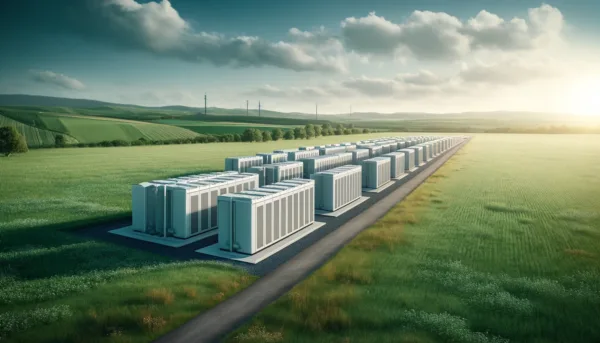
Base Power today announced a $1 billion Series D financing at a $13 billion post-money valuation, alongside the commercial launch of Base Core, its next-generation home battery built at Base Factory 1 in Austin. The round is co-led by Ribbit, Addition, Valor Equity Partners and JPMorganChase’s Strategic Investment Group, with participation from Altimeter, D1 Capital Partners, Sands Capital, Coatue, Layer Global and Energy Impact Partners, and re-investment from every major existing backer including Thrive Capital, Andreessen Horowitz, Lightspeed, Trust Ventures and Alphabet-owned CapitalG. The deal takes total capital raised by the two-year-old Austin company to more than $2.5 billion, and lifts its valuation more than threefold in the ten months since its $4 billion Series C closed in October 2025. The central tension for executives, investors and grid planners is no longer whether distributed home batteries can supplement traditional generation, but whether Base Power can execute at industrial scale while defending its economics against Tesla, Enphase and a widening field of Chinese-built alternatives.
What did Base Power actually raise, and how does the Series D reset the price tag of America’s fastest-growing home battery startup?
The Series D is a $1 billion primary financing at a $13 billion post-money valuation, according to the company’s announcement. The syndicate is unusually broad. Ribbit brings a fintech-oriented growth-capital lens. Addition, which led the October 2025 Series C, retains its position. Valor Equity Partners, whose founder Antonio Gracias sits on the Base Power board, extends its early-cycle backing. The most notable new entrant is JPMorganChase’s Strategic Investment Group, which is deploying capital under the bank’s Security and Resiliency Initiative, an infrastructure-focused programme rather than a general venture arm.
Base Power’s pace of price appreciation is the striking number. The company raised $200 million in a Series B in April 2025, closed the $1 billion Series C at a $4 billion valuation in October 2025, and has now closed a further $1 billion at $13 billion in August 2026. That is a 3.25 times step-up in ten months. Forbes reported in late May 2026 that the company was in talks at a $12 billion mark, meaning the final close came in slightly above that leaked target. For context, few pre-IPO energy companies in the United States have moved this quickly through the venture ladder without a public listing.
The strategic point is not the headline number but the composition. When a global universal bank’s balance-sheet investment programme, a Big Tech-affiliated growth fund, a fintech-heavy specialist and an Elon Musk-linked growth investor all reinvest or enter at the same time, the signal is that the underlying model is being underwritten by different investment theses rather than a single narrow bet on residential storage.
Why does the Base Core launch matter more than the funding round itself for the residential storage market?
Base Core is the company’s second-generation home battery, positioned at 39.2 kilowatt-hours of energy capacity, expandable to 78.4 kilowatt-hours with a second unit. That single-unit rating is roughly three times the capacity of a Tesla Powerwall 3, which offers 13.5 kilowatt-hours of usable energy, and roughly eight times the capacity of an Enphase IQ Battery 5P at 5 kilowatt-hours. The company says installation takes less than one hour, the unit switches over seamlessly during outages, and it is engineered for extreme-weather conditions.
The scale point matters for two reasons. First, the residential storage market has been converging on higher-capacity units as customers seek whole-home backup rather than critical-load-only coverage, and Base Core sits at the top end of that trend. Second, the higher the installed kilowatt-hours per home, the larger the aggregated fleet that Base Power can dispatch back to the grid under its utility partnerships. Fleet size, not marketing narrative, is what utilities pay for.
The company disclosed that its battery fleet now exceeds 500 megawatt-hours, up from roughly 100 megawatt-hours at the time of the Series C close in October 2025. That is a fivefold expansion in ten months, and it has been achieved through partnerships with El Paso Electric, Austin Energy and CoServ that collectively account for more than 200 megawatts of contracted capacity, alongside an earlier 50-megawatt expansion with GVEC.
How does Base Power’s distributed storage model compare to Tesla’s Powerwall and Enphase’s IQ Battery in the race for grid capacity?
The competitive backdrop is dominated by two publicly listed players. Tesla remains the most-quoted residential battery brand on major marketplaces, holding an estimated share in the low-to-mid 40 percent range on installed capacity terms, with Enphase Energy running second in the mid-teens. Barclays analysts previously noted that Tesla is the preferred brand for backup applications, while Enphase and SolarEdge are used more for load shifting.
Base Power’s differentiation is structural rather than product-driven. Tesla and Enphase sell hardware through installer networks and rely on homeowners to monetise the batteries. Base Power sells the electricity service, retains ownership of the battery, and monetises the fleet through utility partnerships and retail-electricity supply. In effect, it is running a distributed generation and retail utility hybrid, using the home as the deployment site and the resident as the beneficiary of backup power and a lower supply bill. Its June 2026 Illinois launch, which claimed a rate 25 percent below the fixed ComEd supply rate, exemplifies the pitch to the customer.
That business model has three consequences for competitive analysis. First, unit economics depend on utility payments and retail spread, not one-time hardware sales, which makes the model more capital-intensive but potentially more recurring. Second, Base Power competes less directly with Tesla and Enphase than with retail electricity providers and gas-peaker developers. Third, the model scales with utility willingness to pay for distributed capacity, which is why the JPMorganChase infrastructure-programme investment is more strategically consistent than a typical venture placement.
Why did JPMorganChase’s Strategic Investment Group and CapitalG choose Base Power over public-market alternatives?
The stated rationale from Todd Combs, who heads JPMorganChase’s Strategic Investment Group under the Security and Resiliency Initiative, is that the bank is backing companies that strengthen the physical infrastructure of the American economy and help meet growing power demand. That framing places Base Power alongside the bank’s broader infrastructure security thesis rather than as a discretionary growth bet.
The commercial logic tracks. Grid interconnection queues for new gas turbines and utility-scale batteries in Texas, California and PJM regions have stretched into multi-year backlogs. Distributed batteries deployed on customer premises bypass interconnection queues entirely, because the connection is already installed. Antonio Gracias described the model as one of the fastest and most cost-effective ways to add capacity to the grid, and the argument is that a fleet of home batteries can be built faster than any peaker plant, subject only to manufacturing throughput at Base Factory 1 and installation labour on the ground.
CapitalG, Alphabet’s independent growth investment fund, first entered on the Series C. Its reinvestment is consistent with Alphabet’s own interest in grid capacity for its data-centre load. Data-centre power procurement is one of the fastest-growing categories of demand in the United States, and any technology that adds distributed dispatchable capacity indirectly benefits hyperscaler siting economics.
What execution and capital-allocation risks still surround Base Power’s national expansion beyond Texas and Illinois?
The most material risks are operational rather than financial. Base Power currently serves Texas customers, has extended into the Chicagoland region of Illinois since June 2026, and has stated an intention to expand nationally. Each new state or utility service territory involves separate retail licensing, tariff negotiation, permitting for battery installations and interconnection paperwork. The company has not disclosed how many states it plans to enter in the next twelve to twenty-four months, and management has not committed to a specific national footprint timeline.
The second execution question is manufacturing throughput. Base Factory 1 is now producing thousands of systems a month, according to Justin Lopas, Base Power’s chief operating officer and co-founder. Scaling from thousands to tens of thousands per month, which will be required if the fleet is to grow from 500 megawatt-hours to the multi-gigawatt-hour scale implied by a $13 billion valuation, requires either a rapid expansion of Factory 1 or the commissioning of Factory 2. The company has referenced planning for a second factory but has not disclosed its location or expected commissioning date.
The third area is capital allocation. Base Power now sits on more than $2.5 billion of aggregate raised capital. Deploying that at returns above its financial and operational cost requires disciplined selection of utility partners, disciplined installation cost management and disciplined customer acquisition. Cash burn during national expansion is likely to remain elevated, and the ability to reach cash-flow break-even at scale is the most consequential unresolved question in the investment case.
How does the Austin Factory 1 fit into the wider push to reshore critical energy infrastructure manufacturing?
Base Core is being marketed as a first-of-its-kind home battery built in the United States. That claim is deliberate. The residential storage market has been reshaped over the past three years by tariffs, section 301 duties on Chinese lithium-iron-phosphate cells, and the Inflation Reduction Act’s domestic-content bonuses on storage installed in energy communities. A US-built battery captures a stack of federal and state incentives that an imported unit cannot, and it also gives utility partners a more defensible political story on ratepayer-funded infrastructure procurement.
Base Factory 1 sits on the former Austin American-Statesman downtown site. It represents one of the few dedicated residential storage manufacturing facilities in the United States and is one of the assets JPMorganChase and Valor Equity Partners have specifically referenced in their support. The strategic significance is that Base Power is not only a retail energy company and a fleet operator, but also a domestic manufacturer, which affects how policymakers and regulators are likely to view the company’s growth in the coming policy cycle.
What does a $13 billion valuation imply about the terminal value investors are attaching to distributed virtual power plants?
At a $13 billion post-money valuation on roughly 500 megawatt-hours of deployed capacity, the implied enterprise value per installed megawatt-hour sits well above the levelised cost of comparable utility-scale storage. This tells you the market is not valuing Base Power on today’s fleet but on a forward view of gigawatt-hour-scale deployment and the recurring cash flows from utility capacity payments and retail electricity supply.
Comparable public benchmarks are limited. Tesla’s residential storage business sits inside a $1.4 trillion group and is not separately valued. Enphase Energy trades at an equity value that reflects both its microinverter business and its battery growth. Sunrun, the largest residential solar-plus-storage installer, operates on a lease and power-purchase model closer to Base Power’s economic structure, but with a very different capital structure. None of these public comparables offers a clean read on the pure-play distributed virtual power plant valuation.
The final analytical point for institutional investors is that Base Power’s $13 billion mark now sets a private-market anchor for the entire distributed storage category. Later-stage entrants and competitors will price their next rounds against it. The mark itself becomes a competitive signal.
Key takeaways as Base Power closes its $1 billion Series D and rolls out the Base Core home battery
- Base Power closed a $1 billion Series D at a $13 billion post-money valuation on 3 August 2026, taking total capital raised past $2.5 billion in less than three years since founding.
- The round was co-led by Ribbit, Addition, Valor Equity Partners and JPMorganChase’s Strategic Investment Group, with participation from Altimeter, D1 Capital, Sands Capital, Coatue, Layer Global and Energy Impact Partners, and re-investment from Thrive Capital, Andreessen Horowitz, Lightspeed, Trust Ventures and CapitalG.
- The valuation is 3.25 times the $4 billion mark set at the October 2025 Series C close, and slightly above the $12 billion level Forbes reported was being discussed in May 2026.
- Base Core, launched alongside the funding round, delivers 39.2 kilowatt-hours per unit, roughly three times the capacity of a Tesla Powerwall 3, and installs in under an hour according to the company.
- Fleet capacity has grown from about 100 megawatt-hours at the Series C close to more than 500 megawatt-hours in August 2026, supported by partnerships with El Paso Electric, Austin Energy, CoServ and GVEC for more than 200 megawatts of contracted capacity.
- JPMorganChase’s participation through its Security and Resiliency Initiative frames Base Power as critical infrastructure, and CapitalG’s re-investment reflects Alphabet’s parallel interest in distributed dispatchable capacity for data-centre load.
- The strategic contest is with Tesla’s Powerwall and Enphase’s IQ Battery on hardware, and more importantly with gas-peaker developers and traditional retail electricity providers on the business model.
- Execution risks are concentrated in national expansion beyond Texas and Illinois, manufacturing throughput ramp at Factory 1 and disciplined capital deployment across new utility service territories.
- The domestic manufacturing story protects Base Power against tariff and content-rule shifts on imported storage, and positions it favourably in policy debates on ratepayer-funded infrastructure procurement.
- The next measurable proof points are the commissioning timeline of a second factory, the pace of new utility partnership announcements outside Texas and Illinois, and any move toward disclosing unit economics or a path to positive cash flow.
Discover more from Business-News-Today.com
Subscribe to get the latest posts sent to your email.