



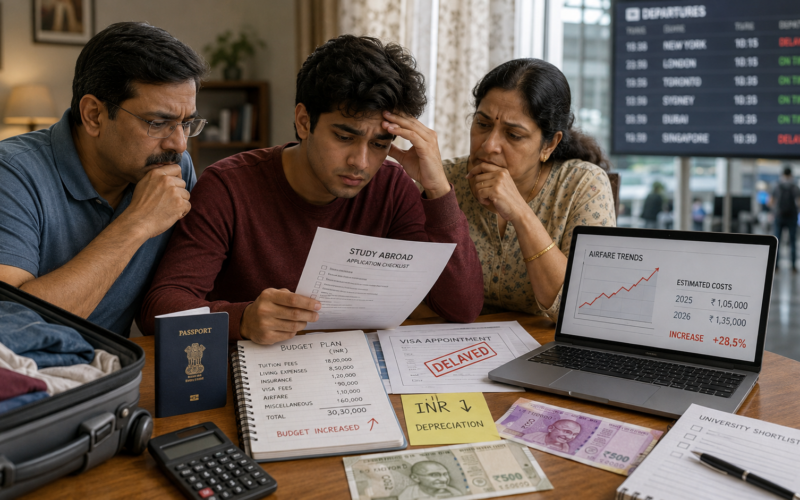
Indian students preparing to leave for foreign campuses in the 2026 intake are confronting a financial environment unlike anything recent cohorts have faced, with the Indian rupee weakening past 95 against the United States dollar, United States student visa issuance tightening sharply, and airfares climbing on fuel-related pressure. Against this backdrop, Prodigy Finance, the international student lender, has advised prospective borrowers to think carefully about the currency in which they fund their education and to begin travel planning early in the current admission season.
The guidance comes from Sonal Kapoor, Global Chief Business Officer at Prodigy Finance, who has framed the present moment as a critical decision point for Indian families weighing how to pay for tuition, housing, and daily living costs abroad. Her central argument is that students moving overseas for the first time are exposed to currency risk in a way that is easy to underestimate, because tuition and rent are settled in the destination currency while household savings sit in rupees.
Why is rupee depreciation against the US dollar adding new pressure on Indian study abroad students in 2026?
The rupee has been among the weakest performers across emerging market currencies over the past year. It slipped to record lows through May 2026, trading near 95 against the United States dollar after spending most of 2024 in the low 80s, a decline of more than 10 percent over twelve months. The slide has been driven by elevated crude oil import costs, sustained foreign portfolio investor outflows, a widening current account deficit, and the fragility of the United States and Iran ceasefire arrangement, which keeps oil prices and the Strait of Hormuz risk premium in focus.
For a student paying a fixed dollar tuition bill, every step down in the rupee raises the rupee cost of the same degree. Sonal Kapoor has noted that the same depreciation that hurts a departing student can benefit a graduate already employed abroad and remitting earnings home, because dollar income converts into more rupees. The asymmetry is the point. A first-time student carries the cost of the weak rupee on the way in, before any earning power exists to offset it. Sonal Kapoor has said Prodigy Finance is receiving a large volume of correspondence from anxious students trying to understand how to manage tuition, housing, exchange losses, and travel simultaneously.
This is why Sonal Kapoor has urged students to consider funding in dollars or in the same currency as their destination country. Borrowing in the destination currency means tuition, repayment, and the loan itself sit on the same side of the exchange rate, removing the layer of currency mismatch that catches families who borrow in rupees and pay in dollars.

How are United States F-1 visa constraints and rising airfares compounding costs for Indian students this intake season?
Currency is only one of several pressures stacking up at once. United States F-1 student visa issuance to Indian applicants fell steeply through 2025 and into 2026, with State Department data pointing to a drop of roughly 60 to 69 percent during the peak pre-fall months compared with the prior year. Processing delays have built up at consulates in New Delhi, Hyderabad, and elsewhere, with applications routed into administrative processing and tighter vetting that now includes review of applicants’ public social media activity. Appointment slots began reopening gradually from April 2026, but availability remains uneven, and applicants with prior refusals have faced the narrowest options.
The visa squeeze interacts directly with cost. Students who cannot lock a timely appointment risk deferring an intake, while those who do travel are paying more to get there. Airfares have been rising on fuel-related pressure, and for students from modest households a meaningful share of the overall budget is now absorbed by travel itself before a single class begins. Sonal Kapoor has advised students not to delay travel planning, to use flexible booking options where available, and to assume that airfares may climb further over the coming months. Early planning, in her view, can make a real difference to the final outlay.
Why do collateral and co-signer requirements on Indian education loans burden students from Tier 2 and Tier 3 cities?
The financing channel itself is a constraint for many Indian applicants. Surveys of prospective students have indicated that a rising majority now come from Tier 2 and Tier 3 cities and from households of modest means, where studying abroad is treated as a generational opportunity rather than a routine expense. Even in metropolitan centres such as Mumbai, Pune, Hyderabad, and Bengaluru, a large share of outbound students come from families without deep financial reserves.
For these households, traditional education loans often require collateral such as land, property, or gold, or a co-signer who shares legal liability. Those requirements add pressure on families already managing rising tuition, housing, and travel costs, and they can exclude capable students who lack assets to pledge. Merit-based international lenders that assess a student on future earning potential rather than present assets remain relatively few in number, which is the gap Prodigy Finance positions itself to fill. Its model evaluates the degree programme, the institution, and projected post-study earnings, allowing applications without collateral or a co-signer and disbursing funds directly to the university.
What do the ProdiSHE campaign and NovaGrad initiatives offer eligible STEM students from India in 2026?
To ease some of the cost burden during the current cycle, Prodigy Finance and NovaGrad have introduced support initiatives aimed at students in science, technology, engineering, and mathematics fields. Through the ProdiSHE campaign, two eligible STEM students from India may receive 1,000 United States dollars applied toward their loan amount. Separately, selected students applying through NovaGrad may receive application fee reimbursements of up to 200 United States dollars. Winners under both initiatives are scheduled to be announced in June.
The initiatives sit within a broader institutional focus on widening access. Founded in 2007, Prodigy Finance has supported more than 47,000 international master’s students and disbursed over 2.3 billion United States dollars to students from more than 150 countries. The lender operates a borderless model funded by impact investors and other qualified institutions, and it is authorised and regulated by the Financial Conduct Authority in the United Kingdom. Sonal Kapoor’s wider message to Indian students is that the combination of currency risk, visa friction, and travel inflation calls for earlier and more deliberate financial planning than previous cohorts needed.
What are the key takeaways from the 2026 study abroad funding and currency challenge for Indian students?
- The Indian rupee weakened past 95 against the United States dollar through May 2026, a decline of more than 10 percent over twelve months, driven by crude oil import costs, foreign portfolio investor outflows, a widening current account deficit, and a fragile United States and Iran ceasefire.
- Sonal Kapoor, Global Chief Business Officer at Prodigy Finance, has advised Indian students to consider funding their education in dollars or in their destination country’s currency to remove the mismatch between rupee savings and dollar tuition obligations.
- United States F-1 student visa issuance to Indian applicants fell sharply through 2025 and into 2026, with processing delays at consulates including New Delhi and Hyderabad, tighter vetting that now reviews public social media, and appointment slots only reopening gradually from April 2026.
- Rising airfares linked to fuel pressure are absorbing a meaningful share of student budgets, prompting Sonal Kapoor to recommend early travel planning and flexible flight booking before fares climb further during the intake season.
- Surveys indicate a rising majority of outbound Indian students now come from Tier 2 and Tier 3 cities and modest households, for whom collateral and co-signer requirements on traditional education loans add significant financial strain.
- Prodigy Finance operates a merit-based, borderless lending model that assesses future earning potential rather than present assets, allowing applications without collateral or a co-signer, with funds disbursed directly to the university.
- Through the ProdiSHE campaign, two eligible STEM students from India may receive 1,000 United States dollars toward their loan, while selected NovaGrad applicants may receive application fee reimbursements of up to 200 United States dollars, with winners announced in June.
- Founded in 2007, Prodigy Finance has disbursed over 2.3 billion United States dollars to more than 47,000 students from over 150 countries, and is authorised and regulated by the Financial Conduct Authority in the United Kingdom.
Discover more from Business-News-Today.com
Subscribe to get the latest posts sent to your email.