



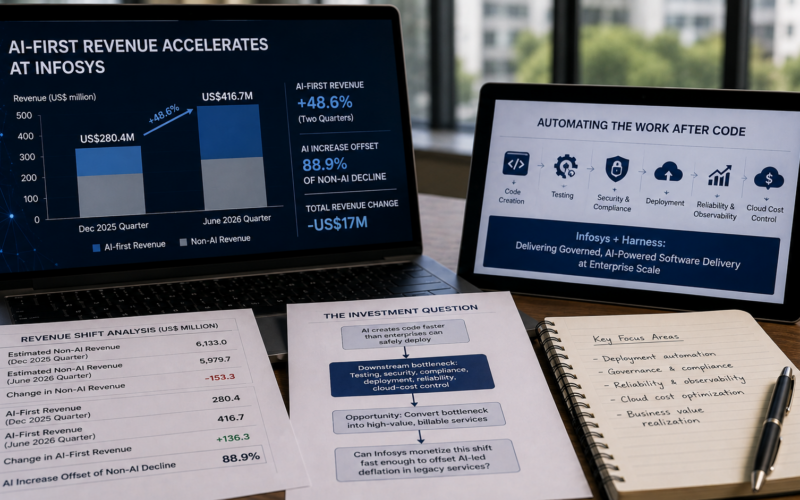
Infosys Limited (NSE: INFY; BSE: 500209; NYSE: INFY) increased estimated AI-first revenue from US$280.4 million in the December 2025 quarter to US$416.7 million in the June 2026 quarter, a 48.6% rise across two quarters, even as total reported revenue slipped by US$17 million.
Estimated non-AI revenue declined by US$153.3 million between those reporting points, while AI-first revenue increased by US$136.3 million. On that mechanical reported-dollar comparison, the AI increase offset 88.9% of the non-AI decline.
That shift gives the April collaboration between Infosys Limited and Harness Inc. commercial importance. The two companies want to automate the work following code creation, including testing, security, compliance, deployment, reliability and cloud-cost control. If generative AI creates code faster than enterprises can safely place it into production, this governed layer could become a new source of modernization work.
The evidence does not yet show that Harness contributed to Infosys’ US$416.7 million AI-first revenue estimate. Neither company disclosed a joint customer, contract value, bookings target, revenue-sharing structure, minimum commitment or pipeline contribution. The calculated revenue shift establishes the market context for the partnership, not its financial impact.
The investment question is whether Infosys can convert that downstream bottleneck into billable work quickly enough to counter AI-led deflation in legacy services. Management has acknowledged the compression but not quantified it. Harness is therefore one possible mechanism for replacing effort-based revenue with higher-value deployment, governance and optimization work.
How did Infosys AI revenue offset 88.9% of the two-quarter non-AI revenue decline?
Infosys reported US$5.099 billion of revenue for the quarter ended December 31, 2025. Management later identified AI-first revenue as 5.5% of that quarter’s total, implying approximately US$280.4 million. For the quarter ended June 30, 2026, total revenue was US$5.082 billion and AI-first revenue represented 8.2%, implying approximately US$416.7 million.
The AI-first share expanded by 2.7 percentage points, or 49.1% relative to the earlier level. Because total reported revenue declined slightly, estimated AI-first revenue grew by 48.6% in dollar terms.
Subtracting the derived AI figures from reported group revenue produces an estimated non-AI total of US$4.819 billion for Q3 FY26 and US$4.665 billion for Q1 FY27. That is a decline of US$153.3 million, or 3.2%. The US$136.3 million AI increase divided by the US$153.3 million non-AI decrease produces the 88.9% offset.
This is a mix analysis, not an organic revenue bridge. It spans two quarters, uses rounded percentages and cannot remove currency, acquisitions or reclassification. Infosys said acquisitions contributed approximately 1.1% to Q1 sequential growth, but did not separate acquired AI revenue. Even with that limitation, the calculation shows why AI monetization has become essential to the growth profile.
The 8.2% figure covers AI-first revenue within the six Hexagon value pools. Management highlighted process AI, AI strategy and engineering, and data for AI as areas contributing a larger share. AI-augmented work embedded inside existing engagements is tracked internally but excluded, so the calculation does not value every contract using artificial intelligence.

What does the Infosys and Harness everything-after-code partnership actually sell?
The collaboration combines Infosys Topaz Fabric across infrastructure, models, data, applications and workflows, Infosys Cobalt cloud offerings, and the Harness Software Delivery Platform across testing, deployment, security, governance, reliability and cost optimization.
The proposition is that faster code generation shifts the constraint downstream. Enterprises must still test changes, verify security, satisfy regulators, manage approvals, deploy across clouds, observe performance and remediate failures. Fragmented processes can make those steps the slowest and riskiest part of delivery.
The target is complex, regulated environments where governance and auditability can matter more than raw coding speed. Infosys brings enterprise access and legacy-system knowledge; Harness brings operational signals and a software-delivery knowledge graph.
Harness has cited customer examples involving releases up to 75% faster, cloud costs up to 60% lower and as much as tenfold DevOps efficiency. Those are company-reported maxima, not Infosys forecasts. The collaboration did not say which modules would be deployed first or whether Infosys would resell licences, bundle them into services or share revenue.
Why could post-code automation create revenue while AI compresses legacy work?
Infosys faces both sides of the AI equation. AI-first projects are expanding, but clients expect automation to reduce effort in existing contracts. Management said AI-led deflation affects large and non-large deals on top of traditional renewal productivity concessions.
The company still achieved a net pricing increase, but it was softer than expected as clients sought more productivity and competition intensified. Because Infosys has not quantified compression, investors cannot calculate the AI-first revenue needed to neutralize pressure on traditional services.
Everything after code could create adjacent scope instead of making the same work cheaper. Clients producing more changes with coding agents may need stronger release orchestration, automated testing, security controls, policy enforcement, resilience, cost optimization and production observability.
Automation can also reduce labour in testing, deployment and operations. Infosys must structure engagements around outcomes, managed operations or transformation milestones rather than assume that every feature expands billing.
Can 80,000 coding-tool users become a governed software-delivery advantage at scale?
Infosys said more than 80,000 employees were using coding tools such as Claude Code or Codex for clients and selected internal projects by July. Against a June workforce of 328,062, that represents at least 24.4%, or almost one in four employees. The company is also planning to build a group of 6,000 frontier engineers over several years.
At the December quarter, Infosys was working with 90% of its 200 largest clients on AI journeys, had more than 4,600 AI projects under way and had built over 500 agents. Those figures were not updated in Q1 and remain a December operating baseline, not current August counts.
Harness must earn its place between coding adoption and production evidence. Infosys disclosed coding-tool users, but not deployment frequency, lead time, failure rates, recovery time, security remediation or cost per release.
Does Infosys have enough large-deal distribution to commercialize Harness at scale?
Infosys won US$3.6 billion of large-deal total contract value in Q1 FY27, with 61% classified as net new. That implies approximately US$2.196 billion of net-new total contract value, although contract value is not quarterly revenue and generally converts over several years.
Management said 20% of large-deal value came from new vendor consolidation. Applied mechanically to US$3.6 billion, that represents about US$720 million. Consolidation could favour a common testing, deployment, security and governance platform, but Infosys did not say Harness was included. The figure is a distribution indicator, not partnership revenue.
Active clients increased 8.9% year on year to 2,027, while gross additions rose 66.7% to 155. US$10 million-plus clients increased 5.0% to 333, but US$100 million-plus clients remained at 41 and the top 25 revenue share fell 130 basis points to 33.9%.
A named enterprise win with defined scope and milestones would provide stronger proof.
What do margins reveal about the cost of building Infosys AI revenue momentum?
Infosys generated a 21.1% operating margin in Q1 FY27, up 20 basis points sequentially, while retaining full-year guidance of 20% to 22%. The result shows that AI investment has not yet broken the group’s established margin range, but the internal bridge reveals a visible cost.
Management attributed a 50-basis-point headwind to investment in AI sales and marketing. Applied to US$5.082 billion of quarterly revenue, that is mechanically equivalent to about US$25.4 million, or 2.4% of the quarter’s US$1.072 billion operating profit. Currency movement contributed a 70-basis-point tailwind and Project Maximus added 20 basis points, helping absorb the investment and other pressures.
Infosys reported free cash flow of US$955 million and conversion of 116.4% of net profit, while cash and investments stood at US$3.916 billion. It can fund training, sales activity and platform integration without depending on Harness for immediate liquidity.
Harness-linked unit economics remain undisclosed, including licensing costs and expected margin contribution.
Why has Infosys stock sentiment lagged the acceleration in AI-first revenue?
Infosys shares closed at ₹1,175.10 on the National Stock Exchange of India on August 7, up 0.87% in the session. The stock gained 3.98% over the week and 9.64% over one month, marking a measurable short-term recovery following the July 23 Q1 results.
The longer view remained cautious. The shares were down 18.22% over one year and traded 32.0% below their 52-week high of ₹1,728, although they stood 19.6% above the 52-week low of ₹982.40. Market capitalisation was approximately ₹4.77 trillion.
The combination of a positive one-month return and a negative one-year return is consistent with a market that has rewarded recent momentum without erasing the longer decline. Q1 constant-currency revenue grew 2.4% year on year, but FY27 guidance of 1.5% to 3.0% includes about 1.7% from recent acquisitions. Weak volumes, a client programme termination, offshoring and softer pricing gains complicate the headline momentum.
What would prove the Infosys and Harness partnership is becoming a growth engine?
Infosys has established a material revenue base for its broader AI strategy. AI-first revenue reached an estimated US$416.7 million in Q1 FY27 and mechanically offset almost 89% of the non-AI decline measured against Q3 FY26. That is no longer an experimental pilot category.
Harness addresses a credible bottleneck. Faster code generation increases the importance of testing, deployment, security, governance, reliability and cost control. Infosys has the account access, workforce and deal distribution needed to take that proposition to market.
What remains unproven is the partnership itself. No disclosed customer, booking, annual contract value, revenue contribution, attach rate or joint margin target connects Harness to Infosys’ financial statements. The companies have described the capability, but not the commercial conversion.
The decisive evidence would be a named enterprise deployment with measurable before-and-after results, followed by repeat wins. Contract value, recurring platform revenue, implementation scope, deployment frequency, failure reduction, remediation time, cloud-cost savings and margin contribution would reveal whether everything after code is becoming a durable business.
Until that evidence appears, the Infosys and Harness partnership is strategically aligned with the expanding AI-first part of Infosys’ portfolio, but it cannot yet be credited as a growth engine. The strategic rationale is credible; revenue attribution is still waiting for its first production release.
Discover more from Business-News-Today.com
Subscribe to get the latest posts sent to your email.