



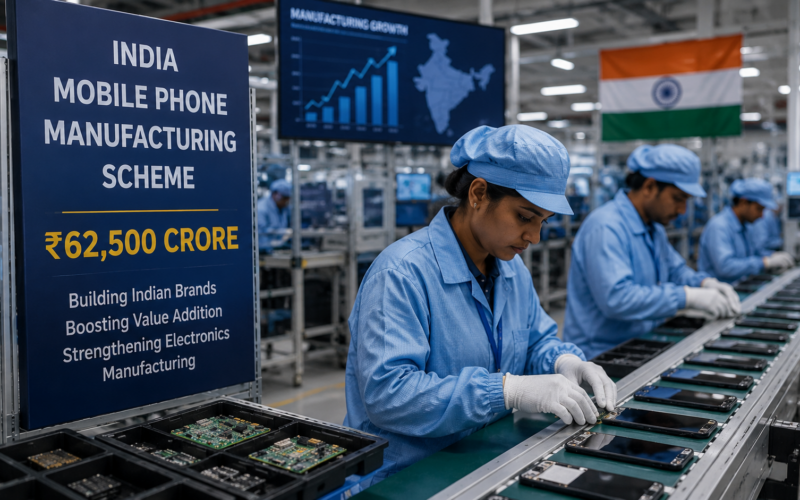
India has formally notified a ₹62,500-crore Mobile Phone Manufacturing Scheme as the government attempts to move the country from large-scale smartphone assembly towards deeper electronics manufacturing, higher domestic value addition and stronger Indian brands, while expecting Apple Inc. (NASDAQ: AAPL) to broaden its manufacturing footprint in the country beyond iPhones.
The Ministry of Electronics and Information Technology (MeitY) notified the scheme on August 21, 2026, following Cabinet approval in July. Electronics and Information Technology Minister Ashwini Vaishnaw said alongside the rollout that Apple was expected to widen its Indian manufacturing activities beyond iPhones, while Google LLC could move a significant portion of export-oriented device manufacturing from China to India.
Those comments should be viewed as the government’s assessment of the emerging supply-chain opportunity rather than confirmation from either company of specific new production programmes. The larger significance is that India is now putting a five-year incentive framework behind the next stage of mobile manufacturing after the earlier Production Linked Incentive scheme for large-scale electronics manufacturing ended on March 31.
How will India’s ₹62,500 crore Mobile Phone Manufacturing Scheme work?
The Mobile Phone Manufacturing Scheme will run from FY2026-27 through FY2030-31 and is divided into two principal segments. The first targets large-scale mobile phone manufacturers and electronics manufacturing services companies, while the second is designed specifically to help Indian-owned brands develop scale, design capability and intellectual property.
Large manufacturers can receive incentives ranging from 2.25% to 5% of eligible sales, subject to the conditions and performance thresholds specified under the scheme. Companies can obtain an additional incentive of up to 1.5% for sourcing designated components and sub-assemblies domestically, provided localisation requirements are met for at least 25% of the relevant phones produced during the financial year.
The structure makes localisation more important than simply increasing final-device assembly. Components such as display modules, camera modules, enclosures, batteries and cables represent areas where a larger domestic supply chain could retain more of the economic value generated by India’s rapidly expanding handset exports.
Eligibility requirements also set a relatively high scale threshold. Large mobile phone manufacturers and contract manufacturers generally need FY2025-26 turnover of at least ₹10,000 crore, while the separate Indian-brand segment has lower thresholds intended to create space for domestic companies capable of building competitive products.

Why is the government expecting Apple to move beyond iPhone manufacturing in India?
Apple has become one of the most visible beneficiaries of India’s transition into an export-oriented smartphone manufacturing base. Its contract-manufacturing ecosystem has expanded rapidly, helping make smartphones one of India’s largest individual export categories and demonstrating that high-volume electronics manufacturing can be relocated from historically concentrated Asian supply chains.
The next commercial question is whether that ecosystem remains heavily centred on iPhone final assembly or broadens into additional devices, components and manufacturing processes. Vaishnaw’s comments indicate that policymakers believe the latter is becoming increasingly feasible.
Apple has not, however, announced a corresponding August 21 plan detailing which additional products would be manufactured in India, where they would be produced or what investment would be required. That distinction is important because Apple’s product supply chains are managed through a network of suppliers and contract manufacturers, and production shifts typically occur in stages rather than through a single corporate relocation.
Google presents a similar opportunity. The government expects more export-oriented device production to move from China towards India, but the eventual scale will depend on product economics, supplier readiness, component availability and the quality and reliability of the domestic manufacturing ecosystem.
India’s policy objective is therefore broader than attracting another assembly line. It is attempting to create enough manufacturing density that global companies have economic reasons to locate components, tooling, design support and associated suppliers in the country.
Can the new scheme deepen India’s domestic electronics value addition?
India has already achieved dramatic growth at the final-product level. The government estimates that 99.2% of mobile phones used domestically are now manufactured in India, while the country has become the world’s second-largest mobile phone manufacturer by volume.
Electronics production has risen more than sevenfold since FY2014-15 to above ₹13 lakh crore, while electronics exports have increased more than elevenfold to above ₹4 lakh crore. Smartphones became India’s largest individual exported commodity in FY2025-26, illustrating how quickly the country’s position in global electronics trade has changed.
The more difficult phase is increasing the amount of each device that is actually created domestically. Final assembly can generate substantial exports and employment while still depending heavily on imported displays, semiconductors, camera assemblies and other high-value inputs.
The additional localisation incentive attempts to address that gap directly. If suppliers respond by building economically competitive component capacity in India, the scheme could increase domestic value addition while reducing the vulnerability created by importing critical modules from a small number of Asian manufacturing centres.
The government expects cumulative mobile phone production of approximately ₹39 lakh crore over the five-year programme and around 60,000 direct additional jobs. Those are programme targets rather than guaranteed outcomes, and the quality of the supply chain created will arguably matter as much as the headline production number.
Why does the Indian-brand component make MPMS different from the previous manufacturing push?
One of the more distinctive aspects of the scheme is its attempt to create Indian-controlled phone companies rather than relying entirely on global brands manufacturing domestically.
Companies seeking benefits under the Indian-brand segment must meet ownership and control conditions, including incorporation in India, majority Indian citizen shareholding, Indian management control and ownership of relevant intellectual property and trademarks in India. They must also maintain in-house design and research capabilities.
Eligible Indian brands can receive a 5% manufacturing incentive and an additional 3% linked to Indian design and research and development, in addition to potential localisation support. That creates a higher theoretical incentive intensity than the large-scale manufacturing segment because the policy is trying to encourage domestic ownership of higher-value functions.
Whether incentives are sufficient to create internationally competitive Indian smartphone brands is a harder question. Brand building requires distribution, software integration, sustained product development, marketing expenditure and scale in addition to manufacturing capability.
However, the design of the programme signals a policy shift. India’s first smartphone-manufacturing phase concentrated on getting devices made domestically; the new framework increasingly asks who owns the design, intellectual property and higher-margin parts of the value chain.
What does the India manufacturing push mean for Apple investors?
Apple shares finished August 21 around $311, broadly unchanged from the previous session after falling about 1.8% on August 20. There is no evidence that the India manufacturing comments were a meaningful driver of the stock’s immediate movement, and a potential expansion of Indian production would be too early-stage to justify interpreting daily trading as a market verdict on the policy.
For Apple investors, India’s significance is instead strategic. A geographically broader manufacturing base can reduce excessive dependence on individual production centres, while India’s large domestic consumer market creates the possibility that manufacturing scale and future sales growth reinforce each other.
The commercial value of the new scheme will therefore be determined less by its ₹62,500-crore headline and more by what manufacturers actually localise. If India moves from assembling smartphones to producing a wider range of components and Apple devices at globally competitive yields and costs, the manufacturing shift would become substantially more difficult to reverse.
Discover more from Business-News-Today.com
Subscribe to get the latest posts sent to your email.