
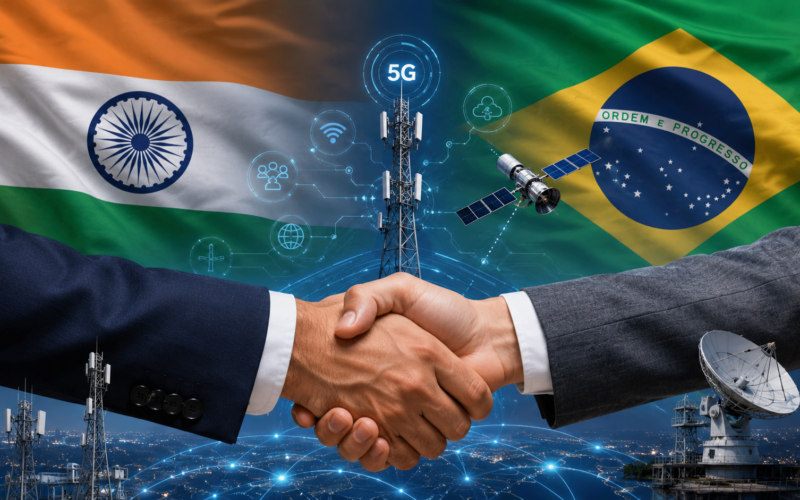
India and Brazil have signed a memorandum of understanding establishing a broad bilateral framework for telecommunications and information and communication technologies, bringing 5G, 6G, Open RAN, Internet of Things, direct-to-device connectivity, low Earth orbit satellites, non-terrestrial networks and submarine cables inside a single cooperation mechanism. Indian Communications Minister Jyotiraditya M. Scindia and Brazilian Communications Minister Frederico de Siqueira Filho signed the agreement on August 21 on the sidelines of the BRICS ICT Track meeting in Pune. The framework also includes artificial intelligence, spectrum and satellite-orbit management, cybersecurity, private networks, digital infrastructure, consumer protection and universal connectivity. No investment value, procurement commitment, implementation budget or project deadline was disclosed, making the agreement a policy and technology-cooperation framework rather than an immediate telecom contract.
The breadth of the agreement is notable because it combines conventional connectivity infrastructure with several technologies that could shape the next generation of telecom networks. India and Brazil can use the framework to exchange information, regulatory experience and technical practices while exploring joint opportunities, but the commercial significance will depend on whether the discussions eventually produce trials, standards cooperation, vendor partnerships or physical infrastructure investment.
Why are India and Brazil putting 5G, 6G, Open RAN and satellite connectivity in one framework?
Telecommunications architecture is becoming less dependent on a single type of network. A future user may connect through terrestrial 5G or 6G in one location, private enterprise infrastructure in another, and a low Earth orbit satellite network when terrestrial coverage becomes unavailable. Open RAN attempts to make parts of the radio-access network more interoperable, while direct-to-device satellite technology is designed to extend connectivity directly to conventional or near-conventional mobile devices.
Bringing these technologies under one bilateral framework allows regulatory and technical discussions to develop together rather than as isolated workstreams. Spectrum policy, for example, affects terrestrial mobile networks, satellite connectivity and direct-to-device services simultaneously. Open RAN deployment can depend on interoperability standards and testing, while non-terrestrial networks require coordination around satellite systems and spectrum use.
India and Brazil are also large countries where universal connectivity cannot be addressed purely by adding conventional urban mobile sites. A combination of fibre, mobile networks and satellite systems can therefore have greater relevance than any one technology in isolation. The agreement does not determine which architecture either country will ultimately favour, but it creates a formal channel for sharing deployment and policy experience across those options.

Could the India-Brazil pact create opportunities for Open RAN and telecom equipment suppliers?
Open RAN is one of the more commercially interesting areas included in the memorandum because it attempts to reduce dependence on tightly integrated radio-access systems supplied by a single vendor. In principle, more open interfaces can allow carriers to combine hardware and software from different suppliers, although real-world interoperability, performance and cost remain central challenges.
If India and Brazil move from policy cooperation toward joint testing, standards work or operator trials, telecom equipment manufacturers and software suppliers could gain opportunities across radio units, baseband software, network orchestration and testing. The memorandum itself does not award business to any vendor, and no participating companies were named. Any assumption about future contract winners would therefore be premature.
The same applies to 6G. Commercial 6G networks are not being created by this agreement, but regulatory coordination before standards and spectrum frameworks mature can influence how easily equipment and services eventually operate across jurisdictions. Early government-to-government cooperation can become commercially important when companies later attempt to export telecom products into markets that use compatible technical frameworks.
Why do LEO satellites and direct-to-device connectivity have strategic importance for both countries?
Low Earth orbit satellite systems and direct-to-device services can fill coverage gaps where terrestrial infrastructure is difficult or expensive to build. The India-Brazil memorandum specifically includes LEO satellites, non-terrestrial networks, direct-to-device connectivity and satellite-orbit management, showing that satellite communications are being treated as part of mainstream telecom planning rather than as an entirely separate industry.
This creates several layers of policy coordination. Regulators need to determine how satellite spectrum is allocated, how foreign and domestic operators gain market access, how interference is managed and how satellite networks interact with terrestrial mobile services. Direct-to-device connectivity adds another layer because satellite operators increasingly want to use spectrum that interacts directly with consumer handsets.
For India and Brazil, better coordination could eventually support rural connectivity, disaster resilience and communications in geographically difficult areas. The commercial opportunity will depend on national licensing decisions and operator strategies, neither of which was settled by the August memorandum.
Why are optical fibre and submarine cables still central in a pact filled with emerging technologies?
Satellite systems may attract more attention, but most global digital traffic ultimately depends on fibre. Submarine cables carry enormous quantities of international data between regions, while terrestrial optical networks connect data centres, mobile towers, enterprises and broadband customers. The India-Brazil agreement explicitly includes both optical fibre and submarine cables alongside newer technologies.
That combination reflects a broader reality in digital infrastructure: AI applications, cloud services and 6G networks cannot scale merely by improving wireless access. Traffic still has to move between compute clusters, countries and networks, and international connectivity becomes increasingly important as data-centre and cloud capacity expands.
Submarine-cable cooperation could eventually encompass resilience, landing infrastructure, investment frameworks or new international routes, although the memorandum does not identify a specific cable project. Any future infrastructure announcement would therefore represent a separate commercial milestone rather than implementation already guaranteed by the current agreement.
What does the India-Brazil ICT memorandum actually commit the two governments to do?
The memorandum establishes a framework for exchanging information, experience and best practices and for exploring opportunities based on equality, mutual benefit and mutual respect. It also covers capacity building, digital inclusion, consumer protection, cybersecurity and the environmental impact of information and communication technologies.
What it does not contain is equally important. There is no disclosed spending commitment, no telecom-equipment procurement, no spectrum award, no 6G deployment timetable and no named commercial consortium. The agreement should therefore be viewed as an institutional foundation from which more specific initiatives may emerge.
Its value will become measurable only when follow-on activity appears. Joint pilot networks, coordinated research programmes, standards initiatives, operator partnerships, subsea-cable projects, spectrum arrangements or direct-to-device trials would demonstrate that the framework is producing commercial and technical outcomes.
How does the agreement fit into India’s 2026 BRICS technology agenda?
The memorandum was signed during the BRICS ICT Track hosted in Pune from August 17 to August 21 under India’s 2026 BRICS chairship. The broader programme focused on resilient ICT ecosystems, cybersecurity, digital skills, emerging network technologies, innovation and cooperation among member countries.
India’s bilateral deal with Brazil converts some of those multilateral themes into a country-to-country framework. Rather than limiting cooperation to BRICS-level declarations, the two governments now have a mechanism through which telecom regulators and policymakers can pursue more detailed engagement across areas ranging from Open RAN to satellite systems.
The next stage will determine whether that framework becomes commercially significant. If it produces concrete infrastructure, research or standards initiatives, the agreement could strengthen technology links between two of the largest digital markets in the Global South. Without those follow-on steps, it will remain broad diplomatic architecture covering an impressive list of technologies but carrying limited immediate financial consequence.
Discover more from Business-News-Today.com
Subscribe to get the latest posts sent to your email.