




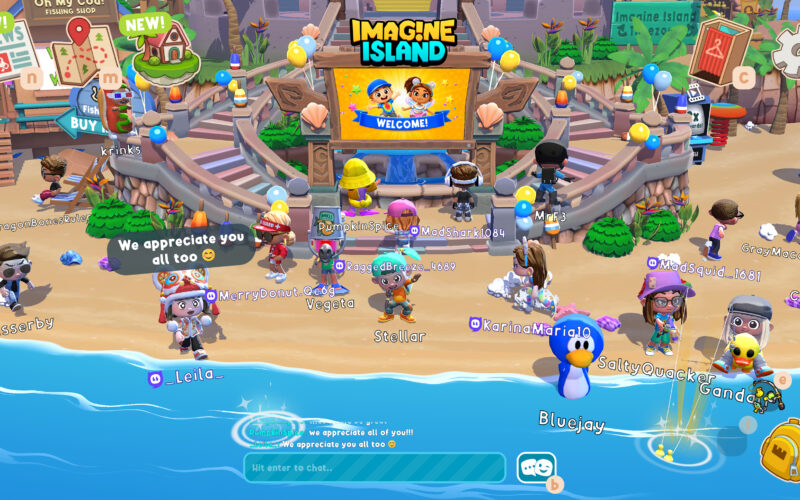
Magic Potion Games has taken its children-focused online world Imagine Island out of beta after attracting more than one million players, giving the privately held gaming studio an unusually visible proof point as it prepares to expand the platform with new entertainment partnerships, creator tools and a paid membership model. The company said the beta audience was generated without paid marketing, while a newly completed Series A financing has added capital and gaming-industry backing for the next stage of development. Imagine Island is designed primarily for children aged 6 to 13 and combines social gameplay with live moderation, privacy protections and age-appropriate communication features. The strategic question now changes substantially: reaching one million players demonstrates discovery and initial demand, but the more difficult test is whether Magic Potion Games can retain those users, deepen engagement and introduce recurring revenue without weakening the trust-based positioning that helped differentiate the platform in the first place.
The August 20 announcement is therefore more significant than a conventional beta graduation. Magic Potion Games is moving from proving that families will try Imagine Island to proving that a relatively small independent studio can operate a persistent children’s social world at increasing scale, maintain a demanding safety infrastructure, support a growing content cadence and build a commercially viable subscription business at the same time. Those objectives reinforce one another when execution works, but they can also create tension because richer social features, user-generated content and commercial expansion all increase operational complexity.
Why does reaching one million Imagine Island players matter more when the growth came without paid marketing?
Magic Potion Games said Imagine Island welcomed more than one million players during its beta period entirely through organic growth and without paid marketing. For an emerging consumer gaming product, that distinction matters because paid user acquisition can make an audience number look considerably stronger than the underlying product economics. Organic discovery does not by itself prove retention or profitability, but it can suggest that recommendations, platform distribution, community interest and product-market curiosity are generating acquisition without the studio having to continuously purchase traffic.
There is also evidence that the disclosed audience expanded relatively quickly during 2026. Magic Potion Games was publicly discussing more than 500,000 Imagine Island players around its browser distribution push earlier this year, while its August announcement places cumulative participation above one million. That implies the disclosed player base has roughly doubled within several months, although the available figures are cumulative player counts rather than daily or monthly active users and therefore should not be interpreted as a direct measure of ongoing engagement.
That distinction will become increasingly important after beta. A million people trying a game is a distribution milestone. A meaningful percentage returning repeatedly, creating content, inviting friends and eventually convincing parents that a membership is worth renewing is a business model. Magic Potion Games has not disclosed retention rates, daily active users, monthly active users, average session duration or payer conversion, leaving those metrics as the most important missing evidence behind the headline audience number.
The company’s browser-first accessibility could nevertheless support continued low-friction acquisition. Imagine Island can currently be played through compatible desktop and mobile web browsers, removing the need for a conventional console or large application download. For younger audiences moving between tablets, phones and computers, reducing that installation barrier can improve discoverability and make links shared between families and friends more useful as an acquisition channel.
How is Magic Potion Games changing Imagine Island from a free beta into a recurring-revenue platform?
The commercial model provides one of the clearest indications that Imagine Island is entering a materially different phase. When Magic Potion Games introduced the title in 2024, it highlighted that Imagine Island was free to play, carried no advertising and had no in-game purchases. The company’s current plan retains free access but adds an optional membership intended to unlock additional virtual items, building tools, in-game currency and premium experiences.
That shift is strategically logical. Persistent online worlds require continuous spending on developers, artists, servers, moderation, customer support, privacy compliance and fresh content. An indefinitely free product without advertising or meaningful purchases eventually requires either continuing external financing or a revenue model. Subscription-style membership gives Magic Potion Games an opportunity to create recurring revenue without depending primarily on repeated microtransactions aimed at children.
The membership proposition is deliberately being framed around predictability for parents. Magic Potion Games says it wants one recurring payment to provide access to additional content rather than continually encouraging users to make incremental purchases. Its membership materials currently describe benefits including exclusive outfits and virtual items, premium building kits for player-created Home Islands and additional quantities of the game’s Candy currency. The studio has not yet publicly established the conversion rate or revenue economics that would demonstrate whether families accept that proposition at scale.
That makes membership conversion one of the most important future indicators for the company. Too little premium differentiation could produce weak conversion because families may be satisfied with the free experience. Too much restriction could have the opposite problem, making the free world feel incomplete and undermining the accessibility that supported organic adoption. Magic Potion Games therefore has to construct a fairly delicate economic boundary where paying members perceive substantial value while free users continue to regard Imagine Island as a complete and welcoming environment.

Can Imagine Island turn child safety into a competitive advantage as larger gaming platforms strengthen protections?
Magic Potion Games has positioned safety as part of the product architecture rather than an additional parental-control layer. Imagine Island incorporates live moderation, age-appropriate social functionality and privacy protections, while the company has previously identified k-ID and Microsoft’s Community Sift among its safety technology partners. The platform’s parental controls include the ability to manage children’s communication settings, and Magic Potion Games says safety features will remain available regardless of whether a family purchases membership.
The timing is significant because child safety is rapidly becoming less of an optional differentiator and more of a competitive requirement across online gaming. Roblox Corporation, the much larger platform against which any new children’s social world will inevitably be compared, rolled out Roblox Kids and Roblox Select accounts globally in June 2026, combining age checks, age-based content access, communication controls and additional review requirements for experiences offered to younger users.
Regulatory expectations are also moving. Amendments to the United States Children’s Online Privacy Protection Rule became effective in 2025, with most regulated entities required to comply with the revised provisions by April 22, 2026. That means platforms serving children are operating in an environment where privacy design, parental consent, data handling and age-appropriate functionality are increasingly intertwined with product development rather than being matters that can be addressed after scale has already arrived.
For Imagine Island, this creates both an opportunity and an execution burden. A smaller platform designed around children’s safety from inception may be able to avoid some of the architectural compromises encountered when broad social platforms retrofit protections onto larger ecosystems. The trade-off is that live moderation and closely managed social interaction can become operationally expensive as participation grows, particularly once creator tools allow users to produce more of the environments and experiences that other children encounter.
Why could creator tools and major children’s franchises become Imagine Island’s most important growth engines?
Magic Potion Games plans to introduce several entertainment partnerships later in 2026 involving what it described as major children’s franchises. The company has not yet named those franchises, so their commercial significance cannot be assessed until specific partners, content rights and launch structures are disclosed. The strategy is nevertheless important because recognisable intellectual property could lower acquisition friction dramatically by giving children a reason to enter Imagine Island even before they have developed familiarity with the platform’s original world.
Licensed content could also provide Magic Potion Games with recurring events rather than isolated promotional moments. A children’s franchise can become a themed environment, a set of virtual items, quests, social events or creator assets, allowing the platform to reuse licensed intellectual property across multiple engagement loops. That model could help Imagine Island build a predictable content calendar while giving entertainment partners access to a child-oriented digital environment that emphasises controlled interactions.
Creator tools may ultimately be even more consequential. Persistent online platforms become harder to scale when every meaningful experience must be produced internally. Allowing users to build Home Islands or other creative spaces can expand the content supply without requiring Magic Potion Games to manufacture every playable environment itself.
The economics are attractive, but moderation requirements rise in parallel. User-generated worlds can introduce inappropriate imagery, language, behaviour or design patterns even when the platform’s original content is tightly controlled. Magic Potion Games therefore needs creator functionality to expand creativity faster than it expands moderation risk and operating cost. That balance will determine whether Imagine Island evolves into a genuine platform or remains primarily a professionally developed online game with social and construction features.
What does the new Series A financing reveal about Magic Potion Games’ ambitions for Imagine Island?
Magic Potion Games said it has completed a Series A financing, although the August 20 announcement did not disclose the amount raised or the company’s valuation. The financing expands a backer group that includes Square Enix, 1AM Gaming, 1Up Ventures and Konvoy, while Gregory Milken, founder and managing partner of 1AM Gaming, is joining the Magic Potion Games board alongside Konvoy general partner Josh Chapman. Alex Seropian, the founder of Bungie, and Club Penguin co-founder Lane Merrifield have also been advising the company.
That combination of investors and advisers gives Magic Potion Games considerable gaming-industry experience relative to its current scale, but the financing should principally be viewed as additional execution capacity rather than validation that the business model has already succeeded. The capital will have to support product development, moderation infrastructure, entertainment licensing, creator functionality and commercial expansion before the company can demonstrate whether its early user growth translates into sustainable economics.
The undisclosed financing amount also limits any meaningful assessment of runway. Without knowing the size of the Series A, current cash burn or the financial commitments associated with forthcoming content partnerships, it is not possible to determine how aggressively Magic Potion Games can expand or how soon another financing event might eventually be required. What the round does provide is a clearer signal that investors are prepared to finance the platform beyond the experimental beta stage.
What evidence would show that Imagine Island is becoming a durable Gen Alpha gaming platform?
The post-beta case now depends less on headline downloads or cumulative registrations and more on measurable engagement quality. Repeat usage, monthly active players, retention by cohort, time spent creating rather than simply visiting, membership conversion and renewal rates would reveal whether Imagine Island is developing the network effects required for a persistent social platform.
The entertainment partnerships scheduled for later in 2026 provide another test. If recognised franchises generate temporary traffic followed by weak retention, they may function primarily as acquisition campaigns. If those launches create continuing communities, user-generated worlds and paying households, they could become a repeatable distribution model capable of extending Imagine Island well beyond the audience reached during beta.
Magic Potion Games has already cleared an important initial hurdle by demonstrating that a new children’s browser world can attract more than one million players without paid advertising. What remains unresolved is whether that audience contains enough repeat engagement and parental willingness to pay to finance a continuously moderated, content-rich social environment. The next meaningful proof point will therefore not simply be the next cumulative player milestone; it will be evidence that organic acquisition is converting into durable participation and recurring membership revenue without compromising the safety proposition on which Imagine Island is being built.
Key takeaways on Magic Potion Games and Imagine Island after the one-million-player beta milestone
- Imagine Island attracted more than one million players during beta, which Magic Potion Games says came without paid marketing.
- The company has completed a Series A financing, although the amount and valuation were not disclosed.
- Imagine Island is moving from beta validation toward a commercial phase built around optional recurring memberships.
- The platform originally launched without ads or in-game purchases, making the new membership model a significant evolution in monetisation.
- Magic Potion Games plans major entertainment partnerships, additional gameplay, creator tools and community events later in 2026.
- Safety remains central to Imagine Island’s differentiation through live moderation, privacy protections and age-appropriate social features.
- Larger competitors are also increasing age-based protections, which means child safety is becoming an industry requirement as well as a potential competitive advantage.
- The one-million-player figure demonstrates acquisition but does not reveal active-user retention, engagement or membership conversion.
- Creator tools could reduce the company’s dependence on internally produced content, while simultaneously increasing moderation requirements.
- The strongest future evidence of commercial traction would be sustained active-user growth, membership renewals and successful retention following licensed entertainment launches.
Discover more from Business-News-Today.com
Subscribe to get the latest posts sent to your email.

