International Business Machines Corporation (NYSE: IBM) has finalised a $1 billion research and development award from the United States Department of Commerce for Anderon, its newly created quantum semiconductor manufacturing subsidiary. IBM is separately committing approximately $1 billion of its own capital to the venture, creating a combined public-private commitment of roughly $2 billion around a dedicated 300-millimetre quantum wafer foundry in Albany, New York.
Anderon has already begun processing its first quantum wafers, meaning the initiative is moving beyond a proposed factory. The business is being designed as a pure-play foundry available to customers across the quantum ecosystem rather than solely as an internal fabrication operation for IBM’s own quantum computers.
Why does quantum computing need a dedicated semiconductor foundry?
Quantum computing has historically been dominated by research questions: how to create better qubits, reduce error rates and demonstrate algorithms capable of outperforming conventional machines. As the technology matures, manufacturing consistency becomes equally important.
A laboratory can produce a small number of experimental processors through highly customised processes. Commercial quantum computing requires repeatable fabrication capable of producing many wafers with predictable performance.
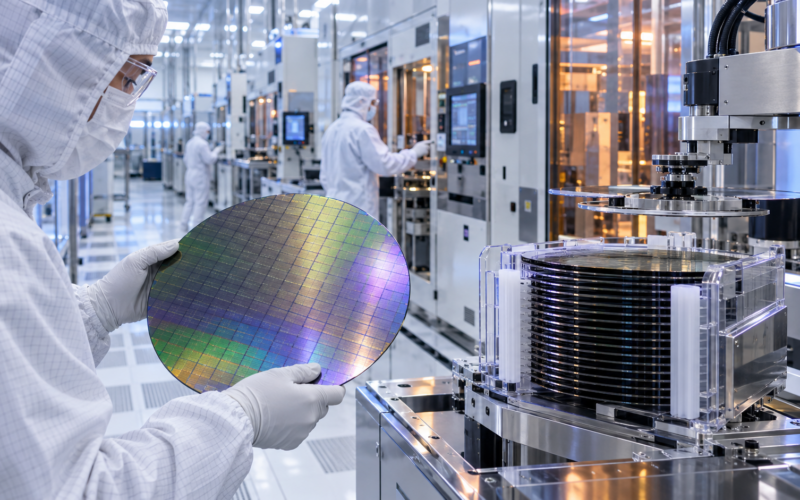
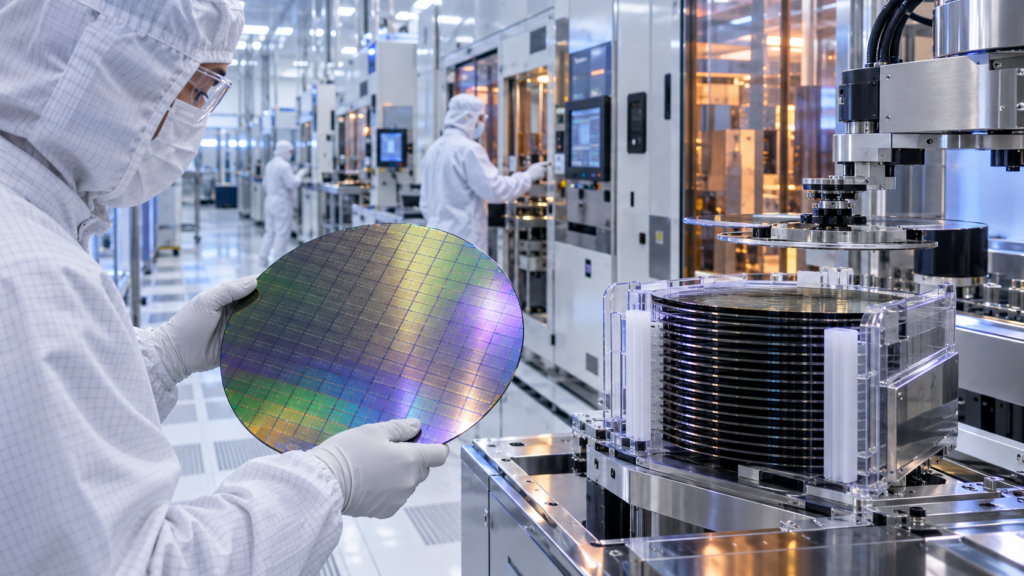
Anderon is intended to close that gap. The 300-millimetre facility will manufacture specialised wafers supporting superconducting qubit arrays, quantum input-output signalling and readout components. IBM says the foundry could later support additional quantum architectures beyond its initial technologies.
This changes the competitive question from who can demonstrate the most impressive laboratory device to who can manufacture quantum hardware reliably enough for larger systems.
That is a transition the conventional semiconductor industry went through decades ago.
Why is IBM separating Anderon rather than keeping the foundry entirely inside IBM Research?
A pure-play structure allows the foundry to serve competing quantum-computing developers rather than functioning only as an IBM manufacturing department. That could create an independent commercial platform around manufacturing expertise even if the quantum market ultimately contains several successful processor architectures.
IBM remains deeply involved. It is contributing approximately $1 billion in cash as well as intellectual property, physical assets and skilled personnel, while the government funding accelerates research and manufacturing scale.
The model resembles traditional semiconductor foundries in which manufacturing capacity becomes valuable separately from chip design.
If quantum computing eventually develops an ecosystem containing dozens of hardware companies, universities and specialised technology developers, a neutral fabrication platform could capture business from customers that cannot economically construct advanced factories themselves.
That would give IBM exposure to the growth of the overall quantum ecosystem rather than only to sales of IBM-branded machines.
How does the $2 billion foundry fit IBM’s much larger quantum investment plan?
The Anderon commitment is part of a broader IBM strategy rather than an isolated government-supported project. IBM announced in May that it plans to invest more than $10 billion over five years toward developing large-scale quantum computing, covering research, manufacturing, partnerships and potential acquisitions.
IBM has also diversified its underlying quantum technology strategy. Its acquisition of HRL Laboratories added expertise in spin-based qubits alongside IBM’s longstanding work on superconducting quantum circuits. The company intends eventually to transfer relevant production from HRL’s California operations into IBM’s New York manufacturing ecosystem.
That suggests IBM no longer wants to depend on a single technical pathway. Quantum computing remains sufficiently immature that several architectures could ultimately prove commercially useful.
A foundry capable of supporting multiple approaches becomes strategically valuable under that uncertainty.
How large is the opportunity if quantum computing eventually reaches commercial scale?
IBM and the United States Department of Commerce have cited estimates suggesting the quantum industry could eventually generate hundreds of billions of dollars of economic value. Such long-range estimates should be treated cautiously because useful fault-tolerant quantum computing has not yet reached widespread commercial deployment.
The obstacles remain substantial. Quantum systems must maintain fragile states, correct errors and scale the number of usable qubits without introducing so much noise that additional hardware becomes counterproductive.
Manufacturing consistency will not solve every one of those problems, but it becomes increasingly important as systems scale.
The investment thesis behind Anderon is consequently analogous to building semiconductor infrastructure before mass-market demand is completely visible. If quantum adoption accelerates, manufacturing can become a bottleneck. If technological progress takes considerably longer, the foundry may operate below the scale implied by current investment.
Can IBM afford such large long-term technology investments while its core business grows slowly?
IBM reported second-quarter 2026 revenue of $17.2 billion, up approximately 1% year over year, while free cash flow for the quarter reached $2.54 billion. For the first half of 2026, free cash flow totaled approximately $4.76 billion.
The business mix remains uneven. Software revenue increased 5%, consulting was roughly flat and infrastructure revenue fell 7%. IBM also ended the second quarter with approximately $62 billion of total debt including IBM Financing debt, while completing $10.5 billion of acquisitions during the first half.
Quantum investments therefore compete for capital with acquisitions, dividends, artificial intelligence and hybrid-cloud development. IBM can finance the programme, but investors will eventually need evidence that research spending produces economically meaningful businesses.
The government award reduces IBM’s direct funding burden and effectively shares some technology-development risk with the public sector.
Why did IBM shares fall despite finalisation of the $1 billion award?
IBM shares closed September 16 at approximately $237.49, down about 4.4% for the session. The broader US market was also pressured after the Federal Reserve increased interest rates, and the government award had previously been outlined through a May letter of intent, meaning finalisation was not an entirely new $1 billion surprise for investors.
The stock movement therefore should not be treated as a referendum on quantum computing alone. IBM shares had already faced pressure in 2026 as investors digested slower core revenue growth and infrastructure weakness.
The real test for Anderon will take years rather than trading sessions.
Investors should watch customer announcements, wafer volumes, additional capital partners and evidence that IBM can translate quantum hardware development into commercially deployable systems.
The quantum race is still being fought over scientific performance. Anderon represents IBM’s bet that the next phase will increasingly be fought over manufacturing scale.
Discover more from Business-News-Today.com
Subscribe to get the latest posts sent to your email.