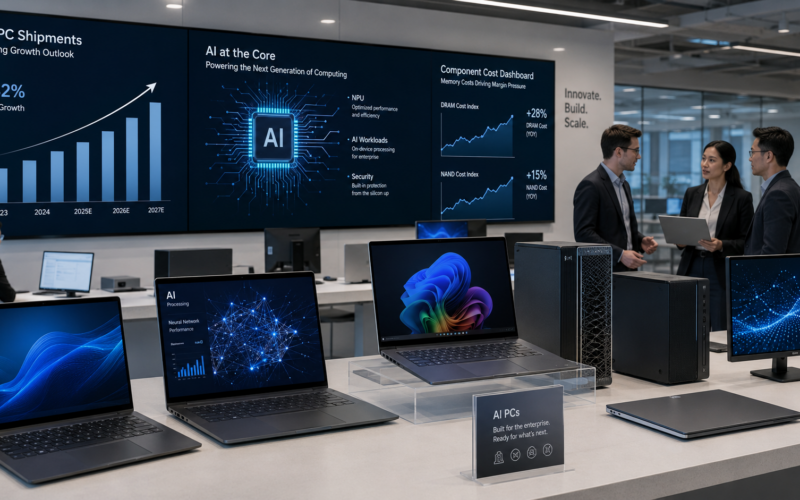
HP Inc. (NYSE: HPQ) reported stronger fiscal second quarter revenue and adjusted earnings as AI PCs and the Windows 11 refresh cycle lifted demand across its Personal Systems business. The Palo Alto-based company posted second quarter net revenue of $14.4 billion, up 9.0 percent from the prior-year period, while non-GAAP diluted earnings per share rose 21 percent to $0.86. HP Inc. guided fiscal 2026 non-GAAP diluted earnings per share to a range of $2.90 to $3.10 and said AI PCs could represent 60 percent to 70 percent of total shipments next fiscal year. The strategic question for HPQ investors is whether AI PC adoption can offset higher memory costs, softer second-half PC demand, and the long-term drag from a mature printing business.
Why did HP Inc.’s Q2 earnings beat still leave investors focused on margin pressure?
HP Inc.’s second quarter looked strong on the surface. Revenue came in ahead of expectations, adjusted earnings beat estimates, Personal Systems revenue accelerated, and cash flow improved sharply from the prior-year period. The company also benefited from a stronger commercial PC refresh cycle as businesses prepare for the end of Windows 10 support, which has pushed many enterprises to replace ageing devices rather than stretch hardware life further.
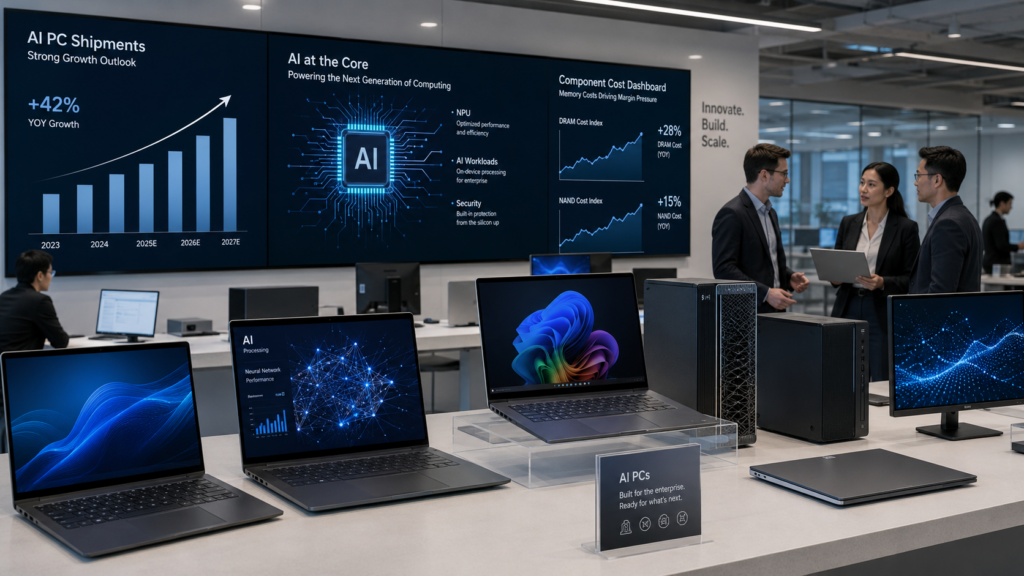
The reason investor reaction remains more complicated is that HP Inc.’s beat came with a tighter earnings outlook. Fiscal 2026 non-GAAP earnings guidance of $2.90 to $3.10 was strong enough to show operating resilience, but it also removed the previous upper-end room that investors had hoped might expand after a revenue beat. That matters because HP Inc. is not a high-multiple software story where revenue acceleration alone can carry sentiment. It is a hardware-led company where gross margin, component cost discipline, working capital, and capital returns do a lot of the valuation heavy lifting.
The pressure point is memory. AI data center demand has tightened global memory supply and lifted component costs across the broader technology hardware chain. HP Inc. is trying to manage that through product reconfiguration, supplier actions, pricing, and higher-margin mix. However, cost inflation in a competitive PC market can be difficult to pass through cleanly. When customers are excited about AI PCs but not necessarily excited about paying much more for them, the margin math becomes a little less cinematic.
How important is AI PC adoption to HP Inc.’s future growth strategy?
AI PC adoption is now the core upside argument for HP Inc. because it gives the company a credible replacement-cycle narrative in a category that has often looked mature. HP Inc. said AI PCs represented 44 percent of total PC shipments in the second quarter, up from more than 35 percent in the previous quarter. The company expects AI PCs to account for 60 percent to 70 percent of shipments in fiscal 2027 and more than 70 percent by fiscal 2028.
That is strategically significant because AI PCs give HP Inc. a reason to push premium configurations, higher memory content, better processors, more secure endpoint devices, and commercial productivity use cases. Enterprises are not simply buying laptops for basic refresh needs. They are increasingly evaluating whether local AI processing can support productivity tools, security features, collaboration workflows, device management, and employee experience improvements. This creates an opening for HP Inc. to defend pricing in a category where commoditisation has historically been brutal.
The risk is that AI PC adoption may become a volume story before it becomes a margin story. If AI PCs quickly become the new baseline, HP Inc. may ship more premium-like devices while competition pulls pricing down. Lenovo Group Limited, Dell Technologies Inc., Apple Inc., and other device makers are all chasing the same upgrade cycle. HP Inc. therefore needs to show that AI PC demand supports better unit economics, not just a shinier label on the next corporate laptop order.
What does the Windows 11 refresh cycle mean for HP Inc.’s commercial PC business?
The Windows 11 refresh cycle is giving HP Inc. a timely demand tailwind. Many enterprises delayed PC upgrades after the pandemic-era hardware boom, but the end of Windows 10 support is forcing chief information officers to address device fleets, security standards, compatibility requirements, and employee productivity needs. That creates a cleaner commercial replacement cycle, especially in large organisations with disciplined IT refresh schedules.
For HP Inc., this matters because commercial PCs usually carry better strategic value than purely consumer-driven volume. Commercial customers often buy in larger batches, attach services, prioritise security and manageability, and evaluate total cost of ownership rather than sticker price alone. That gives HP Inc. more room to position AI PCs as part of a managed endpoint strategy, not just a hardware sale. It also aligns with the company’s broader push around intelligent devices, edge AI, connected work experiences, and workforce productivity.
The second-order risk is timing. A refresh cycle can boost near-term shipments, but it can also pull forward demand. If enterprises complete major upgrades over the next few quarters, HP Inc. will need AI-enabled use cases to sustain momentum beyond the replacement wave. The company has a window to convert refresh demand into deeper customer relationships, but the window will not stay open forever. PC cycles have a nasty habit of looking permanent right before procurement teams go quiet again.
Why are memory costs becoming a bigger issue for HP Inc. and the broader PC industry?
Memory costs are becoming one of the most important variables in the HP Inc. earnings story because the artificial intelligence boom is pulling supply toward higher-value data center applications. As hyperscalers and server manufacturers consume more advanced memory for AI infrastructure, PC makers are facing tighter availability and higher input costs. That creates an uncomfortable irony for HP Inc.: the same AI cycle that is creating demand for AI PCs is also making some of the components needed for those devices more expensive.
HP Inc. can respond in several ways. It can redesign configurations, source alternative components, pursue supplier commitments, push pricing, prioritise premium products, and use operational efficiency to absorb part of the cost. The company has already signalled that it expects operating margins to bottom out before improving in fiscal 2027, which suggests management sees the current cost environment as painful but manageable.
The risk is that the PC market may not allow full cost pass-through. Consumers remain price-sensitive, small businesses are cautious, and large enterprises negotiate aggressively. If memory prices stay elevated, HP Inc. may have to choose between protecting volumes and protecting margins. That is not a fun boardroom menu. The better outcome would be a stabilisation in memory pricing while AI PC demand continues to scale, allowing HP Inc. to benefit from premium mix without losing too much margin to suppliers.
How does HP Inc.’s printing business affect the broader $HPQ earnings story?
HP Inc.’s printing business remains important because it contributes cash flow and profit stability, even though it no longer carries the same growth excitement as AI PCs. In the second quarter, printing revenue was broadly stable, giving investors a reminder that HP Inc. is not only a PC cycle story. Printing still supports the company’s ability to return capital, invest in new categories, and maintain dividend appeal.
However, printing is also a structural constraint on the valuation narrative. The market does not typically assign high growth multiples to mature printing businesses, especially when supplies trends, hybrid work patterns, enterprise print volumes, and hardware replacement cycles remain uneven. HP Inc. has tried to offset this with subscriptions, managed print services, industrial graphics, and AI-powered workflow features, but investors still tend to view printing as a cash-generating segment rather than a major growth engine.
The strategic role of printing is therefore defensive but useful. It can help HP Inc. fund innovation, absorb cyclical pressure, and support shareholder returns. What it cannot do is carry the long-term growth story by itself. For HPQ to rerate meaningfully, the market will need to believe that AI PCs, commercial device refresh, services, and edge AI can create enough growth to outweigh the maturity of printing.
What does current HPQ stock performance suggest about investor sentiment after the Q2 beat?
HP Inc. shares recently traded around $25.04, down about 1.8 percent from the previous close, with an intraday range between $24.66 and $26.64. The stock’s 52-week range is roughly $17.56 to $29.55, placing HPQ above its lows but still below the upper end of its annual trading band. The company’s market capitalisation was recently around $23.3 billion, while its price-to-earnings ratio was near 9.5.
That valuation tells a fairly clear story. Investors are not pricing HP Inc. like a broken business, but they are also not treating AI PCs as a transformational growth engine yet. The stock still reflects a mature hardware company with cyclical exposure, input-cost risk, and a dividend-supported shareholder return profile. The recent rally into earnings showed optimism around AI PCs and the Windows 11 refresh cycle, but the post-results caution shows investors are still watching margins closely.
Sentiment is best described as cautiously constructive. Bulls can point to revenue acceleration, AI PC mix improvement, commercial refresh demand, free cash flow, and valuation support. Bears can point to memory inflation, narrowed guidance, potential second-half PC market softness, and limited printing growth. HP Inc. has improved the narrative, but it has not yet escaped the hardware-sector rulebook: revenue is nice, margins pay the rent.
What should investors watch next as HP Inc. tries to turn AI PC momentum into durable earnings?
The first metric to watch is AI PC mix. If AI PCs continue rising as a share of shipments and support stronger average selling prices, HP Inc. can argue that the category is improving the economics of the PC business. If AI PCs simply become standard configurations without pricing power, the benefit may be more limited. Shipment mix alone is useful, but gross margin will tell the real story.
The second metric is Personal Systems operating margin. That will show whether HP Inc. can manage the cost shock from memory and other components while competing against Lenovo Group Limited, Dell Technologies Inc., Apple Inc., and other PC vendors. Investors should watch whether management’s expectation of margin bottoming proves realistic, especially if the second-half PC market softens.
The third metric is free cash flow. HP Inc. projected fiscal 2026 free cash flow of about $2.8 billion to $3.0 billion, which matters because capital returns remain a key reason many investors own HPQ. Dividend support and share repurchases can help stabilise sentiment, but they depend on cash generation. If AI PC growth, margin repair, and free cash flow line up, HP Inc. can make a stronger case that this is more than a temporary PC refresh trade.
Key takeaways on what HP Inc.’s Q2 results mean for $HPQ, AI PCs and the PC hardware market
- HP Inc.’s second quarter results showed stronger revenue and adjusted earnings, but investors remain focused on whether margin pressure will limit upside.
- AI PCs are becoming a material part of HP Inc.’s shipment mix, rising to 44 percent of total PC shipments in the second quarter.
- HP Inc. expects AI PCs to reach 60 percent to 70 percent of shipments in fiscal 2027, making the category central to the HPQ investment case.
- The Windows 11 refresh cycle is helping commercial PC demand, but investors must watch whether this pulls forward future replacement activity.
- Memory cost inflation is the main risk to HP Inc.’s near-term margin recovery because AI infrastructure demand is tightening component supply.
- HP Inc.’s printing business continues to provide cash flow support, but it is unlikely to drive a major valuation rerating by itself.
- HPQ stock still trades like a mature hardware company despite AI PC optimism, with valuation anchored by margin risk and cyclical demand concerns.
- Free cash flow guidance remains important because dividends and buybacks are central to HP Inc.’s shareholder return appeal.
- Competitive pressure from Lenovo Group Limited, Dell Technologies Inc., Apple Inc., and other PC vendors could limit pricing power in AI PCs.
- The next phase of the HPQ story depends on whether AI PCs improve unit economics, not merely shipment headlines.
Discover more from Business-News-Today.com
Subscribe to get the latest posts sent to your email.