




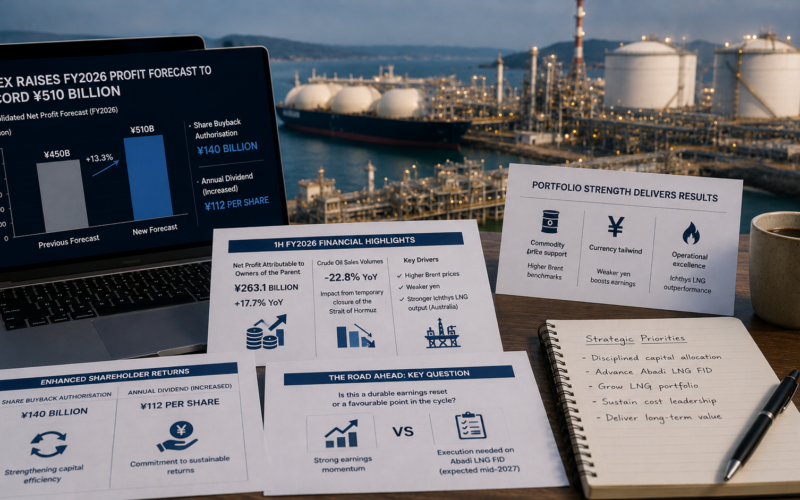
Inpex Corporation (TSE:1605), Japan’s largest oil and gas explorer and producer, has raised its full-year 2026 consolidated net profit forecast to a record ¥510 billion from ¥450 billion previously, alongside a ¥140 billion share buyback authorisation and a lifted annual dividend of ¥112 per share. First-half net profit attributable to owners of the parent reached ¥263.1 billion, up 17.7 percent year-on-year, despite crude oil sales volumes falling 22.8 percent during the temporary closure of the Strait of Hormuz. Higher Brent benchmark assumptions, a weaker yen and stronger-than-expected output from the Ichthys LNG project in Australia more than offset the volume loss. President Takayuki Ueda described the outcome as a portfolio victory and said the current share price does not reflect the company’s growth potential, framing the buyback as a direct response. The immediate question is whether the enhanced returns and lifted guidance mark a durable earnings reset for Inpex, or whether they capture a favourable point in the commodity and currency cycle that must still be converted into progress on the Abadi LNG final investment decision now expected around mid-2027.
How does Inpex’s record first-half profit reset the base earnings picture despite the Hormuz volume shock this year?
The most striking feature of Inpex’s interim disclosure is that a record profit was delivered with materially lower physical crude sales. The 22.8 percent contraction in oil sales volumes reflects the temporary closure of the Strait of Hormuz during the earlier Middle East conflict, which disrupted liftings from Inpex’s Abu Dhabi interests. In previous cycles, that scale of volume loss would have been very difficult to absorb. This time, the combination of a higher Brent price assumption, a weaker yen against the US dollar and stable production at the Ichthys LNG project in Australia was sufficient to lift interim earnings by 17.7 percent to ¥263.1 billion.
The full-year net profit range now anchored at ¥510 billion is roughly 13 percent above the previous ¥450 billion guidance and, based on the company’s own communication, on track to be the highest annual result Inpex has ever reported. Management has been explicit that the guidance is presented in ranges to accommodate ongoing Middle East and market volatility, which is an important editorial signal. It means the ¥510 billion figure should be read as a mid-case forecast rather than a floor, and any renewed disruption to Gulf traffic or a sharp reversal in the yen would push realised earnings lower even if operational output holds. For a listed producer whose earnings sensitivity to Brent and to the yen has historically been well telegraphed to the market, that framing is a form of internal discipline rather than a hedge against under-delivery.
Why does the ¥140 billion buyback and dividend increase signal a real shift in Inpex’s capital return philosophy?
The ¥140 billion repurchase authorisation covers up to 50 million common shares, roughly 4.3 percent of the outstanding share count excluding treasury shares, and will be executed on the Tokyo Stock Exchange between 10 August and 31 December 2026. That programme sits on top of an annual dividend lifted to ¥112 per share, an increase of ¥12 from the prior year. It also follows the earlier ¥100 billion authorisation approved in late 2025, which was substantially completed by early 2026. Taken together, Inpex is now running one of the more assertive capital-return programmes among Asian integrated energy producers.
The strategic message is more important than the headline yen figure. For much of the past decade, Inpex was defined by its capital intensity, with Ichthys absorbing tens of billions of US dollars and the Abadi project in Indonesia adding a second heavy commitment in the pipeline. By committing to a larger buyback while simultaneously advancing engineering procurement and construction tendering on Abadi, management is signalling that it can fund the next growth cycle from operating cash flow without curtailing shareholder returns. That is a credible position only if the current earnings trajectory holds and if Abadi’s cost profile does not escalate materially between the mid-2027 final investment decision and first LNG. Any slippage in either variable would force the company to reweight between distributions and project spend.
There is also a valuation motivation. Ueda’s comment that the current share price does not reflect the company’s growth potential is unusually direct for a Japanese major. In practice, it aligns the buyback authorisation with the classic textbook rationale for buying back shares at what management believes is a discount to intrinsic value. Whether that view proves correct is a separate question, but the intent is clearly communicated.
What does stronger-than-planned Ichthys LNG output mean for Inpex’s cash generation and the portfolio thesis?
The Ichthys LNG project in Australia is the operational cornerstone of the upgraded guidance. Inpex has said it now expects the facility to exceed its previous 2026 production guidance, with an average of approximately 10 cargoes per month across the year. That implies more than 120 cargoes in 2026, a level that reflects sustained plant availability at both liquefaction trains after several years of debottlenecking and reliability investment.
The commercial significance is greater than the volume figure alone suggests. Ichthys sells the majority of its LNG under long-term contracts predominantly linked to oil-indexed pricing formulas, which means the current higher Brent assumption feeds directly through into realised LNG revenue with a modest lag. Simultaneously, the weaker yen inflates the yen value of dollar-denominated LNG receipts. That double lever is central to the ¥510 billion earnings picture and helps explain why the record first-half result was possible even with lower oil liftings.
The portfolio implication is that Inpex’s earnings profile is becoming less tied to spot Middle East crude cargoes and more tied to sustained LNG offtake from Australia. That is the shift Ueda referred to when he described the interim result as a portfolio victory. It is genuine, although it should not be overstated. The Abu Dhabi interests remain a material contributor when Gulf traffic is normal, and any prolonged reduction in Ichthys reliability would still expose Inpex to a concentration risk that the buyback and dividend cannot offset.
How does the mid-2027 Abadi LNG final investment decision fit into Inpex’s next growth cycle?
Inpex has confirmed that the final investment decision on the Abadi LNG project in Indonesia is now expected around mid-2027, and that EPC tendering began in July with two consortia in contention for the primary construction package. The project has a long pre-history and was previously reshaped from a floating LNG design into an onshore development. Its return to active tendering marks the point at which capital commitments start to translate into contracted contractor scopes, which is a decisive step before final sanction.
For Inpex, the strategic value of Abadi is that it extends the LNG platform beyond Ichthys and creates a second large operated LNG position with direct exposure to Asian demand. Management has previously indicated a nameplate output of around 9.5 million tons per annum, and disclosures around the recent earnings call suggest that a heads of agreement covering a portion of that output has been discussed. The commercial marketing progress will be as important as engineering progress in shaping the final investment case.
There are two risks to keep clearly separate. The first is timing. A final investment decision expected in the middle of 2027 is a firm but not certain milestone, and any delay would push first LNG further into the next decade. The second is cost. Inpex has not disclosed a final capital cost estimate, and the current EPC selection process is precisely where the industry has historically learned whether early cost expectations are realistic. Investors watching the buyback and dividend should keep the Abadi cost outcome in view as the swing variable for medium-term capital allocation.
What does the Middle East exposure reveal about Inpex’s real portfolio diversification?
The 22.8 percent decline in first-half crude oil sales volumes is a useful stress test of Inpex’s diversification claims. The volume loss was not the result of reservoir underperformance or asset problems in Abu Dhabi, but of the closure of the Strait of Hormuz during the earlier US-Iran confrontation. The Strait was subsequently reopened following the memorandum of understanding signed in June, and the Energy Information Administration has since indicated an expectation that most of the shut-in crude production will return to near pre-conflict averages by the end of 2026, with the remainder online in the first quarter of 2027.
That timeline is broadly consistent with Inpex’s decision to raise its full-year forecast rather than adopt a defensive posture. It also underscores that the company’s operational exposure to Gulf routes is real but manageable when Ichthys is running at planned levels. If the Hormuz corridor comes under renewed pressure, the earnings composition would tilt further towards the Australian LNG stream, which is precisely why management can present the buyback and dividend at the same time as maintaining growth commitments. In a genuine sustained shock, however, Inpex would still face lower realised Abu Dhabi volumes and would need to demonstrate that Ichthys production and long-term LNG contract deliveries can carry a larger share of the earnings base.

Why does management believe the share price undervalues Inpex, and what would validate that view for the market?
Inpex shares have traded in a broad range in recent months. The stock has moved between roughly ¥3,300 and ¥3,700 in the summer trading window, well below the 52-week high near ¥4,955 recorded earlier in the cycle. On a trailing basis, the shares carry a modest price-to-earnings ratio around 10 to 11 times and a dividend yield close to three percent based on the previous payout, which will move higher as the ¥112 dividend is applied. Analyst price targets have moved up alongside the guidance revision, with published estimates in the ¥4,000 to ¥4,200 range from independent research providers, although a single point of consensus should not be inferred from a small sample.
Management’s argument that the market undervalues the company implicitly rests on three points. First, that the current earnings base at ¥510 billion is durable rather than a cyclical peak. Second, that Ichthys reliability is embedded rather than opportunistic. Third, that Abadi will move forward without a cost outcome that resets the whole return profile. Each of those points is defensible on the current disclosures, and none is independently proven at this stage. A sustained rerating in the shares would likely require Inpex to demonstrate at the next reporting cycle that the higher earnings run rate is holding without further help from the Brent assumption, and that Abadi’s EPC selection has narrowed cost uncertainty rather than widened it. Business News Today notes that share-price direction from here is closely tied to how markets weigh these operational proof points against ongoing commodity and currency assumptions, rather than to the buyback flow alone.
What are the main execution and market risks that could unwind the upgraded 2026 outlook for Inpex shareholders?
The clearest risk is a reversal in the two macro variables that have been most supportive during the first half. If Brent retreats materially from the assumed range, or if the yen strengthens against the US dollar, the guidance mid-case would come under pressure even without any operational disruption. The EIA’s most recent short-term energy outlook already anticipates a lower average Brent price for the remainder of 2026 than the peaks seen earlier in the year, which is one reason Inpex has expressed the forecast in ranges.
The second risk is geopolitical. The Strait of Hormuz has reopened under the June memorandum of understanding, but the underlying tensions in the Gulf are not resolved. A renewed disruption during the second half would repeat the volume shock and, this time, could coincide with less favourable pricing. The third risk is project execution at Abadi. A cost estimate materially above earlier internal assumptions would force a re-examination of the current cash-return posture, and any timing slip in the final investment decision would push first cash flow further out.
The fourth risk is one Inpex controls least directly. Northern Territory environmental proceedings previously brought against the Ichthys joint venture over Darwin emissions reporting remain a background item, and while they do not appear central to the current guidance, they illustrate the residual regulatory exposure that any long-duration LNG operator carries. None of these risks individually threaten the guidance, but they are the variables to watch.
What has improved for Inpex, what remains unresolved, and what is the next measurable proof point for the market?
The first-half result and the upgraded guidance materially strengthen Inpex’s near-term financial narrative. The record interim profit, the buyback and the higher dividend collectively deliver a coherent shareholder-return message that is unusual in scale for a Japanese energy major. The Ichthys production upgrade adds operational credibility to the earnings base.
What remains unresolved is the durability of the underlying macro assumptions and the Abadi capital picture. The next measurable proof point will be the third-quarter update, which will show whether the higher earnings run rate is holding as Abu Dhabi volumes normalise and whether the buyback pace is tracking the stated December end date. Beyond that, the EPC selection outcome on Abadi and any further heads-of-agreement announcements on marketed volumes will indicate whether Inpex is closing the gap between its own view of intrinsic value and where the market has been prepared to price the shares.
Key takeaways for investors tracking Inpex Corporation and the Japanese LNG sector
- Inpex raised its 2026 full-year net profit forecast to a record ¥510 billion from ¥450 billion, alongside a lifted annual dividend of ¥112 per share and a ¥140 billion buyback authorisation.
- First-half net profit reached ¥263.1 billion, up 17.7 percent year-on-year, despite a 22.8 percent decline in crude oil sales volumes tied to the temporary Strait of Hormuz closure.
- The Ichthys LNG project in Australia is now expected to exceed prior 2026 production guidance, with roughly 10 cargoes per month implying more than 120 cargoes across the year.
- Higher Brent assumptions and a weaker yen were the primary macro drivers of the earnings upgrade, presented in ranges to reflect ongoing Middle East and market volatility.
- The ¥140 billion buyback covers up to 50 million shares, or about 4.3 percent of outstanding shares excluding treasury, to be executed between 10 August and 31 December 2026.
- President Takayuki Ueda said the current share price does not reflect the company’s growth potential, framing the buyback as a response to a perceived valuation gap.
- Abadi LNG in Indonesia is now targeting a final investment decision around mid-2027, with EPC tendering already active between two consortia and initial marketing discussions under way.
- The main risks to the upgraded outlook are a reversal in Brent or yen assumptions, renewed Gulf disruption, and any cost or timing slippage on the Abadi project.
- Independent analyst fair-value estimates have moved higher toward the ¥4,000 to ¥4,200 range, above the summer trading band, although a single consensus should not be inferred from a small research sample.
- The next measurable proof point is the third-quarter update, which will test whether the higher earnings run rate is holding as Gulf volumes recover and buyback execution progresses.
Discover more from Business-News-Today.com
Subscribe to get the latest posts sent to your email.

