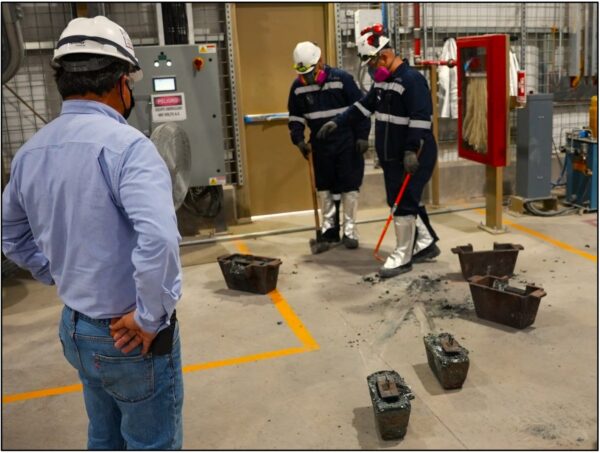


Fulcrum Metals plc (AIM: FMET), a technology-led AIM-listed company targeting the recovery of precious and critical metals from historic mine tailings in Ontario, Canada, has delivered preliminary Phase 3 metallurgical results at its flagship Teck-Hughes project in Kirkland Lake that materially improve its investment case at a moment when gold is trading around US$4,720 per ounce. The preliminary results, produced in collaboration with process technology partner Extrakt Process Solutions LLC, confirmed gold and silver recoveries exceeding 70% using a cyanide-free leach approach, with the programme now extended to finalise optimised recovery rates and to incorporate additional critical metals including gallium and tellurium. The results follow the completion of a 159-hole auger drilling campaign at Teck-Hughes that has increased the average gold equivalent grade at the project to above 0.7g/t, an 8% upgrade on the previous estimate, setting the stage for a maiden 43-101-compliant mineral resource estimate in the months ahead. With the conceptual pre-tax NPV for Teck-Hughes estimated at US$33 million on a US$2,899/oz gold price baseline, the combination of enhanced recovery rates, a rising gold price, a multi-metal co-product profile, and the upcoming maiden resource positions Fulcrum Metals at a particularly sensitive inflection point for investors monitoring the AIM junior mining space.
How does cyanide-free leach technology change the economics of historic gold tailings projects in Ontario?
The strategic logic behind Fulcrum Metals sits at an intersection most junior explorers cannot access: turning legacy environmental liabilities into near-term production assets without the regulatory, reputational, and capital burden associated with conventional cyanide-based processing. Extrakt Process Solutions’ proprietary TNS technology recovers precious and critical metals from refractory ore through a non-cyanide leach process with leach times as low as six hours. For Teck-Hughes, that means Fulcrum can advance through feasibility stages without triggering the full suite of environmental approvals that a greenfield mine in Ontario’s Kirkland Lake camp would require.
The Kirkland Lake region carries historical gold production of over 110 million ounces across more than 70 documented legacy waste sites over the past century, making it one of the most concentrated inventories of reprocessable tailings on the continent. Fulcrum’s exclusive master licence agreement with Extrakt covers gold mine waste sites across the Timmins and Kirkland Lake mining districts, giving the company rights over a substantial portion of that inventory. The focus at this stage is on Teck-Hughes and the adjacent Sylvanite project, but the broader territorial exclusivity represents a pipeline that most comparably sized AIM juniors simply do not have access to.
Phase 2 conceptual study economics from March 2025 anchored the Teck-Hughes investment case at a pre-tax NPV7.5 of US$33 million, based on 2,000 tonnes per day throughput, a 59.4% gold recovery rate, a six-hour leach time, and a gold price assumption of US$2,899 per ounce. Every one of those inputs has since moved in Fulcrum’s favour. Gold has nearly doubled the study’s price assumption. Recovery rates in Phase 3 preliminary testing have already exceeded 70%, with further optimisation ongoing. The leach programme extension is designed to lock in those gains and incorporate gallium and tellurium into the recoverable asset base, both of which are classified by Canada as critical minerals essential to the global energy transition. The Phase 4 preliminary feasibility study that follows will be running these numbers into a materially different commodity and technical environment than the Phase 2 study assumed.

What does the 159-hole auger drilling campaign at Teck-Hughes tell investors about the maiden mineral resource estimate?
The completion of the expanded 159-hole auger drilling campaign at Teck-Hughes, announced in December 2025, represents the most comprehensive delineation work the project has undergone in recent history. Initial photon gold assays from the first 94 holes returned gold grades averaging 0.65g/t from surface, with best intersections of 1.62g/t over 0.8 metres and average hole results of 1.02g/t over 4.75 metres. Samples from the full 159-hole programme have been submitted to Actlab for comparative gold fire assay and ICP-MS ultratrace multi-element analysis, incorporating silver, gallium, and tellurium alongside the standard gold assay.
The 8% increase in average gold equivalent grade, to above 0.7g/t, announced in January 2026 alongside the updated corporate presentation is not a trivial number. A prior non-compliant resource estimate over the Teck-Hughes tailings placed contained gold at approximately 138,460 ounces across 6.53 million tonnes at 0.66g/t. Even before the current optimised assay set is complete, the grade uplift combined with the expanded drilling footprint suggests the maiden 43-101-compliant mineral resource estimate will be positioned at or above that historical baseline. An MRE that materially exceeds 100,000 ounces of gold equivalent, at a gold price above US$4,000 per ounce, would give Fulcrum Metals a number around which institutional attention could plausibly coalesce for the first time.
The company has engaged WSP Canada to advise on environmental and engineering permitting strategies across Teck-Hughes and Sylvanite, a quietly significant development. Permitting engagement at this stage, running parallel to the resource estimate process, signals that Fulcrum Metals management is building towards a production-readiness timeline rather than treating the MRE as an end in itself. Investors who have watched AIM junior mining stories stall between resource estimate and development often cite the permitting gap as the key delay. Fulcrum’s decision to address this simultaneously with the resource work reduces that risk vector, even if it does not eliminate it.
Why does the critical minerals angle at Teck-Hughes matter for Fulcrum Metals beyond the gold price story?
The identification of gallium and tellurium within the Teck-Hughes and Sylvanite tailings in April 2025 added a dimension to the Fulcrum Metals story that goes well beyond precious metal recovery. Gallium is a key input in semiconductor manufacturing, used in compound semiconductors, radio frequency chips, and solar cells. Tellurium is essential for cadmium telluride thin-film solar panels, a technology that has gained significant commercial ground in utility-scale solar deployment. Both elements are on Canada’s critical minerals list, which unlocks access to a range of federal support mechanisms and, more practically, positions the company within policy narratives around supply chain security and domestic critical mineral production that carry weight with a specific class of investor and partner.
The commercial significance of gallium and tellurium as co-products at Teck-Hughes depends entirely on whether Phase 3 extended leach testing delivers recoverable quantities that are material relative to project economics. Fulcrum Metals has not yet released assay data for these elements from the full 159-hole programme. What is already clear is that recovering these metals as by-products of a gold and silver leach process carries near-zero additional cost at the margin. If gallium and tellurium grades are confirmed at commercially meaningful levels, the effective gold equivalent price for the project’s recoverable inventory increases substantially, and the story transitions from a gold tailings play to a multi-metal critical minerals project, a classification that attracts a different and typically deeper pool of institutional capital.
How does gold trading above US$4,700 per ounce reshape the Fulcrum Metals NPV and competitive positioning among AIM juniors?
The Phase 2 conceptual study sensitivity analysis, published in March 2025, demonstrated that a 25% increase in the gold price from the US$2,899 base assumption would materially move the project NPV. Gold has since moved approximately 63% above that assumption, reaching around US$4,720 per ounce at the time of writing. The sensitivity analysis is no longer hypothetical. Running current gold prices through the Phase 2 framework, while acknowledging that a formal restatement awaits the Phase 4 PFS, implies a conceptual NPV substantially north of the US$33 million baseline figure. Chief Executive Ryan Mee acknowledged as much in the December 2025 announcement, noting that the combination of improved recovery rates and gold above US$4,000 per ounce has the potential to justify significant increases in Fulcrum’s headline NPV for Teck-Hughes.
For context, gold hit a record high above US$5,600 per ounce in late January 2026 before pulling back sharply in March. It now trades around US$4,720 per ounce, down approximately 17% from peak but still dramatically above any assumption embedded in Fulcrum’s existing study work. Wells Fargo Investment Institute has set a year-end 2026 gold price target of US$6,100 to US$6,300 per ounce, representing potential upside of roughly 30% to 35% from current levels. Whether or not that target is reached, the structural drivers behind gold’s recent run, including central bank accumulation, geopolitical risk, and dollar uncertainty, show no sign of resolution in the near term. For a pre-revenue junior with project economics tied directly to the gold price, the macro backdrop is about as favourable as it gets.
The broader AIM junior gold space has benefited from this environment. Investors who have been underweight small-cap gold explorers relative to the senior producers have had reason to rotate, and Kirkland Lake as a name carries historical weight that resonates with resource-literate retail investors. The challenge for Fulcrum Metals is translating that macro tailwind into share price performance at a time when the stock, trading around 3.75p to 4.65p on the London market, remains well below its 52-week high of 15p and has underperformed the FTSE All Share index significantly over the past year. The market has to date applied a substantial discount to Fulcrum Metals relative to its technical newsflow, which is not unusual for pre-resource AIM juniors with thin coverage and no revenue. The maiden MRE is the catalyst most likely to compress that discount.
What does the Tully Gold Project divestment to Loyalist Exploration tell investors about Fulcrum Metals’ capital allocation strategy?
The sale of the Tully Gold Project to Loyalist Exploration Limited (CSE: PNGC) and the associated strategic repositioning provides a useful lens on how Fulcrum Metals management thinks about portfolio focus and balance sheet risk. The transaction, which closed in October 2025, generated CA$500,000 in cash consideration, an equity stake of 19.99% in Loyalist valued at approximately CA$3.5 million as of January 2026, and a 2.0% net smelter return royalty on the Tully project. Fulcrum also retains milestone-linked additional consideration, including further Loyalist shares upon Tully’s resource being restated above 200,000 ounces and a production decision.
The structure achieves two things simultaneously. It removes the capital burden of advancing a conventional hard rock exploration project in Timmins, which would have competed for management bandwidth and cash with the tailings strategy, while preserving meaningful economic upside through the royalty and equity stake. Loyalist has engaged environmental consultants to advance permitting work at Tully, a project with a historical resource of approximately 107,000 ounces at high grade, suggesting the asset is moving forward rather than sitting dormant. For Fulcrum Metals shareholders, the arrangement converts a cash-consuming exploration asset into a royalty and equity position that generates upside without ongoing expenditure.
In February 2026, Fulcrum Metals raised approximately £980,000 through a warrant acceleration exercise, with proceeds directed towards ongoing development work across its tailings assets including a pilot scoping study and advancing the maiden MRE. The total issued share capital post-exercise stands at 142,130,752 ordinary shares. At a price of 4.65p, that implies a market capitalisation of approximately £3 million, a figure that is strikingly compressed relative to both the company’s technical newsflow and the macro environment for gold. The Tully divestment effectively pre-funded a portion of the upcoming work programme without diluting shareholders through a discounted equity placing.
What are the execution risks investors should monitor as Fulcrum Metals advances towards a Phase 4 feasibility study at Teck-Hughes?
The Fulcrum Metals investment case is analytically coherent but carries a well-understood set of execution risks that any serious investor must price. The first is resource risk. Preliminary Phase 3 results have delivered gold and silver recoveries above 70% in optimised leach conditions, but final test work data has not yet been released. If the extended leach programme returns lower-than-expected recovery rates for gallium, tellurium, or silver in the full programme, or if gold recovery rates in the final results do not hold at the preliminary levels, the economics of the Phase 4 PFS will be weakened before it is even commissioned.
The second risk is the resource estimate itself. A maiden MRE that disappoints in terms of contained ounces, grade, or classification, particularly one that falls materially short of the implied historical baseline of approximately 138,000 contained ounces, would be a negative catalyst rather than the positive inflection the company and its followers are anticipating. The assay results from the full 159-hole programme, not yet published in their entirety at the time of writing, will be the key input. Investors should pay close attention to the ICP-MS multi-element data when it is released, as it will be the first indication of whether the critical minerals thesis has quantitative substance behind it.
The third risk is the gold price itself. Fulcrum Metals has no hedging capacity at this stage, and project economics are fully exposed to spot gold. A sustained fall in the gold price towards the US$3,000 to US$3,500 range would materially compress the NPV uplift the current environment has created, and at a market capitalisation of around £3 million, any deterioration in macro sentiment towards gold juniors would hit liquidity and shareholder returns quickly. The fourth risk is financing. A Phase 4 PFS and subsequent development will require capital well beyond the current balance sheet. How management structures that raise, and at what price relative to any disclosed resource value, will determine whether the next round of newsflow creates or destroys shareholder value.
How is the market pricing Fulcrum Metals relative to its technical progress and the current gold price environment?
Fulcrum Metals shares are trading around 3.75p to 4.65p on AIM as of the time of writing, against a 52-week high of 15p and a consensus analyst target price of approximately 32.89p, according to data from Stockopedia. The implied upside to consensus target is substantial, at over 600% from recent lows, but such figures carry limited weight for a pre-revenue micro-cap without institutional sponsorship across multiple sell-side firms. There is no formal broker consensus available on the stock, and the thin liquidity profile means the share price can move sharply on relatively small volumes in either direction.
The warrant acceleration exercise completed in February 2026, at 5p per warrant, generated just under £1 million in aggregate proceeds and produced a nominal floor reference for shareholder base expectations. That 5p exercise price sits above the current market price, which means warrant holders who exercised are underwater on their investment, and the warrants outstanding at 10p until August 2027 represent potential future dilution if the share price recovers sufficiently. The market is, in the most straightforward terms, discounting the technical progress Fulcrum Metals has delivered and waiting for hard resource data before re-rating. The AIM market has seen enough pre-MRE gold stories to be appropriately sceptical of claims that precede an MRE. If the maiden resource delivers, the re-rating case is straightforward. If it disappoints, the share price is likely to reflect the downgrade quickly.
It is worth noting that retail investor community coverage of Fulcrum Metals through platforms such as Share Talk is active and has been tracking the company’s milestones closely. That coverage, while not institutional in nature, contributes to retail liquidity and narrows the information gap that typically penalises small AIM juniors. Social amplification of the critical minerals narrative, combined with gold at multi-year highs, gives Fulcrum Metals an unusually accessible retail thesis in addition to the technical investment case.
Key takeaways: What the Fulcrum Metals Phase 3 results and MRE milestone mean for investors, peers, and the AIM mining sector
- Phase 3 preliminary metallurgical testing at Teck-Hughes has confirmed cyanide-free gold and silver recoveries above 70%, materially above the 59.4% baseline used in the March 2025 Phase 2 conceptual study, with the extended programme targeting further optimisation and critical metals incorporation.
- The 159-hole auger drilling campaign is complete and full assay results are pending. An 8% increase in average gold equivalent grade to above 0.7g/t has been confirmed, setting up a maiden 43-101-compliant MRE that will be the company’s most significant value-defining event to date.
- Gold trading around US$4,720 per ounce is approximately 63% above the price assumption embedded in the Phase 2 NPV study. If sustained or extended towards the US$6,100 to US$6,300 range targeted by Wells Fargo Investment Institute, the implied economics of the Phase 4 PFS will be substantially stronger than any prior public estimate.
- Gallium and tellurium have been identified in the Teck-Hughes and Sylvanite tailings. Both are Canadian-designated critical minerals. If ICP-MS multi-element assay results confirm commercially meaningful grades, the project transitions from a gold tailings story to a multi-commodity critical minerals asset, accessing a different and deeper investor audience.
- The Tully Gold Project divestment to Loyalist Exploration converted a capital-intensive exploration asset into CA$500,000 cash, a 19.99% equity stake valued at approximately CA$3.5 million, a 2% NSR royalty, and milestone-linked upside. This capital allocation decision reduces management distraction and pre-funds work programme costs without a discounted equity raise.
- Fulcrum Metals has engaged WSP Canada on permitting strategy at Teck-Hughes and Sylvanite in parallel with the resource estimate process, addressing a critical execution gap that has delayed comparable AIM junior stories at similar stages.
- At a market capitalisation of approximately £3 million and a share price around 3.75p to 4.65p against a 52-week high of 15p, Fulcrum Metals is priced as though the market is waiting for MRE confirmation before engaging. The consensus analyst target of approximately 32.89p implies multi-hundred percent upside that will only be tested against actual resource data.
- Key execution risks include: final Phase 3 leach results not holding at the 70% preliminary level; a maiden MRE that fails to meet or exceed the historical non-compliant estimate of approximately 138,460 contained ounces; gold price deterioration compressing project economics; and the financing terms required for Phase 4 development.
- Fulcrum Metals holds exclusive Extrakt technology licences across over 70 documented legacy waste sites in the Timmins and Kirkland Lake districts. If Teck-Hughes and Sylvanite advance to production, the licence framework provides a ready-made pipeline of subsequent projects that no competitor can replicate without a new commercial arrangement.
- The confluence of green mining credentials, critical mineral exposure, gold near multi-year highs, a pending maiden MRE, and a valuation that implies near-zero attribution to any of these factors makes Fulcrum Metals one of the more analytically interesting micro-cap AIM situations in the current precious metals cycle.
Discover more from Business-News-Today.com
Subscribe to get the latest posts sent to your email.