



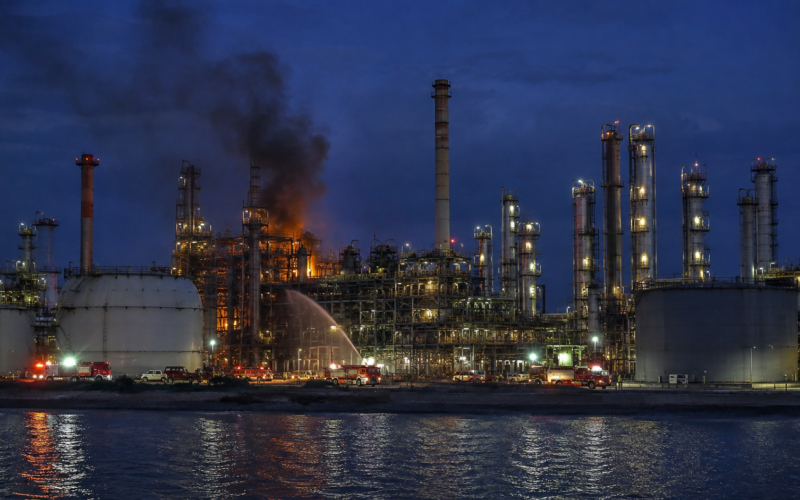
Yemen’s Iran-aligned Houthi movement has launched a drone attack against Saudi Aramco’s Jazan refinery in southwestern Saudi Arabia while simultaneously escalating missile and drone strikes against Yemen’s government-held Mocha port, creating the first major security test for the new Saudi Arabia-Türkiye-Pakistan mutual defence agreement signed on August 7.
Saudi Arabia’s Energy Ministry confirmed that a fire broke out at a facility belonging to the Jazan refinery before being extinguished without reported injuries. The ministry did not publicly attribute the incident, but Houthi military spokesperson Yahya Saree said the group had used a drone to attack the refinery in response to what he described as Saudi drone incursions over Yemen. The Jazan facility can process approximately 400,000 barrels of crude oil per day, making it an important part of Saudi Arabia’s refining system on the Red Sea side of the kingdom.
The timing gives the attack much greater geopolitical significance than another isolated Houthi strike. Saudi Arabia, Türkiye and Pakistan signed a mutual defence agreement only two days earlier stipulating that an armed attack against one of the three countries would be considered an attack against all. The agreement was designed to strengthen collective deterrence as Saudi infrastructure faces growing threats linked to the wider United States-Israel war with Iran.
Neither Ankara nor Islamabad had publicly indicated by early August 10 whether the Jazan attack would trigger any formal consultation or military response under the new pact. Turkish Foreign Minister Hakan Fidan had already emphasised when the agreement was signed that the alliance was not directed against Iran or any other specific country and that the three states would determine the degree and form of assistance through consultations if one member came under attack.
Why does the Houthi attack on Saudi Aramco’s Jazan refinery matter beyond the immediate fire?
The operational damage reported at Jazan appears limited so far, with Saudi authorities saying the fire was extinguished and no injuries recorded. The strategic significance comes instead from the refinery’s location, capacity and role in an energy network increasingly exposed to regional warfare.
Jazan lies on Saudi Arabia’s Red Sea coast, geographically removed from the Strait of Hormuz. That matters because Riyadh has been relying more heavily on western export and processing infrastructure as conflict with Iran and attacks on Gulf shipping have reduced confidence in normal tanker movements through Hormuz. The kingdom’s Red Sea system therefore provides a partial strategic alternative when eastern export routes become disrupted.
The Houthis have repeatedly targeted Saudi oil infrastructure in Jazan and Yanbu, demonstrating that moving energy activity towards the Red Sea does not eliminate security risk. Instead, Saudi Arabia increasingly faces pressure on both sides of the kingdom: Iranian and Iran-linked threats around the Gulf and Strait of Hormuz, and Houthi missile and drone capabilities along the Red Sea and Yemen frontier.
That dual-front vulnerability helps explain Riyadh’s decision to deepen defence cooperation with Türkiye and Pakistan rather than depend exclusively on its traditional United States security relationship.

How does the August 9 strike test the Saudi Arabia-Türkiye-Pakistan mutual defence pact?
The trilateral agreement signed on August 7 contains unusually strong language for a regional security partnership. Pakistan’s Foreign Ministry said the pact regards an armed attack against any one of the three countries as an attack against them all, placing the framework conceptually closer to a collective defence arrangement than a conventional memorandum on military cooperation.
The Houthi attack now raises the obvious question of what that commitment means in practice. Riyadh could request intelligence assistance, air-defence support, surveillance cooperation, logistics, training or more direct military contributions, but nothing in the public statements surrounding the pact requires an automatic armed response whenever Saudi infrastructure is attacked.
Türkiye brings NATO’s second-largest military, an expanding drone and missile industry and significant air-defence expertise. Pakistan contributes one of the Muslim world’s largest armed forces, a nuclear deterrent and decades of security cooperation with Saudi Arabia. The political symbolism of those capabilities is considerable, but deterrence ultimately depends on whether potential attackers believe the three countries will coordinate meaningfully during an actual crisis.
The Jazan incident therefore represents an early credibility test. If Riyadh invokes the agreement in some form and Ankara and Islamabad visibly assist, the pact could quickly become a substantive component of Gulf security. If the response remains largely rhetorical, adversaries may conclude that the collective-defence language is narrower than it first appeared.
Why are the Houthis attacking Saudi Arabia again after years of reduced cross-border fighting?
The current escalation is closely tied to the wider regional war involving Iran, Israel and the United States.
The Houthis declared a naval blockade against Saudi Arabia in July, arguing that Riyadh was participating in what they described as a siege of Yemen. Saudi Arabia rejects that allegation and has accused the group of threatening civilian and commercial infrastructure while attempting to extend Iran’s regional pressure campaign into the Red Sea.
Houthi forces have since targeted oil tankers, Saudi energy installations and military positions. On August 5, the group said it launched missile attacks against Saudi-linked oil tankers in both the Red Sea and Gulf of Aden, although Saudi Arabia did not confirm those particular claims.
The latest Jazan strike follows attacks on Saudi-backed military camps in Yemen and on the Najran region of Saudi Arabia, where 11 civilians were wounded last week. Together, the incidents show that the relative restraint established after the 2022 Yemen truce is deteriorating rapidly.
Saudi Arabia has attempted for several years to reduce its direct exposure to the Yemen war. The new sequence of strikes now creates pressure on Riyadh to decide whether continued restraint remains viable when Houthi attacks are extending towards oil infrastructure and civilian areas.
What happened at Mocha port and why is the Red Sea location strategically important?
The Saudi refinery strike was accompanied by a larger Houthi assault on Mocha, the government-held port city on Yemen’s Red Sea coast.
Yemeni government-aligned forces said missiles and drones hit the port and surrounding areas, killing at least seven people, including four troops and three civilians, while injuring another 15 civilians. Yemen’s Transport Ministry said the attack caused severe damage to port buildings, piers, commercial goods and food supplies.
Mocha has become increasingly important because it is controlled by forces aligned with Yemen’s internationally recognised government and has been renovated to handle shipping that avoids the Houthi-held port of Hodeida. The city is also close to the Bab el-Mandeb Strait, one of the most important maritime gateways connecting the Red Sea with the Gulf of Aden and Indian Ocean.
The Bab el-Mandeb route carries heightened importance for Saudi Arabia because disruption in the Strait of Hormuz has forced Gulf exporters and international energy markets to focus more closely on alternative Red Sea infrastructure. If Houthi operations threaten both Saudi Red Sea facilities and ports near Bab el-Mandeb, the kingdom’s ability to bypass Hormuz becomes less secure.
That is why the Mocha and Jazan attacks should be considered together rather than as unrelated incidents. Both target the geographic system supporting Saudi Arabia’s western energy and maritime resilience.
Could the Houthis close Bab el-Mandeb and trap Saudi oil exports between two threatened chokepoints?
Completely closing Bab el-Mandeb would be difficult, particularly because regional and international naval forces have the capability to intervene. However, maritime disruption does not require a legally or militarily complete blockade.
Shipping companies respond to risk. Repeated missile and drone attacks can drive up war-risk insurance premiums, force vessels to reroute, discourage crews and owners from transiting contested waters and increase freight rates even when the physical channel technically remains open.
Saudi Arabia has already faced this dynamic around Hormuz, where uncertainty about Iranian restrictions has distorted energy flows. Brent crude rose to around $84.46 per barrel in early Monday trading as markets reconsidered expectations that an Iran-Oman shipping arrangement would quickly reopen the strait.
If Bab el-Mandeb becomes simultaneously less reliable, the market problem changes from disruption at one chokepoint to pressure on both of Saudi Arabia’s principal maritime orientations. That would increase the strategic importance of pipelines, storage capacity and coordinated naval protection.
The Houthis understand this leverage. Even attacks causing limited physical damage can generate disproportionate economic consequences when they target the infrastructure and sea lanes on which global energy trade depends.
Why could the renewed Yemen fighting threaten the fragile post-2022 truce?
Yemen’s civil war never reached a comprehensive political settlement. The 2022 truce sharply reduced major fighting, but it left the Houthis controlling Sanaa and much of northern Yemen while the internationally recognised government and allied factions retained territory across the south and east.
The latest attacks are eroding that uneasy balance.
The Houthis have carried out coordinated missile and drone strikes against government military positions, Saudi territory and now Mocha. Yemeni government forces have responded militarily, increasing the possibility of a cycle in which retaliation gradually expands into sustained frontline warfare.
Rashad al-Alimi, head of Yemen’s Saudi-backed Presidential Leadership Council, has urged the international community and particularly the United States to move beyond containing Houthi attacks and address what he described as their underlying sources and military instruments.
That language suggests the government may increasingly favour stronger military pressure if international diplomacy fails to halt the attacks. The risk is that a campaign originally connected to the wider Iran war could reopen Yemen’s domestic conflict on a much larger scale.
Such an escalation would place civilians, ports, energy infrastructure and humanitarian supply routes under renewed pressure across a country already deeply damaged by more than a decade of conflict.
Could Türkiye or Pakistan become directly involved in defending Saudi Arabia?
Direct combat involvement remains possible but is far from automatic.
Türkiye has emphasised that the new pact is a general security arrangement rather than an alliance aimed specifically at Iran or the Houthis. Hakan Fidan said the three governments would consult and determine the type and scale of assistance required if one member faced aggression.
That flexibility allows several levels of response. Türkiye could contribute drone detection, electronic warfare, air-defence systems or intelligence without deploying combat forces. Pakistan could increase training, military personnel, aircraft or surveillance cooperation without becoming directly involved in operations inside Yemen.
For Islamabad, involvement would require careful diplomacy because Pakistan maintains relations with Iran and has traditionally tried to avoid becoming fully embedded in Saudi-Iranian rivalry. Türkiye faces a similar balancing problem because Ankara also maintains diplomatic and commercial channels with Tehran.
The most likely initial use of the pact may therefore be defensive integration rather than immediate offensive action. Joint radar coverage, drone interception, maritime surveillance and intelligence sharing could strengthen Saudi protection while reducing the likelihood that Türkiye or Pakistan becomes directly drawn into the Yemen war.
What does the Jazan attack mean for Saudi Aramco and global energy security?
Saudi Aramco has extensive redundancy across production, refining, pipelines and export facilities, meaning a temporary fire at a single refinery does not automatically threaten Saudi oil supplies.
The larger concern is cumulative risk.
Saudi energy infrastructure has faced repeated attacks during the 2026 regional conflict, while shipping routes in both the Persian Gulf and Red Sea remain exposed. A security environment in which refineries, tankers and ports are repeatedly targeted increases operating costs even when individual attacks fail to create significant production losses.
The Jazan refinery’s location makes it particularly important in the current environment because it supports the kingdom’s western energy infrastructure. A sustained campaign against Jazan, Yanbu or associated Red Sea shipping could undermine the diversification strategy Saudi Arabia relies on when Hormuz becomes unreliable.
Oil markets are already highly sensitive to the political negotiations surrounding the Strait of Hormuz. Renewed Houthi attacks add a second source of risk that traders must incorporate into prices, helping explain why crude has remained elevated despite hopes of a diplomatic breakthrough with Iran.
For Riyadh, protecting energy infrastructure is therefore inseparable from protecting state revenue, export reliability and international confidence in Saudi Arabia as a dependable supplier.
What are the key takeaways from the Houthi attack on Saudi Aramco’s Jazan refinery?
- Yemen’s Iran-aligned Houthis said they targeted Saudi Aramco’s Jazan refinery with a drone on August 9, while Saudi Arabia confirmed a fire at the facility that was extinguished without reported injuries.
- The Jazan refinery can process around 400,000 barrels of crude oil per day and sits on Saudi Arabia’s Red Sea coast, making it strategically important as Hormuz disruptions increase the value of western Saudi energy infrastructure.
- The attack came only two days after Saudi Arabia, Türkiye and Pakistan signed a mutual defence agreement stating that an armed attack against one of the three countries would be regarded as an attack against all.
- Türkiye and Pakistan had not publicly indicated whether the Jazan incident would trigger any specific action under the pact, while Turkish officials have stressed that assistance would be decided through consultations rather than automatically.
- Houthi forces simultaneously attacked Mocha port in Yemen with missiles and drones, killing at least seven people and injuring 15 civilians while causing serious damage to port infrastructure.
- Mocha lies close to the Bab el-Mandeb Strait, a critical route connecting the Red Sea with the Gulf of Aden and an increasingly important alternative for Saudi energy exports when the Strait of Hormuz is disrupted.
- The attacks deepen concerns that Yemen’s post-2022 reduction in major fighting is breaking down, as Houthi attacks on Saudi territory and government-controlled areas become increasingly frequent.
- The broader energy risk is now centred on simultaneous pressure around Hormuz and Bab el-Mandeb, potentially raising freight, insurance and oil-market risk even when individual attacks cause limited operational damage.
Why this first security test could determine whether the new Saudi defence pact becomes meaningful
The timing of the Jazan attack makes it almost impossible to separate from the defence pact Saudi Arabia signed with Türkiye and Pakistan two days earlier. Riyadh created the agreement precisely because the kingdom faces a more complicated threat environment in which drones, missiles, militias and attacks on energy infrastructure can arrive from several directions without resembling a conventional state-to-state war.
That creates the pact’s first difficult question. Collective-defence language sounds powerful when announced at a summit, but deterrence depends on how partners respond when the attack comes from a non-state movement such as the Houthis rather than another government. Türkiye and Pakistan must now decide whether assistance against such attacks falls within the political meaning of the agreement and, if so, what form that support should take.
A measured response could actually strengthen the pact more effectively than an immediate offensive operation. Integrated drone detection, intelligence sharing, maritime patrols and air-defence cooperation would demonstrate practical solidarity while allowing Ankara and Islamabad to avoid being drawn unnecessarily into another Yemen intervention. Such steps would also address the type of low-cost asymmetric threat that has repeatedly challenged much more expensive Saudi defence systems.
The broader problem is that Riyadh no longer faces a single maritime security crisis. Hormuz remains uncertain because of the confrontation with Iran, while the Houthis are intensifying pressure along the Red Sea and around Bab el-Mandeb. Saudi Arabia’s energy system was built with geographic redundancy precisely to reduce dependence on one route, but simultaneous threats to eastern and western infrastructure can erode the protection that redundancy provides.
For that reason, the August 9 attacks may become more important than the limited damage at Jazan suggests. The fire was extinguished, production disruption has not been reported as catastrophic, and no injuries occurred at the refinery. What has changed is the strategic context: Saudi Arabia has just declared that attacks on its territory concern three countries, and the first attack capable of testing that promise has already arrived.
Discover more from Business-News-Today.com
Subscribe to get the latest posts sent to your email.