


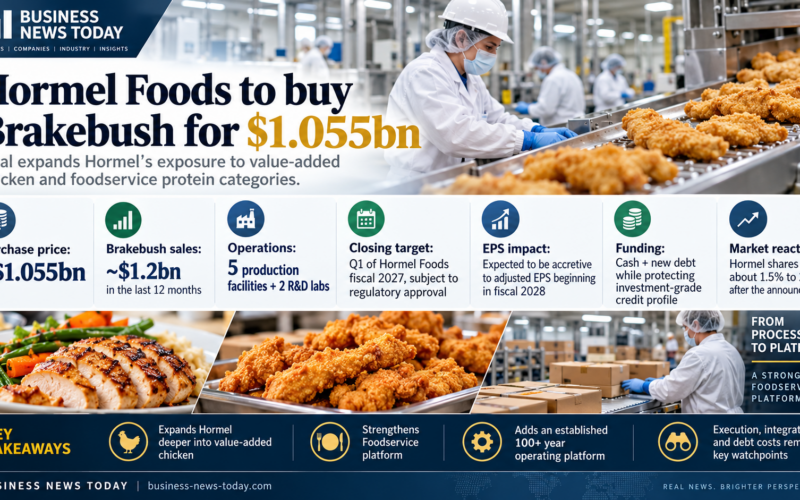
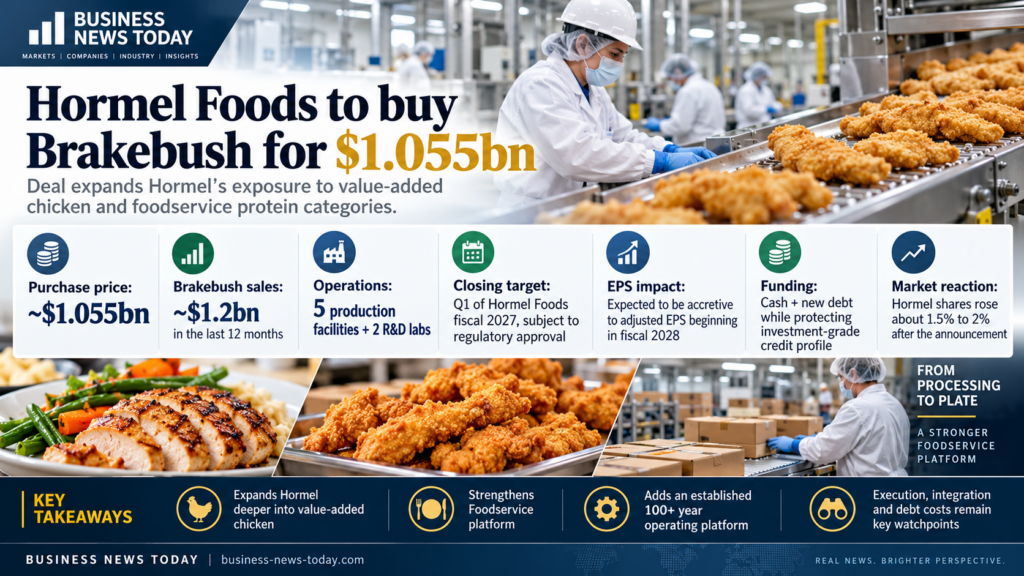
Hormel Foods Corporation (NYSE: HRL), the Minnesota-based owner of brands including Spam and Skippy, has agreed to acquire Brakebush Brothers, LLC for approximately $1.055 billion as the packaged-food company increases its exposure to protein-rich foodservice categories. Brakebush generated approximately $1.2 billion of net sales during the last 12 months and operates five production facilities and two research and development laboratories.
The transaction is expected to close during the first quarter of Hormel Foods’ fiscal 2027, subject to regulatory approval and customary conditions. Hormel Foods expects the acquisition to become accretive to adjusted earnings per share beginning in fiscal 2028 and plans to fund the transaction using cash and new debt while protecting its investment-grade credit profile.
Hormel Foods shares rose approximately 1.5% to 2% after the transaction was announced, indicating an initially constructive market response despite the additional debt and integration requirements.
Why does Hormel Foods want Brakebush Brothers?
Brakebush operates in value-added chicken rather than primarily selling undifferentiated commodity poultry. Its products include prepared and portioned chicken used by restaurants, foodservice operators and other institutional customers.
That distinction matters because branded and value-added products can generate more attractive economics than commodity meat processing. Customers are paying not simply for raw protein but for consistency, preparation, formulation, convenience and supply reliability.
Hormel Foods has spent years shifting its portfolio toward categories where brands or specialised processing create greater differentiation. Brakebush strengthens that strategy by expanding the company’s exposure to chicken while giving Hormel Foods a deeper presence in foodservice.
Hormel Foods already owns substantial protein businesses, but chicken provides a different demand profile from turkey, pork and shelf-stable meat. Consumer interest in high-protein meals has also supported demand across restaurants and retail, giving management a secular argument for increasing exposure.
Brakebush is also more than 100 years old and has long-established customer relationships. Hormel Foods therefore acquires an operating platform rather than needing to build new processing capacity and customer distribution from scratch.
Is Hormel paying an expensive price for Brakebush?
The headline valuation produces an interesting comparison. Hormel Foods is paying approximately $1.055 billion for a company that generated roughly $1.2 billion of net sales over the preceding 12 months. That equates to a purchase price of approximately 0.88 times trailing sales before adjusting for any debt, cash or other balance-sheet items not disclosed in the headline announcement.
A sub-one-times-sales acquisition multiple does not automatically mean the company is cheap. Food manufacturing margins can vary significantly depending on commodity inputs, plant utilisation, labour expenses, customer concentration and product mix.
Hormel Foods has not disclosed Brakebush’s EBITDA in the announcement, preventing investors from calculating an enterprise-value-to-EBITDA multiple. Without that information, the transaction cannot be fully compared with other protein acquisitions.
Still, the sales multiple provides context. Hormel Foods is adding annual revenue equivalent to roughly 10% of its own fiscal 2026 sales outlook for a purchase price close to $1 billion.
Hormel Foods expects fiscal 2026 net sales of approximately $12.1 billion to $12.2 billion. Third-quarter net sales were $2.96 billion, while adjusted operating income was $266 million and adjusted operating margin reached 9%.
If Brakebush can approach Hormel Foods’ broader margin structure after synergies, the economics could become attractive. That remains an analytical scenario rather than guidance because Brakebush’s profitability has not been publicly disclosed.
Why is foodservice becoming more important to Hormel Foods?
Hormel Foods’ latest quarterly results highlighted the strength of Foodservice even while portions of the consumer business faced softer demand and commodity-driven pricing pressure. Management said Foodservice again outperformed broader industry trends during the fiscal third quarter.
Foodservice customers have different economics from grocery consumers. Restaurants and institutional operators value consistency, labour-saving preparation and supply reliability, particularly when employee costs remain high.
Pre-portioned or prepared proteins can reduce kitchen labour and waste. A food supplier capable of offering several formats through established distribution channels can consequently capture value beyond the underlying commodity.
Brakebush strengthens Hormel Foods in precisely that area. The acquisition gives Hormel Foods additional production capability, category expertise and direct customer relationships while broadening the company’s prepared-chicken portfolio.
The combination could also allow Hormel Foods to cross-sell existing products through Brakebush relationships and distribute Brakebush products through Hormel Foods’ larger commercial platform.
Those revenue synergies are more uncertain than cost savings because customers ultimately determine purchasing behaviour, but they could become important if Hormel Foods can bundle products across restaurant menus.
What risks come with expanding deeper into poultry?
Chicken is a large and growing protein category, but it is not risk free. Poultry processors remain exposed to feed prices, labour costs, disease outbreaks, energy expenses and changes in wholesale chicken pricing.
Brakebush is described as non-vertically integrated, meaning the company does not control the entire production chain from birds and feed through finished products. That structure can reduce capital intensity but increases dependence on external poultry supply.
Hormel Foods must also integrate five manufacturing facilities into its operating network while preserving customer relationships developed under family ownership. Culture can matter in acquisitions of long-established private companies, particularly when customer and employee relationships have accumulated over generations.
Debt financing creates an additional consideration. Hormel Foods plans to use cash and new borrowings for the transaction, meaning interest expense will absorb part of the early contribution.
That helps explain why adjusted earnings-per-share accretion is not expected until fiscal 2028 rather than immediately after closing.
How does Brakebush fit Hormel’s wider portfolio reset?
Hormel Foods has been reshaping its portfolio while trying to generate stronger profit growth from a relatively slow-moving packaged-food market. Fiscal third-quarter organic net sales declined 2%, although adjusted earnings and operating performance improved.
Management raised and narrowed its fiscal 2026 adjusted earnings-per-share outlook to $1.45 to $1.51 and expects adjusted operating income of $1.08 billion to $1.12 billion. That means Hormel Foods is entering the Brakebush acquisition from a position of improving adjusted profitability rather than attempting to repair an immediate earnings crisis.
The portfolio logic is also relatively straightforward. Categories such as prepared protein and foodservice offer opportunities for innovation and customer-specific solutions that conventional packaged grocery products may not.
Hormel Foods does not need Brakebush to become a consumer household name. The value can sit behind restaurant menus where consumers may never see the supplier’s brand.
That business-to-business positioning can generate durable volume if customer relationships are long term, although large foodservice customers can also exert significant negotiating power.
Why did Hormel Foods shares respond positively?
The initial 1.5% to 2% rise suggests investors did not interpret the purchase price as obviously excessive.
The ratio of purchase price to revenue likely helped sentiment, as did the clear connection with Hormel Foods’ existing Foodservice business. Transactions generally receive more favourable reactions when investors can understand how the acquired assets fit the buyer’s existing distribution and manufacturing infrastructure.
The delayed earnings accretion nevertheless means shareholders should not expect an immediate transformation. Fiscal 2027 will include closing, integration and financing effects before expected adjusted EPS accretion begins in fiscal 2028.
The most important future disclosures will therefore be Brakebush profitability, expected synergies, financing costs and any updated segment targets after closing.
The strategic premise is uncomplicated. Hormel Foods is spending approximately $1.055 billion to acquire roughly $1.2 billion of annual sales in a protein category where it believes demand and foodservice utilisation can continue growing. The value case depends on turning that attractive headline revenue multiple into durable cash flow and margins.
Discover more from Business-News-Today.com
Subscribe to get the latest posts sent to your email.