


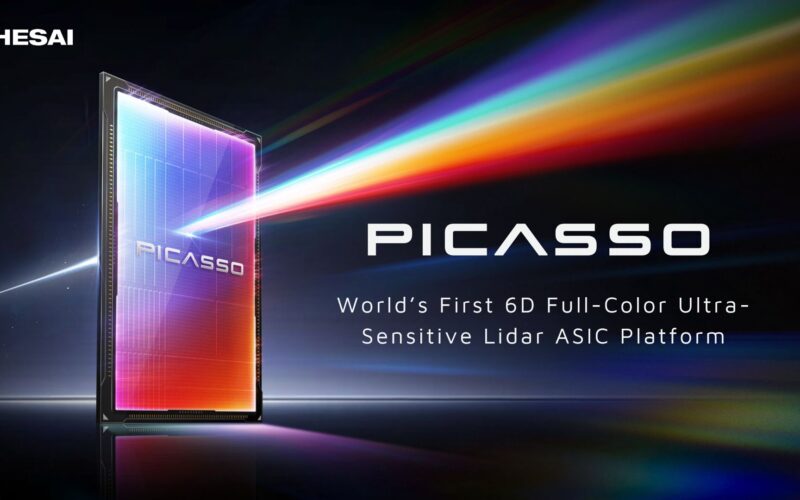
Hesai Technology (NASDAQ: HSAI; HKEX: 2525) has used its 2026 Technology Open Day to signal that it no longer wants to be seen as only a lidar vendor. The company unveiled Picasso, a full-color lidar SPAD-SoC platform, upgraded its ETX automotive lidar architecture, previewed a new Kosmo spatial intelligence hardware platform, and disclosed a strategic move into robotic actuation modules. The combined message is more important than any single product launch because it suggests Hesai Technology is trying to reposition itself from a component supplier to a broader infrastructure player in what it calls the physical AI era. For investors, competitors, and automotive customers, the real question is whether this expansion creates a larger moat or simply adds more execution burden.
Why does Hesai Technology’s Picasso platform matter beyond another lidar performance upgrade in 2026?
The most important strategic point in the Picasso launch is that Hesai Technology is trying to shift the basis of competition away from simple range, resolution, and price. Full-color lidar, if commercialized at scale, could improve how autonomous systems interpret traffic lights, lane markings, work zones, and other context-heavy edge cases that camera-only or conventionally fused systems must infer through more complex sensor stacks. In other words, Hesai Technology is arguing that perception quality should be judged not just by how far a sensor sees, but by how directly it understands the scene.
That matters because lidar has entered an awkward middle age. It is no longer novel, but it is not yet universally accepted. Reuters noted that lidar was used in only a small share of vehicles globally in 2025, and not every automaker believes it is necessary. Tesla has stayed committed to camera-first autonomy, while other manufacturers continue to weigh cost, packaging, compute load, and safety tradeoffs. In that environment, a vendor that can redefine lidar as a higher-value perception layer rather than a commodity distance sensor may have a better shot at protecting margins.
Picasso also reinforces the logic of vertical integration. Hesai Technology said it has developed all seven core lidar components in-house and has expanded its internal ASIC capabilities. That is not just engineering chest-thumping. In automotive supply chains, vertical integration can lower bill-of-materials risk, improve qualification control, shorten iteration cycles, and help defend pricing when customers start asking rude questions about cost. The flip side is that it raises the capital and organizational burden on the supplier. If demand disappoints, integrated players wear more of the fixed-cost pain themselves.

How does the upgraded ETX platform change Hesai Technology’s position in level 3 and level 4 autonomy?
The upgraded ETX platform is where the commercial argument becomes more concrete. Hesai Technology is positioning ETX for Level 3 and above autonomous driving, with channel configurations rising as high as 4,320 and detection ranges that target long-distance object recognition. Reuters reported that the ETX product is expected to enter mass production later in 2026 and appear in flagship vehicles by 2027. That timing matters because the next phase of advanced driver assistance is increasingly about whether suppliers can support limited but reliable higher-autonomy functions in premium and upper-midmarket vehicles.
The significance of ETX is not merely technical. It speaks to the architecture battle inside the automotive industry. NVIDIA’s DRIVE Hyperion platform emphasizes a standardized sensor-and-compute reference architecture that can reduce integration risk and accelerate deployment across vehicle programs. Hesai Technology’s inclusion in that ecosystem improves credibility with automakers that do not want to build every autonomy component from scratch. It also gives Hesai Technology a path into global programs where the compute stack, validation workflow, and sensor strategy are being harmonized rather than reinvented for each model.
Still, ETX is not a guaranteed home run. Long-range, high-channel lidar sounds wonderful in presentations, but mass adoption depends on cost, thermal management, packaging, software maturity, validation, and the willingness of automakers to absorb sensor complexity into vehicle economics. This is where the industry gets less poetic. A sensor can be impressive and still lose if the system-level value proposition does not survive procurement meetings.
Why is Hesai Technology expanding from automotive lidar into robotics, spatial intelligence, and physical AI?
The launch of Kosmo and the move into robotic actuation modules show that Hesai Technology wants exposure to markets beyond passenger vehicles. That is strategically rational. Automotive wins are large, but they are slow, qualification-heavy, and vulnerable to pricing pressure from OEMs. Robotics, embodied AI, industrial automation, and digital twin applications offer a broader set of use cases, potentially faster product cycles, and different purchasing logic. A robot maker may care less about automotive-grade validation theater and more about data capture, interaction quality, and deployment speed.
Kosmo appears designed to address the growing hunger for real-world 3D data in robotics training, spatial computing, and digital environment creation. That puts Hesai Technology closer to the data layer of physical AI rather than just the sensing layer. If that strategy works, the company could participate not only in hardware shipments but in the workflows that train, simulate, and update intelligent machines. That is a more interesting place to be than selling boxes that customers immediately try to squeeze for price.
The robotic actuation angle is even more ambitious. Moving from robot “eyes” into robot “muscles” is a classic adjacency play, but it also invites a classic problem: adjacencies often look neat on strategy slides and messy in execution. Hesai Technology may indeed have underlying capabilities that travel well into actuation modules. But investors should treat this as an early strategic signal rather than a proven second engine of growth. The company is broadening its addressable market, yes, but it is also broadening the number of things that can go wrong.
What does current HSAI stock performance suggest about investor sentiment toward Hesai Technology’s strategy?
Hesai Group’s Nasdaq-listed ADRs were trading at $21.97 on April 20. Market data pages showed roughly 4.07% gains over five days, a slight one-month decline, and a 52-week range around $10.85 to $30.85. That combination suggests a stock that has delivered substantial volatility and still sits in the middle of a bigger re-rating conversation rather than at the end of one. Investors clearly recognize that Hesai Technology is not a fringe player. The question is whether they are ready to value it as a durable platform company rather than as a cyclical or policy-exposed sensor name.
Recent momentum looks broadly aligned with the company’s stronger industry positioning. Hesai Technology has cited market-share leadership, multiple production design wins, and a widening role in autonomous driving and robotics. However, public markets tend to be stingy about awarding platform multiples until adjacent businesses start producing visible revenue, not just exciting nouns. “Spatial intelligence” and “physical AI” are compelling themes, but investors will eventually ask for backlog, customer conversion, margin impact, and revenue mix. Capital markets, in their own charming way, like poetry only after the spreadsheet works.
There is also a geopolitical and competitive layer. Hesai Technology operates in sectors where supply chains, export controls, autonomy regulation, and China-related investor perception can influence valuation as much as product performance does. Even if the technology case strengthens, the stock may continue to trade with higher-than-average sensitivity to policy headlines and sector mood.
What happens next if Hesai Technology succeeds in turning lidar leadership into a broader physical AI platform?
If Hesai Technology executes well, it could evolve from a top automotive lidar supplier into a more diversified infrastructure company serving autonomous vehicles, robotics developers, industrial automation vendors, and digital-twin ecosystems. In that scenario, Picasso would matter because it changes perception quality, ETX would matter because it anchors automotive commercialization, and Kosmo would matter because it opens a data and intelligence layer above sensing. The endgame would be a company that sells not just components, but pieces of the stack that help machines see, understand, and interact with the world.
If the strategy stumbles, the risks are more familiar. Automotive lidar could become more price-competitive, robotics adjacencies could take longer than expected to monetize, and investors could decide that the company is stretching across too many fronts at once. The market is often generous to focused specialists and suspicious of aspiring ecosystems until the revenue arrives.
For now, the announcement looks less like a product refresh and more like a deliberate attempt to reset Hesai Technology’s identity. That makes it strategically significant. The company is trying to tell customers and investors that the future value pool will not belong only to whoever ships the cheapest lidar, but to whoever provides the most useful machine perception and the most scalable bridge from sensing to intelligence. It is an ambitious claim. Now comes the inconvenient industry tradition of having to prove it.
What are the key takeaways on what Hesai Technology’s 2026 launch means for competitors and the wider lidar industry?
- Hesai Technology is trying to move the lidar discussion from hardware specs and pricing toward perception quality and system-level intelligence.
- Picasso gives Hesai Technology a stronger narrative around differentiated sensing, especially in scenarios where color context matters.
- The upgraded ETX platform strengthens Hesai Technology’s claim to serve higher-autonomy vehicle programs, not just conventional ADAS deployments.
- Alignment with NVIDIA DRIVE Hyperion improves ecosystem credibility and could reduce adoption friction for automakers using standardized autonomy stacks.
- The robotics and spatial intelligence push is strategically sensible because it reduces dependence on automotive program cycles and pricing pressure.
- Kosmo suggests Hesai Technology wants exposure to the data-generation layer of physical AI, which may prove more durable than pure sensor revenue.
- The new actuation-module strategy expands total addressable market, but it also materially increases execution complexity.
- HSAI stock performance indicates investor interest remains alive, though the market still appears to be valuing promise with caution rather than with full conviction.
- Competitive pressure from camera-first autonomy advocates and lower-cost sensing approaches remains a genuine constraint on lidar’s global adoption curve.
- The broader industry implication is that future winners in autonomy may be the companies that integrate sensing, compute compatibility, and real-world intelligence workflows most effectively.
Discover more from Business-News-Today.com
Subscribe to get the latest posts sent to your email.