


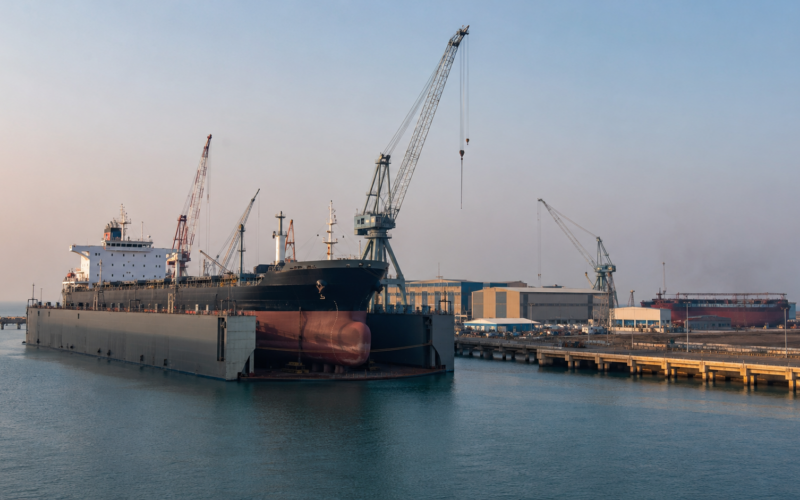
Cochin Shipyard Limited (NSE: COCHINSHIP) is expected to invest approximately ₹920 crore in ship-repair infrastructure and operate a new large-vessel repair facility at Vadinar after the Ministry of Ports, Shipping and Waterways granted the project in-principle support under the Shipbuilding Development Scheme. Deendayal Port Authority will develop around ₹650 crore of civil infrastructure, taking the combined project investment to ₹1,570 crore, with completion planned within 36 months. The ministry has separately given in-principle approval to a nearly 2,000-acre greenfield shipbuilding cluster at Kuchhadi in Gujarat’s Porbandar district. Together, the projects are intended to create large commercial shipbuilding capacity and expand India’s ability to repair vessels that currently depend on overseas yards. The central tension is that government support has improved project viability, but commercial success still depends on final approvals, timely construction, private shipyard participation and sufficient vessel demand.
What did the shipping ministry approve at Porbandar and Vadinar, and what remains conditional?
The July 15 announcement covered two separate maritime infrastructure projects under the Shipbuilding Development Scheme. The first is a greenfield shipbuilding cluster at Kuchhadi in Porbandar district. The second is a brownfield ship-repair facility at Vadinar in the Gulf of Kutch.
The Porbandar cluster will be developed through National Shipbuilding and Heavy Industries Park-Gujarat, a special purpose vehicle promoted jointly by the Ministry of Ports, Shipping and Waterways and the Gujarat Maritime Board. It is planned as an integrated maritime manufacturing zone containing shipyards, ancillary manufacturing units, shared infrastructure and capability-development centres.
The proposed cluster is designed to support annual shipbuilding capacity of between 1.2 million and 1.5 million gross tonnage. This represents intended production capacity rather than secured construction orders, completed facilities or guaranteed vessel output.
The Vadinar project is more advanced in the approval process. The Cabinet Committee on Economic Affairs approved the ₹1,570 crore facility on May 5, 2026. The subsequent in-principle approval under the Shipbuilding Development Scheme makes the project eligible for financial assistance covering 25% of eligible capital infrastructure costs.
The latest approval should therefore not be interpreted as commissioning, construction completion or immediate commercial readiness. The projects still require detailed implementation, procurement, contracting and environmental or statutory clearances where applicable. The Porbandar cluster will also need private shipbuilders and component manufacturers to commit capital before its proposed capacity can translate into production.
The Vadinar development has identified implementing entities, an investment split and a three-year construction plan. Porbandar remains a broader industrial platform whose ultimate capital requirement, tenant structure and commissioning schedule have not yet been publicly detailed.

Why could the Porbandar shipbuilding cluster change India’s commercial vessel capacity?
Porbandar is intended to address more than a shortage of physical dock space. Large-scale shipbuilding requires fabrication yards, dry docks, heavy-lift equipment, steel-processing capacity, design expertise, classification support and a network of specialised suppliers. Developing these capabilities within a shared cluster can reduce the cost of duplicating infrastructure across individual yards.
The cluster model could allow participating shipbuilders to concentrate their investment on production facilities while using common waterfront, transport, testing and training infrastructure. It may also make the site more attractive to marine-engine suppliers, electrical-system manufacturers, steel fabricators and other component businesses that need proximity to shipyards.
The proposed annual capacity of up to 1.5 million gross tonnage is strategically significant, but capacity alone does not establish competitiveness. Shipowners select yards based on price, delivery reliability, design capability, financing availability, after-sales support and confidence that the vessel will be completed on schedule.
India will therefore need more than subsidised infrastructure to convert Porbandar into an international shipbuilding centre. The cluster must attract experienced operating partners, secure anchor orders and develop a dependable supplier ecosystem. It will also have to manage long construction cycles and the working-capital requirements associated with large commercial vessels.
The ownership structure is intended to reduce early infrastructure risk through cooperation between the central government and Gujarat. However, no publicly confirmed role for Cochin Shipyard has been announced at Porbandar. Cochin Shipyard’s involvement in the wider story is tied specifically to the separate Vadinar repair project.
Treating both projects as a single Cochin Shipyard expansion would therefore overstate the company’s disclosed scope. Porbandar is primarily a national and regional maritime-manufacturing initiative, while Vadinar is a defined operating expansion for Cochin Shipyard and Deendayal Port Authority.
How will Cochin Shipyard and Deendayal Port Authority divide the ₹1,570 crore Vadinar investment?
Deendayal Port Authority is expected to invest approximately ₹650 crore in civil infrastructure, including a 650-metre jetty and associated marine works. Cochin Shipyard will invest about ₹920 crore in ship-repair infrastructure, including two large floating dry docks, and will operate the completed facility.
This division allocates waterfront and civil works to the port authority while placing specialised repair equipment and operations under Cochin Shipyard. It gives the project a clearer commercial structure than a conventional jointly funded industrial park.
Both components are planned for completion within 36 months. The schedule will require coordinated design, procurement and construction because the floating dry docks, jetty, workshops and supporting infrastructure must operate as one integrated facility.
Vadinar’s natural deep draft and proximity to Deendayal Port and Mundra provide an important geographic advantage. Large vessels operating along international shipping routes could access the site without travelling to Cochin Shipyard’s existing facilities on the southwestern coast or leaving India for repairs.
The proposed facility will be capable of servicing vessels measuring up to 300 metres in length. Government assessments have identified a domestic capacity gap for ships exceeding approximately 230 metres, particularly large commercial and foreign-flagged vessels.
The project has also been designed to handle as many as 34 vessels annually and capture an estimated 5% to 6% of the addressable repair market. Those figures represent project expectations rather than contracted utilisation. The facility will still need to compete on repair quality, turnaround time, pricing and access to replacement components.
For Cochin Shipyard, the operating role is as important as the capital investment. The company is not merely supplying floating dry docks. It will be responsible for converting the infrastructure into a recurring repair business and building relationships with domestic and international fleet operators. Vadinar investment structure
Why does large-vessel repair capacity matter after Cochin Shipyard’s uneven FY2026 performance?
Cochin Shipyard reported consolidated revenue from operations of ₹5,021.87 crore for FY2026, an increase of 4.2% from ₹4,819.96 crore in FY2025. Profit after tax declined 13.4% to ₹716.74 crore from ₹827.33 crore, indicating that higher revenue did not translate into corresponding earnings growth.
The divergence was partly visible in the segment mix. Shipbuilding revenue increased 13.9% to ₹3,365.57 crore, while ship-repair revenue declined 11.2% to ₹1,656.30 crore. Shipbuilding segment earnings improved, but ship-repair segment earnings fell sharply.
The fourth quarter showed the volatility within repair activity more clearly. Ship-repair revenue dropped 60.6% year on year to ₹329.78 crore, while shipbuilding revenue increased 25.3% to ₹1,154.49 crore. Consolidated quarterly revenue fell 15.6%, and net profit declined 3.7% to ₹276.48 crore.
Ship repair can be attractive because projects are generally shorter than new vessel construction and can generate repeat business through scheduled surveys, refits and life-extension work. However, revenue can vary according to the timing of vessel arrivals, dock availability, contract duration and the completion of large individual assignments.
Vadinar could reduce this volatility by adding a second major repair location on India’s western coast and expanding the range of vessels Cochin Shipyard can handle. It may also allow the company to pursue repair work from ships calling at nearby ports without displacing existing assignments at Kochi.
The strategic benefit will not appear immediately in revenue. Cochin Shipyard must first fund and construct the floating dry docks, commission the facility and build a customer pipeline. The project is therefore a medium-term capacity investment rather than an extension of the current order book.
Cochin Shipyard’s latest detailed company disclosure placed its order book at approximately ₹21,100 crore, including around ₹19,600 crore of shipbuilding work and ₹1,500 crore of repair orders. The company had 75 vessels under execution across its facilities, with projects distributed across design, fabrication and advanced completion stages. Vadinar adds future operating capacity, but it does not automatically add ₹920 crore or ₹1,570 crore to revenue-generating orders.
Can Cochin Shipyard absorb ₹920 crore of new capital expenditure without weakening returns?
Cochin Shipyard’s expected ₹920 crore commitment is equivalent to approximately 18% of FY2026 consolidated revenue and about 128% of annual profit after tax. The investment will be distributed over the construction period rather than incurred in a single quarter, but it is still financially material.
The Shipbuilding Development Scheme’s 25% assistance for eligible capital infrastructure should improve project viability. However, the public announcement does not provide a complete allocation of that assistance between the assets being developed by Cochin Shipyard and Deendayal Port Authority.
It would therefore be premature to subtract 25% from Cochin Shipyard’s ₹920 crore commitment and treat the remainder as its confirmed net investment. Eligible costs, disbursement conditions and the final funding structure must first be established.
The company has already completed a substantial capacity-expansion programme. Its earlier investments included a large dry dock and an international ship-repair facility at Kochi. Management has indicated that around ₹3,250 crore was deployed across the group’s expansion programme over several years.
Vadinar extends this network approach. Cochin Shipyard is building a broader operating footprint through its Kochi facilities and subsidiaries, including Udupi Cochin Shipyard and Hooghly Cochin Shipyard. A western repair hub could give the group geographic diversification and reduce dependence on a single yard.
The investment case depends on utilisation. A floating dry dock has a significant fixed-cost base, while project returns are sensitive to the number, size and duration of repairs. High utilisation could create operating leverage, but lower-than-planned vessel arrivals would extend the payback period.
Investors will need evidence that the facility can attract large commercial vessels currently using overseas repair centres. Memoranda of understanding, fleet-service agreements and advance customer commitments would provide more meaningful proof of demand than capacity figures alone.
How do the Gujarat projects fit India’s attempt to build a competitive maritime manufacturing ecosystem?
The two projects address different parts of the maritime value chain. Porbandar is intended to create new shipbuilding capacity and attract manufacturers, while Vadinar focuses on recurring repair and maintenance activity for the operating fleet.
This pairing matters because a sustainable maritime industry cannot depend only on building ships. It requires design, construction, repair, component supply, classification, training, port services and vessel finance. Shipbuilding creates long-cycle industrial demand, while repair work can generate repeat revenue and support skilled employment between construction programmes.
The government expects Vadinar to generate approximately 290 direct jobs and more than 1,100 indirect jobs. The wider economic effect could extend to marine engineering, steel fabrication, electrical systems, logistics and specialised maintenance contractors.
Porbandar has the potential to produce a larger industrial multiplier if it attracts several shipbuilders and supporting manufacturers. However, the cluster will need anchor investors capable of bringing technology, international customer access and delivery systems.
Government support can reduce the initial cost of common infrastructure, but it cannot replace commercial discipline. Indian yards must still compete with established international shipbuilding and repair centres on productivity, labour efficiency, procurement reliability and delivery schedules.
The projects could also strengthen domestic supply chains by creating sufficient demand for locally manufactured equipment. Their long-term value will be greater if they increase Indian content in propulsion, control, electrical and marine-support systems rather than relying heavily on imported components.
What does Cochin Shipyard’s current share price imply for the Vadinar expansion thesis?
Cochin Shipyard shares were trading at ₹1,384.60 at 10:43 a.m. IST on July 22, down 1.48% from the previous close of ₹1,405.30. The stock had declined approximately 1.9% over the latest five trading sessions and 6.2% over one month.
The share remained within a 52-week range of ₹1,187 to ₹1,979.90 and was about 30% below the upper end of that range. Its market capitalisation was approximately ₹36,571 crore, while the trailing price-to-earnings ratio was around 51 times.
This valuation indicates that the market continues to assign a substantial premium to Cochin Shipyard’s order pipeline, defence exposure and commercial maritime opportunities despite the decline from its 52-week high. The multiple also leaves limited tolerance for persistent margin weakness or delays in converting capacity into revenue.
The current price is close to the ₹1,400 floor set for the government’s July offer for sale. The government offered up to 5.04% of Cochin Shipyard’s equity, including an oversubscription option. The non-retail portion received strong demand, while the retail allocation was substantially undersubscribed.
The offer for sale did not raise capital for Cochin Shipyard because the shares were sold by the government. It improved public availability of the stock but did not directly finance the Vadinar investment. The company must still fund its ₹920 crore project component through its own resources, project assistance or other approved financing arrangements.
The recent price weakness cannot be attributed solely to the Gujarat announcement. It occurred amid the offer for sale, FY2026 earnings moderation and broader changes in defence and shipbuilding valuations. The Vadinar approval is strategically positive, but its financial contribution remains several years away. Cochin Shipyard market data
Which milestones will show whether Porbandar and Vadinar are becoming commercially viable assets?
The first milestone for Vadinar will be confirmation of the detailed funding and implementation agreements between Cochin Shipyard, Deendayal Port Authority and the Ministry of Ports, Shipping and Waterways. This should clarify eligible government assistance, capital responsibility and project-governance arrangements.
The second will be the award of contracts for the two floating dry docks, jetty works and workshops. Procurement dates will determine whether the 36-month completion target remains achievable.
The third will be evidence of customer demand before commissioning. Framework agreements or repair commitments from major fleet operators would reduce utilisation risk and support a faster ramp-up.
For Porbandar, the most important milestone will be the entry of anchor shipbuilders. Land allocation, private investment commitments and the start of common-infrastructure construction would demonstrate that the cluster is progressing beyond policy approval.
The Gujarat projects have improved India’s long-term maritime capacity roadmap and given Cochin Shipyard a defined route into large-vessel repair at Vadinar. What remains unresolved is the commercial conversion of that capacity. Timely capital deployment, anchor customers, private shipyard participation and sustained repair margins will determine whether the approvals become productive industrial assets or remain underutilised infrastructure.
What are the key takeaways from the Porbandar and Vadinar maritime projects?
- The shipping ministry has granted in-principle approval to separate shipbuilding and repair projects in Gujarat.
- The Porbandar cluster will cover nearly 2,000 acres and target annual capacity of 1.2 million to 1.5 million gross tonnage.
- National Shipbuilding and Heavy Industries Park-Gujarat will develop Porbandar through a central and state-backed special purpose vehicle.
- No disclosed Cochin Shipyard role has been confirmed for the Porbandar cluster.
- The Vadinar repair facility has a combined investment requirement of ₹1,570 crore.
- Deendayal Port Authority will invest approximately ₹650 crore in civil infrastructure and a 650-metre jetty.
- Cochin Shipyard will invest around ₹920 crore in two floating dry docks and operate the facility.
- Vadinar is designed to repair vessels measuring up to 300 metres and is targeted for completion within 36 months.
- Cochin Shipyard’s FY2026 revenue increased, but profit and ship-repair performance weakened.
- Funding clarity, private participation, anchor customers and facility utilisation are the next measurable tests.
Discover more from Business-News-Today.com
Subscribe to get the latest posts sent to your email.