


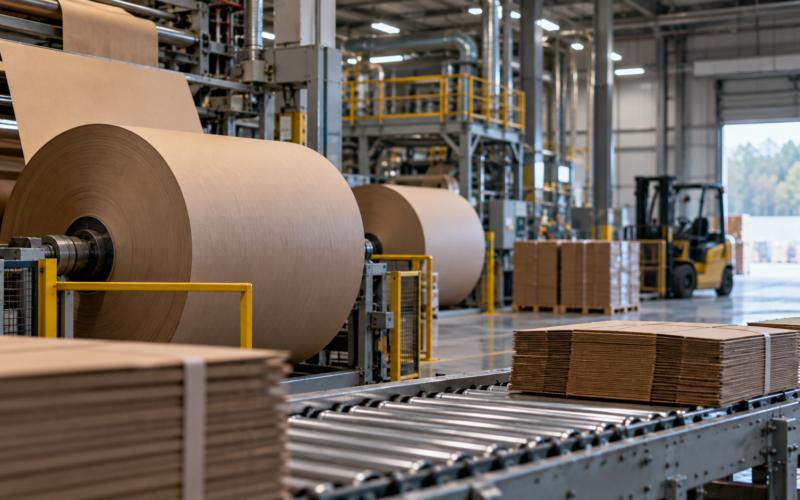
Greif, Inc. (NYSE: GEF, GEF.B) is permanently closing its Sweetwater paperboard mill in Austell, Georgia and eliminating approximately 90 jobs as the industrial packaging company exits the coated recycled paperboard market and pushes deeper into a multi-year programme designed to simplify its portfolio, lower structural costs and concentrate capital on businesses offering stronger long-term returns. The mill is expected to cease operations by the end of calendar 2026, with Greif providing severance benefits, career-transition resources and other assistance to employees affected by the shutdown.
The Sweetwater decision removes approximately 120,000 tons of annual paperboard production capacity and represents more than another isolated plant closure. Greif said the facility’s operating configuration, limited integration with the wider company network and cost position had prevented it from achieving what management considers a sustainable competitive position, leading the company to conclude that additional investment could not produce attractive enough returns. The mill currently produces coated recycled paperboard, uncoated recycled paperboard and gypsum facing and backing grades, while Greif intends to transfer affected uncoated recycled paperboard customers toward other facilities in its North American network.
The closure fits into a much larger transformation under President and Chief Executive Officer Ole Rosgaard, who has been shrinking weaker manufacturing positions while selling major assets, reducing debt and directing resources toward packaging businesses where Greif believes it has a clearer competitive advantage. Greif had already achieved approximately $90 million of cumulative run-rate savings under its cost-optimization programme by the end of its fiscal third quarter and continues to target at least $120 million of annualised savings by the end of fiscal 2027. The company is therefore closing Sweetwater from a position of substantially improved financial strength rather than because an immediate liquidity crisis is forcing the decision.
Why is Greif closing the Sweetwater paperboard mill after years of operating in recycled board?
Greif’s explanation centres on manufacturing economics and network integration rather than a sudden collapse in demand for every grade produced at Sweetwater. Management said the mill’s configuration and cost structure prevented it from creating a sustainable competitive position, while its relatively limited integration with Greif’s broader manufacturing system reduced the strategic case for keeping the facility open. Chief Executive Officer Ole Rosgaard said the company had considered the impact on employees and the surrounding community but concluded that capital should be directed toward assets with stronger prospects for profitable growth.
Sweetwater occupies an interesting position inside Greif’s Georgia manufacturing footprint because it sits near another Austell operation and has access to a significant rail corridor connected with the broader North American network. Geographic location alone was therefore not sufficient to protect the mill, which illustrates how industrial companies increasingly evaluate facilities around unit cost, asset configuration, utilisation and strategic fit rather than proximity to transportation infrastructure alone. Greif’s decision suggests management believes the remaining North American paperboard network can serve the customers it wants to retain more efficiently without continuing to support Sweetwater’s entire product mix.
The implications extend beyond the 90 employees because mill closures can affect recycled-fibre suppliers, logistics providers, maintenance contractors and local businesses surrounding a manufacturing site. Greif has not disclosed an estimate of indirect employment effects, meaning it would be inappropriate to extrapolate the 90 direct positions into a larger unverified community job-loss figure. What is confirmed is that the Sweetwater closure will permanently remove 120,000 tons of annual production capacity, making the action material to Greif’s manufacturing network even though the direct employee number is relatively modest compared with the company’s global workforce.
Why is Greif exiting coated recycled paperboard entirely?
The closure formally takes Greif out of the coated recycled paperboard, or CRB, market, marking another major portfolio decision inside its fibre operations. Coated recycled paperboard is typically manufactured from recovered fibre and finished with a coating that allows higher-quality printing and packaging applications, while uncoated recycled paperboard serves a different group of industrial and consumer uses. Greif has historically supplied CRB products from multiple mills, but a series of previous closures steadily reduced that manufacturing footprint before the Sweetwater decision completed the exit.
In May 2025, Greif announced the closure of its Los Angeles paperboard mill, which removed approximately 50,000 tons of coated recycled paperboard capacity and 22,000 tons of uncoated recycled paperboard capacity. Earlier in 2025, the company also permanently stopped production on the Number 1 paperboard machine at Austell and closed its Fitchburg, Massachusetts operation, actions that together affected approximately 140 positions. Greif said those earlier decisions reflected increased costs, weaker demand in important end markets and the disadvantages associated with non-integrated manufacturing assets.
The sequence shows that Sweetwater is not a standalone response to one poor quarter but the culmination of a longer reassessment of Greif’s paperboard portfolio. The company will continue producing uncoated recycled paperboard elsewhere and has told affected Sweetwater URB customers that it intends to transition them through the broader North American mill network, meaning Greif is narrowing its fibre strategy rather than abandoning recycled paperboard altogether. The essential strategic shift is from maintaining multiple product categories toward allocating capital to grades and facilities where management believes scale, network integration and cost structure support stronger returns.
How does the Sweetwater closure fit Greif’s $120 million cost-reduction programme?
Greif’s restructuring has already moved well beyond individual mill closures. The company said it had achieved approximately $90 million of cumulative run-rate cost savings by the end of the third quarter of fiscal 2026, reaching the high end of its original fiscal-year objective ahead of schedule and maintaining its commitment to at least $120 million by fiscal 2027. Those savings include manufacturing efficiencies, selling, general and administrative expense reductions and organisational changes across the company.
The workforce has already participated materially in that programme. Greif disclosed after its fiscal 2025 fourth quarter that it had eliminated approximately 8% of professional positions, equivalent to roughly 190 roles, as management removed what it characterised as redundant costs under its revised operating model. That action was separate from plant closures affecting manufacturing employees, illustrating that Greif’s efficiency programme has targeted corporate structures and physical production capacity simultaneously rather than concentrating exclusively on factory labour.
Greif’s latest reported workforce was approximately 12,000 full-time employees as of September 30, 2025, with around half located in North America and about 38% represented by labour unions. The 90 Sweetwater positions therefore account for less than 1% of the global workforce, but that comparison understates the local impact because an entire manufacturing site is being closed rather than positions being distributed across a worldwide organisation. The broader pattern matters more strategically: Greif is repeatedly showing that facilities and functions failing to meet its return requirements can be removed even while the company remains profitable and continues investing elsewhere.
Why is Greif restructuring when profit and EBITDA are improving?
Greif’s latest financial results underline why the Sweetwater closure should not be interpreted as a sign that the overall company is in distress. Fiscal third-quarter net income increased 156.7% year over year to $78.8 million, while adjusted EBITDA rose 24.7% to $183.4 million. Adjusted net income increased 87% to $93.3 million, demonstrating that underlying earnings improved substantially even after excluding several accounting and restructuring-related adjustments.
The balance sheet has also become dramatically stronger after Greif sold its Containerboard Business and timberlands assets and used proceeds to repay debt. Total debt fell to approximately $1.03 billion at June 30 from $2.72 billion in the prior-year comparison, while net debt declined to $741.9 million and the leverage ratio dropped to 1.1 times from 3.1 times. Those changes have allowed Greif to increase its quarterly dividend by 10.7%, resume share repurchases and simultaneously continue investing in acquisitions and selected manufacturing businesses.
That financial backdrop helps explain management’s willingness to close Sweetwater now. Industrial companies often find it easier to make difficult portfolio decisions when stronger cash generation and lower leverage give them flexibility to absorb closure costs, support affected workers and redirect capital without threatening day-to-day liquidity. Greif appears to be using that stronger position to accelerate decisions around businesses that management believes would otherwise dilute long-term returns.
What is happening inside Greif’s Sustainable Fiber Solutions business?
Sweetwater sits within a fibre business that continues to face muted industrial demand and pricing pressure. Greif’s Sustainable Fiber Solutions segment generated fiscal third-quarter net sales of $346.5 million, down $24.2 million from the prior-year period due mainly to lower selling prices, divestiture effects and reduced volumes. Adjusted EBITDA declined by $6.3 million to $42.5 million, although operating profit increased because restructuring charges, impairment expenses and selling, general and administrative compensation costs were lower.
Those results demonstrate why management is focused on manufacturing efficiency even while the wider company reports stronger earnings. A segment can remain profitable while still containing individual mills whose economics no longer meet corporate return thresholds, particularly when overall industry demand is subdued and commodity-like packaging grades experience pricing pressure. Closing one higher-cost or poorly integrated mill can theoretically strengthen the economics of remaining plants by transferring selected volume and reducing excess capacity.
The key execution question is whether Greif can retain Sweetwater customers through the transition rather than allowing competitors to capture the business. The company has specifically said it is working with affected URB customers to migrate supply through its broader North American network, signalling that at least part of the displaced production is intended to remain inside Greif rather than disappear entirely. Successful migration would allow the company to remove a weaker asset while preserving customer relationships, which would make the closure more economically attractive than simply abandoning the associated revenue.
How does the Sweetwater closure connect with Greif’s larger portfolio transformation?
Greif has been reshaping its portfolio much more aggressively than the 90-job figure alone suggests. The company sold its Containerboard Business, including the CorrChoice sheet feeder network, to Packaging Corporation of America for $1.8 billion and subsequently used proceeds from that transaction and the sale of timberland assets to dramatically reduce leverage. The company has simultaneously made smaller acquisitions in packaging categories where it believes returns and strategic fit are stronger, including the June 2026 purchase of Envaplast, which serves primarily agrochemical customers.
This creates a clear capital-allocation pattern in which Greif is willing to sell or close large legacy assets while investing selectively in businesses with higher margins, better cash conversion or stronger market positions. The Sweetwater mill appears to have failed that test because management concluded its cost structure and network integration could not support sustainable competitiveness. Closing it therefore frees both operating attention and future maintenance capital that might otherwise have remained tied to a structurally weaker asset.
The strategy does not eliminate execution risk because industrial portfolio transformations can become overly aggressive if companies repeatedly reduce capacity before market demand recovers. Greif still needs sufficient manufacturing flexibility to serve customers reliably, particularly in packaging markets where transportation costs can make geographic proximity economically important. Management’s decision to preserve and invest in the broader URB network indicates that it believes the remaining assets provide enough coverage after Sweetwater exits.
What does the decision mean for Greif employees as restructuring continues?
The immediate impact is clearest in Austell, where approximately 90 colleagues will lose their positions when Sweetwater closes. Greif said affected workers will receive severance benefits and career-transition resources, although the company has not publicly disclosed the precise timing or terms of individual separation packages. For employees who have already experienced earlier reductions around Greif’s Austell footprint, the closure also represents another stage of manufacturing consolidation in a location that historically supported multiple paperboard operations.
Across the broader company, the workforce outlook is more mixed because Greif continues to acquire businesses and invest in selected operations even while removing jobs elsewhere. The company’s strategy is not centred on a stated global headcount-reduction percentage but on cost optimisation and portfolio quality, which means employment can rise in growth businesses while declining in mills, corporate functions or regions management considers less competitive. That creates a different workforce risk from a single mass-layoff programme because restructuring can occur through repeated smaller decisions over an extended period.
Employees should therefore watch Greif’s progress toward the remaining $30 million or more of savings required to reach its minimum $120 million fiscal 2027 run-rate target. Management has said the target represents defined actions it expects to execute rather than speculative opportunities, implying additional changes are already sufficiently developed to be included in planning. Greif has not disclosed that those remaining savings will necessarily require a specific number of further job cuts, so any prediction of additional layoffs would go beyond current company guidance.
How did Greif shares react to the Sweetwater mill closure?
Greif Class A shares closed at $82.90 on September 16, up approximately 1.7% for the session, after trading as high as $84.67. The stock had closed at $81.50 the previous day, meaning the market did not show an obvious negative reaction on the day the Sweetwater closure was announced. It would nevertheless be inappropriate to attribute the entire increase directly to the mill decision because share prices reflect broader market conditions, investor positioning and multiple company-specific factors simultaneously.
The stock was trading below its 52-week high of approximately $90.57 but substantially above its low near $55.75, reflecting improved investor sentiment as Greif reduced leverage and strengthened profitability during 2026. The company’s willingness to increase its dividend and restart share repurchases has reinforced the narrative that asset sales and cost reductions are improving financial flexibility rather than merely compensating for deteriorating operations.
For investors, Sweetwater is therefore more relevant as evidence of continued portfolio discipline than as a standalone earnings event. Ninety jobs and 120,000 tons of capacity are meaningful locally, but the larger investment question is whether repeated asset closures, cost reductions and divestitures can create a sustainably higher-margin Greif without sacrificing enough revenue or manufacturing capability to limit future growth.
What should investors and employees watch after the Sweetwater closure?
The first milestone is whether Greif completes the Sweetwater shutdown by the end of calendar 2026 and transfers URB customers into its remaining network without meaningful revenue leakage. Customer retention will determine whether the company can capture the cost benefits of removing the mill while continuing to monetise part of its historical business. The company will also need to manage inventory, customer qualification and supply logistics carefully because paperboard buyers cannot always switch production sites without technical and commercial adjustments.
The second milestone is progress toward the $120 million cost-optimization target. Greif has already captured approximately $90 million of cumulative run-rate savings, leaving management with additional actions to implement through fiscal 2027 even after the significant reductions already achieved. Investors should therefore expect continued scrutiny of manufacturing assets and overhead, although management has not announced another company-wide workforce target.
The third issue is capital redeployment. Greif has reduced leverage dramatically, repurchased shares, increased its dividend and completed a bolt-on acquisition while continuing to close lower-return assets, creating a much more active capital-allocation model than a simple packaging-volume strategy. The success of that model will depend on whether money no longer tied to businesses such as Sweetwater ultimately produces better returns through growth assets, acquisitions or shareholder distributions.
The Sweetwater closure therefore captures the broader character of Greif’s transformation. The company is profitable, financially stronger and reducing leverage, yet it is simultaneously prepared to close an entire mill and eliminate 90 positions because management believes the asset no longer meets its strategic or economic requirements. For employees, that means improved corporate results do not necessarily translate into protection for individual facilities; for investors, it means Rosgaard’s restructuring is moving from broad cost targets into increasingly specific choices about where Greif intends to compete and where it is prepared to walk away.
Discover more from Business-News-Today.com
Subscribe to get the latest posts sent to your email.