


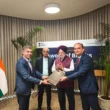

Greenlane Renewables Inc. (TSX: GRN) has signed definitive agreements with Panasonic do Brasil Limitada to localize production of its Cascade LF landfill gas upgrading technology and Cascade MS biogas upgrading product lines in Brazil. The agreement gives Panasonic do Brasil Limitada a technology license to fabricate Greenlane Renewables Inc. branded product modules at its facilities in São José dos Campos, São Paulo, while Greenlane Renewables Inc. retains control over product design, supplier selection, quality assurance, sales, commissioning, and servicing. Panasonic do Brasil Limitada is expected to invest R$8 million to R$10 million, or around C$2 million to C$3 million, in facility modifications, tooling, production equipment, working capital support, and advance payment assurances. For Greenlane Renewables Inc., which recently traded around C$0.23 to C$0.24 on the Toronto Stock Exchange against a 52-week range of roughly C$0.08 to C$0.33, the partnership is less about one manufacturing agreement and more about whether the company can convert Brazil’s biomethane momentum into repeatable equipment demand.
Why does Greenlane Renewables’ Panasonic partnership matter for Brazil’s biomethane equipment market?
The Greenlane Renewables Inc. and Panasonic do Brasil Limitada agreement matters because it targets one of the most practical bottlenecks in Brazil’s biomethane market: the ability to manufacture, deliver, and support gas upgrading systems locally at a cost and timeline that project developers can absorb. Brazil has large landfill, agricultural, ethanol, and sugarcane-linked feedstock opportunities, but biomethane growth does not materialize only because demand exists. It depends on project finance, equipment availability, offtake structures, permitting, grid or transport access, and confidence that technology suppliers can support assets after installation.
By granting Panasonic do Brasil Limitada a technology license for fabrication in Brazil, Greenlane Renewables Inc. is moving closer to an asset-light scaling model in which its intellectual property, engineering, brand, and lifecycle services become the core profit levers, while a manufacturing partner carries much of the local production burden. That is strategically important for a smaller publicly listed clean technology company because balance-sheet discipline matters. Greenlane Renewables Inc. needs exposure to the upside of Brazil’s biomethane market without tying too much capital into plant-level manufacturing infrastructure.
The partnership also signals a sharper localization strategy. Instead of shipping complex modules into Brazil and absorbing the cost, timing, currency, and logistics risks that can come with cross-border equipment supply, Greenlane Renewables Inc. is positioning itself closer to end-market demand. For customers developing landfill gas or biodigester projects, that could reduce procurement friction and improve confidence around delivery schedules. For competitors, it raises the bar because the contest is no longer only about gas upgrading performance. It is also about who can manufacture closer to the customer, support local content expectations, and respond to project developers without treating Brazil as an export-only market.
How could Cascade LF and Cascade MS strengthen Greenlane Renewables’ position in landfill gas and biodigester projects?
Cascade LF is central to the partnership because Greenlane Renewables Inc. is aiming the technology at landfill gas upgrading, a segment where nitrogen removal, methane recovery, system efficiency, and installed cost can materially affect project economics. The company has positioned Cascade LF as a next-generation landfill gas upgrading technology that includes a proprietary Linear Nitrogen Rejection Unit and is designed to deliver high methane recovery at a lower cost per unit of performance. In practical terms, that means Greenlane Renewables Inc. is trying to help landfill operators and biomethane developers improve the conversion of waste gas into usable renewable natural gas or biomethane.
Cascade MS adds another angle because it targets membrane separation for biogas upgrading, particularly in large biodigester projects. Brazil’s biomethane opportunity is not limited to landfills. The country’s agricultural base, ethanol industry, and sugarcane processing chain create a broader waste-to-energy runway, although these assets require different commercial models and feedstock structures. A shared product platform between Cascade LF and Cascade MS could help Greenlane Renewables Inc. standardize components, improve procurement leverage, and simplify servicing across multiple project types.
The competitive implication is that Greenlane Renewables Inc. is trying to move from bespoke project delivery toward productized systems that can be replicated. That shift can be powerful if demand is deep enough because standardization can improve margins, speed up installation, and reduce engineering complexity. The risk is equally clear. Productized equipment still has to perform under varied site conditions, and landfill gas quality can be difficult because feedstock composition is not always neat and polite. Biomethane may be green, but the gas stream itself can have the personality of a difficult spreadsheet.
Why is local production in São Paulo strategically important for Greenlane Renewables and Panasonic do Brasil?
São José dos Campos gives the partnership an industrial base in São Paulo, one of Brazil’s most important manufacturing and technology regions. For Panasonic do Brasil Limitada, the partnership creates a role in renewable fuel equipment production that extends beyond consumer electronics or conventional industrial manufacturing. For Greenlane Renewables Inc., it provides local manufacturing credibility without requiring the company to build and finance a standalone Brazilian plant.
This matters because Brazil’s biomethane developers will increasingly evaluate equipment suppliers on delivery certainty and local support, not just technical specifications. A locally produced Greenlane Renewables Inc. branded module could help developers reduce lead-time exposure, manage import-related friction, and align more closely with local project financing expectations. In infrastructure markets, the supplier that can cut uncertainty often earns a premium even before performance is fully visible.
There is also a working-capital advantage. Panasonic do Brasil Limitada is expected to provide working capital and advance payment assurances to meet customer requirements. For a smaller clean technology company, that is not a minor detail. Greenlane Renewables Inc. can face timing mismatches between order intake, procurement, manufacturing, and cash collection. A partner with stronger local balance-sheet capacity can help reduce execution strain, especially if order volumes accelerate.
The risk is that localization can create coordination complexity. Greenlane Renewables Inc. retains design, supply chain management, supplier quality assurance, marketing, sales, commissioning, and servicing. Panasonic do Brasil Limitada handles fabrication. That split can work well if governance is tight, but it leaves little room for fuzzy accountability. If a customer experiences a delay, quality issue, or commissioning challenge, the market will not care which partner owned the problematic step. The Greenlane Renewables Inc. brand will remain on the module.
What does the Panasonic agreement reveal about Brazil’s broader renewable natural gas strategy?
Brazil’s renewable natural gas and biomethane market is moving from concept to industrialization. Landfill gas upgrading, sugarcane-derived residues, vinasse, agricultural waste, and biodigester projects all point toward a market where biomethane could serve transport, industrial heat, gas grid blending, and decarbonization requirements. For Greenlane Renewables Inc., Brazil is attractive because the feedstock base is large, the project pipeline is developing, and local production could make the economics more scalable.
The policy backdrop is another part of the story. Brazil has been moving toward stronger renewable fuel and waste-to-energy frameworks, and the Fuel of the Future law has increased attention on biomethane blending and renewable fuel pathways. While policy support does not guarantee project bankability, it can create demand signals that help developers, lenders, and industrial offtakers underwrite long-term investments. Equipment suppliers such as Greenlane Renewables Inc. benefit when policy converts an environmental opportunity into a commercial requirement.
The second-order effect is that Brazil could become a test case for whether biomethane equipment suppliers can localize technology in emerging clean fuel markets without sacrificing quality or economics. If Greenlane Renewables Inc. and Panasonic do Brasil Limitada prove that standardized modules can be produced locally and deployed at scale, the model may be relevant in other markets where organic waste streams are large but imported equipment economics are difficult. If execution stumbles, competitors with deeper manufacturing networks or more integrated project delivery models may gain ground.
How should investors read Greenlane Renewables stock sentiment after the Panasonic Brazil deal?
Greenlane Renewables Inc. stock still reflects the tension common to small-cap clean technology companies: a large addressable market on one side and execution risk on the other. Shares recently traded around C$0.23 to C$0.24, below the upper end of the 52-week range near C$0.33 but meaningfully above the lower end near C$0.08. That range suggests the market has already rewarded some recovery or improved optionality, but it has not priced Greenlane Renewables Inc. as a de-risked growth story.
Recent performance signals are mixed depending on the data source and measurement window, with short-term movement not enough to prove a durable sentiment shift. That is sensible. A manufacturing partnership can improve strategic positioning, but investors will need to see order conversion, shipment timing, gross margin impact, working-capital discipline, and service revenue attachment before assigning higher confidence to the model. Small-cap investors often love market-expansion stories, until the cash conversion cycle walks into the room wearing steel-toed boots.
The Panasonic do Brasil Limitada agreement should therefore be read as a credibility catalyst rather than an immediate financial transformation. The target to ship the first system by the end of 2026 gives investors a milestone, but it also creates a timeline against which execution will be measured. If the partnership leads to repeatable customer orders, faster delivery, and lower installed cost, the strategic value could compound. If the first systems take longer than expected or margins remain unclear, the market may treat the announcement as another promising clean technology partnership that still needs proof.
What execution risks could decide whether Greenlane Renewables converts Brazil demand into revenue growth?
The biggest execution risk is whether localized manufacturing can scale without weakening product reliability. Biomethane upgrading equipment sits in a demanding operational environment, and landfill gas can contain impurities that challenge system performance. Greenlane Renewables Inc. will need Panasonic do Brasil Limitada to meet quality expectations while also coordinating with suppliers, customers, commissioning teams, and service personnel. Local production reduces some risks, but it introduces others.
The second risk is customer timing. Biomethane projects often depend on permitting, landfill operator commitments, industrial offtake agreements, financing, and policy incentives. Even when demand appears strong, project schedules can move slowly. Greenlane Renewables Inc. can build manufacturing readiness, but revenue recognition depends on customers moving from interest to contracted orders and then to funded deployment. Brazil may be a high-potential market, but high potential is not the same as purchase orders.
The third risk is competitive response. Companies selling biogas upgrading, membrane systems, pressure swing adsorption, water wash systems, and landfill gas technologies will not ignore Brazil’s growth outlook. If Greenlane Renewables Inc. gains traction through Panasonic do Brasil Limitada, rivals may respond with their own localization strategies, pricing pressure, partnerships, or bundled project-finance approaches. That means Greenlane Renewables Inc. must convert early localization into customer loyalty and service stickiness, not merely temporary visibility.
What does this partnership mean for the next phase of Greenlane Renewables’ growth strategy?
The Greenlane Renewables Inc. strategy appears to be shifting toward a more scalable combination of proprietary technology, local manufacturing partnerships, and lifecycle services. That is the right direction if the company wants to expand in regions where demand is growing faster than imported equipment models can support. It also aligns with the broader clean infrastructure trend in which technology suppliers must localize not just sales teams, but parts of the supply chain.
For Panasonic do Brasil Limitada, the partnership offers entry into a specific industrial decarbonization niche with real infrastructure relevance. For Greenlane Renewables Inc., the benefit is leverage. A larger manufacturing partner can help Greenlane Renewables Inc. pursue Brazilian demand while keeping its own capital burden more manageable. The agreement also strengthens Greenlane Renewables Inc.’s ability to present itself as a serious Brazil supplier at a time when landfill gas and agricultural biomethane projects may attract more policy and industrial attention.
The next proof points will matter more than the announcement itself. Investors should watch whether the first system ships by the end of 2026, whether customers adopt both Cascade LF and Cascade MS, whether localized production improves margins or only supports volume, and whether Greenlane Renewables Inc. can turn Brazil into a repeatable growth platform. The partnership gives Greenlane Renewables Inc. a stronger hand. Now the company has to play it without overbetting the table.
Key takeaways on Greenlane Renewables, Panasonic, and Brazil’s biomethane equipment market
- Greenlane Renewables Inc. is using the Panasonic do Brasil Limitada agreement to reduce manufacturing and delivery friction in Brazil, rather than relying only on export-led equipment supply.
- The partnership strengthens Greenlane Renewables Inc.’s Brazil positioning because local production can matter as much as technology performance in infrastructure-heavy biomethane projects.
- Cascade LF gives Greenlane Renewables Inc. a clearer landfill gas upgrading story, while Cascade MS expands the opportunity into large biodigester and agricultural biogas projects.
- Panasonic do Brasil Limitada’s expected R$8 million to R$10 million investment is modest in absolute terms but strategically useful because it supports tooling, production equipment, working capital, and customer payment assurance.
- Greenlane Renewables Inc. retains design, supplier quality, sales, commissioning, and service responsibilities, which means the company keeps strategic control but also remains exposed to execution accountability.
- Brazil’s biomethane market offers meaningful demand potential, but project timing will depend on permitting, financing, offtake agreements, and policy implementation.
- Greenlane Renewables Inc. stock sentiment remains cautious because the market still needs evidence that strategic partnerships can translate into revenue growth, margin improvement, and cash discipline.
- The first-system shipment target by the end of 2026 gives investors and customers a concrete milestone to measure whether the Panasonic partnership is progressing.
- Competitors in biogas upgrading may respond with their own localization strategies if Greenlane Renewables Inc. gains traction in Brazil.
- The agreement is best viewed as a strategic credibility catalyst, not an immediate financial reset, because commercial proof will come through orders, shipments, margins, and service revenue.
Discover more from Business-News-Today.com
Subscribe to get the latest posts sent to your email.


