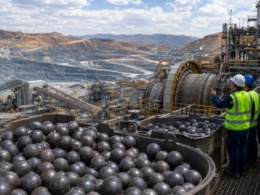
Green Canada Uranium Corp. is set to become a newly traded TSX Venture Exchange uranium explorer on September 9 after receiving final exchange approval for the listing created through the reverse takeover of MAACKK Capital Corp. The company will trade under the symbol GCUC as a Tier 2 mining issuer and enters the public market with the Marshall Project in Saskatchewan’s Athabasca Basin as its principal exploration asset.
The September 4 approval completes a corporate process that had already reached legal closing on September 1. Green Canada simultaneously completed its reverse takeover, C$991,348 of final flow-through financing, acquisition of 100% of the Marshall Project and receipt of an exclusivity right to negotiate for as much as 51% of the North Millennium Project. Total financings completed in connection with the transaction since January reached approximately C$2.92 million.
The resulting company has 63.824 million shares outstanding, approximately 3.93 million warrants and 2.95 million options. PTX Metals Inc. owns 18.167 million shares, or 28.46%, while Australia-listed Basin Energy Limited holds approximately 7.324 million shares, representing 11.54%. Together, those two strategic shareholders control approximately 40% of Green Canada Uranium’s basic shares before trading begins.
There is no legitimate post-listing share-price reaction yet. GCUC is expected to begin trading at the market open on September 9, so the first session will establish the public-market valuation rather than extending a historical price series from MAACKK Capital.
What exactly does Green Canada Uranium own when GCUC starts trading?
Green Canada Uranium owns a 100% interest in the Marshall Project, covering seven mineral claims and approximately 11,225 hectares in Saskatchewan’s Athabasca Basin. Marshall is an exploration-stage uranium project rather than a defined mine development, with no operating revenue and no mineral reserve or production forecast attached to the transaction.
The location is central to the investment thesis. Green Canada describes Marshall as being positioned along regional geological trends associated with uranium discoveries in one of the world’s best-known high-grade uranium districts. CanAlaska Uranium Ltd. has been appointed project operator, giving Green Canada access to a team with extensive Athabasca exploration experience.
The company must fund at least C$1.5 million of exploration at Marshall during the 24 months following closing. CanAlaska is entitled to an operator fee equal to 20% of initial exploration expenditures incurred under the first work programme, meaning a meaningful portion of the exploration budget will also support project management and operating services.
Marshall currently has no operating revenue and was recorded with approximately C$1.58 million of total assets and no liabilities in the carve-out financial information at March 31, 2026. The investment case therefore depends on future exploration success rather than existing cash flow.
How much did Green Canada Uranium actually pay to acquire the Marshall Project?
The consideration structure is more complicated than a single headline purchase price.
Green Canada agreed to pay Basin Energy and its Marshall subsidiary C$600,000 in cash through four C$150,000 instalments over three years. Another C$300,000 is payable through three instalments, with the first C$100,000 satisfied at closing through 588,235 Green Canada Uranium shares issued at C$0.17 and the remaining C$200,000 payable in cash during the following two years.
Basin Energy also received 6.376 million shares representing 9.99% of Green Canada Uranium immediately following the transaction before incorporating other Basin-held shares. After all closing issuances, Basin Energy owns approximately 7.324 million shares, equivalent to 11.54% of GCUC.
Using C$0.17 purely as a reference value for the 6.376 million acquisition shares would imply approximately C$1.08 million, but that is not a disclosed cash purchase price and should not be treated as an independent project valuation. The actual economics include cash instalments, equity consideration, exploration commitments and retained rights granted to Basin Energy.
Those retained rights are important. Basin Energy has a three-year right of first refusal over any sale of Marshall and retains the ability to repurchase up to 25% of the project for C$1 million until the earlier of five years after closing or Green Canada spending C$10 million on exploration.
Green Canada therefore owns 100% today, but that ownership can fall to 75% if Basin Energy exercises the repurchase right under the contractual conditions.
Why does PTX Metals owning 28.46% matter for new GCUC shareholders?
PTX Metals enters the listing as Green Canada Uranium’s largest disclosed shareholder with 18.167 million shares, representing 28.46% of the basic equity. PTX received those securities through the reverse takeover in exchange for its existing holding in Green Canada Corporation rather than purchasing them in the public market.
That holding provides continuity from Green Canada’s earlier corporate structure and leaves PTX strongly exposed to any future discovery success at Marshall or other Green Canada projects.
Basin Energy’s 11.54% stake creates a second sizeable strategic block. Combined, PTX and Basin Energy hold approximately 25.49 million of the 63.82 million shares outstanding, equal to almost 40% of the company. This concentrated ownership could limit the initial free float and potentially contribute to trading volatility when GCUC begins trading.
The new public market will therefore need to establish a price across a relatively concentrated shareholder structure rather than a widely distributed mature issuer.
Additional dilution is also possible. Green Canada Uranium has approximately 3.93 million warrants and 2.95 million options outstanding, while its omnibus incentive plan permits further awards within specified limits.
The existing securities are not necessarily problematic because warrant and option exercises can provide additional capital, but investors should evaluate exploration progress on a fully diluted rather than basic-share basis as the company expands its work programme.
How much financing does Green Canada Uranium have for exploration after the RTO?
Green Canada raised approximately C$2.92 million through multiple financings between January and the September closing. The final C$991,348 tranche consisted of 3.201 million charity flow-through units at C$0.25 and 955,000 flow-through units at C$0.20.
The structure directs capital toward Canadian exploration expenditure. Green Canada intends to renounce qualifying exploration expenses to subscribers under Canadian tax rules, which helps explain why the flow-through prices differ from ordinary equity pricing.
The latest units also include warrants. Charity flow-through units carry one whole warrant and the standard flow-through units carry half a warrant, with each whole warrant exercisable at C$0.22 for 24 months after closing.
The C$2.92 million financing total is meaningful relative to the mandatory C$1.5 million Marshall exploration commitment, but it is not all unrestricted cash available exclusively for that project. Green Canada also has corporate costs, scheduled acquisition instalments and exploration opportunities elsewhere in its portfolio.
Its predecessor business was pre-revenue. Green Canada Corporation reported no revenue for 2024, 2025 or the first quarter of 2026 and recorded a C$277,044 net loss in 2025 followed by an C$88,543 loss in the March 2026 quarter.
Capital-market access will therefore remain important if Marshall progresses into increasingly intensive drilling campaigns.
What is the North Millennium opportunity and why does Green Canada not own 51% yet?
Green Canada has received a nine-month exclusivity right from CanAlaska and Basin Energy to conduct due diligence and negotiate a potential earn-in option for as much as a 51% interest in the North Millennium Project. The right is not the same as acquiring 51% ownership.
Green Canada issued 600,000 shares to CanAlaska and 400,000 shares to Basin Energy in consideration for the exclusivity arrangement.
The nine-month window gives management time to assess technical data and negotiate the expenditure, payment and ownership conditions that would govern any future earn-in. No definitive 51% earn-in agreement has yet been announced.
North Millennium gives GCUC additional Athabasca optionality without immediately committing the capital required for a second major exploration programme. If due diligence is favourable, management can negotiate the terms for participation; if the economics or geology prove unattractive, the exclusivity arrangement does not itself force the company to acquire the interest.
That distinction matters because junior explorers can quickly dilute shareholder capital by accumulating too many early-stage properties before proving a flagship project.
Why could the first GCUC trading session be unusually volatile?
Green Canada Uranium will begin trading with only about 63.8 million basic shares outstanding, while PTX Metals and Basin Energy collectively control nearly 40% of them. Other securities may also remain subject to statutory or contractual resale restrictions following the financings and reverse takeover.
That concentrated structure can reduce the amount of stock immediately available for trading.
There is also no prior GCUC public-market price from which investors can anchor valuation. Financing shares were issued at several prices, including C$0.17, C$0.20 and C$0.25 depending on transaction purpose and tax status, but those figures are not equivalent to an exchange-established market value.
September 9 will therefore provide the first meaningful indication of how public investors value the combination of Marshall, the C$2.92 million financing base, the North Millennium option opportunity and the company’s strategic shareholder structure.
The most important longer-term metric will not be the first-day percentage move. Green Canada needs drilling to establish whether Marshall contains uranium mineralisation capable of supporting a materially higher project valuation.
The listing gives investors direct access to a new Athabasca-focused uranium vehicle. The next phase has to prove that the geological assets acquired through the reverse takeover justify the capital structure that will begin trading under GCUC.
Discover more from Business-News-Today.com
Subscribe to get the latest posts sent to your email.