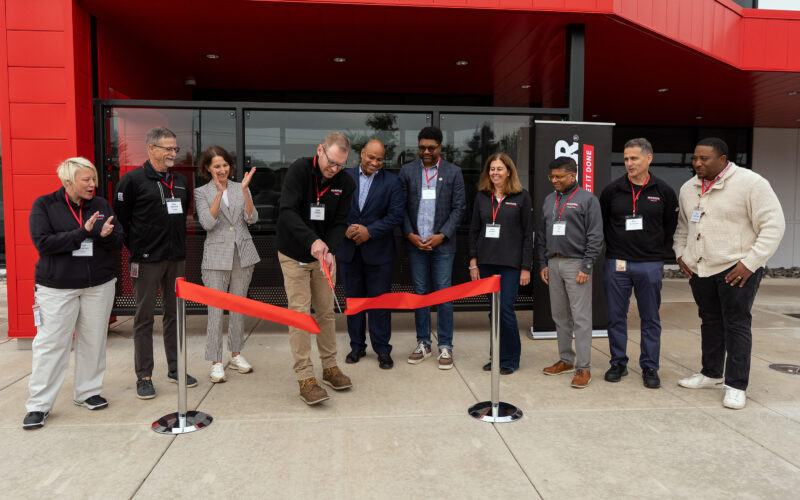
W.W. Grainger, Inc. (NYSE: GWW) has opened its Northwest Distribution Center in Gresham, Oregon, completing a multi-year expansion designed to increase product availability and shorten fulfillment times across the Pacific Northwest. The 550,000-square-foot facility, located roughly 16 miles from Portland, creates approximately 150 jobs and expands a regional network serving businesses, government agencies and institutions that depend on maintenance, repair and operating products. The opening matters beyond the building itself because Grainger’s competitive proposition increasingly depends on combining digital ordering with dense physical inventory positioned close enough to support next-day fulfillment. It also arrives shortly after Grainger reported 11.9% second-quarter growth in its High-Touch Solutions North America segment and increased its full-year 2026 sales outlook, suggesting the company is bringing additional distribution capacity online while its core business is gaining volume.
The final facility is larger than the project Grainger originally announced in July 2023. At that time, the company planned a 500,000-square-foot highly automated distribution center on a 48-acre site, expected to stock more than 135,000 industrial products and eventually employ more than 150 people. Subsequent company updates described the project at approximately 535,000 square feet, while the completed building is now 550,000 square feet. The finished footprint is therefore about 10% larger than the original plan, although Grainger has not disclosed a final project investment figure in its opening announcement.
Why does Grainger need another major distribution center when it already reaches most U.S. customers next day?
Grainger’s physical distribution network is one of the less visible parts of its competitive advantage.
Industrial customers often order maintenance products because something has failed, is about to fail or needs to be replaced before operations are interrupted. That makes availability and delivery speed fundamentally different from convenience-oriented consumer e-commerce. A delayed motor, pump, safety product or power-transmission component can affect an operating facility where the cost of downtime substantially exceeds the price of the item being ordered.
Grainger has historically designed its U.S. distribution footprint around next-day availability. When it announced the Gresham project in 2023, the company said its network allowed it to reach about 99% of the U.S. market with next-day delivery and identified the Pacific Northwest as a region where stocking substantially more products locally could improve customer service.
The new facility does not necessarily increase that 99% geographic statistic dramatically because Grainger already serves most U.S. postal codes quickly. Its more important role is increasing depth.
A customer may technically sit within a next-day delivery zone, but fulfillment quality also depends on whether the correct product is positioned in the correct distribution center when the order arrives. Moving a larger assortment closer to Oregon, Washington, Idaho and Montana can reduce dependence on inventory transported from more distant facilities, potentially improving order completeness as well as speed.
That distinction becomes important in maintenance, repair and operating distribution because Grainger manages an enormous assortment. The company’s U.S. High-Touch Solutions business gives customers access to more than a million products, while individual distribution centers carry selected inventory based on regional demand and service requirements.
The competitive advantage is therefore not simply owning warehouses. It is deciding what should sit inside each warehouse.

Why did the Grainger Gresham distribution center grow from 500,000 to 550,000 square feet?
The evolution of the project gives some insight into how Grainger’s network requirements changed during construction.
When Grainger announced the facility in July 2023, it described a planned 500,000-square-foot building that would hold more than 135,000 products and initially employ around 80 people before expanding beyond 150 employees over time. By February 2024, Grainger referred to the Oregon project as approximately 535,000 square feet. The grand-opening announcement now places the final facility at 550,000 square feet and says it creates approximately 150 jobs.
That makes the completed building 50,000 square feet larger than the original announcement, equivalent to an increase of about 10%.
Grainger has not attributed that difference to a particular design revision, inventory requirement or automation configuration, so it would be speculative to assign a single cause. However, the expansion occurred while the company was pursuing a much wider distribution-network investment program.
In 2024, Grainger said several major warehouse projects under development would collectively add approximately 3.5 million square feet to its network, increasing total warehouse space by more than 35%. The program included new facilities in Oregon and Texas as well as a bulk warehouse in North Carolina.
The Gresham opening should therefore be seen as one node in a larger network redesign rather than an isolated Oregon real-estate project.
That matters strategically because distribution businesses can eventually encounter a physical constraint even when digital demand remains strong. A website can display millions of products, but fast fulfillment depends on sufficient buildings, automation, inventory and transportation capacity sitting behind that interface.
Grainger is investing before that constraint materially damages the service proposition.
How could the Northwest Distribution Center improve Grainger service across Oregon and the Pacific Northwest?
Grainger has operated in Oregon since 1945 and currently employs around 240 people in the state before considering the impact of the new facility. The company says the Gresham center expands its ability to support businesses, government agencies and institutions across the wider Pacific Northwest.
The geography is commercially logical.
Gresham sits in the Portland metropolitan area, providing access to Oregon’s largest population and industrial center while also connecting into transportation routes serving Washington and the broader Northwest. Grainger’s original project announcement said the facility would complement ten existing distribution-center and branch locations across Oregon, Washington, Idaho and Montana.
Inventory localization can improve service in several ways.
First, customers receive more products from a facility closer to their operations. Second, a larger regional assortment can increase the probability that multiple items in one order are available from the same distribution point. Third, additional network capacity can provide resilience during spikes in demand or disruptions affecting other facilities.
That resilience can be especially relevant when industrial demand becomes unpredictable. Maintenance spending does not always move neatly with broader economic growth because emergency repairs, weather events, safety requirements and unplanned equipment failures can generate localized demand independently of the economic cycle.
A dense supply network effectively monetizes preparedness.
Grainger’s value proposition is strongest when the customer pays not simply for a commodity industrial item but for confidence that the right item can be obtained without allowing a facility problem to become a larger operational problem.
Why does the Oregon opening matter more after Grainger’s High-Touch Solutions sales jumped 11.9%?
The timing of the facility opening is particularly notable because Grainger’s core North American distribution operation is growing strongly.
Second-quarter company sales reached $5.021 billion, increasing 10.3% year over year and 13.7% on a daily, organic constant-currency basis. The High-Touch Solutions North America segment increased sales 11.9%, or 11.7% on a daily constant-currency basis, driven by higher volume and pricing as tariff costs were passed through to customers.
That volume growth is relevant to distribution infrastructure.
If more customer orders move through Grainger’s existing network, additional warehouse space can help prevent faster sales growth from creating service bottlenecks. Warehouse expansion becomes particularly valuable when the company can put capacity into operation before existing facilities become congested.
Grainger also reported second-quarter operating earnings of $807 million, up 19%, while diluted earnings per share increased 20.5% to $12.01. Gross margin expanded 100 basis points to 39.5% and operating margin increased 120 basis points to 16.1%. The quarter included a $43 million benefit from refunds on tariffs imposed under the International Emergency Economic Powers Act for products directly imported by Grainger, meaning the full margin expansion should not be interpreted as entirely structural.
Nevertheless, the underlying operating performance provides significant capacity to finance infrastructure.
Grainger generated $444 million of operating cash flow during the second quarter and spent $111 million on capital expenditures. For the full year, management now expects between $575 million and $650 million of cash capital expenditure.
The Northwest Distribution Center is exactly the type of physical asset that explains why a digitally sophisticated distributor still requires hundreds of millions of dollars in annual capital spending.
How does Grainger make a large warehouse investment pay when industrial distribution margins depend on efficiency?
A larger distribution center creates capacity, but capacity itself does not guarantee economic returns.
Warehouse economics improve when increased throughput is absorbed without requiring labor, inventory and transportation costs to rise at the same rate. Grainger’s original description of the Gresham facility as highly automated therefore matters even though the company’s August opening announcement does not provide a detailed list of robotic systems or automation technologies installed inside the completed building.
Automation can potentially increase picking speed, reduce travel time inside the building, improve inventory accuracy and allow a larger assortment to be handled with greater consistency.
The employment numbers demonstrate why automation should not automatically be interpreted as an absence of jobs. The original project expected about 80 employees initially and more than 150 over time, while Grainger now says the opened facility creates approximately 150 positions.
That suggests the facility reached something close to its originally anticipated mature employment footprint by opening, although Grainger has not disclosed whether all 150 positions are already filled.
The economic objective is straightforward. Grainger needs the facility to improve service enough to support incremental sales and customer retention while operating efficiently enough that the additional network expense earns an acceptable return on invested capital.
That return will not appear as a separate Northwest Distribution Center revenue line. It will instead show up indirectly through sales growth, product availability, freight performance, working capital and segment margins.
Why does local inventory become more important as Grainger expands the number of products customers can buy?
Broad-line industrial distribution creates a paradox.
Customers value having access to a very large assortment, but carrying every possible product in every distribution center would tie up enormous amounts of working capital.
Grainger therefore has to balance assortment breadth against physical inventory efficiency.
The High-Touch Solutions model offers more than one million products through its U.S. business, while Grainger’s digital operations and product-information systems make that assortment searchable and purchasable. The company’s broader distribution architecture then determines which products deserve local stocking based on customer demand and service economics.
The planned 135,000-plus items for the Northwest Distribution Center illustrate that selectivity. Grainger does not need every product in Gresham. It needs the right subset of products likely to be required quickly by Pacific Northwest customers.
That is where data becomes inseparable from warehousing.
Product information tells Grainger what an item is. Customer and ordering data indicate who buys it, where, how frequently and with what urgency. Distribution algorithms and operational planning can then determine where inventory should sit.
The physical facility consequently becomes an expression of Grainger’s data advantage rather than a separate old-economy asset.
The strongest industrial distributors increasingly combine both.
Could the new Oregon distribution center help Grainger gain market share rather than simply support existing customers?
Grainger operates in an unusually fragmented market.
Its investor materials have estimated the U.S. business-to-business supply market at roughly $1.5 trillion, with an addressable opportunity around $575 billion for its High-Touch Solutions business. Grainger has previously described itself as the largest MRO player while holding only a single-digit share of that addressable market.
That fragmentation means infrastructure can become offensive rather than defensive.
A regional customer using several smaller distributors may shift more spending toward Grainger if the company can provide broader product availability, reliable next-day service, technical support and consolidated procurement through one relationship.
Every additional product Grainger can supply quickly potentially increases the portion of a customer’s maintenance budget the company can capture.
This is different from a mature retailer adding stores simply to defend market share. Grainger still has substantial whitespace inside existing geographic markets because customers frequently purchase MRO supplies from multiple sources.
A larger Pacific Northwest inventory position can therefore support share-of-wallet expansion even without dramatic population or industrial growth in the region.
The relevant performance measure becomes not just how quickly the warehouse ships goods, but whether Grainger gains more customer spending because of that service advantage.
What does Grainger’s higher 2026 guidance suggest about demand as the new facility enters operation?
Grainger increased its annual outlook after the second quarter.
The company now expects 2026 sales of $19.4 billion to $19.7 billion, compared with its previous forecast of $19.2 billion to $19.6 billion. Daily organic constant-currency growth is expected between 11.5% and 13%, up from the prior 9.5% to 12% range. Diluted adjusted earnings per share guidance increased to $45.50 to $47.25 from $44.25 to $46.25.
Management also lifted its expected High-Touch Solutions North America operating margin range to 17.2% to 17.6%.
Those numbers matter when evaluating the distribution investment because new facilities normally add fixed costs before reaching optimal utilization.
Opening Gresham into a strong demand environment is preferable to opening additional capacity while volumes are contracting. Higher sales can move through the facility more quickly, helping absorb labor, depreciation and other infrastructure costs.
That does not mean the Oregon center will immediately improve consolidated margins. Start-up costs, inventory positioning and operational ramp-up can initially work in the opposite direction.
The important long-term test is whether the network supports Grainger’s stated objective of taking market share while maintaining high service levels and attractive profitability.
What is GWW stock signaling after Grainger’s strong quarter and Oregon distribution expansion?
Grainger shares closed at $1,306.95 on August 19, down about 0.5% during the session, giving W.W. Grainger a market capitalization of approximately $61.7 billion. The stock remains around 8% below its 52-week high of $1,419.91 reached on July 17, while standing roughly 44% above its 52-week low of $906.52.
The recent performance is more mixed than the annual range suggests.
Grainger closed at $1,304.88 on August 12, meaning the stock was essentially flat over the following week through August 19. Compared with the July 20 close of $1,371.22, however, the shares are down roughly 4.7%.
That pullback has occurred even though the second-quarter results were strong and management increased annual guidance.
The stock’s valuation provides one reason expectations remain demanding. At roughly $1,307 and trailing earnings per share near $39, Grainger trades at approximately 33 times trailing earnings. A valuation at that level generally requires more than stable operations. Investors are effectively expecting continued market-share gains, earnings growth and disciplined capital deployment.
The Gresham facility will not materially alter the investment case by itself, but it represents the infrastructure needed to support the operating model underlying that valuation.
Grainger has to keep translating warehouse expansion, technology investment and assortment growth into higher customer spending and attractive incremental margins.
What will prove whether Grainger’s Northwest Distribution Center is creating economic value?
The most useful evidence will probably not come from another ribbon-cutting announcement.
Grainger needs the new distribution center to translate into measurable improvements in Pacific Northwest product availability, order completeness, delivery reliability and customer growth. Increased throughput should eventually support higher sales without requiring distribution costs to rise proportionately.
Inventory productivity will be equally important. Stocking more than 135,000 products closer to customers improves service only if Grainger can forecast regional demand accurately enough to avoid tying excessive capital into slow-moving inventory.
The facility also needs to integrate smoothly with the company’s wider network. Distribution centers create the most value when inventory and orders can be dynamically balanced across multiple sites rather than treating each warehouse as an isolated regional operation.
The broader corporate numbers suggest Grainger has room to execute. North American sales are growing at double digits, annual guidance has moved higher and operating cash flow remains substantial. Those conditions provide a supportive backdrop for absorbing new capacity.
The more revealing fact may be how the Gresham project evolved. Grainger began with a 500,000-square-foot plan and an eventual workforce above 150 people. It has opened a 550,000-square-foot facility creating approximately 150 jobs while the company’s sales base has grown from $15.2 billion in 2022, when the project was being developed, to $17.9 billion in 2025 and potentially more than $19 billion in 2026.
The building is therefore not simply extra warehouse space. It is part of Grainger’s attempt to preserve a difficult promise at greater scale: give millions of industrial customers access to an increasingly broad assortment while still making the item they urgently need feel locally available.
What are the key takeaways from Grainger’s new Gresham, Oregon distribution center?
- W.W. Grainger opened its Northwest Distribution Center in Gresham, Oregon, on August 19, 2026.
- The completed facility spans 550,000 square feet and creates approximately 150 jobs.
- Grainger originally announced a 500,000-square-foot facility in 2023, making the finished building about 10% larger than the initial plan.
- The original project plan called for more than 135,000 industrial products to be stocked at the Northwest Distribution Center.
- Grainger initially described the Gresham building as highly automated and designed to strengthen next-day fulfillment across the Pacific Northwest.
- The company’s High-Touch Solutions North America sales increased 11.9% in the second quarter of 2026.
- Grainger reported total Q2 sales of $5.021 billion, up 10.3%, while diluted earnings per share increased 20.5% to $12.01.
- Management increased full-year 2026 sales guidance to $19.4 billion to $19.7 billion and raised its adjusted EPS range to $45.50 to $47.25.
- GWW shares closed at $1,306.95 on August 19, around 8% below their 52-week high but approximately 44% above the annual low.
- The main economic test is whether the new capacity improves product availability and customer growth while preserving Grainger’s strong North American margins.
Discover more from Business-News-Today.com
Subscribe to get the latest posts sent to your email.