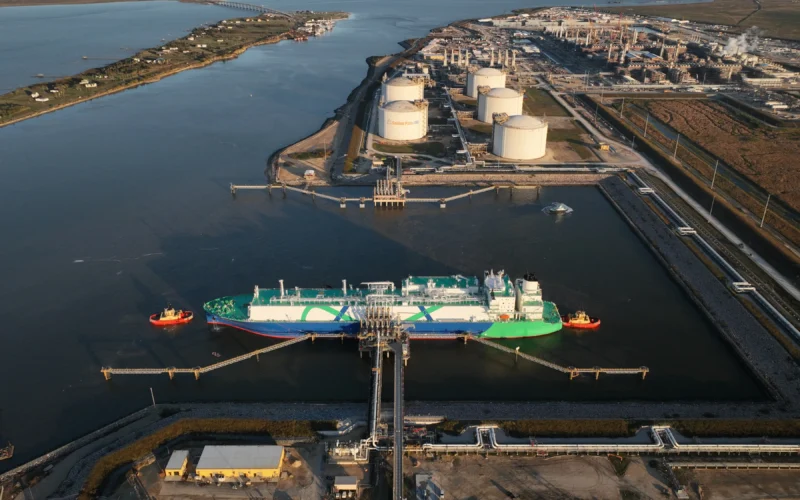
Golden Pass LNG, a joint venture between QatarEnergy (70%) and ExxonMobil (NYSE: XOM, 30%), achieved first production of liquefied natural gas from Train 1 at its Sabine Pass export terminal in Texas on 30 March 2026, setting the stage for initial cargo deliveries expected in the second quarter of this year. The milestone marks the transition of a project more than seven years in the making from a construction undertaking into an operating export facility, and arrives at a moment of acute structural dislocation in global LNG markets. With QatarEnergy’s Ras Laffan industrial complex in Qatar sidelined by Iranian missile strikes and the Strait of Hormuz effectively closed to LNG tanker traffic, a facility capable of supplying global markets without transiting Persian Gulf chokepoints carries strategic weight well beyond its nameplate capacity. For ExxonMobil, which closed at $171.47 on the NYSE on 30 March 2026 and touched a fresh 52-week high of $176.41 the same day, the Golden Pass milestone reinforces a capital allocation narrative built around long-cycle LNG and upstream growth as energy prices surge to multi-year highs.
How does the Golden Pass LNG project fit into QatarEnergy’s global supply strategy after Ras Laffan damage?
The strategic calculus behind Golden Pass shifted materially in early March 2026 when Iranian drone and missile strikes damaged two of QatarEnergy’s fourteen LNG trains at Ras Laffan Industrial City, sidelining approximately 12.8 million tonnes per annum of export capacity and prompting the company to declare force majeure on long-term supply contracts with customers in Italy, Belgium, South Korea, and China. QatarEnergy’s CEO, Qatar’s Minister of State for Energy Affairs Saad Sherida Al-Kaabi, has described the damage as costing the company an estimated $20 billion in lost annual revenue and requiring three to five years to repair fully. The Ras Laffan outage, combined with the near-closure of the Strait of Hormuz, has removed roughly 20 percent of global LNG export capacity from the market at a stroke, according to market participants and analysts, triggering a near-50 percent jump in European benchmark gas prices and a roughly 39 percent surge in Asian LNG spot prices in the immediate aftermath of the shutdown.
Into this supply vacuum, Golden Pass LNG arrives with a geography that no Qatari terminal can replicate: a U.S. Gulf Coast location accessible to global buyers without any passage through the Persian Gulf or the Strait of Hormuz. For QatarEnergy, which holds 70 percent of the joint venture and will offtake the same proportional share of capacity, Golden Pass represents the first meaningful piece of its international portfolio that can operate independently of the crisis in its domestic energy heartland. The project was also described by Al-Kaabi as representing a significant part of QatarEnergy’s 2018 commitment to invest $20 billion in the U.S. energy sector, a strategy now validated by circumstances it could not have anticipated when the final investment decision was taken in February 2019.
What are the capacity details and timeline for full operations across all three Golden Pass LNG trains?
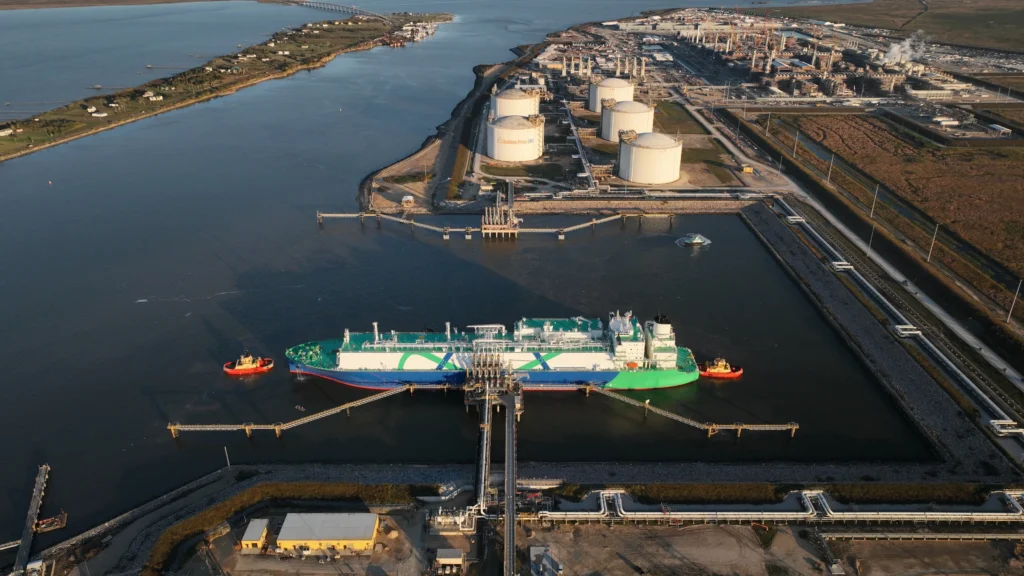
Golden Pass LNG operates one of the largest LNG export terminals in North America, configured with three liquefaction trains delivering a total nameplate capacity of 18.1 million tonnes per annum, five 155,000 cubic metre LNG storage tanks, and two marine berths designed to accommodate the largest LNG carriers currently in service. Train 1, now in production, has a nominal output of approximately 5.2 million metric tonnes per annum. The second and third trains are expected to come online in late 2026 and 2027 respectively, meaning full facility capacity will not be reached until next year, a constraint that limits near-term market relief but confirms a sustained ramp trajectory. With first cargo deliveries now anticipated before the end of June 2026, the facility will begin contributing to global LNG supply in a meaningful, if initially partial, way during a period of exceptional tightness.
The existing terminal infrastructure at Sabine Pass includes the import-era facilities that Golden Pass originally built in the early 2000s, when the project was designed to receive LNG from the Middle East for regasification and distribution into the U.S. domestic market. That original import-terminal model was rendered commercially obsolete by the shale gas revolution, which turned the United States from a net importer to the world’s largest LNG exporter. The conversion and expansion required retrofitting the existing storage and marine assets while constructing three new liquefaction trains and associated treatment, power, and utility systems. That construction programme, which saw final engineering and procurement managed by a joint venture of Chiyoda, McDermott, and Zachry, ran significantly over schedule and cost following Zachry Holdings’ bankruptcy filing in May 2024, which forced a contractor restructuring before new crews could resume work.
What construction setbacks delayed Golden Pass LNG and how did the project overcome the Zachry bankruptcy in 2024?
The $10 billion-plus capital commitment made in 2019 ultimately landed roughly $2 billion over the original budget, a cost overrun attributable in large part to the disruption caused by the contractor crisis. Zachry Holdings, one of three partners in the engineering, procurement, and construction consortium, filed for bankruptcy in May 2024 and initiated a structured exit from the project, citing financial challenges connected to the Golden Pass construction programme specifically. The exit triggered thousands of layoffs on site and required QatarEnergy and ExxonMobil to reorganise the workforce and contractor relationships before activities could resume at full pace. The delay pushed the original commissioning timeline back by several quarters and added to the project’s cost base, though the sponsors ultimately absorbed those overruns and brought the facility through to first LNG without abandoning the project structure.
The completion of Train 1 commissioning and the achievement of first LNG in March 2026 reflects the success of that recovery effort. ExxonMobil’s CEO Darren Woods had previously indicated publicly that he expected first LNG volumes in early March, noting that Train 1 achieved mechanical completion in the final quarter of 2025. The actual milestone came slightly later than that early guidance, but within the broader timeframe markets were tracking. Golden Pass CEO Alex Savva characterised the achievement as reflecting the dedication of employees, shareholders, and partner organisations across a programme that required sustained commitment over many years and through at least one major contractor disruption.
How does the Hormuz crisis and the Ras Laffan outage reshape the commercial value of cargoes from Sabine Pass?
The timing of Golden Pass LNG’s first production is extraordinary in the context of global energy markets. Iran’s effective closure of the Strait of Hormuz has paralysed commodity flows from the Persian Gulf, sidelining not just the Ras Laffan facility but also disrupting shipping across a region that collectively supplies a substantial proportion of global energy. Asian LNG spot prices have surged approximately 90 percent since the conflict began, while European benchmark gas futures jumped to roughly 50 percent above pre-conflict levels in the immediate aftermath of the Ras Laffan attack. Morgan Stanley analysts warned in research published in early March 2026 that the damage to QatarEnergy’s facilities could eliminate the supply surplus that had been forecast for the global LNG market in 2026, tightening conditions and lifting price risk across both European and Asian import markets.
For buyers scrambling to secure replacement supply, cargoes originating from the U.S. Gulf Coast carry an entirely different geopolitical risk profile from cargoes that require Persian Gulf transit. Golden Pass LNG at Sabine Pass can load tankers bound for Europe, Asia, or any other destination without any exposure to the Hormuz bottleneck. That physical characteristic, previously an operational detail, has become a commercially significant differentiator in a market where the security of supply chain routing now commands a measurable premium. Europe, which was already managing unusually low storage inventories heading into the 2026 summer refilling season, faces the most immediate pressure, as the disruption increases competition for all available Atlantic Basin LNG cargoes. Asian importers, particularly those with high exposure to Qatari contracted volumes now under force majeure, face a structural supply gap that cannot be bridged by short-term spot procurement alone.
How is ExxonMobil stock performing and what does the Golden Pass milestone signal to investors in XOM?
ExxonMobil shares closed at $171.47 on the NYSE on 30 March 2026, touching an intraday and 52-week high of $176.41 the same session, a level the stock had not reached in at least twelve months. The 52-week low of $97.80 was recorded on 10 April 2025, meaning the stock has approximately doubled from trough to peak over the trailing year, a performance that reflects both company-specific operational delivery and the broader energy market repricing triggered by the Middle East conflict. ExxonMobil has delivered a trailing twelve-month return of over 44 percent, with the stock up approximately 11 percent over the past thirty days alone as crude oil prices pushed above $100 per barrel for the first time since 2022.
The consensus analyst rating for ExxonMobil remains a Buy, though the average twelve-month price target of around $156 sits below the current trading price, suggesting that part of the recent rally reflects exogenous shock factors rather than purely fundamental re-rating. That context matters for interpreting the Golden Pass announcement: the milestone is strategically significant and commercially well-timed, but the stock’s recent performance has been driven as much by oil prices above $100 per barrel and geopolitical risk premiums as by any single project event. Over the longer arc, Golden Pass adds an estimated 5.2 million metric tonnes per annum of LNG-linked revenue when Train 1 reaches sustained operations, with the full facility’s 18.1 million tonne capacity representing a meaningful, recurring cash flow contributor once all three trains are commissioned. For investors assessing ExxonMobil’s portfolio durability through an energy transition period, the Golden Pass milestone adds a long-cycle LNG asset with decades of operating life to a production base the company has committed to growing through Permian basin output, Guyana deepwater expansion, and LNG.
What competitive and industry implications follow from a new 18 mtpa U.S. LNG facility entering service in 2026?
Golden Pass LNG enters service as the United States consolidates its position as the world’s largest LNG exporter, a role it assumed only a few years ago after the shale revolution fundamentally reordered global gas trade flows. The facility joins a Gulf Coast export cluster that includes Sabine Pass LNG operated by Cheniere Energy, Freeport LNG, Cameron LNG, and the more recently commissioned Corpus Christi and Plaquemines facilities, collectively giving the United States an export capacity base that no other country can match at present. The broader U.S. LNG buildout benefits from a structural advantage in feedstock pricing: Henry Hub gas, priced in dollars per million British thermal units and historically lower than international benchmarks, forms the cost foundation for all U.S. LNG export economics. In a tightened global market where international spot LNG prices have surged to multi-year highs, the margin dynamics for U.S. liquefaction operators have rarely been more favourable.
For the broader competitive landscape, Golden Pass represents both supply addition and a qualified offset to the Ras Laffan outage. At 18.1 million tonnes per annum at full capacity, it represents less than a full replacement for the 12.8 million tonnes per annum sidelined at Ras Laffan, and its Train 2 and Train 3 ramp will extend through late 2026 and into 2027. The implication is that global LNG markets face a multi-quarter period during which supply recovery is gradual and demand pressure, particularly in Europe and Asia, remains elevated. That environment favours all operating LNG producers with flexible or spot-linked volume, including Cheniere Energy, Shell, TotalEnergies, and the Australian LNG consortiums, all of which stand to benefit from sustained price elevation. The medium-term risk is the reverse scenario: if the Hormuz crisis de-escalates faster than expected and Ras Laffan damage proves repairable ahead of the worst-case five-year estimate, a significant oversupply correction could materialise in 2027 as new trains come online into a partially re-supplied market.
What are the execution risks and next milestones between first LNG production and full Golden Pass commercial operations?
Between first LNG and full commercial operations, Golden Pass must navigate several operationally distinct phases that each carry their own execution risk. The immediate near-term objective is the achievement of sustained liquefaction operations from Train 1 and the delivery of a first cargo to a global customer, both of which the company expects to complete in the second quarter of 2026. The transition from first LNG to sustained operations involves progressively increasing throughput while maintaining safety, equipment integrity, and process stability across the full liquefaction, storage, and loading chain. The commissioning of large-scale LNG trains has historically seen variability between first molecule and stable nameplate output, a consideration that applies here even absent any further contractor or construction complications.
The subsequent commissioning of Trains 2 and 3 carries integration risk even as Train 1 is reaching steady-state performance. The facility will be managing active operations alongside continued construction and commissioning activity, which requires rigorous operational sequencing and safety management. The workforce and organisational capacity implications are non-trivial: the same management team responsible for Train 1 start-up will need to run operations while overseeing the next two train commissionings. QatarEnergy and ExxonMobil both have extensive global LNG operating experience, with the ExxonMobil team having drawn on assignments across Australia, Malaysia, Indonesia, Nigeria, and Qatar for the Golden Pass commissioning roster, which provides reasonable grounds for confidence in execution capability. The commercial objective is to deliver reliable, high-uptime performance against long-term offtake contracts and to build a track record that supports the reputational case for QatarEnergy’s U.S. investment strategy over the next decade.
Key takeaways: What Golden Pass LNG first production means for QatarEnergy, ExxonMobil, and global LNG markets
- Golden Pass LNG has achieved first production from Train 1 at Sabine Pass, Texas, marking the operational transition of the $10 billion-plus QatarEnergy and ExxonMobil joint venture from construction to active LNG export operations.
- The milestone arrives as roughly 20 percent of global LNG supply is sidelined due to Iranian strikes on QatarEnergy’s Ras Laffan facility and the effective closure of the Strait of Hormuz, turning Golden Pass’s Gulf Coast geography into a strategic asset rather than a logistical footnote.
- First cargo deliveries are expected in Q2 2026, with Trains 2 and 3 scheduled for late 2026 and 2027, meaning full 18.1 million tonne per annum capacity will not be reached until next year.
- European and Asian gas buyers face a structural supply gap that Golden Pass partially but not fully addresses; Train 1 at roughly 5.2 million mtpa is insufficient to offset the 12.8 million mtpa sidelined at Ras Laffan.
- ExxonMobil (XOM) shares touched a fresh 52-week high of $176.41 on 30 March 2026 and have gained over 44 percent in the trailing twelve months, reflecting both company-specific delivery and a broader energy market repricing as crude oil pushes above $100 per barrel.
- The project ran approximately $2 billion over budget and experienced significant delays after lead contractor Zachry Holdings filed for bankruptcy in May 2024, requiring a restructuring of the EPC consortium before construction could resume.
- Golden Pass represents QatarEnergy’s largest single investment in the United States and a central component of the company’s $20 billion U.S. energy commitment, providing a supply lifeline that does not depend on Persian Gulf infrastructure.
- The medium-term industry risk is a potential oversupply correction in 2027 if Ras Laffan repairs accelerate and multiple new LNG trains globally come online simultaneously into a market that has partially stabilised.
- Competitors including Cheniere Energy, Shell, TotalEnergies, and Australian LNG consortiums benefit from the same market tightness in the near term, as sustained elevated spot prices improve margins across all operating LNG export facilities.
- Execution risk remains between first LNG and sustained commercial operations: the operational ramp-up of Train 1 alongside concurrent commissioning of Trains 2 and 3 will test the facility’s management bandwidth and safety protocols across a complex multi-phase start-up schedule.
Discover more from Business-News-Today.com
Subscribe to get the latest posts sent to your email.