



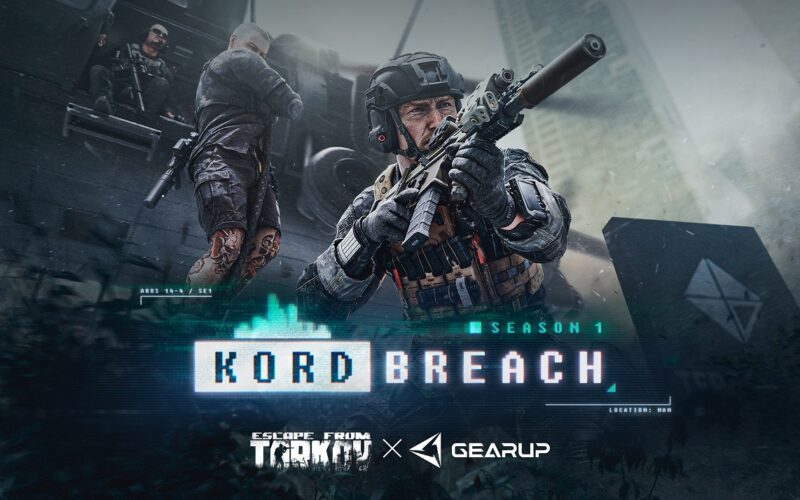
GearUP Portal Pte. Ltd. has partnered with Battlestate Games Limited’s Escape from Tarkov to provide network optimisation during the tactical shooter’s new Kord Breach season, with free access to the GearUP service running from August 4 through August 11, 2026. The collaboration is designed to reduce latency, packet loss and connection instability for players accessing Escape from Tarkov across different regions. For GearUP, however, the more important business opportunity extends beyond improving connectivity during one gaming event. The campaign places its subscription-led network optimisation product in front of a highly engaged audience at precisely the point when a major seasonal update is encouraging players to return, making conversion after the free period the real commercial test.
The timing matters because Escape from Tarkov has just moved further toward the recurring seasonal engagement model that dominates much of modern online gaming. The Kord Breach update introduced the game’s first seasonal system, including Global Modifiers, a Kord Breach task line and a free Battle Pass, adding another reason for existing and returning players to spend sustained time inside the game.
That creates favourable conditions for a network optimisation provider. A player experimenting with GearUP during a quiet period may struggle to determine whether the service materially changes the experience. A player returning for a major season, potentially playing longer sessions and connecting repeatedly to multiplayer servers, has far more opportunities to judge whether routing optimisation makes a noticeable difference.
Financial terms between GearUP and Battlestate Games Limited were not disclosed. That makes it inappropriate to treat the partnership as a directly measurable revenue event. Its strategic value instead lies in distribution, product sampling, brand credibility and the possibility that temporary free users become paying customers after August 11.
Why does the Escape from Tarkov Kord Breach season create an unusually useful trial window for GearUP?
Network optimisation services face a fundamental marketing challenge: their product is invisible when everything works properly.
Unlike a graphics card, controller or monitor, there is no physical feature for a customer to inspect. The value proposition becomes noticeable mainly when a user experiences high latency, packet loss, jitter, unstable routing or difficulty maintaining reliable connections to geographically distant servers.
Escape from Tarkov provides an interesting environment in which to demonstrate that proposition because connectivity can directly affect the perceived quality of a high-stakes multiplayer session. GearUP says its technology selects optimised paths between users and game servers rather than altering the underlying game. The company describes its service as connection optimisation, explicitly separating it from modifications to gameplay itself.
That distinction matters. GearUP cannot eliminate every potential source of lag. Server-side problems, inadequate local hardware, overloaded home Wi-Fi or other infrastructure constraints may remain outside the scope of routing optimisation. What the product is attempting to address is the path that gaming traffic takes across networks, particularly when conventional routes are congested or inefficient.
The Kord Breach launch consequently gives GearUP a relatively concentrated opportunity to demonstrate its value proposition under real playing conditions.
Battlestate Games Limited is simultaneously supporting the first season with other engagement mechanisms, including a Twitch Drops campaign running during August. Taken together, these initiatives create a period in which player attention is likely to be considerably more concentrated than during an ordinary mid-season week.
For GearUP, concentrated attention is commercially useful even without a disclosed payment from Battlestate Games Limited. Product discovery may be the more important asset.

How could seven days of free Escape from Tarkov acceleration become a customer-acquisition funnel for GearUP?
The commercial structure resembles a software sampling campaign more than a conventional sponsorship.
GearUP has made its Escape from Tarkov optimisation available without requiring an active membership during the August 4 to August 11 promotional period. That removes the immediate subscription decision and allows players to test whether the service improves their own network conditions.
The strategic sequence is straightforward. Players encounter GearUP through a game they already intend to play, activate the optimisation service without an upfront membership commitment, accumulate personal experience with the product and then decide whether that improvement is worth paying for once free access ends.
That is materially different from acquiring customers through generic performance advertising.
A user who arrives through an online advertisement may still need convincing that a network optimisation tool is relevant. An Escape from Tarkov player using GearUP during Kord Breach has already moved several steps down the customer-acquisition funnel. The game provides the use case, the seasonal event provides urgency and the free period reduces initial friction.
The unresolved question is conversion.
Neither the partnership announcement nor the companies’ public material provides a conversion target, expected number of trial users, customer-acquisition cost or projected revenue contribution. Without those metrics, the commercial impact cannot yet be quantified.
The most meaningful evidence would therefore emerge after the campaign: how many Escape from Tarkov players activated the service, how frequently they used it, whether engagement remained high throughout the free period and how many subsequently became paying members.
Why is Escape from Tarkov strategically different from simply adding another supported game?
GearUP already supports thousands of games, so technical compatibility with another title would not by itself constitute a particularly significant development.
The distinction is the formal collaboration.
GearUP says its platform currently supports more than 3,000 games and has more than eight million monthly active users. It also highlights partnerships or integrations involving gaming and technology brands including Discord, ASUS, PUBG and Where Winds Meet.
Those relationships indicate that GearUP is attempting to expand through ecosystems rather than depending entirely on consumers independently discovering a network booster.
Escape from Tarkov fits that strategy well. The title has spent years building a recognisable position within hardcore tactical and extraction shooters, while Battlestate Games Limited continues to develop it following the full release of Escape from Tarkov in November 2025.
Association with established games can reduce one of the obstacles facing network optimisation providers: trust.
Gaming connectivity software interacts with network traffic, meaning users may reasonably want reassurance that the software is compatible with the game and does not interfere with gameplay systems. An officially promoted collaboration can therefore carry greater commercial weight than merely listing a title inside a catalogue of supported games.
In that sense, the partnership gives GearUP both distribution and validation.
Can GearUP turn game partnerships with Escape from Tarkov, PUBG and others into a scalable distribution strategy?
The broader strategic question is whether individual game partnerships can be repeated economically.
GearUP appears to be building several routes into the gaming market. Its products span Windows computers, mobile devices, consoles and supported routers, while partnerships with hardware and gaming platforms provide additional entry points beyond direct software downloads.
That model could become more powerful as the company adds recognisable games.
A user initially attracted by Escape from Tarkov does not necessarily remain valuable only when playing Escape from Tarkov. Because the same GearUP membership can support a much wider gaming library, customer acquisition around one title can potentially generate engagement across multiple games.
This creates the possibility of portfolio economics.
Rather than treating every supported title as an independent product, GearUP can use individual releases, seasons, tournaments and gaming events as acquisition moments for a broader network service. A player may arrive because of Escape from Tarkov, subsequently use the service for another multiplayer game and become less dependent on any single content cycle.
The challenge is ensuring that partnerships generate incremental users rather than simply subsidising existing customers.
Free promotional access carries an economic cost because network optimisation requires infrastructure and bandwidth. The partnership becomes more attractive if it attracts new users who later subscribe or increases retention among existing customers. It becomes less compelling if large numbers of users consume free capacity but disappear immediately after the campaign.
That is why post-campaign retention matters more than headline download numbers.
What does GearUP’s eight-million-user scale suggest about competition in gaming network optimisation?
GearUP’s claim of more than eight million monthly active users suggests that gaming connectivity has developed into a meaningful software category rather than remaining a specialist tool for a small group of technically sophisticated players.
The addressable problem is easy to understand. Online gaming is global, while network performance remains highly dependent on geography, internet service providers, peering relationships, congestion and server location.
Games themselves cannot control every part of that network path.
This creates room for specialised routing providers that attempt to identify more efficient routes between players and game infrastructure. The commercial opportunity becomes particularly relevant for users playing on servers outside their immediate region or in markets where internet routing quality varies materially between providers.
Scale, however, does not automatically establish defensibility.
Network optimisation providers ultimately compete on measurable performance, geographic infrastructure, game compatibility, pricing and customer confidence. Marketing partnerships can attract users, but retention depends on players seeing a sufficiently consistent difference to justify continuing a paid membership.
GearUP’s growing catalogue and partnership network therefore provide reach. The harder requirement is demonstrating that reach can translate into durable customer economics.
Why could game publishers increasingly treat connectivity partners as part of player retention strategy?
The Escape from Tarkov collaboration also points toward a broader change in how online games may approach technical experience.
Historically, publishers primarily focused on infrastructure directly under their control, including game servers, matchmaking and software optimisation. Yet the player’s connection crosses infrastructure outside the publisher’s network before reaching those servers.
A technically healthy game server can still deliver a frustrating experience when the route between the player and that server is inefficient.
Third-party network optimisation providers position themselves inside that gap.
For publishers, such partnerships can become a relatively lightweight way of offering players another troubleshooting option without rebuilding telecommunications infrastructure themselves. For connectivity providers, game partnerships supply a highly targeted audience whose need for the service becomes immediately understandable.
The economics may become particularly attractive around launches and seasonal updates.
Those are periods when publishers want returning users to stay engaged, while network optimisation providers want consumers to experience their products under conditions where performance differences are easiest to notice.
Escape from Tarkov’s Kord Breach season provides exactly that overlap.
What would show whether the GearUP and Escape from Tarkov partnership created lasting commercial value?
The collaboration already gives GearUP greater exposure among Escape from Tarkov players, but visibility should not be confused with demonstrated commercial success.
The strongest next evidence would be retention data.
If a meaningful proportion of users who receive free optimisation through August 11 continue using GearUP afterwards, the campaign would provide evidence that gaming partnerships can serve as an efficient subscription-acquisition channel. Repetition of similar campaigns around other major game launches could then become strategically more significant.
Additional developer and hardware relationships would strengthen that model further because they would diversify where GearUP acquires users.
Conversely, weak conversion would suggest that free access is useful primarily as branding rather than as a direct subscription funnel. That would not make partnerships worthless, but it would change how their economic value should be assessed.
For Battlestate Games Limited, the test is simpler. Players need to perceive that the collaboration contributes to a smoother experience without interfering with the hardcore mechanics that define Escape from Tarkov.
For GearUP, the standard is higher.
The company has already built scale, claims millions of monthly active users and supports thousands of games. The next stage is showing that formal partnerships with titles such as Escape from Tarkov can convert momentary attention into persistent use. The August 11 end of the free-access campaign is therefore not really the end of this partnership’s business test. It is when the more important measurement begins.
What are the key takeaways from the GearUP and Escape from Tarkov Kord Breach partnership?
- GearUP Portal Pte. Ltd. and Escape from Tarkov have launched a network optimisation collaboration around the new Kord Breach season.
- Escape from Tarkov players can use the dedicated GearUP optimisation service without an active membership from August 4 through August 11, 2026.
- The campaign targets latency, packet loss and unstable network routing rather than changing Escape from Tarkov gameplay.
- The timing gives GearUP access to players returning for Escape from Tarkov’s first seasonal system and free Battle Pass.
- GearUP says its broader platform has more than eight million monthly active users and supports more than 3,000 games.
- The company already highlights relationships involving Discord, ASUS, PUBG and other gaming brands, suggesting partnerships are becoming part of its distribution strategy.
- No financial terms, user-acquisition targets or expected revenue contribution from the Escape from Tarkov collaboration were disclosed.
- The most important commercial measurement will be whether free Escape from Tarkov users continue using GearUP after August 11.
- Strong conversion could support more launch-driven partnerships with game publishers, while weak retention would make the initiative primarily a brand-awareness exercise.
Discover more from Business-News-Today.com
Subscribe to get the latest posts sent to your email.