




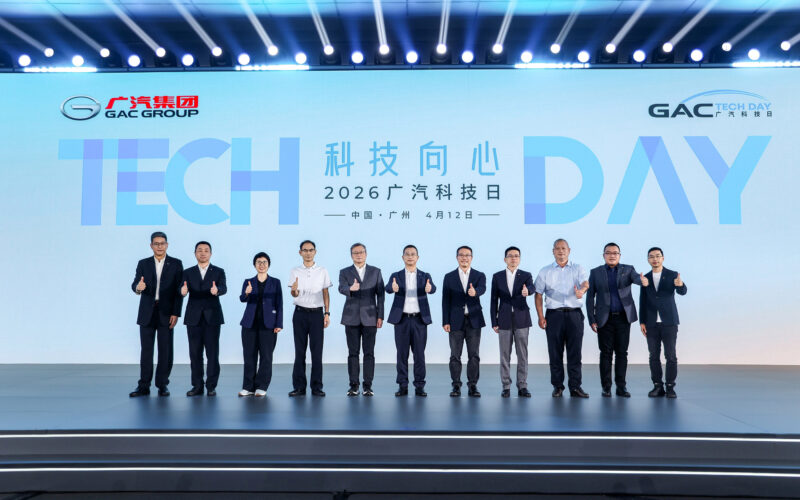
Guangzhou Automobile Group Co., Ltd. (2238.HK) used Tech Day 2026 to present five core technology pillars spanning hybrid powertrains, vehicle body engineering, intelligent systems, electronic architecture, and automotive semiconductors. On the surface, the event looked like a broad technology showcase. In practice, it was a strategic statement about how the Chinese automaker wants to compete in the next phase of smart mobility, where advantage is increasingly defined by control over the full vehicle stack rather than by isolated model launches. The event matters because it suggests Guangzhou Automobile Group is trying to move from being seen as a vehicle manufacturer with technology programs to being judged as a mobility platform builder with increasingly integrated hardware and software capabilities.
The significance of that shift is easy to underestimate. China’s electric and intelligent vehicle market is no longer rewarding generic electrification narratives in the way it did a few years ago. Consumers now expect strong software, credible assisted-driving capabilities, energy efficiency, rapid digital upgrades, and brand experiences that feel coherent rather than bolted together. For established vehicle groups, that raises the bar. It is no longer enough to produce a competitive electric sedan or launch a new hybrid drivetrain. The harder task is to prove that powertrain, body, cockpit, software, connectivity, and silicon can be developed as one system that delivers lower cost, better durability, and faster iteration. That is the battleground Guangzhou Automobile Group chose to address directly.
Why Guangzhou Automobile Group is emphasizing hybrid systems instead of treating electrification as a one-path strategy
The first major signal from the event was Guangzhou Automobile Group’s treatment of hybrid technology as a central pillar rather than a transitional footnote. Under the ADiMOTION Power label, the company grouped range extension, plug-in hybrid, and hybrid-electric solutions into a single architecture-led power strategy. That matters because the Chinese and global market are both showing that the future of electrification is more mixed than some automakers had expected. Battery electric vehicles remain strategically critical, but hybrid formats are proving especially valuable in markets where charging infrastructure, price sensitivity, and range anxiety still shape buying behavior.
By framing ADiMOTION as a full-scenario solution, Guangzhou Automobile Group is trying to position itself for wider demand coverage. That gives it a chance to defend share across customer segments that may not be ready for a pure battery electric shift. It also improves the company’s ability to tailor propulsion formats to different use cases, including family vehicles, larger utility vehicles, and regional markets with uneven charging networks. In other words, this is not just an engineering update. It is an attempt to build commercial flexibility into the company’s future lineup.
The fuel-efficiency claims also matter strategically, even if they should still be read as performance targets that must be validated in the market. If Guangzhou Automobile Group can deliver hybrid products that materially improve consumption in larger vehicle classes, it gains a more persuasive value proposition in a market where consumers are comparing not only purchase price but long-term operating cost. That becomes especially relevant when competition intensifies and discounting pressures margins. Better efficiency can act as both a consumer selling point and a margin-defense mechanism, because it gives a brand something more durable to market than price alone.

How does the new Starship Body platform change Guangzhou Automobile Group’s position in utility and lifestyle vehicles?
The Starship Body concept may sound like event-stage branding, but the underlying engineering direction is more important than the name. Guangzhou Automobile Group is effectively arguing that it can combine the structural strengths of rugged frame-based vehicles with the comfort and packaging benefits of monocoque design. If executed well, that would widen the company’s room to compete in categories where lifestyle utility, towing, outdoor capability, and daily usability increasingly overlap.
This matters because utility vehicles are no longer niche products in China or in export markets. Consumers increasingly want vehicles that can signal robustness without punishing them with crude ride quality or obvious trade-offs in daily use. Guangzhou Automobile Group’s claim around torsional stiffness and towing capacity points to a deliberate effort to serve this blended demand. Strategically, that could support the development of more premium or adventure-oriented products that expand brand reach beyond traditional commuter segments.
There is also a second-order industrial implication. Vehicle body innovation is often overshadowed by software and battery headlines, yet it can be one of the clearest sources of long-term competitive separation. A more capable structural platform can improve safety perception, reduce platform fragmentation, support multiple body styles, and extend product optionality over time. That is why the Starship Body announcement deserves more attention than it may initially receive. It is a reminder that smart mobility is not only about screens and algorithms. Mechanical and structural engineering still determine what kinds of products an automaker can credibly build.
What does ADiGO Intelligence really signal about Guangzhou Automobile Group’s software and user-experience ambitions?
The intelligence layer is where Guangzhou Automobile Group most clearly tried to shift the conversation from feature accumulation to user understanding. ADiGO Intelligence, with its cloud-edge architecture and three AI engines focused on perception, multi-agent collaboration, and emotional expression, suggests the company wants its cockpit and digital services to become more anticipatory. That language needs to be translated cautiously, because auto companies frequently overstate how close in-car intelligence is to truly proactive assistance. Even so, the strategic direction is clear.
Guangzhou Automobile Group is trying to move beyond the reactive command model that has defined many automotive interfaces. Instead of waiting for a user to trigger each function, the company wants its system to infer intent, coordinate functions across the cabin, and create a more personalized experience. If successful, that would improve both user stickiness and brand differentiation. Smart cockpits are becoming central to repeat-purchase decisions, especially in China, where consumers are often more willing to evaluate vehicles like connected devices.
There is also a broader competitive reason this matters now. In the intelligent vehicle race, software quality increasingly shapes the perception of the whole brand. A good powertrain can be hidden behind a weak digital experience, but a poor software experience is visible every day. That means cockpit intelligence is not just a feature layer. It is a frontline reputational layer. Guangzhou Automobile Group appears to understand that, and Tech Day 2026 was partly an attempt to show it can build a more coherent digital identity for its vehicles.
Why X-SOUL Architecture 4.0 could matter more to execution than most flashy product-stage claims
If there was one announcement with the strongest operational implications, it was X-SOUL Architecture 4.0. Guangzhou Automobile Group described it as a six-domain fusion platform covering intelligent driving, cockpit, powertrain, chassis, body, and connectivity. That may sound technical, but it goes directly to a core problem in the modern auto industry: complexity inflation.
As vehicles become more software-defined, automakers risk creating layered, fragmented architectures that are expensive to update, hard to validate, and slow to scale. Domain fusion is meant to simplify that problem. If Guangzhou Automobile Group can genuinely reduce hardware redundancy, streamline control logic, and accelerate over-the-air deployment, it gains advantages that go well beyond headline feature upgrades. It can shorten iteration cycles, reduce maintenance friction, improve bug-fix speed, and potentially lower total development cost across future programs.
The promised eight-minute full-vehicle over-the-air upgrade timeline is also strategically relevant because it speaks to user trust. Fast update capability is not just a neat engineering statistic. It implies that the company wants to deliver something closer to consumer-electronics responsiveness in an automotive setting. That matters because customer expectations are drifting in that direction. The less painful the update experience, the more realistic it becomes for an automaker to treat software refreshes as an ongoing value channel rather than as a periodic nuisance.
How important is Guangzhou Automobile Group’s domestic chip strategy in the wider Chinese auto supply chain shift?
The semiconductor piece may be the most consequential of the five pillars, because it touches industrial policy, supply-chain resilience, and future cost control at the same time. Guangzhou Automobile Group said it has jointly developed nearly 400 chips with 105 ecological partners and plans to launch what it describes as China’s first intelligent new energy vehicle with a fully domestic chip design. That announcement goes beyond branding. It aligns with a broader effort inside China’s technology and manufacturing sectors to reduce dependence on external semiconductor bottlenecks.
For Guangzhou Automobile Group, domestic chip capability offers three possible advantages. First, it can improve resilience against supply shocks and geopolitical disruptions. Second, it can give the company greater control over vehicle function design and cost optimization. Third, it can create a platform advantage if these chips are integrated tightly with the company’s own software and architecture layers. That is why the chip narrative is not separate from the rest of the event. It is the glue that makes the full-stack story more credible.
The company’s decision to say it will open chip achievements to the wider industry is also revealing. On one level, this sounds collaborative and ecosystem-oriented. On another, it suggests Guangzhou Automobile Group wants to participate in standard-setting rather than merely consume standards set by others. That can be strategically valuable if sectors such as rail transit, low-altitude mobility, and embodied intelligence become larger adjacent growth arenas. It is an attempt to widen the relevance of the company’s technology base beyond passenger vehicles alone.
Can Guangzhou Automobile Group convert Tech Day 2026 into commercial traction in China’s crowded smart mobility race?
That is the central question, and it remains open. Technology days are useful for signaling direction, but the market eventually judges product execution, cost discipline, quality consistency, and brand desirability. Guangzhou Automobile Group has laid out a broad and ambitious stack. The challenge now is proving that these pieces translate into competitive products at scale rather than staying trapped in presentation logic.
Execution risk sits in several places. Hybrid gains must translate into real consumer value and not just laboratory certification. Intelligent systems must perform reliably in messy real-world environments. Electronic architecture claims must lead to smoother ownership experiences, not just faster demos. Domestic chip development must avoid becoming a political talking point without sufficient commercial impact. In short, the company has raised the burden of proof for itself.
Still, the strategic direction looks rational. Rather than betting everything on a single hero product, Guangzhou Automobile Group is trying to build layered capability across the vehicle stack. In the current market, that is a more durable way to compete. It does not guarantee leadership, and it certainly does not make competition easier. However, it does suggest the company understands where the industry’s center of gravity is moving. Smart mobility is no longer about adding intelligence around the edges of the car. It is about redesigning the car as an integrated digital, electrical, and mechanical system. Tech Day 2026 was Guangzhou Automobile Group’s clearest attempt yet to show it wants to play that game on its own terms.
What are the key takeaways from Guangzhou Automobile Group’s Tech Day 2026 for executives, competitors, and investors?
- Guangzhou Automobile Group is trying to reposition itself as a full-stack smart mobility player rather than a conventional automaker with scattered technology programs.
- The hybrid strategy suggests the company sees electrification as a portfolio problem, not a single-format race, which could improve resilience across mixed-demand markets.
- Structural innovation through the Starship Body platform points to a serious push into more capable and versatile vehicle categories, not just digital upgrades.
- ADiGO Intelligence shows Guangzhou Automobile Group understands that software quality is now central to brand perception and repeat-purchase behavior.
- X-SOUL Architecture 4.0 may be the most commercially important announcement because architecture simplification can improve update speed, cost control, and scalability.
- Domestic chip development is not only a supply-chain hedge, it is also an attempt to gain tighter control over function design and long-term margin structure.
- Opening chip achievements to adjacent sectors hints at a broader ecosystem ambition that could extend beyond passenger vehicles over time.
- The company’s strategy appears aligned with China’s industrial push for deeper localization in critical auto technologies, especially semiconductors and intelligent systems.
- The real test now shifts from technical claims to productization, reliability, and whether consumers can feel the difference in actual vehicles.
- For competitors, the message is that differentiation in the next phase of mobility will come from system integration, not from isolated headline features.
Discover more from Business-News-Today.com
Subscribe to get the latest posts sent to your email.