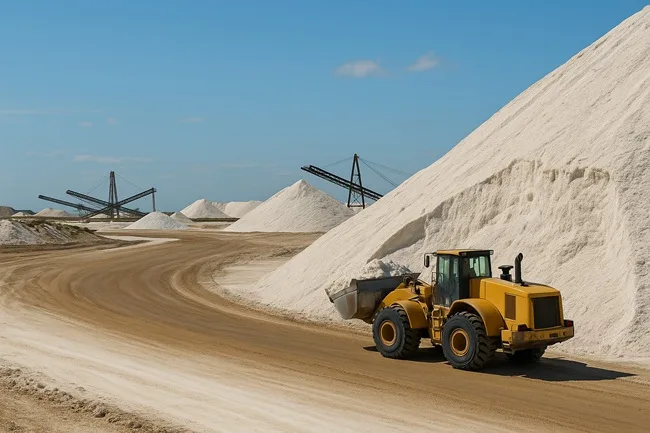





Sow Good Inc. (Nasdaq: SOWG) has entered into a definitive agreement to acquire the Tanzanian subsidiaries holding the Nachu Graphite Project from Ryzon Materials Ltd, marking a dramatic shift from its origins as a freeze-dried snack company into a prospective critical minerals and battery anode developer. The transaction, structured as an all-share deal, positions Sow Good Inc. to participate in the global lithium-ion battery supply chain at a time when demand for non-China graphite sources is intensifying.
This is not just a diversification strategy. It is a wholesale reinvention. And markets, predictably, are treating it with a mix of intrigue and skepticism. Early trading behavior and investor commentary suggest that credibility and execution risk, rather than the asset itself, are driving initial sentiment.
Why is Sow Good Inc. entering the graphite and battery anode market at a critical inflection point for global supply chains?
The move comes at a time when graphite has quietly become one of the most strategically sensitive inputs in the lithium-ion battery ecosystem. While lithium and nickel dominate headlines, natural graphite remains essential for battery anodes, and global processing capacity is still heavily concentrated in China. Governments in the United States and Europe have made it clear that supply chain diversification is no longer optional but a policy priority.
Within that context, the Nachu Graphite Project in Tanzania offers a theoretically compelling entry point. The asset is described as an advanced-stage development project with a completed bankable feasibility study, a special economic zone license, and a reported 15.5-year mine life. The project also benefits from proximity to infrastructure, including access to the port of Mtwara, which could support export logistics.
More importantly, Sow Good Inc. is positioning Nachu not merely as a mining operation but as the foundation for a battery anode materials platform. That distinction matters. The value in graphite is increasingly shifting downstream toward processing and battery-grade material production, where margins and strategic relevance are higher.
How credible is Sow Good Inc.’s transition from consumer snacks to critical minerals development?
Sow Good Inc. is effectively attempting a sector leap that few companies successfully execute. Moving from consumer packaged goods into mining and battery materials is not an adjacent expansion. It is a complete operational and strategic reset. The skill sets, capital requirements, regulatory frameworks, and risk profiles are fundamentally different.
From an investor perspective, the credibility question is unavoidable. Sow Good Inc.’s historical business model, centered on freeze-dried treats, does not naturally translate into expertise in mineral development, project financing, or metallurgical processing. The company itself acknowledges that execution will depend on attracting experienced mining professionals and building a new technical leadership base. That creates a dependency on external talent and partners from day one. Without that, the pivot risks being perceived as opportunistic rather than strategic.
What does the Nachu Graphite Project actually offer in terms of scale, economics, and strategic positioning?
On paper, the Nachu Graphite Project has several attributes that align with what strategic investors look for in battery materials. The project is reported to host one of the larger known deposits of high-purity natural flake graphite globally. It is supported by a feasibility study prepared under the JORC Code and includes defined mineral resources and reserves that suggest long-term production potential. The presence of a special economic zone license also introduces potential tax and regulatory advantages.
Equally significant is the reported binding offtake agreement with a Tier-1 United States electric vehicle and energy storage manufacturer. If validated and maintained, such an agreement could provide demand visibility and support financing efforts.
However, there is a critical caveat. Sow Good Inc. explicitly states that it has not independently verified the technical and economic data associated with the project. That disclosure shifts part of the burden of proof onto future filings and third-party validation. Until the project is fully aligned with United States disclosure standards under S-K 1300, investors are likely to treat these figures with caution.
Why are investors reacting cautiously to what appears to be a strategically aligned acquisition?
The market’s initial hesitation is less about graphite and more about execution risk layered on top of capital structure concerns. The transaction involves significant share issuance, which introduces immediate dilution. At the same time, Sow Good Inc. has been managing Nasdaq compliance challenges, including minimum bid price requirements that necessitated a reverse stock split. These factors combine to create a perception that the company is simultaneously restructuring its equity base while attempting a capital-intensive pivot.
There is also the question of financing. Developing a graphite mine and downstream processing capability requires substantial capital investment, often in the hundreds of millions of dollars. Sow Good Inc. has indicated that it intends to pursue project-level financing through debt, export credit agencies, and strategic partnerships. While this approach is standard in mining, it is also highly dependent on project credibility, commodity price outlook, and partner confidence.
How does the project’s ownership history and geographic location influence risk perception?
The Nachu Graphite Project’s history adds another layer of complexity. The asset has changed hands through prior ownership structures, including development under Magnis Energy Technologies before being transferred to Ryzon Materials Ltd. Such transitions are not uncommon in mining, but they often reflect a combination of financing challenges, strategic shifts, or execution hurdles.
For Sow Good Inc., this means inheriting not just an asset but also its legacy. Investors will be closely watching for clarity around permitting continuity, contractual obligations, and the durability of prior feasibility assumptions.
Geographically, Tanzania has emerged as an increasingly important player in the global graphite market. The country offers resource scale but also introduces jurisdictional considerations, including regulatory stability, infrastructure execution, and political risk. These factors are manageable but require experienced local engagement and long-term operational planning.
What should executives and investors watch over the next 12 months to assess whether this pivot can succeed?
The next phase will be defined by validation rather than vision. Independent verification of the project’s technical and economic data under United States reporting standards will be the first major inflection point, as it establishes whether the inherited feasibility assumptions can withstand regulatory scrutiny and support credible valuation frameworks.
Clarity around the reported offtake agreement will carry equal weight. Market confidence will depend on understanding the strength of the counterparty, the durability of volume commitments, and the pricing structure, all of which directly influence the project’s ability to secure financing and move toward construction.
Attention will also shift to the formation of a credible execution team. The ability of Sow Good Inc. to attract experienced mining executives, technical specialists, and project finance expertise will determine whether the transition from consumer products to critical minerals is operationally viable rather than aspirational.
Financing progress will ultimately define the pace and credibility of the entire strategy. Evidence of strategic partners, debt providers, or export credit support would signal that external stakeholders view the project as bankable, whereas continued reliance on equity issuance could reinforce concerns around dilution and limit investor confidence.
What this development reveals about broader trends in capital markets and critical minerals strategy
Public markets are increasingly being used as vehicles to reposition assets into sectors aligned with long-term structural demand. Critical minerals, driven by electrification and energy transition themes, have become one of the most attractive targets for such repositioning.
At the same time, this trend highlights a tension between strategic opportunity and execution reality. While the demand outlook for battery materials is robust, the path from asset acquisition to production is long, capital-intensive, and technically demanding. Companies that can bridge that gap will be rewarded. Those that cannot risk becoming case studies in overextension.
Key takeaways on what this development means for the company, its competitors, and the industry
- Sow Good Inc. is attempting a full strategic reinvention, shifting from consumer products to critical minerals with implications for its investor base and valuation framework
- The Nachu Graphite Project offers potential entry into a supply-constrained segment of the battery ecosystem, particularly for non-China graphite supply
- Execution credibility, including technical validation and team building, will determine whether the pivot is viewed as strategic or speculative
- Significant share issuance and ongoing listing compliance challenges create near-term pressure on investor sentiment and stock performance
- The reported offtake agreement could be a key value driver, but only if independently verified and commercially robust
- Financing remains the central risk, with project-level funding likely to shape timelines and equity dilution outcomes
- The transaction reflects a broader trend of public companies repositioning toward energy transition materials, often with mixed results
- Competitors in the graphite and battery materials space may face increased attention as new entrants attempt to capture strategic supply chain positioning
Discover more from Business-News-Today.com
Subscribe to get the latest posts sent to your email.