




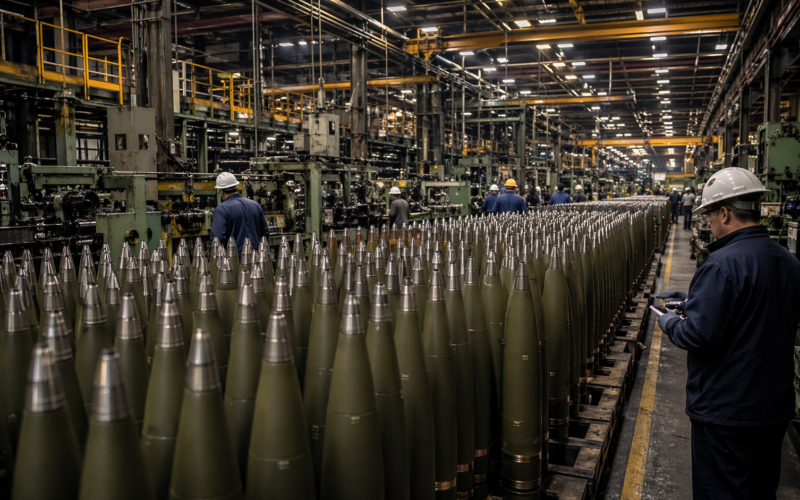
The United States defence industrial base is facing the defining supply constraint of the current geopolitical era: a structural mismatch between the global appetite for munitions and the physical capacity of American factories to fill it. The Stockholm International Peace Research Institute reported in March 2026 that the United States retained a 34 percent share of global arms exports across the 2021 to 2025 period, yet that dominance is being tested by simultaneous demand shocks from the Ukraine conflict, the ongoing Iran crisis, Middle East escalation, and the accelerating military buildups of European NATO allies and Indo-Pacific nations. The US Army is producing approximately 56,000 artillery shells per month as of early 2026, according to analysis by the National Interest, against an original pre-war baseline of 14,000 shells per month and a stated Army target of 100,000 monthly by mid-2026. That gap between current output and stated targets, measured against a backdrop of adversaries producing at exponentially higher rates, is the central problem that Washington’s defence industrial strategy must resolve.
What is driving the global munitions demand that US industry cannot currently satisfy?
The demand side of the equation has been reshaped by three compounding forces operating simultaneously. The Ukraine conflict established a consumption baseline that no Western industrial system was designed to sustain: the Atlas Institute for International Affairs, drawing on NATO and Centre for Strategic and International Studies data, found that Russia expanded its artillery shell production from roughly 400,000 rounds annually in 2022 to an estimated 4.2 million per year by 2025, supported by North Korean imports, giving Russian forces a five-to-one firing advantage over Ukrainian defenders. The second force is the Iran crisis of 2026, which has accelerated foreign military sales notifications from the United States to Middle Eastern partners at a pace not seen in recent decades. A Defence Security Monitor analysis of first-quarter 2026 data found that approved potential US arms sales to the Gulf region exceeded USD 16 billion in missile systems and related equipment within a single quarter, including USD 1.2 billion worth of Advanced Medium-Range Air-to-Air Missiles for the UAE alone. The third force is structural: global weapons transfer volumes rose 9.2 percent in the 2021 to 2025 period compared to the prior five-year period, the fastest increase in a decade, driven primarily by deliveries to Ukraine and accelerating procurement across European NATO members. The United States is now the sole industrial power expected to fill that aggregate gap, and the gap is widening faster than American factories can respond.
How does the US Army’s artillery shell production shortfall reveal deeper structural problems in the defence industrial base?
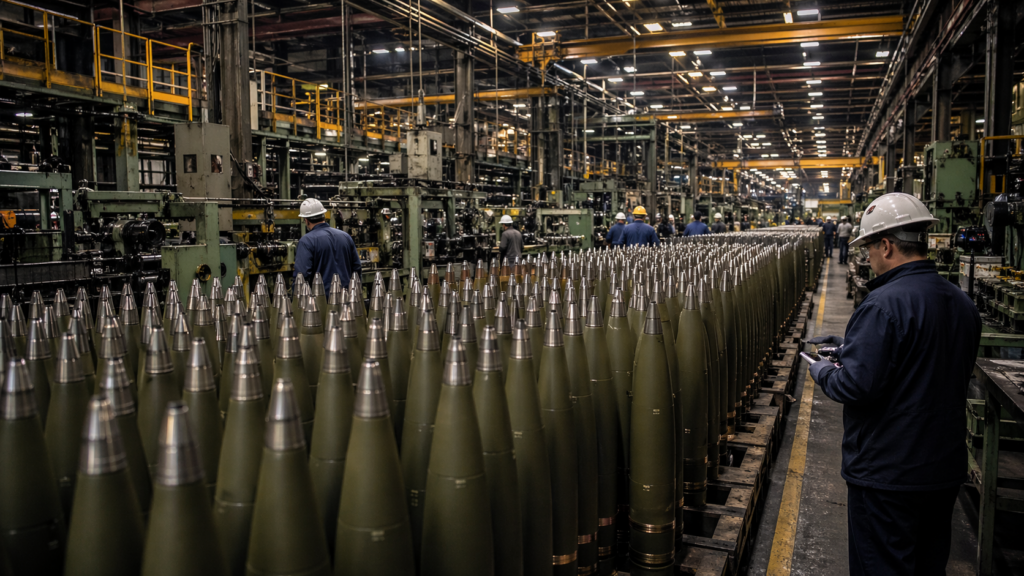
The Army’s goal of reaching 100,000 shells monthly by mid-2026 sounds impressive until one considers that Ukraine’s forces can fire that quantity in a matter of weeks during intensive operations. The National Interest’s analysis of the industrial base found that despite a USD 6 billion investment programme to achieve that monthly rate, production reached only 56,000 shells per month as of February 2026, with lack of energetics, tooling, and trained personnel identified as the primary bottlenecks. The competitive implication is significant: Russia’s 250,000 rounds per month in artillery shell output means that even if NATO reached its 2026 target of 267,000 rounds monthly across the entire Alliance, it would only achieve parity rather than superiority, an insufficient position for credible deterrence. The second-order consequence is one that Washington’s strategic planners are only beginning to quantify publicly: in late February 2026, reports surfaced that America’s top general opposed striking Iran, not because of fog and friction of war, but because it would drain valuable precision-guided munitions from already-exhausted stockpiles. When industrial capacity constrains operational decision-making at the highest levels of military command, the munitions problem has ceased to be a procurement question and become a strategic one.
Why are solid rocket motors and energetics the binding constraint on US precision munitions production?
The most acute bottleneck in American munitions production is not the assembly of finished weapons but the chemistry and manufacturing infrastructure that powers them. Over the past two decades, America’s solid rocket motor industry consolidated sharply, shrinking from six domestic manufacturers to two primary ones. The downstream consequences of that consolidation are now being felt across multiple simultaneous programmes. The US Department of War’s Under Secretary for Acquisition and Sustainment noted in December 2025 that the surge in demand for propellant-based weaponry, combined with a narrow supplier base, had created a production bottleneck in solid rocket motor components, prompting USD 32.7 million in emergency Defence Production Act Title III investments targeting two specialist firms in Washington and Arizona. A fatal explosion at Accurate Energetic Systems’s plant in October 2025 exposed the single-point-of-failure risks embedded throughout the supply chain, with defence data firm Govini noting that certain nozzle components require seven to ten months of lead time to source. The ammonium perchlorate problem is equally concentrated: for years, domestic solid rocket motor production has depended on a single approved source in American Pacific Corporation, owned by NewMarket Corporation, which has since approved a USD 100 million expansion to boost output by more than 50 percent, though the timeline for that expansion to feed into finished weapon systems extends well beyond 2026. Lockheed Martin Corporation (NYSE: LMT) and General Dynamics Corporation (NYSE: GD) broke ground in April 2025 on a joint solid rocket motor facility in Camden, Arkansas spanning 270 acres, with qualification builds planned for 2026, but facilities of that scale take years to reach full operational output.
How is RTX Corporation responding to precision munitions demand, and what do production targets reveal about the scale of the gap?
RTX Corporation (NYSE: RTX), through its Raytheon business, signed five framework agreements with the US Department of War in February 2026 to increase annual production of Tomahawk cruise missiles to more than 1,000 units, Advanced Medium-Range Air-to-Air Missiles to at least 1,900 units, and Standard Missile-6 interceptors to more than 500 units annually, under up-to-seven-year arrangements. Those targets represent production increases of between two and four times current rates across the named programmes, according to Raytheon’s public disclosures. RTX Chairman and Chief Executive Officer Chris Calio said during the company’s first-quarter 2026 earnings call that munitions output rose more than 40 percent year over year, while Raytheon posted 12 consecutive quarters of material growth, though he flagged rocket motors and microelectronics as areas requiring continued monitoring. The competitive implication is that even with RTX’s USD 900 million in capital expenditure invested at Tucson, Huntsville, and Andover facilities over three years, the company’s own leadership is openly flagging supply chain fragility at the sub-tier level. Raytheon also signed a USD 3.7 billion contract in April 2026 to supply Patriot GEM-T interceptors for Ukraine, with a new production facility in Schrobenhausen, Germany, operated through the COMLOG joint venture with MBDA Deutschland, designed to provide supply chain resilience and reduce dependence on US-only manufacturing capacity. The geographic diversification of production to European facilities is itself a signal that US domestic capacity alone cannot serve both American stockpile needs and allied demand simultaneously.
What does European NATO’s shift in procurement strategy mean for long-term US munitions market share?
The geopolitical demand for American munitions is rising at precisely the moment that Europe is accelerating investment in its own production capacity. Foreign military sales notifications from the United States to European NATO countries represented 50.7 percent of those countries’ total military equipment spending between 2022 and 2024, up from 27.83 percent in the 2019 to 2021 period, yet delivery delays resulting from high US demand relative to production capacity are already prompting European capitals to reconsider their dependence on American supply chains. The Bruegel Institute’s March 2026 analysis found that the US defence industrial base can no longer reliably supply Europe at the pace European rearmament requires, particularly for high-end systems such as Patriot air defence where delivery delays of up to ten years have been reported. Germany’s new military procurement plan illustrates the strategic shift: of 154 major defence purchases planned through 2026, only 8 percent are directed to US suppliers, a dramatic reversal from recent years when Germany was among Washington’s largest defence customers. Europe is expected to spend USD 508.9 billion on defence in fiscal year 2026, up from around USD 300 billion on the eve of Russia’s full-scale invasion of Ukraine. The risk for the US industrial base is that the window for capturing that spending is narrowing: if American production ramps take three to five years to materialise and European alternatives come online in the interim, the foreign military sales pipeline that has historically subsidised domestic production costs will shrink, reducing the economies of scale that make American munitions competitively priced.
How does the funding structure for US munitions expansion affect industrial base credibility over the next 24 months?
Congressional funding for munitions expansion has been substantial but fragmented in ways that complicate long-term investment planning for defence manufacturers. The 2026 spending bill included multiyear procurement authority for eight critical munitions programmes including the Advanced Medium-Range Air-to-Air Missile, Tomahawk, Standard Missile-6, and Terminal High Altitude Area Defence system, along with USD 6.3 billion for critical munitions and USD 500 million for solid rocket motor industrial base expansion and workforce development. Centre for Strategic and International Studies missile defence project director Tom Karako noted publicly that the current funding level, while meaningful, requires supplemental appropriations or additional reconciliation vehicles to reach the quantities the Department of War actually needs, with reprogramming from existing accounts viewed as a less desirable option that would reduce funding to other programmes. The structural problem identified by the Centre for Strategic and International Studies industrial base policy centre is that year-over-year munitions demand historically swings by as much as 50 percent, making manufacturers reluctant to build fixed-cost capacity without long-term contractual commitments. The multiyear procurement authorities included in the 2026 bill are designed to address exactly that hesitation, but their effect on sub-tier suppliers, the energetics firms, nozzle manufacturers, and specialty chemical producers who sit below the prime contractors, is indirect and slower to materialise.
What are the key takeaways from the US munitions production capacity debate and its implications for global defence supply?
- The United States Army is producing approximately 56,000 artillery shells per month as of early 2026, well short of its own 100,000 monthly target and a fraction of Russian output, exposing a fundamental gap between declared ambition and industrial reality.
- Solid rocket motor production is the single most acute constraint across precision munitions programmes, with consolidation to two primary domestic manufacturers creating systemic fragility that individual factory investments cannot quickly resolve.
- RTX Corporation, through Raytheon, has committed to increasing Tomahawk production to more than 1,000 units annually and Advanced Medium-Range Air-to-Air Missile output to at least 1,900 units under framework agreements with the Department of War, but these targets represent multi-year build timelines, not near-term capacity.
- The Iran crisis of 2026 has made munitions stockpile depletion an active constraint on US military operational decision-making, not merely a planning concern for future contingencies.
- European NATO members are directing defence spending of USD 508.9 billion in fiscal 2026 partly away from US suppliers toward domestic European production, narrowing the foreign military sales window that historically helped finance US production investment.
- The global ammunition market is projected to grow from USD 6.93 billion to USD 12.13 billion in the United States alone between 2026 and 2031 at an 11.9 percent compound annual growth rate, according to MarketsandMarkets analysis, reflecting the scale of committed government procurement.
- Ammonium perchlorate dependency on a single domestic supplier, American Pacific Corporation, represents a chokepoint that a USD 100 million capacity expansion is intended to address but will not resolve before 2027 at the earliest.
- Bruegel Institute analysis confirms that delivery delays on high-end systems including Patriot interceptors now extend to a decade in some cases, structurally limiting US capacity to serve both domestic and allied demand simultaneously.
- The Defence Production Act Title III mechanism provided approximately USD 940 million in fiscal 2025 investments across 21 industrial base projects, but targeted spending of this scale addresses symptoms rather than the systemic workforce and supply chain depth problems identified in the National Defence Industry Association’s 2025 Vital Signs report.
- The strategic second-order risk is adversarial: China and other potential peer competitors are monitoring US stockpile depletion rates from Red Sea operations and Iran-related expenditure, and the visible gap between American production capacity and wartime consumption rates weakens deterrence credibility in the Pacific theatre.
Discover more from Business-News-Today.com
Subscribe to get the latest posts sent to your email.