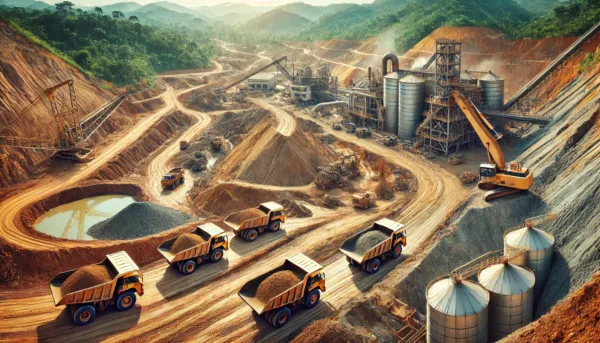



Freeport-McMoRan Inc. (NYSE: FCX) has approved a $4.5 billion expansion and modernisation of its Bagdad copper and molybdenum mine in Arizona, committing to one of the largest new investments in United States copper production. Announced on 4 November 2026, the project is designed to more than double mining and milling rates, lifting annual copper output above 400 million pounds and molybdenum production above 20 million pounds. Initial production from the expanded operation is targeted for mid-2030, supported by a new concentrator, mining equipment, conveyors and infrastructure improvements. However, Freeport shares fell approximately 7.5% on 5 November amid a broader market selloff, placing renewed attention on the economics of a capital-intensive project whose returns will depend on copper prices, construction costs and the timing of additional production.
What does Freeport-McMoRan’s $4.5 billion Bagdad expansion include?
Freeport’s board has approved a major investment programme at the company’s wholly owned Bagdad operation in northwest Arizona. The expansion will increase mining and processing capacity while modernising important parts of the mine’s production infrastructure.
The project includes a new concentrator capable of adding approximately 115,000 metric tonnes of daily nameplate processing capacity. Supporting facilities will include a primary crusher, overland conveyor, water pipeline, power infrastructure and additional mining equipment.
The company expects the expansion to more than double Bagdad’s existing mining and milling rates. Once the expanded operation reaches its long-term planned output, annual copper production is expected to exceed 400 million pounds, including approximately 225 million pounds of incremental production.
Molybdenum output is expected to exceed 20 million pounds annually, an increase of roughly 12 million pounds from existing production levels. The additional molybdenum is commercially important because the metal can provide by-product revenue that offsets some of the costs associated with copper production.
The proposed investment is a brownfield expansion rather than the development of an entirely new mine. It will use Bagdad’s existing operating infrastructure, geological knowledge and workforce while adding substantial processing capacity.
Freeport expects the project to require approximately three and a half years of construction, with initial production targeted for mid-2030. Full annual output will depend on commissioning, the subsequent production ramp-up and the operating performance of the expanded facilities.
The approval establishes a formal capital investment decision, but it does not mean the entire $4.5 billion has already been spent. Engineering, procurement planning and early works are progressing, with substantial expenditure scheduled over the next several financial years.
How much additional copper could Bagdad contribute to US production?
The approximately 225 million pounds of planned incremental annual copper output represents roughly 102,000 metric tonnes of additional copper per year. The calculation converts the company’s pounds-based production estimate into metric tonnes without changing the underlying production guidance.
Freeport expects the expanded operation to become the second-largest copper mine in the United States, behind its Morenci mine in Arizona. This ranking represents the company’s projected position after completion rather than the current operating status of Bagdad.
The project also carries significant implications for molybdenum supply. The planned additional 12 million pounds of annual production would expand output of a metal used in alloy steels and other industrial applications.
Copper is an important material for electrical equipment, transmission infrastructure, industrial machinery and various other manufacturing activities. Additional domestic production could therefore support a broader American supply base, although the mine’s output will be sold through commercial arrangements determined by Freeport.
The incremental production should not be interpreted as metal available immediately. The project is scheduled to begin contributing in 2030, and the full annual benefit will emerge only as the expanded facilities achieve their planned operating rates.
The company also estimates that the project will add approximately 130,000 tonnes of copper-equivalent annual production over the mine’s life, incorporating the contribution of molybdenum. This is an economic equivalence measure rather than a forecast that all output will consist of copper.
The distinction is relevant when evaluating production growth. Copper and molybdenum volumes, prices and production costs will influence the project’s eventual cash generation, and their values cannot be treated as interchangeable physical output.
Why is Freeport expanding an established mine rather than developing a new copper deposit?
Bagdad has operated since 1945 and has a substantial mineral reserve base supporting a long-term mining future. Freeport reported approximately 2.6 billion metric tonnes of ore reserves at a copper-equivalent grade of 0.43%, providing the geological foundation for the planned expansion.
The company estimates that the existing operation has a reserve life exceeding 80 years before considering additional mineral resources. This long-duration resource base creates an opportunity to spread investment across decades of potential production, assuming continued economic and technical viability.
Developing additional capacity at an operating mine can provide advantages over building a completely new project. Existing infrastructure, established operating knowledge and access to trained employees may reduce some development uncertainties.
However, a brownfield location does not eliminate construction or cost risks. Expanding a working mining complex requires coordination between ongoing production and new infrastructure development, creating dependencies involving equipment, utilities and site operations.
The new concentrator will be a central component of the project. Its contribution will depend on achieving the planned processing capacity and recovering sufficient payable metal from the ore being processed.
The company will also need to coordinate mining rates with the capacity of the expanded plant. Increasing milling capacity without an equivalent ability to supply ore would limit the economic benefits of the investment.
Bagdad’s long reserve life improves the strategic rationale for capacity expansion, but the reserve base alone does not establish an attractive return. The project must generate sufficient operating cash over time to recover the capital invested and compensate for commodity-market and execution risks.
How will autonomous trucks and manufacturing technology influence Bagdad’s operating costs?
Freeport completed the conversion of Bagdad’s haulage fleet to autonomous operations in 2025, making it the first major United States mine with a fully autonomous haulage fleet, according to the company.
The modernisation programme provides an existing technological foundation for the larger operation. Freeport intends to use automation, established operating processes and additional scale to improve mining efficiency and long-term cost performance.
The company expects the expansion to reduce Bagdad’s long-term unit net cash costs by approximately 20%. That forecast reflects anticipated economies of scale, technology improvements and the contribution of molybdenum by-product credits.
The projected cost reduction is a management estimate, not a realised saving. Actual costs will depend on equipment performance, labour, energy, maintenance, recovery rates and the realised value of molybdenum.
Autonomous haulage may support more consistent equipment utilisation and mining operations, but it also requires specialist technical systems, maintenance capabilities and effective coordination with other site activities.
The project will combine the existing automated fleet with new processing and infrastructure equipment. Achieving the targeted operating improvements will therefore require the entire production system to function effectively, rather than relying on mining automation alone.
For Freeport, the commercial opportunity is to increase copper output while reducing the cash cost per pound produced. The combination would strengthen operating leverage if production volumes rise as planned and the company maintains control over operating expenditure.
Does the $4.5 billion investment make financial sense at current copper prices?
Freeport has indicated that the Bagdad expansion’s break-even economics are supported at a copper price of approximately $4 per pound, assuming molybdenum prices of $20 per pound. These assumptions provide a reference point for the project’s expected long-term financial viability.
The company reported an average realised copper price of $6.54 per pound during the third quarter of 2026, substantially above the copper assumption used in the project’s break-even analysis. However, current realised prices should not be treated as guaranteed market conditions for production beginning in 2030.
The project also relies on molybdenum by-product economics. A lower molybdenum price would reduce the amount of revenue available to offset copper production costs, potentially affecting profitability even if copper output meets expectations.
A useful capital-intensity comparison is the $4.5 billion planned investment divided by the approximately 225 million pounds of additional annual copper capacity. This produces about $20 of capital investment for each pound of incremental annual copper production capacity.
That figure is not the operating cost of producing a pound of copper or the project’s break-even copper price. It simply describes the scale of the initial investment relative to planned additional annual production.
Freeport expects approximately 20% of the project budget to be spent in 2027, equivalent to roughly $900 million. A further 30% to 35%, or approximately $1.35 billion to $1.58 billion, is expected to be allocated during 2028, with the balance spread across 2029 and 2030.
This expenditure schedule creates a substantial capital requirement before the new facilities begin generating additional production. Returns will consequently depend on completing construction within the planned budget and commissioning schedule.
The company has acknowledged that inflationary pressure and construction-cost escalation could affect its estimates. Any material increase in capital spending would raise the amount of future cash generation required to justify the expansion.
How does the new project fit into Freeport’s latest financial performance?
Freeport reported third-quarter 2026 revenue of approximately $7.55 billion, compared with $6.97 billion in the corresponding previous-year period. Operating income increased to approximately $2.35 billion from $1.97 billion, supported by favourable commodity pricing and its operating portfolio.
Net income attributable to common shareholders reached approximately $1.2 billion, equivalent to $0.81 per share. Adjusted net income was approximately $1.3 billion, or $0.88 per share, after excluding specified charges.
The company produced 832 million pounds of copper during the quarter, while copper sales totalled 749 million pounds. It also produced approximately 234,000 ounces of gold and 22 million pounds of molybdenum.
Freeport generated approximately $2 billion in operating cash flow during the quarter, including working capital and other uses. Capital expenditure totalled approximately $1.2 billion, of which $700 million related to major mining projects.
At the end of September, consolidated debt stood at approximately $9.4 billion, while cash and cash equivalents totalled $4.3 billion. The company reported net debt of approximately $1.8 billion excluding $3.2 billion of debt associated with downstream processing facilities at PT Freeport Indonesia.
This distinction in the net debt calculation is important when evaluating the company’s financing capacity. The adjusted debt measure excludes specified downstream financing, while consolidated debt reflects the broader obligations reported in its financial statements.
The new Bagdad investment will add to Freeport’s future capital commitments. Its ability to fund the expansion will depend on operating cash generation, commodity prices, other project spending and the company’s capital-allocation decisions.
How does the Bagdad investment relate to Freeport’s Grasberg recovery and international portfolio?
Freeport’s operating portfolio includes major copper-producing assets in North and South America and Indonesia. The company is progressing a recovery and expansion programme at its Grasberg minerals district in Indonesia following the September 2025 incident that disrupted underground operations.
In its October 2026 results, Freeport reported that the ramp-up at Grasberg was meeting expectations, with substantial production growth anticipated during 2027 and 2028. It also confirmed that operations at PT Freeport Indonesia’s smelter had resumed during late August.
These developments create a separate source of potential production growth before the Bagdad expansion is expected to begin contributing in 2030.
Freeport is also advancing technical and development opportunities at other established assets, including leaching initiatives in the Americas and the potential expansion of El Abra in Chile.
The company’s strategy therefore involves multiple brownfield opportunities rather than dependence on a single new mine. This provides geographical and project diversification, although it also creates competition for capital and management resources.
Bagdad’s newly approved investment is more advanced as a formal capital commitment than projects still being assessed. It should not be combined indiscriminately with potential future expansions when calculating the company’s confirmed capital expenditure obligations.
The challenge for Freeport is to sequence investments so that existing operations generate sufficient cash to support new capacity while maintaining financial flexibility during commodity-price fluctuations.
Why did Freeport shares fall sharply after the mine expansion announcement?
Freeport-McMoRan shares closed at approximately $57.90 on the New York Stock Exchange on 5 November 2026, down 7.5% from the previous close of $62.60. The stock traded within a wide intraday range and experienced substantially higher trading volume than its recent average.
The broader United States equity market also declined sharply during the session, with the S&P 500 falling more than 4%. Freeport’s decline was larger than that of the benchmark, but the price movement does not establish that investors rejected the Bagdad expansion itself.
The company’s 52-week trading range stood at $38.54 to $80.24, placing the latest closing price approximately 27.8% below the annual high. Its market capitalisation was approximately $83 billion.
The sharp daily decline coincided with renewed attention to a large capital commitment, but copper-market conditions, broader risk sentiment and other company-specific expectations may also have influenced trading.
The new project is expected to contribute production several years after the investment is announced. Its near-term financial effect will involve capital expenditure rather than immediate additional revenue, creating a period during which project costs will be more visible than incremental output.
For investors evaluating the company, the relevant financial trade-off is between committing cash during the construction period and securing greater production capacity at an established mine with a long reserve life.
A stronger assessment of the expansion will require updated capital expenditure guidance, progress towards commissioning and evidence that the expected production and cost improvements remain achievable.
What will determine whether Bagdad becomes a successful US copper expansion?
Freeport has approved a substantial increase in copper and molybdenum production from an established Arizona mine with considerable remaining resources. The project offers an opportunity to increase domestic metals output while applying automation and scale to reduce operating costs.
The construction programme will require several years of expenditure before additional production begins. Engineering completion, equipment procurement, infrastructure installation and commissioning will therefore be important milestones between the current approval and the targeted mid-2030 production start.
Financial performance will depend on the actual capital required, the time taken to achieve planned output and the copper and molybdenum prices realised over the mine’s operating life.
The expansion would materially strengthen Freeport’s United States production base if the company reaches its projected output and operating-cost targets. The decisive evidence will be adherence to the $4.5 billion budget, commissioning progress and confirmation that the expected 20% reduction in long-term unit net cash costs can be achieved as the enlarged operation reaches commercial scale.
What should investors know about Freeport’s $4.5 billion Bagdad copper expansion?
- Freeport-McMoRan approved the $4.5 billion Bagdad mine expansion on 4 November 2026.
- The project is designed to more than double mining and milling rates.
- Long-term annual copper output is expected to exceed 400 million pounds.
- The planned incremental copper production is approximately 225 million pounds annually.
- Molybdenum production is expected to exceed 20 million pounds per year.
- A new concentrator will add approximately 115,000 metric tonnes of daily nameplate processing capacity.
- Initial production is targeted for mid-2030 following approximately three and a half years of construction.
- Freeport expects a 20% reduction in long-term unit net cash costs, subject to achieving planned operating efficiencies.
- Shares declined approximately 7.5% to $57.90 on 5 November amid a broader market selloff.
- Copper prices, capital expenditure, construction progress and production ramp-up will determine the expansion’s returns.
Discover more from Business-News-Today.com
Subscribe to get the latest posts sent to your email.