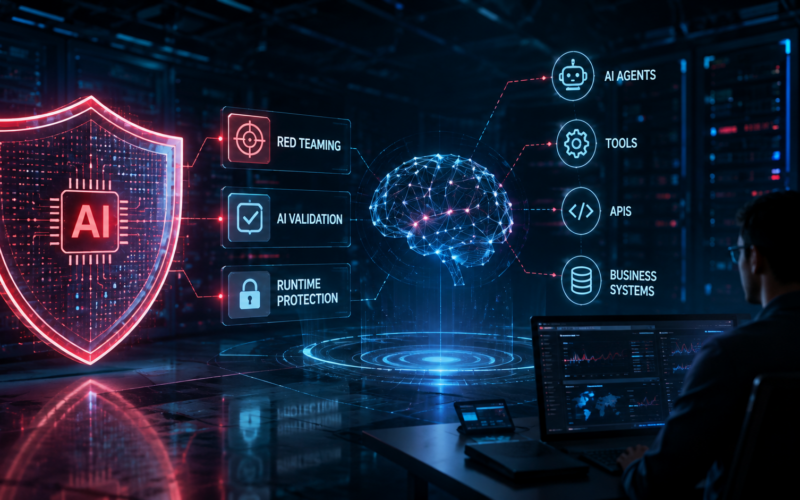
Fortinet, Inc. (NASDAQ: FTNT) has acquired Virtue AI, adding automated red-teaming, continuous artificial intelligence validation and runtime protection for autonomous agents to its expanding AI-native Security Fabric. The acquisition extends Fortinet beyond protecting traffic entering and leaving large language models through FortiAIGate toward testing whether models, AI applications and agents themselves can be manipulated into unsafe actions. Financial terms were not disclosed, although Fortinet said the consideration was immaterial to its business, limiting the immediate balance-sheet risk attached to the transaction. The strategic importance is larger because enterprises are beginning to give artificial intelligence agents access to software tools, application programming interfaces and business systems where a successful prompt injection can potentially cause an action rather than merely generate a bad response. Fortinet shares traded near $157.45 during the August 18 session, approximately 2.7% below their August 11 level and 2.6% lower over one month, while remaining only about 8.5% below the 52-week high after an extraordinary 2026 rally.
Why does Virtue AI give Fortinet capabilities that a conventional firewall or FortiAIGate alone cannot provide?
Traditional cybersecurity products are largely designed around identifiable infrastructure boundaries. Firewalls inspect network traffic, web application firewalls examine application requests, endpoint products monitor devices and data loss prevention systems look for sensitive information moving somewhere it should not.
Generative artificial intelligence introduces a different type of boundary. An application can receive a perfectly legitimate network request containing natural language that manipulates a model into ignoring instructions, disclosing confidential information or calling a connected tool in an unsafe manner.
Fortinet addressed part of that problem earlier this year with FortiAIGate. The product sits between an artificial intelligence application and the underlying large language model, inspecting inputs and outputs for risks including prompt injection, jailbreak attempts, model poisoning, data leakage and excessive resource consumption.
Virtue AI broadens that protection because agentic artificial intelligence introduces behaviour that cannot always be evaluated by examining a single prompt and response.
An autonomous agent may receive an objective, decide which steps to perform, call multiple external tools, access databases, communicate with other agents and complete tasks before a human reviews the individual actions. Security therefore has to determine whether the sequence of decisions remains within authorised boundaries.
Virtue AI gives Fortinet a validation layer around that behaviour. Its technology can test AI systems before deployment, monitor their activity during operation and examine connected Model Context Protocol tools and source code for hidden risks.
The acquisition therefore moves Fortinet from an AI firewall concept toward continuous AI assurance. The company is attempting to secure not just the communication channel around an AI model but the model, application, tools and autonomous behaviour operating behind it.
That is an important distinction because the more authority enterprises give agents, the less useful security becomes when it waits until after the agent has already completed the wrong action.

How serious is the security problem when enterprise AI agents can call tools and take actions autonomously?
The security challenge changes materially when artificial intelligence moves from providing information to performing work. A chatbot that produces an incorrect answer creates one category of risk. An agent capable of changing customer records, generating code, approving transactions or interacting with production systems creates another.
Model Context Protocol has accelerated this transition by providing a standard mechanism through which artificial intelligence applications can connect with data sources and software tools. That flexibility also expands the attack surface because every tool becomes another possible route through which an agent can receive malicious instructions or perform unintended actions.
A compromised agent may not need malware in the conventional sense. An attacker could manipulate information that the agent reads, insert malicious instructions into external content or exploit weaknesses in how the agent interprets its permitted tasks.
Virtue AI’s Guardian Agent capabilities are designed around that problem. Fortinet says the acquired technology can discover unsanctioned artificial intelligence applications and agents, inspect MCP tools and source code, monitor behaviour and block malicious tool calls before execution.
That final function matters commercially. Security teams are increasingly likely to demand controls at the point where an AI recommendation becomes an action.
The issue resembles identity security in one respect. Enterprises already distinguish between a human employee being able to read information and being permitted to change an important system. Autonomous agents will require comparable distinctions, but the decision-making entity may perform thousands of actions far faster than a human user.
AI governance therefore cannot remain limited to whether a company has approved a model. Organisations need visibility into what agents are doing, which systems they can access and whether their behaviour changes after model updates, new prompts or additional tools are introduced.
Fortinet is positioning Virtue AI as part of that control plane. The opportunity becomes larger as artificial intelligence moves deeper into operational workflows, but the security requirement also becomes more difficult because agents are intentionally designed to behave dynamically rather than follow one fixed sequence.
Why could continuous AI red-teaming become more important than one-time security testing?
Conventional application security testing often happens before a system reaches production or at defined intervals afterward. Artificial intelligence complicates that approach because a model can behave differently after fine-tuning, configuration changes, retrieval updates or changes to connected tools.
An AI system that passes a security assessment today may therefore expose a new weakness after tomorrow’s update even when the surrounding software code has changed very little.
Virtue AI is designed to make validation continuous. Fortinet says the platform can test across hundreds of attack vectors and more than 1,000 risk categories while generating evidence that security, risk and compliance teams can use during reviews.
Its agentic red-teaming environment covers more than 50 sandboxed environments and 14 high-stakes domains. Simulated attacks include prompt injection and MCP-related techniques against agent frameworks.
The breadth is useful because artificial intelligence failures do not fit neatly into traditional vulnerability classifications. Security teams need to test whether a model reveals information, follows malicious embedded instructions, violates business policy, uses an unsafe tool or produces harmful content under unusual combinations of inputs.
Multimodal models expand the challenge further. Text is only one input surface when systems can interpret images, audio and video while also generating code.
Virtue AI’s real-time guardrails cover text, images, video, audio and AI-generated code. Integrating those controls with Fortinet’s wider enforcement infrastructure could allow a security policy identified during validation to become an operational control across production environments.
That connection between testing and enforcement could be more strategically important than the individual red-team capability. Security products frequently discover vulnerabilities without providing a direct route to prevent the same behaviour elsewhere.
Fortinet already controls network, endpoint, cloud, application and data security infrastructure for a large customer base. When Virtue AI identifies an unsafe behaviour, the company potentially has several existing enforcement points through which it can respond.
Does Fortinet’s acquisition strategy show cybersecurity platforms consolidating around AI-native security?
Virtue AI is not an isolated acquisition. Fortinet has spent several years adding capabilities around cloud security, data protection, workspace security and software-as-a-service governance.
Lacework expanded Fortinet into cloud-native application protection. Next DLP strengthened data loss prevention and insider-risk capabilities. Perception Point brought advanced protection across email, browsers and collaboration applications, technology now reflected in Fortinet’s current FortiMail Workspace Security portfolio.
Suridata added SaaS Security Posture Management to Unified SASE, extending visibility into application configurations, identities and third-party integrations. Virtue AI now addresses security for models and autonomous agents.
Viewed together, those transactions show Fortinet trying to prevent cybersecurity spending from fragmenting into dozens of independent AI-era products.
That platform strategy has obvious commercial appeal. Large enterprises already operate complicated security estates and may prefer adding artificial intelligence controls to an existing architecture rather than deploying another standalone management console.
The advantage is strongest when security telemetry can be shared. Information about a suspicious user, endpoint, application, cloud workload and AI agent becomes more valuable when it contributes to one coordinated response rather than remaining inside separate products.
The danger is integration complexity. Acquisitions can broaden a product catalogue without producing the architectural unity customers actually want.
Fortinet must integrate Virtue AI’s capabilities into Security Fabric workflows without eliminating the specialised functionality that made the company worth acquiring. Customers should eventually experience continuous AI validation and runtime enforcement as part of a coherent security system rather than as a collection of acquired technologies carrying different interfaces.
The acquisition consideration being immaterial gives Fortinet room to attempt that integration without betting a meaningful portion of its balance sheet. The financial risk is therefore limited, while the strategic upside depends heavily on product execution.
How large could the market for protecting AI agents become if enterprise adoption continues accelerating?
Fortinet cited a Gartner forecast estimating that products and tools used to secure artificial intelligence ecosystems and AI agents could expand from $2.8 billion in 2026 to $16.4 billion by 2030.
That represents an increase of approximately 5.9 times in four years. On a compound basis, the forecast implies annual growth of roughly 56%.
Growth at that rate would create one of the fastest-expanding segments within enterprise cybersecurity.
The forecast is plausible because artificial intelligence security spending starts from a relatively small base while deployments are spreading into more business functions. Companies currently experimenting with internal assistants may eventually operate hundreds or thousands of specialised agents.
Each agent can create requirements around identity, authorisation, data access, runtime monitoring and auditability. Agents communicating with other agents create another layer of complexity because enterprises need to understand which automated systems initiated particular decisions.
However, a rapidly growing market does not mean every specialist AI security vendor becomes a large independent company.
Many capabilities are likely to become features inside established cybersecurity, cloud and developer platforms. Customers may resist paying separately for prompt security, model validation, agent discovery and AI governance when those controls can be integrated with existing security infrastructure.
That dynamic partly explains Fortinet’s acquisition strategy. Virtue AI may be worth considerably more inside a platform reaching hundreds of thousands of Fortinet customers than as a standalone vendor competing for its own budget line.
It also creates competitive pressure. Palo Alto Networks, Check Point Software Technologies, CrowdStrike Holdings and cloud providers are all expanding protection around artificial intelligence workloads in different ways.
Fortinet’s advantage is the breadth of infrastructure it can potentially connect with AI-specific controls. The weakness is that a broad platform must remain technically strong in a specialised market where new attack techniques evolve quickly.
Why do Fortinet’s latest financial results give it unusual flexibility to acquire AI security capabilities?
Fortinet enters the AI security expansion from a strong financial position. Second-quarter revenue increased 26% to approximately $2.05 billion, materially above the comparable period last year.
Product revenue increased 52% to $773 million, showing renewed demand for Fortinet’s hardware and software licensing portfolio. Management has attributed part of product momentum to secure networking deployments connected with artificial intelligence infrastructure and customers upgrading toward higher-performance systems.
Billings increased 33% to $2.37 billion, outpacing reported revenue. Deferred revenue reached approximately $7.68 billion at June 30, providing substantial visibility into future subscription and support revenue.
Profitability also improved. GAAP operating income increased 51% to approximately $689 million, lifting the operating margin to 33.7% from 28.1% one year earlier.
Free cash flow reached approximately $966 million during the quarter, equivalent to a 47.2% margin. Fortinet held around $4.47 billion across cash, cash equivalents and investments at quarter-end.
That combination means a small acquisition such as Virtue AI does not require a financing debate. Fortinet can purchase specialised technology, integrate the engineering team and continue investing organically without placing meaningful pressure on liquidity.
Management also raised full-year 2026 revenue guidance to between $8.02 billion and $8.18 billion. Billings are expected between $9.35 billion and $9.55 billion, while the company targets a non-GAAP operating margin of 35% to 37%.
The financial strength allows Fortinet to use acquisitions differently from early-stage cybersecurity companies. It does not need Virtue AI to generate enough standalone revenue immediately to justify the transaction.
Instead, Fortinet can measure value through additional platform sales, customer retention and higher attachment of AI security products across the existing installed base.
That can produce attractive acquisition economics when integration works because the distribution infrastructure already exists.
Why has Fortinet stock stopped rising despite strong earnings and an expanding AI security strategy?
Fortinet shares traded near $157.45 during the August 18 session, up about 1% from the August 17 close of $155.85 as broader technology shares came under pressure.
The stock was approximately 2.7% below its August 11 close of $161.89. Compared with the July 17 close of $161.61, Fortinet was lower by roughly 2.6% over one month.
Fortinet’s 52-week range stands at approximately $73.55 to $172.09. The August 18 price was therefore about 8.5% below the record high reached on August 5 while remaining more than 114% above the 52-week low.
The wider performance explains why excellent operating results are no longer automatically enough to move the shares sharply higher. Fortinet has already undergone a substantial valuation rerating during 2026 as investors recognised improving product demand, artificial intelligence infrastructure exposure and stronger billings.
At roughly $157.45, Fortinet carried a market capitalisation near $116.5 billion and traded around 56 times trailing earnings. That is a demanding multiple even for a cybersecurity company producing strong revenue growth and exceptional free cash flow.
Investor sentiment therefore appears fundamentally positive but valuation-sensitive. The Virtue AI acquisition strengthens a strategically important product category, yet Fortinet itself says the purchase consideration is immaterial, meaning the transaction is unlikely to alter near-term earnings forecasts materially.
The share-price catalyst will increasingly come from whether new AI security products expand billings and service revenue rather than how many capabilities Fortinet announces.
The pullback from the August high can also be viewed in the context of the broader technology selloff on August 18. Rising bond yields and weakness across semiconductor and artificial intelligence shares pressured technology valuations even as individual company fundamentals remained intact.
Fortinet is therefore entering a different stage of its 2026 rally. The market has already rewarded the recovery in growth. Further gains require evidence that AI security, SASE and security operations can extend that growth rather than simply support an already premium valuation.
What are the key takeaways from Fortinet’s Virtue AI acquisition and expanding AI security strategy?
- Fortinet acquired Virtue AI on August 17 to add automated AI validation, agentic red-teaming and runtime protection for autonomous artificial intelligence systems.
- Financial terms were undisclosed, but Fortinet said the purchase consideration was immaterial to its business, limiting direct balance-sheet risk.
- Virtue AI can test autonomous agents across more than 50 sandboxed environments and 14 high-stakes domains.
- Its continuous validation platform evaluates hundreds of attack vectors and more than 1,000 risk categories while producing audit-ready evidence.
- The acquisition extends Fortinet beyond FortiAIGate, which already protects LLM traffic from prompt injection, data leakage, model poisoning and excessive resource use.
- Fortinet is building a broader AI security stack across models, applications, agents, MCP tools, networks, endpoints, cloud environments and data.
- The Gartner forecast cited by Fortinet implies that the AI ecosystem and agent security market could expand from $2.8 billion in 2026 to $16.4 billion by 2030, equivalent to roughly 56% annualised growth.
- Fortinet reported 26% Q2 revenue growth, 33% billings growth and $966 million of quarterly free cash flow, giving it substantial capacity to fund additional technology acquisitions.
- Fortinet shares were down about 2.7% over five trading sessions and 2.6% over one month during the August 18 session, but remained more than 114% above their 52-week low.
- The next test is commercial integration, specifically whether Virtue AI capabilities increase Security Fabric adoption and generate measurable incremental billings rather than remaining a specialised acquired product.
Can Fortinet turn AI agent security into another platform layer rather than another cybersecurity point product?
The importance of Virtue AI lies less in the size of the acquisition than in what Fortinet believes the enterprise attack surface is becoming. Networks, endpoints and cloud workloads are no longer the final objects requiring protection when autonomous software can interpret information, select tools and take actions inside business systems.
That evolution favours cybersecurity companies capable of connecting AI-specific controls with existing infrastructure. Fortinet already has enforcement points across networking, applications, cloud environments, endpoints and data. Virtue AI gives it additional visibility into whether artificial intelligence systems themselves are behaving safely.
The commercial advantage becomes meaningful when one policy can follow an AI workload across development, validation and production. A vulnerability discovered during automated red-teaming could inform runtime controls, while suspicious agent behaviour could trigger enforcement through other Security Fabric components. That kind of feedback loop is more difficult for isolated AI security vendors to reproduce.
Fortinet still has to prove that integration. Artificial intelligence security is evolving rapidly enough that specialised startups can innovate faster than large platform companies, while customers may prefer model-neutral tools that do not depend on one broader security vendor.
The financial asymmetry nevertheless favours Fortinet. Virtue AI is immaterial to the company financially, but the market it addresses could become material very quickly if enterprises move from experimenting with agents to trusting them with real operational authority. Fortinet is effectively buying an option on that transition at a cost small enough not to matter if adoption develops more slowly.
The harder task begins now. Enterprise customers do not ultimately need another product carrying an AI label. They need evidence that autonomous systems can be tested continuously, observed in production and prevented from taking actions outside approved boundaries. If Fortinet can make Virtue AI part of that control layer, this small acquisition could become strategically more important than its undisclosed price suggests.
Discover more from Business-News-Today.com
Subscribe to get the latest posts sent to your email.