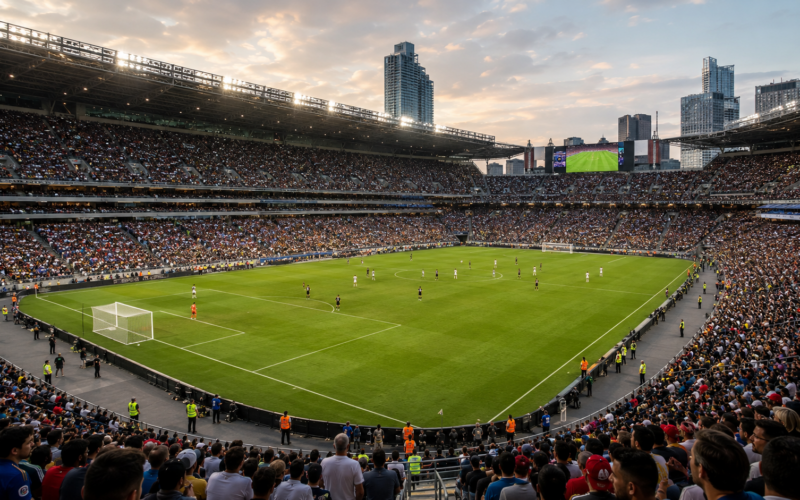
The United States defeated Bosnia and Herzegovina 2-0 in their FIFA World Cup 2026 Round of 32 match at San Francisco Bay Area Stadium in Santa Clara, California, on Wednesday, July 1, 2026. Folarin Balogun opened the scoring in the 45th minute before Malik Tillman converted a direct free kick in the 82nd.
Balogun had already placed the ball in the net in the 32nd minute, but the goal was ruled out for offside. The striker eventually broke Bosnia and Herzegovina’s resistance shortly before half-time, collecting Tillman’s deflected forward pass, holding off the recovering defence and rolling his finish beneath Nikola Vasilj.
The match changed dramatically in the 64th minute when Balogun was shown a straight red card following a VAR review of his challenge on Tarik Muharemović. Bosnia and Herzegovina gained a numerical advantage but failed to turn their increased possession into clear chances, while Matt Freese, Tim Ream and Chris Richards protected the United States lead.
Tillman doubled the advantage with a curling free kick after Stjepan Radeljić fouled Sergiño Dest near the penalty area. The United States advanced to face Belgium at Seattle Stadium on Monday, July 6, while Bosnia and Herzegovina were eliminated after their first appearance in a FIFA World Cup knockout match.
FIFA World Cup 2026 United States 2-0 Bosnia and Herzegovina full match scorecard
Why did the United States dominate the opening possession without creating early chances?
The United States controlled more than 75% of possession during the opening hydration period and completed 136 passes compared with only 23 by Bosnia and Herzegovina. Those numbers reflected territorial control, but they did not initially translate into clear chances because Bosnia defended with five players across the back and three compact midfielders positioned in front of them.
Bosnia’s structure protected the central route towards Tillman, McKennie and Balogun. Pulisic often received with multiple defenders between him and the penalty area, while Dest and Robinson were encouraged to take possession in wide positions where the defensive block could shift across without losing its central protection.
The United States moved the ball patiently but sometimes lacked the speed required to change the point of attack before Bosnia reorganised. Tyler Adams supported the circulation from behind the midfield line, yet the absence of early runs beyond Bosnia’s wing-backs made the passing appear more controlled than threatening.
Bosnia demonstrated the potential weakness in that approach after ten minutes. One direct attack bypassed the United States midfield and produced the first shot on target, forcing Freese to parry before punching away the following corner.
How did Bosnia and Herzegovina’s 5-3-2 structure frustrate Pulisic and Balogun?
Sergej Barbarez’s defensive plan depended on reducing the space between the back five and the three central midfielders. Radeljić, Muharemović and Katić protected the penalty area, while Dedić and Kolašinac could move towards the United States wide players without leaving the centre-backs isolated.
Pulisic attempted to move inside from the left, but doing so placed him close to Šunjić and Gigović. Robinson advanced outside him, although the United States rarely created a clean two-against-one situation before Bosnia’s midfield recovered.
Balogun was surrounded by three central defenders whenever the United States crossed from wide areas. His most dangerous movements therefore came when he started deeper, waited for Bosnia’s line to advance and then accelerated into the space behind it.
That pattern produced his disallowed goal in the 32nd minute. Balogun received alone near the top of the penalty area and finished inside the near post, but he had moved beyond the final defender before the pass was released.
The offside decision denied the United States an opening goal, yet it also revealed the route that would eventually break Bosnia’s resistance. Balogun’s movement was becoming increasingly difficult for a tiring defensive line to track.
Why did Folarin Balogun’s opening goal arrive at the decisive moment before half-time?
The opening goal came when Bosnia appeared close to completing its first-half defensive objective. Tillman attempted a vertical pass through the centre, and the ball reached Balogun after taking a favourable deflection away from the surrounding defenders.
Balogun reacted faster than Muharemović and Radeljić. He protected possession with his body, carried the ball into the penalty area and rolled a controlled finish beneath Vasilj.
The goal was not the product of a long passing combination, but it rewarded the United States for repeatedly positioning players around Bosnia’s defensive block. The pressure increased the probability that a deflection, incomplete clearance or second ball would eventually fall to an attacker.
Balogun almost scored again during first-half stoppage time when his effort struck the top of the crossbar. Bosnia therefore moved from appearing likely to reach the interval level to entering half-time fortunate that the deficit remained one goal.
The timing changed the tactical requirements for the second half. Bosnia could no longer rely entirely on a deep block and isolated counterattacks because elimination would follow unless Barbarez’s side began creating more sustained pressure.
How did Bosnia’s triple half-time substitution change the direction of the match?
Barbarez waited only six second-half minutes before making three substitutions. Džeko, Gigović and Šunjić were replaced by Mahmić, Bajraktarević and Tahirović as Bosnia attempted to increase its mobility and pressing intensity.
Removing Džeko reduced Bosnia’s aerial presence, but it allowed the front line to become more active when closing the United States defenders. Bajraktarević carried the ball more directly, while Tahirović attempted to move possession forward at a quicker tempo than Bosnia had managed before half-time.
Katić tested Freese from distance, and Demirović later forced another save after finding shooting space outside the penalty area. Those efforts increased Bosnia’s shot count, but neither attempt represented a high-quality opportunity.
The central problem remained unchanged. Bosnia could move the ball around the United States defensive block, yet too few players entered the penalty area to occupy Ream and Richards.
The substitutions added speed without creating a reliable final pass. Bosnia were more adventurous after half-time, but the United States continued controlling the most valuable space in front of goal.
Was Folarin Balogun’s VAR red card the correct decision for serious foul play?
Balogun challenged Muharemović near midfield and caught the defender’s lower leg as both players attempted to reach the ball. Referee Raphael Claus initially allowed play to continue before being advised to review the incident.
Slow-motion replays showed Balogun’s foot making forceful contact above Muharemović’s ankle. Claus returned from the pitchside monitor and issued a straight red card for serious foul play.
The challenge did not appear to contain deliberate intent, but disciplinary decisions for serious foul play are based on the nature and danger of the contact rather than whether a player intended to injure an opponent. Balogun’s foot position and the point of impact provided the basis for the dismissal.
The red card transformed the tactical conditions with approximately half an hour remaining. The United States lost its centre-forward and most effective outlet, while Bosnia gained the numerical advantage required to push additional players into advanced positions.
Balogun’s dismissal also created a consequence beyond this match. The striker will miss the Round of 16 meeting with Belgium through suspension, removing the United States’ leading FIFA World Cup 2026 scorer from its next knockout fixture.
How did the United States reorganise defensively after being reduced to ten players?
Mauricio Pochettino initially resisted making an immediate substitution. The United States moved into a compact 4-4-1 shape, with Pulisic becoming the highest attacking player and Tillman and McKennie narrowing towards Adams.
The shape allowed the United States to protect central passing lanes without surrendering the width of the pitch completely. Dest and Robinson defended closer to Ream and Richards, while Freeman remained attentive to Bosnia’s attempts to overload the opposite side.
Adams became increasingly important during this period. He screened passes towards Demirović, challenged for second balls and helped the United States move possession away from its own penalty area whenever Bosnia’s attack broke down.
Ream and Richards dealt with crosses rather than attempting to follow Bosnia’s forwards into midfield. That discipline prevented the numerical disadvantage from creating large gaps between the centre-backs.
Bosnia held more possession and advanced its wing-backs, but the United States forced most attacks towards the outside. The structure reduced the likelihood of a clear central opportunity, which helps explain Bosnia’s expected-goals total of only 0.22 despite playing against ten men.
Why could Bosnia and Herzegovina not exploit the numerical advantage?
Bosnia increased the volume of possession but continued attacking too slowly. The ball frequently travelled across the defensive line before reaching Dedić or Alajbegović, allowing the United States midfield to shift into position before the next forward pass.
The advantage of playing eleven against ten is greatest when the attacking team moves the ball quickly enough to isolate a defender. Bosnia instead attempted several direct crosses into a penalty area protected by Ream, Richards and Adams.
The attacking numbers were also insufficient. Demirović often remained the only central target, while the midfielders waited outside the penalty area rather than making runs beyond him.
Bosnia’s best late sequence came in the 90th minute when a cross travelled through the goalmouth and caused confusion between Freese and the defenders. Richards reacted quickly and blocked the resulting shot before it could threaten the net.
Alajbegović then carried the greatest individual danger during stoppage time, but his effort travelled wide. Bosnia finished with three shots on target, all saved by Freese, and none forced the goalkeeper into an exceptional intervention.
How did Matt Freese preserve another United States clean sheet under pressure?
Freese’s first important action arrived during the opening ten minutes. Bosnia bypassed the United States midfield and generated a shot that the goalkeeper pushed away before he dealt with the resulting corner.
He remained largely protected during the middle of the first half, but the match demanded greater concentration after Bosnia’s substitutions and Balogun’s dismissal. Freese saved Katić’s long-range attempt and remained positioned behind Richards when Demirović shot through the defender’s legs.
The goalkeeper also handled several high deliveries during the closing stages. His willingness to claim crosses reduced the number of second-ball opportunities available to Bosnia inside the penalty area.
There was one late moment of uncertainty when a delivery travelled through the goalmouth, but Richards blocked the shot that followed. Freese recovered and completed the match with three saves and a clean sheet.
His performance was not defined by spectacular stops. The greater value came from positioning, communication and the ability to avoid creating rebounds during the period when Bosnia were searching desperately for a goal.
Why was Malik Tillman the decisive player at both ends of the United States victory?
Tillman contributed to the opening goal by attempting the forward pass that reached Balogun after a defensive deflection. His willingness to play through Bosnia’s compact midfield was important because much of the United States’ earlier possession had moved safely around the defensive structure.
After the red card, Tillman accepted a more demanding defensive role. He narrowed alongside Adams and McKennie, intercepted passes and carried possession towards the touchline whenever the United States needed to reduce Bosnia’s momentum.
His decisive contribution arrived after Radeljić fouled Dest near the penalty area. The free kick was positioned centrally enough to offer several possibilities, but Tillman chose to shoot directly.
The midfielder lifted the ball over and around the wall before bringing it sharply down inside the near side of the goal. Vasilj had moved towards the opposite half of the net and could not recover.
The goal was especially damaging for Bosnia because it arrived while the team held a numerical advantage. Instead of converting eleven-against-ten pressure into an equaliser, Bosnia conceded from a dead-ball situation and entered the final minutes two goals behind.
Why was Christian Pulisic’s disallowed goal still an important tactical warning?
The United States briefly appeared to have doubled its lead before Tillman’s free kick. Tillman used a backheel during the attacking move, McKennie helped progress possession and Pulisic raced behind Bosnia’s defensive line before finishing.
The assistant referee correctly identified that Pulisic had moved offside. The goal was disallowed, but the sequence exposed the risks Bosnia had accepted while pushing additional players forward.
Even with ten players, the United States retained enough technical quality to escape the press and attack the space behind Bosnia’s advanced defenders. Pulisic’s movement forced the visitors to balance their pursuit of an equaliser against the possibility of conceding on the counterattack.
That threat helped prevent Bosnia from committing every available player to the penalty area. The numerical advantage existed, but the United States still possessed runners capable of turning one recovery into a direct attack.
Pulisic was replaced by Pepi in the 87th minute after helping the United States carry the ball away from pressure. His influence was more tactical than statistical, but it remained important during the most difficult phase of the match.
Why did Pochettino wait until the 87th minute to make his first substitutions?
Pochettino retained the same outfield group for more than 20 minutes after Balogun’s dismissal. The decision was unusual because the United States were defending with ten players and several starters had already completed a demanding tactical workload.
One explanation was the stability of the defensive structure. Ream, Richards and Adams remained organised, while Tillman, McKennie and Pulisic continued offering enough ball retention to prevent Bosnia from sustaining uninterrupted pressure.
Changing the shape too quickly could have disrupted those relationships. Pochettino instead trusted the existing players until Tillman’s goal created a two-goal cushion.
Pepi and Sebastian Berhalter then replaced Pulisic and Dest in the 87th minute. Pepi provided a forward outlet, while Berhalter supplied fresh energy for the defensive work required during ten minutes of stoppage time.
Reyna replaced McKennie in the 95th minute rather than an additional defender entering. The United States therefore finished by attempting to retain possession and threaten transitions instead of withdrawing completely into its own penalty area.
The strategy succeeded, although Belgium will present a considerably greater attacking challenge. Against stronger opposition, waiting so long to refresh a ten-player structure could carry greater risk.
What did Bosnia and Herzegovina prove during their first World Cup knockout appearance?
Bosnia and Herzegovina reached the knockout stage for the first time after progressing from a group containing Switzerland, Canada and Qatar. The achievement represented a significant step beyond the country’s only previous FIFA World Cup appearance in 2014.
Barbarez’s team demonstrated defensive discipline during most of the first half. The five-player line remained compact, Vasilj organised the penalty area and the midfield prevented the United States from converting overwhelming possession into early shots on target.
Džeko also added a historic element to the fixture by appearing in a FIFA World Cup knockout match at the age of 40. His influence was limited by the United States’ possession and Bosnia’s defensive priorities, and he was replaced early in the second half.
The disappointment came from what happened after Balogun’s dismissal. Bosnia received an opportunity to play more than 25 minutes against ten opponents but failed to create a clear chance from open play.
Their elimination should not erase the progress represented by reaching the Round of 32. However, the match also showed that Bosnia require more speed, creativity and penalty-area occupation when an opponent stops allowing counterattacking space.
Why did the United States win despite recording only two shots on target?
The United States converted both of its shots on target. Balogun punished an incomplete defensive action before half-time, while Tillman produced a technically outstanding free kick during the period when Bosnia appeared most likely to equalise.
Bosnia recorded three shots on target, but all came from positions that allowed Freese to make controlled saves. The 0.22 expected-goals total indicated that the numerical advantage produced volume without genuine proximity to goal.
The United States also managed the decisive moments more effectively. Richards blocked Bosnia’s most dangerous late effort, Ream won important aerial challenges and Adams repeatedly protected the space in front of the defence.
Efficiency therefore separated the teams. Bosnia defended competently and briefly controlled the tactical conditions, but the United States possessed the individual quality required to convert two difficult moments into goals.
The result was not an attacking performance built on a large number of chances. It was a knockout victory created through patience, defensive organisation, set-piece quality and precise finishing.
What must Bosnia and Herzegovina improve after their FIFA World Cup 2026 elimination?
Bosnia must become more effective when opponents allow them to hold possession. The team’s strongest moments during the tournament came from counterattacks, direct play and set pieces, but the United States forced Barbarez’s players to construct attacks against an organised block.
The movement ahead of the ball was too predictable. Demirović became isolated, the midfielders rarely entered the penalty area and the wing-backs delivered without enough targets occupying the central defenders.
Bosnia also needed to increase the speed of its switches after the red card. Moving the ball from one side to the other should have created one-against-one situations against a tiring ten-player team, yet many passes travelled backwards before the attack reached the opposite flank.
Alajbegović and Bajraktarević offered evidence of a more dynamic future. Both attempted to carry the ball through defensive lines, although their influence arrived too late to change the result.
The transition beyond Džeko will become another central question. His experience and aerial presence remain valuable, but Bosnia require a younger attacking structure capable of pressing, combining and threatening space throughout an entire knockout match.
What must the United States change before facing Belgium without Folarin Balogun?
Balogun’s suspension creates an immediate selection decision for Pochettino. Pepi offers the most direct replacement as a central striker, while the wider attacking structure may need to compensate for the loss of Balogun’s speed and ability to occupy multiple defenders.
Belgium’s defensive performance against Senegal showed vulnerability to direct running and transitions, but Rudi Garcia’s team also demonstrated extraordinary recovery power by overturning a two-goal deficit. The United States cannot assume that an early advantage will be enough in Seattle.
The first-phase possession must become more productive. The United States controlled the ball against Bosnia but required almost the entire first half to register its first valid shot on target.
Belgium will also threaten the defensive line through Romelu Lukaku’s physical presence, Youri Tielemans’ passing and the movement of the attacking midfielders around the striker. Ream, Richards and Adams must prevent Belgium from receiving second balls near the penalty area.
Tillman enters the Round of 16 with increasing responsibility after creating one goal and scoring another. His ability to progress possession and arrive around the penalty area will become especially important without Balogun.
The United States showed resilience by winning with ten players, but Belgium will demand greater attacking speed, earlier substitutions and stronger control of transitions. The Round of 32 victory provided momentum, while the red card ensured that the next tactical problem began before the final whistle.
How does the United States victory shape the FIFA World Cup 2026 knockout bracket?
The United States advanced to the Round of 16 and will face Belgium at Seattle Stadium on Monday, July 6, at 5pm local time. Belgium reached the fixture by recovering from a two-goal deficit to defeat Senegal 3-2 after extra time.
The match brings together two teams that survived dramatically different forms of knockout pressure. The United States protected a lead with ten players, while Belgium scored three times after the 85th minute to escape elimination.
Bosnia and Herzegovina were eliminated after their first FIFA World Cup knockout appearance. Their campaign included a draw against Canada, a victory over Qatar and qualification as one of the strongest third-placed teams.
The winner of United States vs Belgium will advance into the quarter-final branch containing the winners emerging from Spain vs Austria and Portugal vs Croatia. No quarter-final opponent is confirmed until the remaining Round of 32 and Round of 16 fixtures are completed.
Key takeaways from United States vs Bosnia and Herzegovina at FIFA World Cup 2026
- The United States defeated Bosnia and Herzegovina 2-0 and recorded its first FIFA World Cup knockout victory since 2002.
- Folarin Balogun had a 32nd-minute goal ruled out for offside before opening the scoring in the 45th minute.
- Balogun nearly doubled the lead when his effort struck the top of the crossbar during first-half stoppage time.
- Bosnia and Herzegovina changed three players in the 51st minute but continued struggling to create high-quality chances.
- Balogun received a straight red card in the 64th minute following a VAR review of his challenge on Tarik Muharemović.
- Matt Freese made three saves as the United States protected its lead with ten players.
- Christian Pulisic placed the ball in the net in the 79th minute, but his finish was ruled out for offside.
- Malik Tillman scored directly from a free kick in the 82nd minute after Stjepan Radeljić fouled Sergiño Dest.
- Bosnia and Herzegovina finished with only 0.22 expected goals despite playing against ten opponents for the final half hour.
- The United States advanced to face Belgium in Seattle, while Balogun will miss the Round of 16 through suspension.
Discover more from Business-News-Today.com
Subscribe to get the latest posts sent to your email.