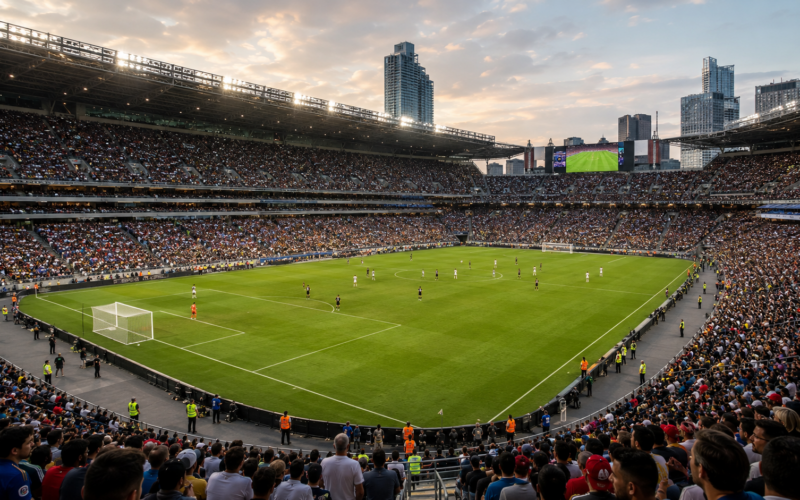
Egypt defeated New Zealand 3-1 at BC Place in Vancouver on June 21, 2026 local time, with the match concluding on June 22 in India, to record the first victory in their men’s FIFA World Cup history. New Zealand led at half-time through Finn Surman’s 15th-minute header, but Egypt transformed the contest after the interval and scored three times in 24 minutes.
Mostafa Ziko equalised with a close-range header from Mohamed Hany’s cross before Mohamed Salah completed the turnaround in the 67th minute. The Egypt captain exchanged passes with Ziko and produced a controlled left-footed finish beyond Max Crocombe.
Substitute Trezeguet added the third goal in the 82nd minute, meeting Salah’s corner with an unmarked header. The result ended Egypt’s 92-year wait for a World Cup victory and moved Hossam Hassan’s side to the top of Group G with four points.
New Zealand remain bottom with one point after surrendering another promising position. Darren Bazeley’s team must now defeat Belgium in their final group fixture and hope the other Group G result supports their qualification bid.
New Zealand vs Egypt FIFA World Cup 2026 match scorecard
How did Finn Surman’s opening goal reward New Zealand’s direct first-half approach?
New Zealand entered the match without a World Cup victory but with confidence from their 2-2 opening draw against Iran. Bazeley retained the same starting team and again built the attack around Chris Wood’s aerial strength, Elijah Just’s running and Callum McCowatt’s movement.
The All Whites were willing to play forward early rather than attempting to match Egypt through prolonged midfield possession. Long passes toward Wood created opportunities to contest second balls, while Tim Payne and Liberato Cacace supplied deliveries from wide areas.
The opening goal came from a corner in the 15th minute. Payne delivered into the central area, where Surman rose above the Egyptian defenders and powered his header beyond Shobeir.
Egypt’s defensive marking was loose, and Surman was allowed to attack the ball with greater momentum than the players around him. The goal silenced the large Egyptian support inside BC Place and gave New Zealand control of the emotional direction of the first half.
The lead also allowed Bazeley’s team to remain compact. New Zealand protected the central spaces, encouraged Egypt to circulate possession in front of the defensive block and looked to attack through Wood whenever the ball was recovered.
Salah and Omar Marmoush struggled to find room behind the defence. Egypt’s passing was slow, while the distances between midfield and attack prevented the combinations required to isolate New Zealand’s defenders.
New Zealand therefore reached half-time with a deserved advantage. Their direct approach had produced the goal, while Egypt had failed to establish the tempo expected from a side containing Salah and Marmoush.
Why did Egypt look so different immediately after the half-time interval?
Egypt’s transformation began with a positional change rather than an immediate substitution. Salah moved away from a fixed position on the right and began operating more centrally between New Zealand’s midfield and defence.
The adjustment allowed Mohamed Hany to advance aggressively from right-back. With Salah moving inside, Hany could occupy the wide space and provide the deliveries that had been missing during the opening half.
Emam Ashour also moved higher and became the connection between Egypt’s midfield and front line. Instead of receiving possession with his back to New Zealand’s compact structure, he found pockets between the lines and helped Egypt accelerate attacks.
The increased speed was evident immediately after the restart. Salah forced Crocombe into a save, Marmoush threatened from the left and Ziko began finding positions inside the penalty area.
New Zealand briefly created an opportunity to double their lead in the 53rd minute. McCowatt met a delivery with a glancing effort that appeared headed toward goal, but Shobeir reacted quickly and pushed the ball over.
The save became an important turning point. Egypt regained possession, resumed their pressure and increasingly prevented New Zealand from leaving their defensive third.
The All Whites had relied on energy, physical pressure and direct running during the first half. Those qualities became harder to sustain as Egypt moved the ball more quickly and forced New Zealand’s midfield to cover greater distances.
By the time the equaliser arrived, the goal had become the logical consequence of Egypt’s dominance rather than an isolated breakthrough.
How did Mostafa Ziko’s equaliser change the Group G match in Vancouver?
Egypt levelled in the 58th minute after another sustained period of possession. Hany advanced into space on the right and delivered a first-time cross before New Zealand could close him down.
Ziko moved between the defenders and met the delivery with a firm close-range header. Crocombe reached the ball but could not prevent it from crossing the line.
The equaliser rewarded Ziko’s persistence after a difficult first half. He had struggled to influence Egypt’s attacking play when operating farther from goal, but the second-half structure allowed him to arrive inside the area.
Hany’s contribution was equally important. His willingness to play almost as an additional winger stretched New Zealand and prevented Cacace and McCowatt from concentrating entirely on Salah.
The goal immediately changed the pressure on both teams. Egypt understood that New Zealand were beginning to tire, while the All Whites suddenly faced the possibility of losing another lead.
New Zealand had also moved ahead twice against Iran before being pegged back. The Ziko goal therefore introduced a psychological challenge as well as a tactical one.
Instead of calming the match through possession, Bazeley’s side continued losing the ball quickly. Egypt recovered second balls, moved players around the penalty area and increased the frequency of their attacks.
Ziko then influenced the decisive second goal, combining with Salah during the move that placed Egypt ahead.
Why was Mohamed Salah’s winning goal the decisive expression of Egypt’s tactical change?
Salah’s 67th-minute goal demonstrated why moving him centrally had transformed the contest.
The Egypt captain received possession with room to carry the ball toward New Zealand’s defence. He exchanged a rapid one-two with Ziko near the edge of the penalty area and continued his run into the space opened by the return pass.
Salah then guided a controlled left-footed finish beyond Crocombe. The move was quick, direct and technically precise, qualities missing from Egypt’s first-half attacking play.
New Zealand’s defenders had spent much of the opening period facing Salah near the touchline, where additional cover could be provided. Once he moved inside, they had to decide whether to step toward him or remain with Marmoush and the supporting runners.
That uncertainty created the gap Salah exploited. Ziko’s return pass removed the nearest defender, leaving the captain with the angle required to finish.
The goal also carried substantial personal significance. Salah had scored at previous World Cups, but this was the first time one of his tournament goals had placed Egypt on course for victory.
His influence extended beyond the finish. Salah continued combining with Ashour, moved into different attacking positions and later delivered the corner for Egypt’s third goal.
The second-half performance showed Egypt at their most dangerous when Salah was not isolated as a conventional winger. His movement through central areas gave teammates more passing options and made the entire attack less predictable.
How did Trezeguet complete Egypt’s comeback after entering as a substitute?
Hossam Hassan introduced Trezeguet during the final quarter as Egypt attempted to turn their advantage into a more secure position.
The substitute brought fresh movement and greater willingness to attack the penalty area. New Zealand were already struggling to follow Egypt’s rotations, and Trezeguet repeatedly looked for space between defenders.
His goal came in the 82nd minute. Salah delivered an outswinging corner toward the near side, where Trezeguet had been left without sufficient defensive attention.
The attacker stooped and directed a powerful header beyond Crocombe. New Zealand’s marking was again a significant problem, just as it had been for Ziko’s equaliser.
The goal removed the remaining uncertainty and allowed Egypt to manage the closing stages. Hassan withdrew Salah and Ashour shortly afterward, protecting two of his most influential players before the final group match.
Egypt could have added a fourth in stoppage time. Zizo intercepted an underhit backpass, moved around Crocombe and appeared to have an open route toward goal.
The substitute delayed his finish while attempting to shift the ball onto his stronger foot, allowing Crocombe to recover and block the shot.
New Zealand also produced a final opportunity when Marko Stamenic’s deflected effort forced Shobeir into a reaction save. Egypt nevertheless retained control and completed the historic victory.
Why did New Zealand lose control after leading at half-time for the second match?
New Zealand’s tournament has contained periods of effective football but repeated difficulty protecting favourable positions.
Against Iran, the All Whites led twice before drawing 2-2. Against Egypt, they entered half-time ahead but could not withstand the tactical and physical pressure that followed.
The central issue was New Zealand’s inability to retain possession after the break. Clearances and direct passes repeatedly returned the ball to Egypt, forcing the defence to absorb another attack without meaningful recovery time.
Wood became increasingly isolated. Egypt’s centre-backs competed more effectively for the initial long pass, while midfielders collected the second ball before New Zealand could move forward in support.
Egypt’s positional changes also caused problems. Salah moved centrally, Hany advanced outside him and Ashour occupied the spaces New Zealand’s midfield had protected during the first half.
Bazeley attempted to respond with substitutions, but the changes arrived while Egypt had already established control. Ben Old entered, while later Chris Randall, Tommy Smith, Tyler Bindon and Luke de Vries were introduced.
New Zealand could not recreate the pressure that produced Surman’s goal. Their attacks became increasingly dependent on long throws, corners and deliveries toward Wood.
The defeat does not eliminate New Zealand, but it exposes the difference between competing well for periods and controlling a complete World Cup match.
What does Egypt’s first World Cup victory mean after a 92-year wait?
Egypt first appeared at the men’s World Cup in 1934. Despite their status as one of African football’s most successful national teams, they had never won a match at the tournament before facing New Zealand.
Their previous eight fixtures had produced draws and defeats across appearances in 1934, 1990 and 2018. The Vancouver comeback therefore ended one of the longest waits for a first World Cup victory.
The achievement is particularly significant because Egypt recovered from a losing position. This was not a narrow result protected through defensive survival. The Pharaohs changed the tactical direction after half-time and scored three times.
Salah provided the defining contribution with a goal and an assist, while Ziko, Hany, Ashour and Trezeguet ensured the victory was built on more than one individual performance.
The result also gives Egypt control of their qualification position. They entered the match with one point after drawing with Belgium and now lead a group containing two established World Cup opponents.
Hassan’s challenge is to make the second-half structure repeatable. The first half showed Egypt can still become static when Salah is isolated and the midfield fails to connect with the attack.
The comeback demonstrated the solution. Salah must receive freedom to move inside, Hany must provide width and Ashour must operate close enough to support combinations around the area.
What does the result mean for the FIFA World Cup 2026 Group G qualification race?
Egypt lead Group G with four points after drawing with Belgium and defeating New Zealand. They also have a +2 goal difference.
Iran and Belgium have two points each after their goalless draw. Iran remain second because they have scored two goals compared with Belgium’s one.
New Zealand sit fourth with one point and a -2 goal difference.
FIFA World Cup 2026 Group G points table
| Team | P | W | D | L | GF | GA | GD | Pts |
|---|---|---|---|---|---|---|---|---|
| Egypt | 2 | 1 | 1 | 0 | 4 | 2 | +2 | 4 |
| Iran | 2 | 0 | 2 | 0 | 2 | 2 | 0 | 2 |
| Belgium | 2 | 0 | 2 | 0 | 1 | 1 | 0 | 2 |
| New Zealand | 2 | 0 | 1 | 1 | 3 | 5 | -2 | 1 |
Egypt will guarantee qualification by avoiding defeat against Iran. A victory would take them to seven points and secure first place.
A draw would move Egypt to five points and guarantee a top-two finish regardless of Belgium’s result against New Zealand.
If Egypt lose, they will remain on four points. That total may still be sufficient through second or third place, depending on Belgium vs New Zealand and the wider ranking of third-placed teams.
New Zealand must defeat Belgium to reach four points. They would then require Egypt to beat Iran for the clearest route to second place. Any other combination could leave them dependent on goal difference, head-to-head calculations or the best third-place ranking.
Iran will guarantee qualification by defeating Egypt. Belgium will also reach five points and secure progression by beating New Zealand.
Key takeaways from New Zealand vs Egypt at FIFA World Cup 2026
- Egypt defeated New Zealand 3-1 at BC Place in Vancouver after trailing 1-0 at half-time.
- Finn Surman gave New Zealand the lead with a 15th-minute header from Tim Payne’s corner.
- Mostafa Ziko equalised with a close-range header from Mohamed Hany’s cross early in the second half.
- Mohamed Salah scored the winning goal in the 67th minute after exchanging passes with Ziko.
- Trezeguet headed home Salah’s corner in the 82nd minute to complete the comeback.
- Egypt recorded their first men’s World Cup victory at the ninth attempt, 92 years after their tournament debut.
- Salah’s move into central positions and Emam Ashour’s increased influence transformed Egypt after half-time.
- New Zealand surrendered a lead for the second consecutive match and remain without a World Cup victory.
- Egypt lead Group G with four points, ahead of Iran and Belgium on two points each.
- Egypt next face Iran, while New Zealand must defeat Belgium to preserve their strongest qualification route.
Discover more from Business-News-Today.com
Subscribe to get the latest posts sent to your email.