
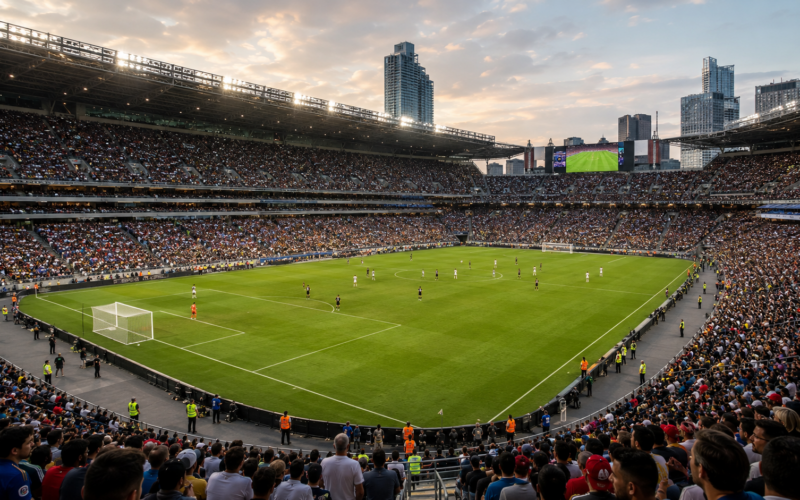
Morocco recovered from falling behind twice to defeat Haiti 4-2 in their final FIFA World Cup 2026 Group C match at Atlanta Stadium in Atlanta, Georgia, on Wednesday, June 24, 2026. The match finished during the early hours of June 25 in India and was watched by an official attendance of 68,239.
Haiti took a shock lead in the 10th minute when Lenny Joseph completed an incisive attacking move, although the goal was formally recorded as an own goal by Morocco goalkeeper Yassine Bounou. Achraf Hakimi equalised in the 39th minute, but Wilson Isidor restored Haiti’s advantage four minutes later with a spectacular long-range strike.
Ismael Saibari made it 2-2 in first-half stoppage time after a low Hakimi delivery, before Morocco’s substitutes decided the contest. Soufiane Rahimi scored the go-ahead goal in the 78th minute and then assisted Gessime Yassine in the 89th minute, with the fourth goal upheld following a VAR review.
Morocco completed Group C unbeaten with seven points but finished second behind Brazil on goal difference. Mohamed Ouahbi’s team advanced to face the Netherlands in the Round of 32, while Haiti ended their first FIFA World Cup appearance since 1974 with three defeats, two historic goals and no points.
FIFA World Cup 2026 Morocco 4-2 Haiti full match scorecard and key incidents
How did Haiti’s direct transitions expose Morocco’s defensive structure twice before half-time?
Morocco entered the match needing a victory and a favourable goal-difference swing to overtake Brazil at the top of Group C. Ouahbi selected an attack-minded 4-2-3-1 with Hakimi advancing aggressively from right-back, Brahim Díaz moving inside and Saibari supporting El Kaabi through central areas.
That structure gave Morocco numbers in possession but created space behind the advancing players. Haiti, already eliminated and therefore free from qualification pressure, used a compact 4-4-2 before breaking quickly through Joseph, Isidor, Casimir and Ruben Providence.
The opening goal emerged from one of Haiti’s best passing sequences of the tournament. Joseph helped complete the move and directed the ball towards goal, where it went in off Bounou and was formally registered as an own goal by the Morocco goalkeeper.
Morocco’s defensive problem was not simply the final touch. Haiti had moved the ball beyond the first pressure, attacked the space between the full-back and centre-back and created an opportunity before Morocco’s holding midfield could recover.
The same transition risk remained visible when Isidor scored in the 43rd minute. Duverne supplied the ball after Morocco failed to establish control, and Isidor took one touch before driving a powerful long-range strike into the top-left corner.
Why did Achraf Hakimi become Morocco’s most important route back into the contest?
Hakimi operated as Morocco’s primary source of width and penetration from the opening minutes. With Díaz and Saibari frequently moving into central positions, the captain had space to advance beyond Haiti’s midfield line and attack Martin Expérience’s side of the defensive block.
Placide initially frustrated him. The Haiti goalkeeper produced a strong double save in the 30th minute, first denying Hakimi and then reacting to stop El Kaabi’s follow-up.
The equaliser arrived nine minutes later after Haiti failed to deal cleanly with another Morocco attack. Placide could not secure the ball inside the crowded goalmouth, allowing Hakimi to react quickly and force it across the line.
Hakimi then created Morocco’s second equaliser during first-half stoppage time. His low delivery travelled across the penalty area, Díaz allowed the ball to run through with an intelligent dummy and Saibari placed his finish beyond Placide.
The goal meant Saibari had scored in all three of Morocco’s group matches. His ability to arrive inside the penalty area from an attacking-midfield position gave Morocco an additional threat whenever Haiti concentrated on El Kaabi and Díaz.
Why did Morocco’s 67 percent possession not produce control during the opening half?
Morocco dominated the ball but did not initially dominate the match’s most dangerous spaces. Their possession frequently developed in front of Haiti’s midfield, while the Caribbean side protected central areas and waited for opportunities to accelerate into the space Morocco left behind.
The Atlas Lions recorded a large volume of attempts, yet many arrived after Haiti had recovered their defensive shape. Placide made several saves because Morocco’s final actions were often hurried or directed from predictable angles.
Haiti’s approach was far more selective. Sébastien Migné’s players finished with only two shots on target, but both became goals because they attacked quickly and decisively before Morocco’s defensive block could reset.
The 2-2 half-time score therefore reflected a contrast between territorial dominance and attacking efficiency. Morocco had the greater volume, while Haiti made significantly more from their limited high-quality transition moments.
Morocco’s late first-half improvement came when their attacks became faster and less dependent on prolonged circulation. Hakimi’s low deliveries, Saibari’s movement and Díaz’s positioning began to create openings inside the penalty area rather than around its edges.
How did Morocco reduce Haiti’s counterattacking threat during the second half?
Morocco’s second-half improvement began with a more disciplined rest defence behind the ball. Sofyan Amrabat stayed closer to the centre-backs, while Neil El Aynaoui became more selective about joining attacks.
That adjustment reduced the open field available to Isidor and Joseph. Haiti could still carry the ball forward, but their transitions increasingly ended against a prepared defender rather than producing direct runs towards Bounou.
Morocco also used their counter-press more effectively. When an attack broke down, the nearest midfielders closed the receiver quickly and forced Haiti either backwards or into ambitious passes that could be recovered.
The pressure was reflected in the corner count. Morocco earned nine corners to Haiti’s one, repeatedly forcing the defence to clear attacks without gaining enough distance to reorganise.
Haiti defended with resilience and kept the score level deep into the second half, but the physical demand became increasingly visible. Morocco’s fresher substitutes were then able to attack defenders who had spent long periods moving laterally and contesting second balls.
Why did Morocco’s triple substitution produce the two decisive goals?
Ouahbi made the match-defining changes in the 70th minute by introducing Rahimi, Ounahi and Yassine for Saibari, Díaz and El Kaabi. The substitutions gave Morocco greater movement across the front line and added players prepared to attack loose balls immediately.
Rahimi moved between the centre and right side rather than operating as a fixed striker. His positioning made it difficult for Haiti’s centre-backs to decide whether to follow him away from the penalty area or remain close to Yassine.
The breakthrough arrived in the 78th minute after Morocco recycled a corner. Chadi Riad helped direct the ball towards Rahimi, who controlled the second phase and struck a turning finish beyond Placide, with a deflection adding to the goalkeeper’s difficulty.
The fourth goal demonstrated the value of the same substitutes in transition. Rahimi chased the ball towards the byline, kept it in play and passed across an exposed goal for Yassine to score his first senior international goal.
VAR reviewed whether the ball had crossed the line before Rahimi’s delivery. The available footage supported the on-field decision, and the goal was allowed to stand.
Morocco therefore received one goal and one assist from Rahimi and another goal from Yassine. The bench did not merely protect the result; it transformed a difficult draw into a two-goal victory.
What did Johny Placide’s final Haiti appearance reveal about the match’s true balance?
Placide conceded four goals, but the scoreline did not accurately represent the quality of his individual performance. The veteran goalkeeper made eight saves and repeatedly kept Haiti level during Morocco’s strongest attacking periods.
His double stop from Hakimi and El Kaabi was the clearest example. Morocco had opened the defence and appeared certain to score, but Placide recovered quickly enough to block the second effort after making the initial save.
There were also moments when his handling contributed to Morocco’s goals, most notably before Hakimi’s equaliser. The combination of excellent saves and costly imperfections reflected the pressure created by 23 attempts and 11 shots on target.
The match was expected to be Placide’s final international appearance. His performance therefore provided an appropriate summary of Haiti’s campaign: brave, occasionally vulnerable, but consistently more competitive than the final results alone might suggest.
Bounou had much less conventional goalkeeping work because Haiti produced only two shots on target. He was still required to save Nazon’s stoppage-time free kick and prevent Haiti from adding a third historic goal.
Why did Morocco finish below Brazil despite completing the group stage unbeaten?
Morocco and Brazil both finished Group C with two victories, one draw and seven points. Their opening meeting ended 1-1, leaving the wider group record to separate the two teams.
Brazil completed the group with seven goals scored and one conceded, producing a goal difference of plus six. Morocco scored six and conceded three, giving the Atlas Lions a goal difference of plus three.
The decisive difference came during the final round. Brazil defeated Scotland 3-0 and preserved another clean sheet, while Morocco conceded twice against Haiti despite eventually scoring four.
Morocco’s second-place finish therefore reflected defensive efficiency rather than a failure to win enough matches. Ouahbi’s team remained unbeaten and demonstrated substantial attacking depth, but the three goals conceded across the group reduced their tiebreaker position.
Brazil advanced as Group C winners to face Japan. Morocco progressed as runners-up and were subsequently paired with Group F winners the Netherlands.
FIFA World Cup 2026 Group C final points table
What does the Netherlands matchup mean for Morocco’s Round of 32 strategy?
Morocco will face the Netherlands at Monterrey Stadium on Monday, June 29, 2026. The Netherlands won Group F with seven points after defeating Tunisia 3-1 in their final group match.
The Dutch offer a more complex tactical challenge than Haiti. They are comfortable progressing through midfield, possess several players capable of receiving under pressure and can punish teams that leave space behind advancing full-backs.
Morocco’s transition defending will therefore require immediate improvement. The same gaps that allowed Joseph and Isidor to attack could become even more damaging against a Netherlands side capable of moving the ball quickly after turnovers.
Hakimi will remain central to Morocco’s attacking plan, but his forward positioning must be balanced by Amrabat and the nearest centre-back. Ouahbi may also consider a more conservative left-back role to maintain three defenders behind the ball during attacks.
Morocco’s bench strength could become a major advantage. Rahimi and Yassine changed the Haiti match after entering together, while Ounahi offered greater control and creativity between the lines.
The Atlas Lions also carry valuable knockout experience from their run to the 2022 semi-finals. Their challenge is to combine that tournament maturity with the more expansive attacking approach shown during the group stage.
What should Haiti take from a campaign that ended without a point?
Haiti lost all three Group C matches, but their campaign contained more competitive moments than the final table suggests. They lost narrowly to Scotland, resisted Brazil for long periods and led Morocco twice before the quality and depth of the Atlas Lions took control.
The two goals in Atlanta were Haiti’s first at a FIFA World Cup since their 1974 appearance. Isidor’s long-range strike, in particular, gave the campaign a moment that will remain significant regardless of the eventual result.
Migné’s team demonstrated pace, directness and commitment during transitions. The larger weakness was their inability to maintain defensive concentration and physical intensity across full matches against deeper squads.
Haiti conceded eight goals and did not collect a point, but the tournament provided a platform for players such as Isidor, Joseph and Casimir. The next challenge is converting occasional attacking quality into a structure capable of surviving sustained pressure.
Key takeaways from Morocco vs Haiti at FIFA World Cup 2026
- Morocco defeated Haiti 4-2 at Atlanta Stadium after falling behind twice during the first half.
- Haiti opened the scoring through a move completed by Lenny Joseph, although the goal was formally recorded as a Yassine Bounou own goal.
- Achraf Hakimi scored Morocco’s first equaliser and assisted Ismael Saibari’s second.
- Wilson Isidor restored Haiti’s lead with a powerful long-range strike in the 43rd minute.
- Saibari scored during first-half stoppage time and found the net in all three of Morocco’s Group C matches.
- Soufiane Rahimi and Gessime Yassine entered together in the 70th minute and scored Morocco’s decisive second-half goals.
- Rahimi recorded one goal and one assist during a match-changing substitute appearance.
- VAR upheld Yassine’s late goal after reviewing whether Rahimi had kept the ball in play.
- Morocco finished second in Group C with seven points and advanced to face the Netherlands.
- Haiti were eliminated without a point but scored their first FIFA World Cup goals in 52 years.
Discover more from Business-News-Today.com
Subscribe to get the latest posts sent to your email.