

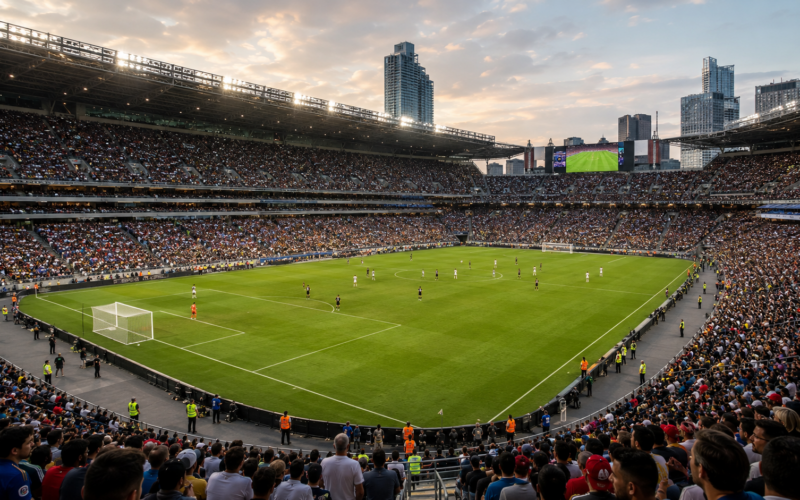
Argentina produced one of the most dramatic comebacks of FIFA World Cup 2026, recovering from two goals down to defeat Egypt 3-2 in their Round of 16 match at Atlanta Stadium on Tuesday, July 7, 2026. Egypt led through Yasser Ibrahim’s 15th-minute header and Mostafa Zico’s 67th-minute finish before the defending champions transformed the match in the final 15 minutes.
Lionel Messi had earlier seen a 21st-minute penalty saved by Mostafa Shoubir, leaving Argentina at risk of a painful knockout exit. Cristian Romero began the recovery in the 79th minute from Messi’s delivery before Messi equalised in the 83rd with a powerful left-footed finish.
Enzo Fernández completed the turnaround in the 90+2nd minute, heading in Lautaro Martínez’s cross after Argentina broke quickly from a tense Egypt attack. The goal sparked furious Egyptian protests after late penalty appeals were waved away, with Egypt’s bench and staff receiving disciplinary sanctions during stoppage time.
Argentina advanced to face Switzerland in the FIFA World Cup 2026 quarter-finals at Kansas City Stadium on Saturday, July 11, at 4pm local time. Egypt were eliminated after coming within minutes of one of the biggest knockout-stage upsets in modern World Cup history.
FIFA World Cup 2026 Argentina 3-2 Egypt full match scorecard and key incidents
How did Egypt take control of the emotional rhythm before Argentina could settle?
Egypt began with a clear plan to defend compactly, break quickly and attack Argentina’s penalty area through early deliveries. Hossam Hassan’s side did not try to match Argentina pass for pass, but the structure gave Mohamed Salah and Haissem Hassan enough freedom to threaten the spaces beside Lisandro Martínez and Cristian Romero.
The opener arrived in the 15th minute from a set-piece pattern that exposed Argentina’s marking. Marawan Attia delivered towards the back post, where Yasser Ibrahim rose above Lisandro Martínez and directed a powerful header beyond Emiliano Martínez.
The goal changed the match immediately. Argentina continued to have more of the ball, but Egypt now had the scoreboard position required to retreat into a deeper block and protect central spaces.
It also placed Argentina in an unfamiliar psychological position. The defending champions had escaped Cape Verde in extra time in the previous round, but Egypt’s early goal created the possibility of a second consecutive knockout scare becoming a genuine elimination.
Why did Messi’s saved penalty become the defining moment of the first half?
Argentina received an ideal opportunity to equalise when Nicolás Tagliafico was fouled inside the penalty area by Haissem Hassan. Messi stepped forward in the 21st minute with the chance to restore control before Egypt’s defensive plan could fully harden.
Shoubir read the penalty and dived to his left, saving Messi’s low strike. The stop was technically excellent, but its psychological impact was even larger.
For Argentina, the miss created tension around every subsequent attack. They were still dominating territory, yet the most reliable player in their modern history had failed to convert from the spot.
For Egypt, the save became a belief multiplier. Shoubir had already produced important performances earlier in the tournament, and this moment told the players in front of him that the upset was not merely possible but actively within reach.
The penalty miss also gave the match its central narrative. Messi looked to be moving towards a painful ending before eventually rewriting the story in the final 15 minutes.
How did Mostafa Shoubir keep Egypt ahead despite Argentina’s growing chance volume?
Shoubir’s penalty save was only the beginning of a demanding first-half performance. Argentina created enough before the interval to avoid trailing, but Egypt’s goalkeeper handled the decisive moments.
Mac Allister found space for a header after Argentina moved the ball into the box, yet Shoubir reacted quickly to prevent the equaliser. Messi then struck the post with a free kick from distance, adding another layer of frustration to Argentina’s first-half pressure.
The best open-play save came when Julián Álvarez received close to goal and attempted to finish from point-blank range. Shoubir stayed upright, narrowed the angle and blocked the attempt.
Egypt reached half-time with only a one-goal lead, but the context mattered. Argentina had generated a heavy expected-goals total, missed a penalty and struck the woodwork, while Egypt had converted one of their few chances.
The match looked increasingly like a classic knockout imbalance: one side controlled the ball, the other controlled the outcome.
Why did Argentina’s possession fail to prevent Egypt’s counterattacking threat?
Argentina completed 541 accurate passes and finished with 62% possession under FIFA’s official match statistics. Those figures show territorial control, but they do not fully explain why Egypt remained so dangerous.
Egypt’s first line of pressure did not need to win the ball constantly. It only needed to guide Argentina into zones where transitions could be launched through Salah, Zico or Haissem Hassan.
Leandro Paredes and Rodrigo De Paul found space in midfield, but many passes moved sideways rather than through Egypt’s defensive block. When Argentina committed full-backs forward, Egypt had the pace and directness to attack the space behind them.
Salah did not need a large number of touches to matter. His presence influenced Argentina’s rest defence and prevented Scaloni’s side from committing every player into the final third without consequence.
That is why Egypt’s limited shot count was misleading. They were not building sustained attacks, but each transition carried enough danger to keep Argentina’s centre-backs uncertain.
Why did the disallowed Zico goal become the match’s first major controversy?
Egypt thought they had doubled their lead before the hour when Zico finished a sweeping counterattack. The move appeared to be one of the best transitions of the match, with Argentina again stretched after losing control of the ball.
The celebrations were cut short after a VAR review identified an earlier foul by Marawan Attia on Lisandro Martínez during the build-up. The decision brought play back and erased what would have been Egypt’s second goal.
From a technical perspective, the review found an infringement before the attacking move became decisive. From Egypt’s perspective, the foul occurred far enough before the finish to feel like an unusually damaging intervention.
The ruling changed the rhythm but did not immediately break Egypt. Instead, it created a sharper sense of injustice and urgency that carried into the next phase.
Argentina were given a reprieve, but they did not immediately use it. Egypt continued to believe they could hurt the defending champions, and eight minutes later they found the valid second goal.
How did Egypt finally convert their counterattacking threat into a 2-0 lead?
The second Egypt goal came from the type of move Argentina had been trying to prevent all afternoon. Salah helped connect the transition, Haissem Hassan found space to deliver, and Zico attacked the six-yard area with conviction.
The cross was precisely weighted, and Zico arrived ahead of Argentina’s defenders to finish from close range in the 67th minute. This time there was no successful review, no reprieve and no escape.
The goal gave Egypt a 2-0 lead with only 23 minutes of normal time remaining. It also made them the first African team to lead the reigning champions by two goals in a World Cup match.
Argentina looked shaken because the pattern was familiar. They had dominated the ball, created more shots and still conceded the cleaner open-play moment when Egypt were given space to run.
At that stage, the defending champions’ title defence appeared close to collapse. Opta later noted that Argentina had just a 0.6% win probability when Romero scored in the 79th minute.
Why did Lautaro Martínez’s introduction change where Messi could influence the match?
Scaloni’s decisive adjustment came in the 66th minute when Lautaro Martínez replaced De Paul and Nico González replaced Tagliafico. Those changes pushed Argentina into a more attacking shape and altered Messi’s role.
Before that point, Messi had often operated in congested central pockets. Egypt crowded those zones with midfielders and centre-backs, denying him the clean touches required to turn and accelerate.
Lautaro’s presence gave Argentina another penalty-area reference point. Egypt’s defenders could no longer focus only on Álvarez or Messi arriving centrally.
The change also allowed Messi to drift wider to the right, where he found more time to lift his head and deliver. That positional shift became decisive for Romero’s goal and the late attacking wave.
Argentina did not suddenly become perfectly structured. The comeback was emotional and chaotic, but the substitutions gave Messi enough room to turn panic into production.
How did Cristian Romero’s 79th-minute header begin Argentina’s comeback?
The first Argentina goal came from Messi’s delivery from the right. Egypt’s defensive line had been retreating deeper, and Romero remained forward after Argentina sustained pressure.
Messi curled the ball into an area that forced Shoubir to stay close to his line. Romero attacked from six yards and headed powerfully towards goal.
Shoubir managed to get a hand to the header, but the contact was not enough to keep it out. The ball crossed the line, and the atmosphere of the match changed instantly.
The goal mattered because it came before the final minutes had fully arrived. Argentina still had enough time to attack without complete desperation, while Egypt suddenly had to defend a one-goal lead with momentum moving against them.
Romero’s header was also symbolically important. A centre-back had started the recovery, but Messi’s delivery had given Argentina the first sign that the match could still bend back towards them.
Why did Messi’s 83rd-minute equaliser feel inevitable despite his earlier miss?
Four minutes after Romero scored, Messi completed his personal reversal. Argentina kept the ball alive around the Egypt penalty area, and the official assist was credited to Gonzalo Montiel as the ball arrived for Messi near the edge of the box.
The finish was instinctive. Messi struck left-footed with little backlift, sending the ball high beyond Shoubir and into the net before the goalkeeper could fully react.
The goal was Messi’s eighth of FIFA World Cup 2026 and his record-extending 21st World Cup goal. More importantly, it erased the weight of the saved penalty.
Egypt had spent most of the match forcing Messi into frustration. By the 83rd minute, the same player who seemed to be heading towards a painful exit had become the centre of another Argentina rescue act.
The equaliser also destroyed Egypt’s defensive certainty. At 2-0, they could protect space. At 2-2, after conceding twice in four minutes, they had to survive an emotional storm.
Why did Enzo Fernández’s stoppage-time winner complete a uniquely Argentine comeback?
The winning goal came after Egypt believed they had penalty claims at the opposite end. Argentina survived the moment, recovered possession and broke quickly before Egypt could reset.
Álvarez moved the ball towards Lautaro Martínez on the right. Lautaro took a touch and delivered a measured cross into the centre, where Enzo Fernández had continued his run from midfield.
The header was placed beyond Shoubir in the 90+2nd minute. It was not the most powerful finish of the match, but it was perfectly directed and devastatingly timed.
The goal completed Argentina’s first World Cup win from a two-goal deficit. It also became one of the latest normal-time winning goals scored by an Argentine player in tournament history.
Fernández’s role was fitting. He had been part of the midfield that struggled for rhythm during Egypt’s best spells, yet his late run represented the collective refusal that has defined Argentina’s recent knockout identity.
Why were Egypt furious after the late penalty appeals and Argentina winner?
Egypt’s protests centred on the sequence before Fernández scored. Egyptian players and staff believed there had been contact involving Mac Allister and Hamdy Fathy inside Argentina’s penalty area, and Salah also appealed after being challenged during the same chaotic passage.
The referee allowed play to continue. Argentina then countered and scored the winning goal, creating the most controversial passage of the match.
The reaction was immediate. Shoubir, Fathy, Attia and Egypt’s bench became involved in protests, with Hossam Hassan booked and goalkeeping coach Saafan Elsaghir sent off.
From Argentina’s perspective, the referee had judged the contact insufficient to award a penalty. From Egypt’s perspective, the contrast with the earlier VAR intervention that disallowed Zico’s goal became impossible to accept.
The controversy will remain part of the match’s story. However, it should not erase Egypt’s performance or Argentina’s late execution, because both were central to why the game became so extraordinary.
How did Egypt come so close to eliminating the defending champions?
Egypt’s plan was simple but brave. They defended deep when required, attacked set pieces aggressively and used Salah, Haissem Hassan and Zico to punish the spaces Argentina left during sustained pressure.
They were also efficient. Egypt scored from a header, had another goal disallowed and then converted a fast counterattack to reach 2-0.
Shoubir’s first-half performance gave the outfield players the platform to believe. Without the penalty save and later stops, Egypt may have been forced into a very different match much earlier.
The eventual collapse came from several overlapping factors. Egypt dropped too deep after the second goal, lost the out ball through substitutions and fatigue, and allowed Messi to receive wider with enough time to deliver.
Even then, Egypt were not outplayed in spirit. They lost because Argentina converted three late moments with ruthless quality and because the decisive officiating moments did not fall their way.
What did the match reveal about Argentina’s strengths and weaknesses?
Argentina’s greatest strength remains competitive endurance. Even when the structure becomes imperfect, the team continues believing it can create one more chance, one more cross or one more late run.
Messi remains the emotional and technical centre. He missed a penalty, looked frustrated for long periods and still finished with a goal, an assist and the decisive influence behind the comeback.
The weakness is equally clear. Argentina have now been forced into consecutive 3-2 knockout escapes, first against Cape Verde and then against Egypt.
Defensively, the team can be exposed when full-backs advance and the midfield loses the second ball. Egypt’s counterattacks repeatedly showed that a compact, fast opponent can stretch the defending champions.
Argentina’s chance creation remains strong, but the finishing has been uneven. Five big chances and 2.84 expected goals were enough, yet the comeback was required because the early chances were wasted.
Why does Messi’s performance deepen the tournament’s defining individual storyline?
Messi’s match began with what could have become the defining failure of his final World Cup run. The saved penalty would have been remembered as the moment Argentina’s title defence unravelled.
Instead, the final 15 minutes reshaped the narrative. His delivery for Romero, his equaliser and his emotional reaction after full-time turned the match into another chapter of Argentina’s late-career Messi story.
The statistics are remarkable. Messi extended his all-time World Cup scoring record and continued his knockout-stage scoring run.
The context matters even more. At 39, he no longer dominates every minute in the same way, but he remains capable of deciding the minutes that matter most.
That is why opponents cannot relax even when he appears subdued. Egypt contained him for most of the match, but they could not contain him for the stretch that decided their tournament.
What must Argentina fix before facing Switzerland in Kansas City?
Switzerland will present a different type of problem from Egypt. Murat Yakin’s side are defensively organised, physically strong and comfortable taking matches into long, low-scoring phases.
Argentina cannot afford another slow start. Switzerland have the discipline to protect a lead more methodically than Egypt managed during the final quarter-hour.
Scaloni must decide whether Lautaro starts after his decisive substitute role. His movement opened spaces for Messi and gave Argentina a more dangerous penalty-area presence late in the match.
The defensive balance also needs attention. Switzerland may not counter with Salah’s profile, but they are capable of exploiting loose passes through Dan Ndoye, Rubén Vargas and Breel Embolo.
Argentina enter the quarter-final alive, but not completely convincing. The defending champions have shown resilience, yet the margin for error is shrinking with every round.
What does the defeat mean for Egypt after a historic World Cup campaign?
Egypt leave FIFA World Cup 2026 with heartbreak, but also with a campaign that significantly advanced the country’s World Cup record. They reached the knockout stage, defeated Australia on penalties and then came within minutes of eliminating Argentina.
Shoubir emerged as one of the tournament’s most important goalkeepers. Zico, Haissem Hassan and Yasser Ibrahim all delivered moments that showed Egypt were more than a defensive outsider.
Salah’s future will now be one of the major questions. If this was his final World Cup match, it ended in emotional devastation but also in a performance where Egypt threatened the defending champions.
Hossam Hassan’s frustration after the match was understandable given the timing of the decisions. Still, Egypt’s late defensive retreat also contributed to the defeat.
The broader lesson is positive. Egypt proved they could compete with elite opposition on a knockout stage, but the next step will require greater composure when protecting a historic lead.
How does Argentina’s comeback shape the FIFA World Cup 2026 quarter-final bracket?
Argentina advanced to face Switzerland at Kansas City Stadium on Saturday, July 11, at 4pm local time. Switzerland reached the quarter-finals by defeating Colombia 4-3 on penalties after a 0-0 draw in Vancouver.
The winner of Argentina vs Switzerland will progress to the semi-final at Atlanta Stadium. That side of the draw also includes Norway and England, who will meet in Miami.
Argentina are still attempting to become the first team since Brazil in 1962 to retain the World Cup. Their path remains alive, but the last two rounds have shown that every opponent can push them to the edge.
Egypt were eliminated in the Round of 16 after producing one of the most memorable performances of the tournament. Their exit completes the quarter-final picture for Argentina’s side of the bracket.
Key takeaways from Argentina vs Egypt at FIFA World Cup 2026
- Argentina defeated Egypt 3-2 after trailing 2-0 with 11 minutes of normal time remaining.
- Yasser Ibrahim headed Egypt ahead in the 15th minute from Marawan Attia’s delivery.
- Lionel Messi had a 21st-minute penalty saved by Mostafa Shoubir.
- Shoubir also denied Alexis Mac Allister and Julián Álvarez during a strong first-half goalkeeping display.
- Mostafa Zico had a second-half goal disallowed after VAR identified a foul by Attia on Lisandro Martínez.
- Zico later scored a valid 67th-minute goal from Haissem Hassan’s cross to put Egypt 2-0 up.
- Cristian Romero started Argentina’s comeback in the 79th minute from Messi’s assist.
- Messi equalised in the 83rd minute with his eighth goal of FIFA World Cup 2026 and record-extending 21st World Cup goal.
- Enzo Fernández headed in Lautaro Martínez’s cross in the 90+2nd minute to complete the comeback.
- Argentina will face Switzerland at Kansas City Stadium on July 11, while Egypt were eliminated after a historic campaign.
Discover more from Business-News-Today.com
Subscribe to get the latest posts sent to your email.