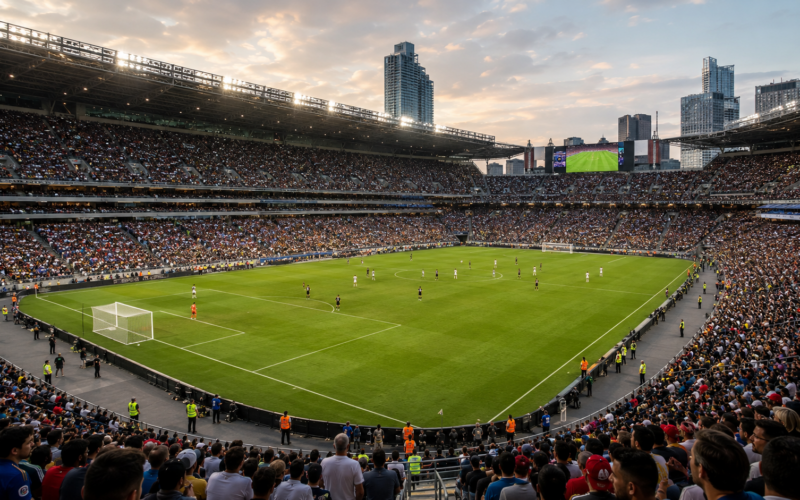
Gabriel Martinelli scored in the fifth minute of stoppage time as Brazil came from behind to defeat Japan 2-1 in their FIFA World Cup 2026 Round of 32 match at Houston Stadium on Monday, June 29, 2026. The five-time champions survived a disciplined Japanese performance in front of 68,777 spectators to secure a place in the Round of 16.
Kaishu Sano gave Japan a deserved lead in the 29th minute after intercepting Danilo’s misplaced pass and driving a powerful finish beyond Alisson. Brazil controlled possession but struggled to penetrate Japan’s compact structure during a first half in which Hajime Moriyasu’s side defended with intensity and tactical discipline.
Casemiro equalised in the 56th minute, heading Gabriel Magalhães’ cross past Zion Suzuki at the far post. Japan’s goalkeeper then produced an outstanding save to push Vinícius Júnior’s curling shot against the post as Brazil increased the pressure.
Martinelli, introduced in the 66th minute, finally decided the match after Bruno Guimarães slipped a pass through Japan’s defensive line. The substitute placed his finish inside the far post to prevent extra time and set up a Round of 16 meeting with Norway at New York New Jersey Stadium on July 5.
FIFA World Cup 2026 Brazil 2-1 Japan full match scorecard and key incidents
Why did Japan’s compact defensive structure frustrate Brazil throughout the first half?
Japan defended in a disciplined 3-4-2-1 structure that frequently became a line of five when Brazil advanced. Junya Ito and Keito Nakamura dropped alongside the three central defenders, limiting the space available for Vinícius Júnior and Rayan to attack from the wings.
Sano and Daichi Kamada protected the central area in front of the defence. Their positioning denied Bruno Guimarães and Paquetá the opportunity to receive cleanly between the lines and turn towards goal.
Brazil recorded plenty of possession but struggled to create high-quality opportunities. Ancelotti’s side moved the ball across the defensive and midfield lines without consistently drawing Japan out of shape.
Vinícius often received possession with two defenders positioned between him and the penalty area. Rayan encountered a similar problem on the opposite side, while Cunha was surrounded whenever he attempted to operate centrally.
Brazil’s first-half shots were predominantly taken from distance or difficult angles. For the first time since their 2018 quarter-final defeat against Belgium, they failed to register a first-half shot on target from inside the penalty area during a FIFA World Cup match.
How did Kaishu Sano punish the defensive error that gave Japan the lead?
Japan’s goal did not develop from a long possession sequence. It came from the aggressive midfield pressure that Moriyasu had designed to punish careless Brazilian passing.
Danilo attempted to move the ball across Brazil’s defensive structure in the 29th minute. The pass lacked sufficient pace and travelled directly into an area where Sano could intercept.
The midfielder immediately accelerated towards the penalty area rather than slowing the move to wait for support. Brazil’s defenders retreated, but none stepped forward quickly enough to block his shooting route.
Sano drove a low right-footed finish beyond Alisson and into the left side of the net. No assist was recorded because the opportunity resulted from his interception.
The goal transformed the tactical conditions. Japan could defend even deeper and ask Brazil to find a way through a compact block, while the pressure surrounding the tournament favourites increased with every unsuccessful attack.
Why did Lucas Paquetá’s injury force Carlo Ancelotti to alter Brazil’s attack?
Paquetá completed the first half but suffered discomfort in the back of his left thigh. He did not return after the interval and was replaced by Endrick.
The change altered Brazil’s attacking distribution. Rather than retaining three conventional midfielders, Ancelotti added another forward capable of attacking the penalty area and occupying Japan’s centre-backs.
Endrick’s movement allowed Cunha to drop towards midfield and link with Guimarães. Brazil also began advancing the full-backs more aggressively, creating wider crossing opportunities that had been limited before half-time.
The official diagnosis later confirmed a muscle injury. No recovery timetable was immediately provided, leaving Paquetá doubtful for the Round of 16 against Norway.
His possible absence matters because Brazil require midfielders who can receive between defensive lines. Against Japan, the attacking improvement came from greater numbers and urgency, but Norway may punish Brazil if the midfield becomes unbalanced.
How did Casemiro recover from Japan’s opening goal to score Brazil’s equaliser?
Casemiro experienced a difficult first half. His positioning did not prevent Sano from advancing after the interception, and he received an early yellow card that restricted the aggression of his defensive challenges.
The veteran nevertheless became increasingly influential after half-time. He moved closer to the penalty area and attacked crosses rather than remaining exclusively behind the ball.
Casemiro nearly equalised when he met an early second-half delivery, but his close-range header lacked enough power to beat the defenders protecting Japan’s goal. The missed chance did not discourage him.
In the 56th minute, Gabriel Magalhães received possession on the left and delivered towards the far post. Casemiro timed his movement behind Japan’s midfield and rose above the defender.
His downward header travelled beyond Suzuki and into the net. At 34 years and 126 days, Casemiro became Brazil’s second-oldest FIFA World Cup scorer, behind only Bebeto against Denmark in 1998.
The goal also reflected Ancelotti’s decision to maintain faith in an experienced player after the defensive problems surrounding Japan’s opener.
Why was Zion Suzuki the main reason Japan remained level until stoppage time?
Japan’s defensive structure began losing its compactness after Brazil equalised. The midfielders had covered significant distances during the first hour, while Brazil were able to introduce fresh attackers.
Suzuki became increasingly important as the spaces around Japan’s penalty area expanded. He completed four saves and dealt confidently with several crosses under physical pressure.
His outstanding intervention came against Vinícius. The Brazil forward collected possession on the left, moved through several challenges and curled towards the far corner.
Suzuki reacted quickly and pushed the ball against the post. The save prevented a potential individual goal and temporarily restored Japan’s belief that the match could reach extra time.
The goalkeeper also denied Paquetá, Cunha and Guimarães at different stages. Brazil generated 1.72 expected goals, compared with only 0.23 for Japan, but Suzuki kept the score level until the final minutes.
His performance was another indication of Japan’s improving individual quality. The problem was that the team became increasingly dependent on him as its ability to retain possession disappeared.
How did Gabriel Martinelli’s introduction give Brazil a different route around Japan?
Martinelli replaced Cunha in the 66th minute. The substitution moved Brazil towards a more fluid forward line, with Endrick occupying central defenders and Martinelli attacking from the left.
Vinícius gained greater freedom to move inside rather than remaining permanently near the touchline. Martinelli’s willingness to run behind the defensive line also forced Japan’s right side to defend facing its own goal.
Japan made two defensive changes during the same period, introducing Sugawara and Junnosuke Suzuki. The fresh players initially helped protect the wide areas, but Brazil continued stretching the block through repeated switches of possession.
Martinelli did not dominate the ball. His value came from making runs that changed the positioning of Japan’s defenders even when he was not receiving a pass.
That movement became decisive during stoppage time. Japan’s defenders had begun focusing on the players around the ball, leaving Martinelli with enough space to attack the channel inside the penalty area.
Why did Bruno Guimarães wait before releasing the decisive pass in stoppage time?
Guimarães received possession near the edge of Japan’s defensive block in the 95th minute. An immediate pass might have allowed the defenders to step forward and catch Martinelli before his run developed.
The midfielder briefly delayed, drawing the nearest opponent towards him. Martinelli continued moving into the gap between Japan’s right-sided defender and centre-back.
Guimarães then slipped the ball through at the precise moment the defensive line had become unbalanced. Martinelli controlled and placed his finish across Suzuki towards the far post.
The goalkeeper reached towards the ball but could not prevent it from crossing the line. Brazil’s substitutes, staff and players celebrated with the relief of a team that had been seconds away from extra time.
Guimarães recorded four chances created and his fourth assist of FIFA World Cup 2026. Only Pelé, with six in 1970, has produced more assists for Brazil during a single edition of the competition since detailed records began.
Why did Japan lose the attacking threat that had unsettled Brazil before half-time?
Japan registered five attempts across the match but produced very little after Casemiro equalised. Their inability to retain possession became increasingly damaging as fatigue affected the midfield and wide players.
Moriyasu introduced defensive replacements in the 66th minute before adding Tanaka and Machino in the 78th. The changes refreshed the team physically but did not restore the passing combinations that had supported Sano, Kamada and Ueda during the first half.
Japan were also missing several important players. Takefusa Kubo had been ruled out with a knee injury, while Kaoru Mitoma, Takumi Minamino and Wataru Endo were unavailable.
Those absences reduced the quality available from the bench. Brazil could introduce Endrick and Martinelli while keeping Neymar in reserve for possible extra time, whereas Japan had fewer players capable of carrying the ball away from pressure.
The Samurai Blue eventually retreated too close to their own goal. Brazil recovered possession quickly after every clearance and sustained the pressure until Martinelli scored.
Why does Japan’s fifth knockout elimination create another strategic decision?
Japan have now reached the knockout stage at five FIFA World Cups without winning a match. Türkiye eliminated them in 2002, Paraguay won on penalties in 2010, Belgium completed a late comeback in 2018, Croatia prevailed on penalties in 2022 and Brazil struck during stoppage time in 2026.
Three of those exits followed a similar pattern. Japan performed strongly, took a lead or remained competitive, but lost control as the match moved into its final phase.
The issue is no longer whether Japan can compete with elite countries. Victories over Germany, Spain and England, along with a friendly win against Brazil, had already demonstrated their technical and tactical development.
The remaining step is managing knockout matches when fatigue, pressure and substitutions become decisive. Japan require greater squad depth and more players capable of slowing the game without abandoning attacking ambition.
Moriyasu has led the national team for eight years. The Japan Football Association must now decide whether continuity offers the best route towards overcoming the knockout barrier or whether the team requires a new tactical direction.
What must Brazil improve before facing Norway and Erling Haaland?
Brazil will face Norway at New York New Jersey Stadium on Sunday, July 5. Norway reached the Round of 16 by defeating Ivory Coast 2-1 through goals from Antonio Nusa and Erling Haaland.
The matchup will present a different challenge from Japan. Norway are more direct, physically stronger and capable of attacking crosses or early passes behind Brazil’s defensive line.
Danilo’s error against Japan offers an obvious warning. Haaland, Nusa and Martin Ødegaard are unlikely to waste similar opportunities if Brazil lose possession while the defensive structure is open.
Brazil will also need to manage Paquetá’s possible absence. Ancelotti could retain Endrick, introduce a more conservative midfielder or adjust Guimarães’ position to preserve control.
The positive lesson from Houston was Brazil’s patience. They did not panic after falling behind and continued creating pressure until the decisive opportunity arrived.
The concern is that Brazil required 95 minutes to overcome opponents who produced only five shots. Norway’s greater attacking threat means another slow or careless first half could create a far more difficult recovery.
How does Brazil’s victory shape the FIFA World Cup 2026 knockout bracket?
Brazil advanced to the Round of 16 for the ninth consecutive FIFA World Cup. They have not failed to reach that stage since their 1990 elimination against Argentina.
Japan were eliminated after another competitive campaign. Their departure also continued Asia’s difficult tournament, although Japan came closer than most regional teams to producing a major knockout result.
Brazil’s meeting with Norway will determine one participant in the quarter-final scheduled for July 11. The winner will face the country advancing from Mexico or Ecuador against England or DR Congo.
Key takeaways from Brazil vs Japan at FIFA World Cup 2026
- Brazil came from behind to defeat Japan 2-1 and reach the Round of 16.
- Kaishu Sano intercepted Danilo’s misplaced pass and scored in the 29th minute.
- Japan limited Brazil to difficult shooting positions during an organised first half.
- Lucas Paquetá left at half-time and was later diagnosed with a left-thigh muscle injury.
- Casemiro equalised with a far-post header from Gabriel Magalhães’ cross.
- Casemiro became Brazil’s second-oldest FIFA World Cup goalscorer.
- Zion Suzuki pushed Vinícius Júnior’s curling shot against the post.
- Gabriel Martinelli entered in the 66th minute and scored the winner at 90+5.
- Bruno Guimarães recorded his fourth assist of FIFA World Cup 2026.
- Brazil will face Norway in the Round of 16, while Japan remain without a FIFA World Cup knockout victory.
Discover more from Business-News-Today.com
Subscribe to get the latest posts sent to your email.