


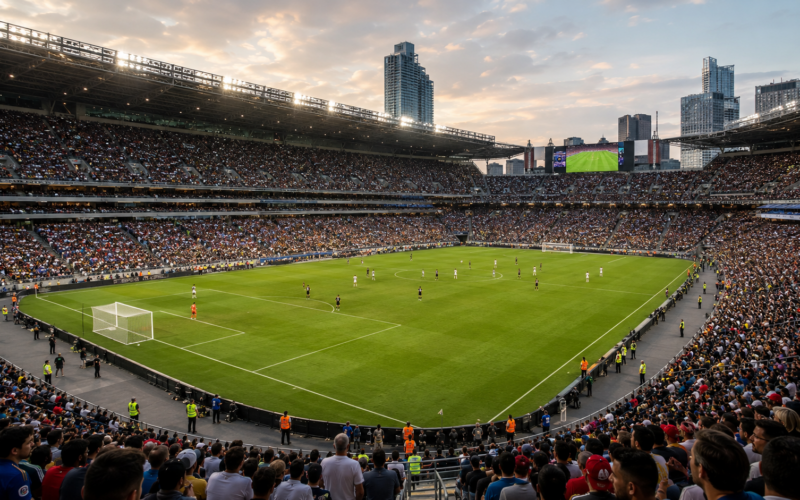
Stephen Eustáquio scored in the second minute of stoppage time as Canada defeated South Africa 1-0 in the opening Round of 32 match of FIFA World Cup 2026 at Los Angeles Stadium in Inglewood, California, on Sunday, June 28, 2026. The late victory sent the co-hosts into the Round of 16 for the first time in their history.
The match appeared destined for extra time until a South African clearance dropped towards Eustáquio outside the penalty area. The Canada midfielder controlled the ball with his chest and drove a powerful right-footed finish into the bottom corner beyond Ronwen Williams.
Canada had created the clearer opportunities before the goal. Aubrey Modiba cleared Moïse Bombito’s header off the line, Williams denied Tajon Buchanan and Tani Oluwaseyi, and Mbekezeli Mbokazi prevented Jonathan David from converting a rebound during the second half.
South Africa controlled more possession but offered little attacking threat after Teboho Mokoena’s early long-range effort. Canada advanced to face the winner of Netherlands vs Morocco in Houston on July 4, while Bafana Bafana’s first appearance in the FIFA World Cup knockout stage ended with a stoppage-time defeat.
FIFA World Cup 2026 South Africa 0-1 Canada full match scorecard and key incidents
Why did South Africa’s possession advantage create so little attacking danger?
South Africa completed 466 passes and controlled more than 58% of possession, but the numerical advantage disguised where most of the ball was being circulated. Ronwen Williams, Ime Okon, Mbokazi and the midfielders exchanged passes inside their own half without consistently moving Canada’s defensive structure.
Canada allowed the centre-backs to hold possession while protecting the routes into Makgopa and Maseko. Eustáquio and Saliba remained compact in central midfield, and the wide players recovered to prevent Mudau and Modiba from creating overloads.
Mokoena produced South Africa’s only shot on target after five minutes, striking from approximately 30 metres. Crépeau dealt with the effort comfortably, and Bafana Bafana did not force another official save during the remaining 85 minutes.
South Africa frequently reached the middle third but lacked the acceleration required to turn possession into penetration. Passes travelled sideways rather than behind Canada’s defensive line, leaving Makgopa isolated between Bombito and Derek Cornelius.
The contrast with Canada was significant. Marsch’s side completed fewer passes but attacked more directly, created twice as many attempts and produced seven shots on target.
How did Moïse Bombito’s return strengthen Canada at both ends of the pitch?
Bombito returned to Canada’s starting defence and immediately restored pace and physical security alongside Cornelius. His ability to defend large spaces allowed Johnston and Laryea to advance without leaving the centre completely exposed.
South Africa attempted to release Maseko and Appollis into the channels, but Bombito repeatedly recovered before either winger could enter a clear shooting position. Canada’s higher defensive line therefore remained relatively stable.
Bombito also produced one of Canada’s best first-half chances. Eustáquio delivered a corner into the penalty area, and the centre-back powered a header towards goal.
Modiba remained on the line and cleared the ball before it crossed. Buchanan reached the rebound from close range, but Williams blocked the follow-up with his body.
The sequence demonstrated the pressure Canada could generate from Eustáquio’s set pieces. It also provided an early warning that South Africa’s defensive resistance depended on emergency interventions rather than complete control.
Why did the Richie Laryea penalty appeal create such a strong Canadian reaction?
Laryea entered the penalty area shortly before half-time and attempted to move beyond Mudau. The South African defender challenged from the side, causing Laryea to fall as he tried to reach the ball.
Canada appealed immediately. Referee João Pinheiro allowed play to continue before the video officials reviewed the incident.
Replays showed Mudau making a small contact with the ball before colliding with Laryea. VAR therefore supported the on-field decision and no penalty was awarded.
Marsch reacted angrily as the players left the field and had to be guided away from the officials. Canada’s frustration was increased by the earlier goal-line clearance and Buchanan’s blocked rebound.
The review did not produce a clear error. However, it reinforced the sense that Canada’s pressure was not being rewarded despite creating the better chances during the first half.
How did Ronwen Williams keep South Africa alive until stoppage time?
Williams finished with five saves and repeatedly prevented Canada from converting its direct attacks. His positioning was particularly important because South Africa’s defensive line occasionally struggled when Canada released runners into space.
The goalkeeper blocked Buchanan during the first-half goalmouth scramble and remained composed when Canada delivered crosses towards David and Oluwaseyi. He also communicated effectively with Mbokazi and Okon as South Africa defended deeper.
Canada’s clearest second-half opening arrived when Oluwaseyi broke through the centre. Williams rushed from his line and blocked the forward’s shot.
The rebound looped towards David, who appeared ready to head into an exposed goal. Mbokazi recovered and produced a decisive clearance before the Canada striker could convert.
Williams also denied David from a tight angle after Davies entered. South Africa’s captain had done enough to take the match towards extra time until Eustáquio’s finish finally beat him.
Why did Jesse Marsch replace two players after only 59 minutes?
Saliba had received a yellow card in the 54th minute and was operating in an area where South Africa were attempting to counterattack. Marsch removed him five minutes later and introduced Sigur to protect Canada against a possible second booking.
Bombito also left during the same substitution window, with de Fougerolles entering alongside Cornelius. The change allowed Canada to manage Bombito’s return while maintaining pace in central defence.
Sigur was himself booked eight minutes after entering, but his passing helped Canada maintain pressure through the middle. De Fougerolles also handled South Africa’s limited direct attacks without significant difficulty.
Marsch then introduced Shaffelburg and Promise David in the 70th minute. Their pace and physicality increased the pressure on a South African defence that had spent much of the match reacting to Canadian transitions.
The substitutions demonstrated that Canada were still attempting to win before extra time. South Africa waited until the 86th minute to make their final attacking changes, leaving the substitutes little time to influence the contest.
How did Alphonso Davies change Canada’s attacking shape after returning from injury?
Davies entered in the 75th minute for his first appearance at FIFA World Cup 2026. A hamstring problem had prevented Canada’s captain from playing during the group stage.
His arrival immediately changed the positioning of Canada’s left side. Davies received higher than a conventional full-back and attacked Mudau directly, while Shaffelburg moved into inside channels.
South Africa could no longer keep the defensive line as narrow because Davies threatened to accelerate around the outside. That wider positioning created additional central space for Eustáquio and David.
Davies released Promise David for a low attempt from distance and later created another shooting opportunity for Jonathan David. Neither chance produced the breakthrough, but Canada’s attacks became faster and less predictable.
The captain also reclaimed the armband from Eustáquio after entering. His return provided Canada with an important physical and psychological lift ahead of the Round of 16.
Why was Mbekezeli Mbokazi South Africa’s most important outfield player?
Mbokazi repeatedly covered behind South Africa’s midfield and full-backs. His speed became essential whenever Canada moved the ball directly towards Oluwaseyi, David or Shaffelburg.
The defender’s most important intervention followed Williams’ save from Oluwaseyi. Mbokazi recognised the danger, sprinted towards his own goal and cleared before David could head the rebound into an exposed net.
He also won several aerial challenges and helped South Africa record 33 clearances. Canada completed only 78.6% of their passes because Bafana Bafana defended aggressively around the penalty area.
Mbokazi’s performance gave South Africa a route towards extra time despite their limited attacking output. Canada required an exceptional finish from outside the area rather than converting one of its earlier close-range opportunities.
The defeat should not obscure the defensive quality he displayed. Mbokazi emerged from the tournament as one of the younger players around whom South Africa can build its next cycle.
How did Stephen Eustáquio finally break the deadlock in the 92nd minute?
Canada continued pushing players forward after the fourth official indicated five minutes of stoppage time. A cross entered the South African penalty area and was headed away towards the edge of the box.
Eustáquio anticipated where the clearance would fall and positioned himself outside the crowded central area. He controlled the ball on his chest rather than attempting an immediate shot.
The midfielder then struck through the ball with his right foot. The finish travelled beyond Mokoena, across Williams and into the bottom corner.
No official assist was awarded because the opportunity resulted from South Africa’s defensive clearance. The goal arrived 64 seconds into stoppage time and left Bafana Bafana with only a few minutes to respond.
Eustáquio had already created five chances from set pieces, matching one of the highest totals recorded in a FIFA World Cup knockout match. His decisive contribution eventually came from open play.
Why could South Africa not produce an equaliser after falling behind?
Broos had introduced Moremi and Rayners shortly before the goal, but South Africa had spent most of the second half playing at a controlled tempo. They were therefore forced to change their approach immediately after conceding.
The defenders moved forward and attempted several direct deliveries into Canada’s penalty area. Crépeau and Cornelius dealt with the first balls, while Johnston and de Fougerolles protected the spaces around them.
South Africa lacked a forward capable of dominating Canada aerially. Makgopa had already been replaced, and Rayners received little time to establish connections with Appollis or Moremi.
The earlier strategy of protecting the draw had also left Bafana Bafana without attacking rhythm. A team that had produced one shot on target during 90 minutes could not suddenly generate a clear chance during the final moments.
The approach almost delivered extra time, but it provided no recovery plan once Eustáquio scored.
What does Canada’s first Round of 16 qualification mean for the co-hosts?
Canada had never previously won a men’s FIFA World Cup knockout match. Their appearances in 1986 and 2022 ended during the group stage, while the expanded 2026 format gave them their first opportunity beyond the opening round.
The co-hosts began the tournament by drawing with Bosnia and Herzegovina, defeated Qatar 6-0 and lost 2-1 to Switzerland. Finishing second meant leaving Canada for the Round of 32, but the support inside Los Angeles Stadium remained heavily Canadian.
The victory represented another step in the team’s development under Marsch. Canada had already reached the 2024 Copa América semi-finals, but winning a home-region FIFA World Cup knockout match carries greater long-term significance.
The result was achieved despite injuries to Koné and Davies and a short recovery period after the Switzerland match. Canada’s depth and physical resilience therefore mattered alongside the individual quality of the winning goal.
Their next opponent will provide a much more demanding test. Netherlands or Morocco will offer greater attacking quality than South Africa and will punish Canada if the four major chances missed in Los Angeles are repeated.
How should South Africa assess its historic FIFA World Cup 2026 campaign?
South Africa began with a 2-0 defeat against Mexico before drawing 1-1 with Czechia. Maseko’s goal against Korea Republic then secured second place in Group A and the country’s first progression beyond the group stage.
The Round of 32 performance demonstrated both the team’s progress and its remaining limitations. Broos built a disciplined defensive structure, but South Africa lacked the pace and power required to threaten Canada consistently.
Bafana Bafana conceded only once across their final two matches. Their difficulty was creating opportunities when opponents denied them transition space.
The tournament also represented the final FIFA World Cup of Broos’ coaching career. The 74-year-old stopped short of immediately confirming whether he would leave the South Africa position but acknowledged that he would not return for another World Cup.
South Africa departed without reaching the Round of 16, yet the campaign established a new national benchmark. Future teams will now be judged against the achievement of reaching the knockouts rather than merely qualifying.
How does Canada’s victory shape the FIFA World Cup 2026 knockout bracket?
Canada became the first team to qualify for the Round of 16. They will face the winner of Netherlands vs Morocco at Houston Stadium on Saturday, July 4.
The winner of that Round of 16 contest will advance to the quarter-final scheduled for July 9. Canada therefore remain two victories away from a place in the last four.
Key takeaways from South Africa vs Canada at FIFA World Cup 2026
- Stephen Eustáquio scored in the 90+2 minute as Canada defeated South Africa 1-0.
- The goal came after Eustáquio controlled a defensive clearance and scored from outside the penalty area.
- Canada reached the men’s FIFA World Cup Round of 16 for the first time.
- Aubrey Modiba cleared Moïse Bombito’s first-half header off the goal line.
- VAR upheld the decision not to award Canada a penalty for Khuliso Mudau’s challenge on Richie Laryea.
- Ronwen Williams made five saves and kept South Africa level until stoppage time.
- Mbekezeli Mbokazi denied Jonathan David after Tani Oluwaseyi’s shot was saved.
- Alphonso Davies made his first appearance of FIFA World Cup 2026 after entering in the 75th minute.
- South Africa held 58.4% possession but registered only one shot on target.
- Canada will face the winner of Netherlands vs Morocco in Houston on July 4.
Discover more from Business-News-Today.com
Subscribe to get the latest posts sent to your email.