


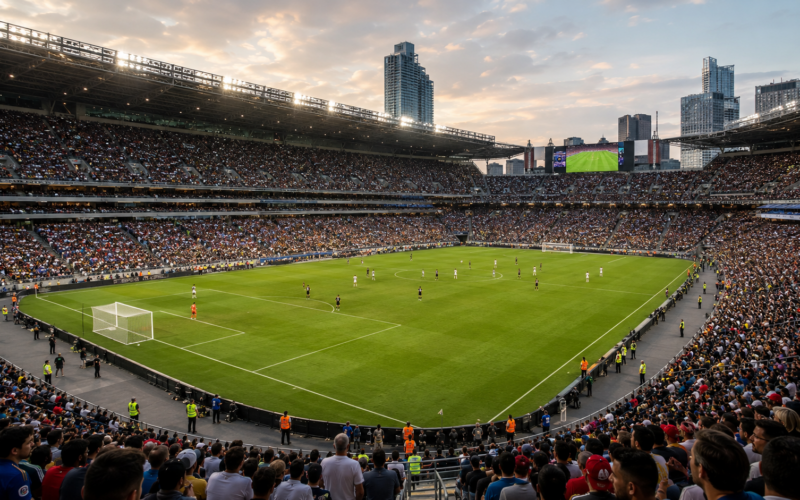
Charles De Ketelaere scored twice and assisted another goal as Belgium defeated the United States 4-1 in their FIFA World Cup 2026 Round of 16 match at Seattle Stadium in Seattle, Washington, on Monday, July 6, 2026. De Ketelaere opened the scoring in the ninth minute, restored Belgium’s lead in the 33rd and later created Hans Vanaken’s second-half goal.
Malik Tillman briefly brought the United States level in the 31st minute with a deflected direct free kick after Folarin Balogun won the foul near the edge of the penalty area. The equaliser electrified the home crowd, but Belgium responded within two minutes when Leandro Trossard crossed from the left and De Ketelaere headed beyond Matt Freese.
The match moved away from the co-hosts in the 57th minute when Freese left his penalty area, failed to clear under pressure from De Ketelaere and allowed Vanaken to score into an exposed net from distance. Romelu Lukaku then came off the bench and scored in stoppage time after Belgium punished another United States defensive mistake.
Belgium advanced to face Spain in the FIFA World Cup 2026 quarter-finals at Los Angeles Stadium in Inglewood, California, on Friday, July 10, at noon local time. The United States were eliminated after their deepest home World Cup campaign since 1994, having won Group D and recorded their first knockout victory since 2002 before running into a more clinical Belgian side.
FIFA World Cup 2026 United States 1-4 Belgium full match scorecard and key incidents
How did Belgium expose the United States before the co-hosts settled into the match?
Belgium made the more authoritative start despite playing away from home against a highly energised Seattle crowd. Rudi Garcia’s side pressed the United States into rushed early clearances, and Matt Freese had to produce a full-stretch save from Timothy Castagne inside the opening minute.
That warning mattered because Belgium were already finding space behind the United States full-backs. Leandro Trossard and Dodi Lukébakio held wide positions, while Charles De Ketelaere drifted away from the centre-backs before attacking the six-yard area.
The ninth-minute opener followed Belgium’s early pressure. Trossard controlled on the left, Alex Freeman blocked the initial delivery, but Nicolas Raskin collected the loose ball and moved towards the byline before sending a low cross through the six-yard box.
De Ketelaere arrived ahead of the United States defenders and finished from close range. The goal reflected Belgium’s sharper reactions, with the visitors winning the second phase after the first cross had been blocked.
Why did the United States struggle to protect the six-yard box against De Ketelaere?
The United States back line had difficulty identifying De Ketelaere’s starting position. He was listed as Belgium’s central forward, but he did not remain fixed between Tim Ream and Chris Richards.
For the first goal, he arrived from a blind-side angle after Raskin drove towards the end line. Ream and Richards were forced to protect the near-post space, leaving De Ketelaere free to attack the centre of goal.
The second Belgium goal created a similar problem from the opposite side. Trossard received on the left and crossed towards the six-yard area, where De Ketelaere rose above Ream and headed high into the net.
That header was not simply a height advantage. It was a timing advantage, because De Ketelaere attacked the ball while the defender was still adjusting his body position.
The United States allowed only two goals during the group stage but looked uncertain against Belgium’s movement. De Ketelaere converted that uncertainty into two first-half finishes and shaped the match before the interval.
How did Malik Tillman briefly restore belief for the United States?
The United States gradually gained more possession after Belgium’s opener, although much of it came in areas that did not immediately threaten Courtois. The equalising opportunity came when Balogun drew a foul just outside the penalty area.
Tillman took responsibility for the free kick after scoring from a set play in the Round of 32. His right-footed strike caught a deflection from the Belgian wall and wrong-footed Courtois before spinning into the centre of the goal.
The finish gave the United States their first shot of the match and their strongest emotional surge of the evening. It also extended a scoring streak that had become one of the team’s most encouraging tournament developments.
Tillman’s goal carried individual significance as well. He became the first United States player to score in consecutive World Cup knockout matches, reinforcing his emergence as one of the most important players of the campaign.
Why did Belgium’s immediate response matter more than the United States equaliser?
The equaliser could have changed the rhythm if the United States had controlled the next five minutes. Instead, Belgium struck again almost immediately and turned the home crowd’s energy back into anxiety.
Belgium’s second goal began with the same calm circulation that had created the opener. The ball moved from right to left, forcing the United States defence to shift across the pitch.
Trossard then delivered a measured cross into the penalty area. De Ketelaere separated from Ream, climbed powerfully and directed a header into the upper corner.
Only two minutes had passed since Tillman’s free kick. The timing prevented the United States from building a sustained spell of pressure and showed Belgium’s superior composure after conceding.
The response also changed the half-time conversation. Rather than entering the break level and emotionally lifted, the United States had to chase the game again against a team that had repeatedly punished defensive hesitation.
How did Amadou Onana’s injury unexpectedly help Belgium through Hans Vanaken?
Onana left the match midway through the first half after suffering a knee injury, forcing Belgium into an early midfield change. Vanaken replaced him and initially appeared to be a defensive compromise because Onana’s ball-winning and physical range were removed.
The change altered Belgium’s midfield profile. Vanaken gave the team a calmer passer and a player capable of arriving around the edge of the area when De Ketelaere dropped into deeper positions.
That became decisive after half-time. De Ketelaere pressed Freese outside the penalty area, disrupted the clearance and knocked the ball into the path of Vanaken.
The substitute recognised the goalkeeper was out of position and struck from distance towards an exposed net. Ream attempted to retreat and protect the line, but the shot bounced into the goal.
What began as an injury problem became another example of Belgium’s depth. Vanaken scored the third goal and later assisted Lukaku, giving Belgium decisive production from a player introduced earlier than planned.
Why was Matt Freese’s 57th-minute error the turning point of the match?
The United States entered the second half still within reach despite Belgium’s first-half superiority. Pochettino introduced Gio Reyna at half-time, seeking a player capable of connecting midfield possession with the forwards.
Freese then misread a long ball that dropped outside his penalty area. He left his line and appeared to control the situation initially, but he could not clear quickly enough under De Ketelaere’s pressure.
The Belgian forward’s challenge knocked the ball loose to Vanaken. With Freese stranded and the goal exposed, Vanaken finished from distance before the covering defenders could recover.
The goal was psychologically damaging because it was not the result of extended Belgium pressure. It came from an individual error at a moment when the United States needed stability.
At 3-1, the match became structurally different. Belgium could defend with greater patience, while the United States had to take more risks and leave additional space for counterattacks.
Why did Belgium’s 2.15 expected goals show a clearer attacking plan than the scoreline alone?
Belgium produced 15 attempts and placed seven on target, creating a steady flow of danger across both halves. The expected-goals figure of 2.15 reflected the quality of the close-range chances converted by De Ketelaere and the late opportunity taken by Lukaku.
The visitors did not dominate possession according to the main statistical feeds. They instead dominated the dangerous zones, particularly the six-yard box and the space behind the United States defensive line.
The United States completed more accurate passes and held a greater share of possession, but that control rarely became threatening. Their 0.67 expected goals came from seven attempts, only two of which forced Courtois into saves.
Belgium’s performance showed the difference between circulation and penetration. The United States moved the ball more often, while Belgium moved it into better finishing positions.
How did Leandro Trossard influence the match without scoring?
Trossard’s contribution began before the first goal. His initial cross was blocked by Freeman, but his positioning on the left created the second phase from which Raskin supplied De Ketelaere.
The Arsenal forward then delivered the decisive assist for Belgium’s second goal. His left-footed cross was placed into the area between goalkeeper and centre-back, giving De Ketelaere the chance to attack forward rather than jump from a standing position.
Trossard also repeatedly helped Belgium escape pressure by receiving on the touchline and carrying the ball away from the United States press. That reduced the amount of sustained pressure the co-hosts could apply after Tillman’s equaliser.
Opta’s broader tournament data placed him among the most productive chance creators at FIFA World Cup 2026. Against the United States, he again provided the delivery that turned Belgium’s attacking structure into goals.
Why did Christian Pulisic and Folarin Balogun struggle to influence open play?
The United States needed Pulisic and Balogun to stretch Belgium’s back line, but neither received consistent service in the areas where they are most dangerous. Belgium’s defensive shape forced the ball wide before closing the passing lanes back inside.
Balogun did contribute to the United States goal by winning the free kick that Tillman converted. However, he did not receive enough early through balls to attack Courtois in transition.
Pulisic frequently came short to help possession, but Belgium were comfortable defending those touches because they occurred away from goal. When he moved inside, Castagne and Mechele had enough cover behind them.
Pochettino replaced Pulisic with Sebastian Berhalter in the 59th minute, searching for fresh pressing and another midfield runner. Balogun later forced Courtois into a save in the 82nd minute, but by then Belgium’s lead had become too difficult to overcome.
The match showed the limitation of possession without service. The United States had attacking talent on the field, but Belgium prevented the ball from reaching those players with time, space and forward momentum.
How did Courtois and Belgium handle the United States’ second-half pressure?
Courtois had relatively little to do for long stretches because Belgium’s defenders blocked central passing lanes before the United States could shoot. Brandon Mechele and Nathan Ngoy protected the space around the penalty spot, while De Cuyper and Castagne resisted being pulled too far inside.
The United States attempted to increase attacking presence through Reyna, Berhalter, Ricardo Pepi and later Haji Wright. Those changes gave Pochettino more players capable of arriving in the box but did not create enough clean chances.
Berhalter produced one of the better openings in the 79th minute with a driven strike that went narrowly wide. Balogun followed by testing Courtois from a firmer angle three minutes later.
Courtois saved that attempt and Belgium managed the rebound cleanly. The goalkeeper’s experience mattered less through spectacular shot-stopping and more through positioning, communication and preventing chaotic second phases.
Belgium never appeared fully comfortable after the United States increased urgency, but they were rarely out of control. Their defensive structure forced the co-hosts into low-percentage attempts and kept the match away from another emotional swing.
Why did Romelu Lukaku’s late goal underline Belgium’s squad depth?
Lukaku replaced De Ketelaere in the 67th minute after the match’s decisive player had already scored twice and assisted once. The substitution gave Belgium a different type of centre-forward for the final phase.
Where De Ketelaere had drifted and combined, Lukaku offered direct physical presence and a powerful finishing threat. The United States defenders had to adjust from tracking a mobile false-nine profile to dealing with a striker who wanted contact and early service.
The fourth goal arrived after another United States mistake. Richards attempted to escape pressure near his own goal, De Cuyper intervened and the ball moved towards Lukaku through Vanaken.
Lukaku finished with a right-footed strike into the bottom corner. The goal gave Belgium’s scoreline the emphatic look that the underlying chance quality already supported.
It also carried historical weight. Lukaku became the first player to score as a substitute in four different FIFA World Cup matches and the first to do so in three matches at a single edition.
Why did Belgium win despite having less possession than the United States?
The possession figure favoured the United States, but the match was decided by the quality of possession rather than its quantity. Belgium repeatedly found attacking players inside the penalty area, while the United States often circulated in deeper or wider zones.
Belgium created four big chances and missed two. The United States did not create a big chance under the main Opta and Sky statistical classifications.
The contrast was also visible in shots on target. Belgium forced seven saves or goals from 15 attempts, while the United States produced only two on-target efforts from seven attempts.
The United States completed more passes at a higher accuracy rate, yet Belgium’s passing carried more vertical threat. Raskin, Trossard and De Ketelaere converted limited possession into the situations that mattered.
This is why the final score did not feel disconnected from the game. The United States had the ball for long periods, but Belgium had the clearer plan, sharper movement and more decisive penalty-area execution.
What did the United States achieve despite another Round of 16 exit?
The defeat should not erase the progress made across the campaign. The United States won Group D, defeated Paraguay and Australia, and then beat Bosnia and Herzegovina in the Round of 32 to record the program’s first knockout victory since 2002.
The team also scored 11 goals, its highest total at a single World Cup. Pochettino finished with more World Cup wins than any previous United States men’s national team manager.
There were individual gains as well. Tillman emerged as a knockout-stage scorer, Balogun provided consistent group-stage output, and Freese started the tournament with several strong performances before the Belgium error.
The problem is that progress was still not enough to reach the quarter-finals. The United States have now exited at the Round of 16 stage in their last four appearances at that level, underlining how difficult the next step remains.
The home tournament generated belief and attention. The football lesson is more demanding: the United States need better defensive decision-making, more reliable chance creation and greater composure against elite European opponents.
What must the United States improve before the next World Cup cycle?
The first improvement must come in defending second phases. Belgium’s first goal came after an initial cross was blocked, while the later goals involved pressure, loose balls and individual mistakes rather than long periods of possession.
The United States also need more varied attacking routes when opponents deny central transitions. Belgium reduced Pulisic and Balogun to limited touches in dangerous areas, forcing the hosts to depend on Tillman’s set-piece quality.
Midfield control requires a further upgrade. Adams, McKennie and Tillman gave the team energy, but Belgium were more precise when the ball entered the final third.
Goalkeeper decision-making will also be scrutinised after Freese’s second-half error. His early save from Castagne was excellent, yet the third goal became the mistake that ended the United States comeback hopes.
The next cycle should build on the positives rather than discard them. The United States proved they can win tournament matches at home, but Belgium exposed the gap between competitive improvement and genuine quarter-final quality.
What must Belgium improve before facing Spain in the quarter-finals?
Belgium’s attacking performance was clinical, but Spain will test their defensive patience in a very different way. Luis de la Fuente’s side will dominate possession through Rodri, Pedri and the wide threat of Lamine Yamal.
Garcia must decide whether De Bruyne remains an unused option or returns for a match that may require more control between the lines. Belgium beat the United States without him, but Spain are likely to demand a greater passing presence.
Onana’s injury also creates a midfield concern. Vanaken scored and assisted after replacing him, yet Spain’s midfield movement will test defensive coverage more severely than the United States did.
Belgium’s centre-backs must prepare for Spain’s late runners. Mikel Merino eliminated Portugal through exactly that type of movement, and Ferran Torres gave Spain another route behind the defensive line.
The positive for Belgium is their depth. De Ketelaere, Vanaken and Lukaku all delivered decisive attacking actions, while Trossard continued to create chances from wide areas.
Against Spain, Belgium will need the same finishing efficiency with more defensive control. The United States match proved their attacking ceiling remains high; the quarter-final will show whether they can manage the ball and tempo against one of the tournament’s most organised teams.
How does Belgium’s victory shape the FIFA World Cup 2026 quarter-final bracket?
Belgium advanced to face Spain at Los Angeles Stadium on Friday, July 10, at noon Pacific Time. Spain reached the quarter-finals by defeating Portugal 1-0 through Mikel Merino’s stoppage-time winner.
The winner of Spain vs Belgium will progress to the semi-finals and face the winner of France vs Morocco. That path creates a European-heavy section of the bracket, with Morocco attempting to break through again after their historic 2022 run.
The United States were eliminated as the final remaining host nation in this part of the draw. Belgium, meanwhile, reached the FIFA World Cup quarter-finals for the fourth time and for the third time in the last four editions.
Key takeaways from United States vs Belgium at FIFA World Cup 2026
- Belgium defeated the United States 4-1 and advanced to a quarter-final against Spain.
- Charles De Ketelaere opened the scoring in the ninth minute from Nicolas Raskin’s low cross.
- Malik Tillman equalised with a deflected direct free kick in the 31st minute.
- De Ketelaere headed Belgium back in front only two minutes later from Leandro Trossard’s delivery.
- Amadou Onana left with a first-half knee injury and was replaced by Hans Vanaken.
- Vanaken scored Belgium’s third goal after De Ketelaere pressured Matt Freese outside the penalty area.
- Sebastian Berhalter fired narrowly wide and Folarin Balogun forced Thibaut Courtois into a late save.
- Romelu Lukaku came off the bench and scored in the 90+3rd minute.
- Belgium generated 2.15 expected goals from 15 shots, compared with 0.67 from seven United States attempts.
- The United States were eliminated after winning Group D and recording their first World Cup knockout victory since 2002.
Discover more from Business-News-Today.com
Subscribe to get the latest posts sent to your email.