

Exide Industries Limited (NSE: EXIDEIND; BSE: 500086) has injected another ₹200 crore into wholly owned subsidiary Exide Energy Solutions Limited, taking its cumulative investment in the lithium-ion battery business to ₹5,102.23 crore. The August 18 transaction was completed through a rights-basis subscription and does not change Exide Industries’ 100% ownership of the subsidiary. The capital is being directed toward Exide Energy Solutions’ greenfield Bengaluru lithium-ion cell manufacturing project, where all four production-line utilities are now operational, customer samples have been dispatched and validation and homologation are underway. The strategic tension is increasingly clear: Exide has spent years financing the manufacturing platform, but FY27 is expected to become the point when the gigafactory begins generating commercial revenue rather than remaining predominantly an investment-stage asset.
The scale is significant even for Exide Industries. Business News Today calculates that the ₹5,102.23 crore cumulative equity investment in Exide Energy Solutions is equivalent to roughly 13% of Exide Industries’ approximately ₹39,500 crore equity market value at the August 18 close. It is also almost equal to Exide Industries’ entire ₹5,305 crore standalone Q1 FY27 revenue. The comparison does not imply that the subsidiary should immediately generate returns proportional to that capital, particularly while a large manufacturing project is still ramping, but it shows why commercial cell production has become increasingly important to the parent company’s valuation story.
Why is Exide Industries investing another ₹200 crore when more than ₹5,100 crore is already inside Exide Energy Solutions?
The latest investment is part of a broader funding commitment approved by Exide Industries’ board in January 2026. The board authorised additional investment of up to ₹1,400 crore into Exide Energy Solutions in one or more tranches to support the greenfield multi-gigawatt lithium-ion cell facility and associated funding requirements. Exide invested approximately ₹100 crore in July, taking cumulative equity support to ₹4,902.23 crore, and the latest ₹200 crore tranche has lifted that figure to ₹5,102.23 crore.
The August 18 investment involved subscription to 57,142,857 Exide Energy Solutions shares with a face value of ₹10 and a premium of ₹25 per share. The transaction was completed in cash on a rights basis, preserving Exide Industries’ full ownership.
The fresh ₹200 crore itself is equivalent to approximately 49% of Exide Industries’ ₹407 crore standalone Q1 FY27 profit after tax. That comparison illustrates the scale of capital allocation taking place outside the established lead-acid battery operation, although the investment is funded from the company’s broader financial resources rather than from one quarter of earnings alone. Exide continues to describe its parent balance sheet as debt-free and carries ICRA AAA/Stable and A1+ ratings, giving it considerably greater funding flexibility than a highly leveraged manufacturer attempting the same transition.
The capital requirement also reflects the nature of lithium-ion cell manufacturing. Unlike battery-pack assembly, cell manufacturing requires electrode-production equipment, dry rooms, formation systems, testing infrastructure, utilities, quality systems and long customer-validation cycles before meaningful revenue can begin. The latest infusion therefore represents continued funding of industrial scale-up rather than an acquisition of a separate operating business.
How close is Exide Energy Solutions’ Bengaluru gigafactory to actually producing commercial revenue?
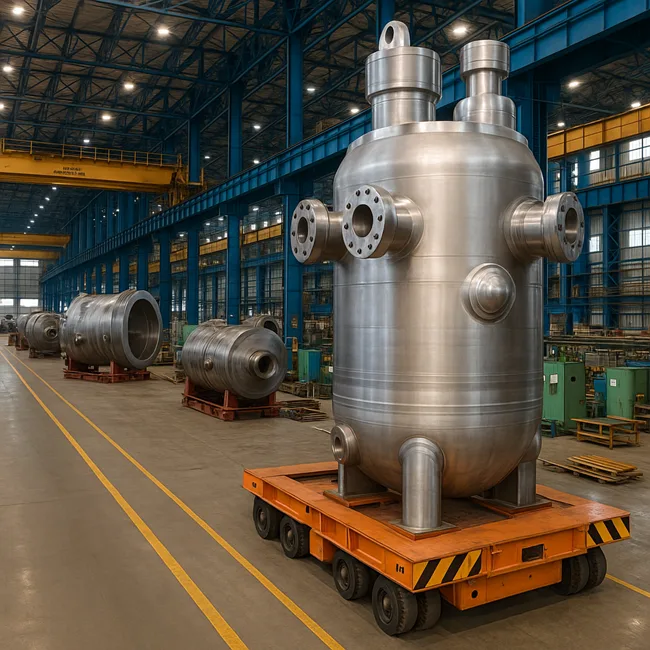
The latest operating disclosures suggest the project has moved well beyond the construction-only stage. Exide Industries said 100% of utilities across four manufacturing lines had been operationalised by the Q1 FY27 update. Nickel manganese cobalt cylindrical cell samples have been dispatched to customers, while lithium iron phosphate prismatic samples have been supplied for three-wheeler and telecom applications.
Exide Energy Solutions has also completed certifications including BIS IS 16046, IS 16893, IS 16085 and UN 38.3. The remaining work is increasingly commercial rather than simply physical construction. Production stabilisation, yield improvement, customer testing, validation, homologation and original-equipment-manufacturer qualification remain underway.
Management expects revenue generation from the gigafactory during FY27 and has previously indicated that commercial contribution could begin from Q3 FY27. The first phase has been described as approximately 6 GWh of capacity, with the wider Bengaluru manufacturing platform designed to scale further as demand develops.
This makes the next several months materially different from the previous investment phase. Installing equipment and producing samples prove that a manufacturing process exists. Customer qualification proves that the cells meet specific commercial requirements. Revenue requires those qualifications to convert into actual orders and repeat production.
For Exide Industries, that distinction matters enormously. The market has spent several years valuing the Bengaluru project partly on future potential. Once commercial production begins, investors will finally be able to assess actual utilisation, selling prices, customer mix, manufacturing yields and operating losses during ramp-up.
Why does Exide Energy Solutions’ ₹157.56 crore FY26 turnover show how early the lithium investment still is?
Exide Energy Solutions reported FY26 turnover of ₹157.56 crore and a loss after tax of ₹248.16 crore. The business includes lithium-ion battery cells, modules and packs, meaning that historical turnover should not be treated as revenue generated by the new Bengaluru cell gigafactory alone. The factory itself had not yet entered normal commercial cell production during FY26.
Business News Today calculates that Exide Industries’ current ₹5,102.23 crore cumulative equity investment is more than 32 times Exide Energy Solutions’ FY26 turnover. That ratio is not a conventional valuation multiple because the subsidiary is still building assets intended to generate revenue over many years, but it does illustrate how heavily the economics remain weighted toward future rather than present earnings.
The ₹248.16 crore FY26 loss is equally important. Early losses are not surprising for a business carrying substantial employee, development, testing and manufacturing-readiness expenses ahead of full plant utilisation. However, those losses mean commercial ramp-up has to achieve two objectives: generate new revenue and progressively absorb the fixed-cost base that currently produces negative earnings.
This is where utilisation becomes more important than commissioning. A 6 GWh facility operating at a low percentage of capacity can carry very different economics from the same facility operating near an efficient production level. Secondary reports following management interactions have indicated an initial utilisation ambition around 25% to 30%, although the pace will depend on customer homologation and demand conversion.
The eventual investment case therefore depends less on whether Exide Energy Solutions sells its first locally manufactured cell and more on how quickly the business can move from first commercial revenue toward repeat orders and higher line utilisation.
Why could India’s shift from imported lithium-ion cells create a much larger opportunity for Exide?
Exide Industries estimates that India’s advanced-chemistry battery market is currently around 25 GWh and remains largely dependent on imports. The company, drawing on Boston Consulting Group and industry estimates, sees potential demand rising to roughly 140 GWh to 150 GWh by 2030, with electric vehicles representing approximately 60% to 70% of the requirement.
That would imply the addressable market potentially expanding by more than five times over four years.
The localisation opportunity is therefore not based solely on stealing market share from existing domestic manufacturers. Much of the opportunity involves replacing imported cells with locally produced batteries as electric-vehicle volumes and stationary-storage requirements expand.
Exide Energy Solutions is targeting both lithium iron phosphate and nickel manganese cobalt chemistries, as well as cylindrical and prismatic form factors. That matters because the Indian market is unlikely to converge around one battery architecture. Three-wheelers, passenger vehicles, telecom backup systems and stationary battery-energy-storage projects can require different combinations of cost, energy density, cycle life and physical packaging.
Exide’s existing market access provides another potential advantage. The parent company serves more than 75 automotive original-equipment manufacturers and has more than 120,000 network touchpoints across India. That infrastructure does not guarantee Exide Energy Solutions battery-cell contracts, because lithium-ion supply decisions involve different qualification standards and competitive dynamics from conventional lead-acid batteries. It does give the group existing relationships through which locally manufactured cells, modules and packs can be evaluated.
The competitive test will be cost. Local manufacturing can shorten working-capital cycles, reduce supply-chain exposure and improve customer collaboration, but domestic cells still have to compete economically against Asian imports. Exide says strategic sourcing, automation and technology-led manufacturing efficiency are central to its cost strategy.
Can Exide Industries’ traditional lead-acid business finance the lithium-ion transition without weakening earnings?
The core business currently provides a strong financial anchor. Exide Industries reported standalone Q1 FY27 revenue of ₹5,305 crore, up 17.6% year on year, while EBITDA increased 19.5% to ₹655 crore. EBITDA margin improved modestly to 12.4% from 12.2%, and standalone PAT increased 27.1% to ₹407 crore.
That operating performance matters because lithium-ion manufacturing is still consuming capital rather than producing meaningful group profit. Exide Industries can therefore use cash generation from automotive replacement batteries, original-equipment-manufacturer demand, industrial applications, solar, inverter batteries and exports to finance the new-energy build-out.
The strategic advantage is considerable. Exide does not need its traditional battery business to disappear for the lithium investment to succeed.
Internal-combustion vehicles will continue requiring starter batteries, while electric vehicles themselves often use auxiliary low-voltage batteries in addition to their high-voltage traction packs. Exide is also expanding in industrial applications including data centres, telecom, renewable-energy backup, railways and specialised systems.
Management has separately targeted more than ₹20,000 crore of revenue from the core lead-acid business over the next two to three years, compared with about ₹17,269 crore in FY26. If that business continues generating cash while lithium-ion production ramps, Exide can potentially fund part of the transition internally without forcing shareholders to rely on immediate profitability from the gigafactory.
The risk is that the two capital cycles overlap. Conventional battery manufacturing continues requiring investment and working capital, while Exide Energy Solutions may need further equity before utilisation reaches efficient levels. Strong Q1 earnings provide financial capacity, but the size of the new-energy commitment means capital discipline still matters.
How significant is the ₹5,102 crore lithium investment relative to Exide Industries’ current valuation?
Exide Industries closed at ₹465.25 on August 18, down 2.2% for the session, giving the company a market capitalisation of approximately ₹39,500 crore. The fresh Exide Energy Solutions announcement was filed after market hours, so the August 18 decline should not be described as a reaction to the ₹200 crore investment.
At the August 18 market value, the ₹5,102.23 crore cumulative Exide Energy Solutions investment represents approximately 12.9% of Exide Industries’ equity capitalisation.
That is large enough for lithium-ion execution to materially influence how the market eventually values the parent company, but still small enough that Exide’s established battery franchise remains the overwhelming financial foundation of the listed business.
EXIDEIND had reached a 52-week high of ₹496.40 on August 11 before retreating to ₹465.25 by August 18, a decline of approximately 6.3% from the peak. The stock nevertheless remained roughly 62% above its ₹287 52-week low and around 28% higher for 2026. Early August 19 trading had the shares around ₹466, leaving them broadly unchanged from the previous close.
That positioning shows that investors are already assigning considerable value to Exide’s combination of stronger core earnings and lithium-ion optionality. The stock is no longer trading close to depressed annual levels where successful gigafactory execution would represent largely unpriced upside.
Sentiment is also mixed rather than uniformly bullish. Market data compiled by Mint shows a spread of analyst views, including strong-buy, buy, hold and sell recommendations, reflecting disagreement over how much future lithium-ion value should already be capitalised into the share price.
The valuation debate will become easier once Exide Energy Solutions starts producing commercially measurable results. Until then, estimates of lithium-ion value remain highly sensitive to assumptions around capacity utilisation, pricing, margins and the amount of additional capital required.
What milestones will show whether Exide’s lithium-ion investment is moving from capex to commercial returns?
The first milestone is straightforward: commercial revenue from locally produced Bengaluru cells. Management has placed that event within FY27, with earlier commentary pointing toward Q3.
The second is customer qualification. Exide Energy Solutions has already shipped NMC cylindrical and LFP prismatic samples, but successful sample production is only the beginning of the automotive qualification process. Repeat supply contracts would provide much stronger evidence of commercial acceptance.
The third is utilisation. A multi-gigawatt plant needs production volume to spread depreciation, employee costs, utilities and manufacturing overheads across a larger number of cells. Revenue growth without improving utilisation could still leave the subsidiary loss-making for an extended period.
The fourth is consolidated profitability. Exide Industries’ standalone Q1 PAT was ₹407 crore, while consolidated profit was lower at roughly ₹351 crore as subsidiaries were incorporated into the group result. That difference cannot be attributed entirely to Exide Energy Solutions because Exide has other subsidiaries, but it underlines why the new-energy business eventually needs to shift from earnings drag toward earnings contribution.
Finally, investors will need to watch cumulative capital requirements. The latest ₹200 crore infusion has taken parent investment above ₹5,100 crore, and Exide Industries has authorised substantial additional FY27 funding. If commercialisation progresses without a much larger increase in required capital, returns could improve rapidly as utilisation rises. If customer qualification or production yields take materially longer, the period between investment and economic return would lengthen.
What are the key takeaways from Exide Industries’ ₹200 crore Exide Energy Solutions investment?
- Exide Industries Limited invested another approximately ₹200 crore in Exide Energy Solutions Limited on August 18 through a rights-basis equity subscription.
- Cumulative Exide Industries investment in the wholly owned lithium-ion subsidiary has now reached ₹5,102.23 crore.
- Business News Today calculates that the investment equals roughly 13% of Exide Industries’ approximately ₹39,500 crore market capitalisation at the August 18 close.
- The cumulative lithium-ion investment is also almost equal to Exide Industries’ ₹5,305 crore standalone Q1 FY27 revenue, illustrating the scale of the new-energy capital commitment.
- Exide Energy Solutions’ Bengaluru gigafactory has operationalised utilities across all four lines and dispatched NMC cylindrical and LFP prismatic cell samples.
- Production stabilisation, yield improvement, customer validation, homologation and original-equipment-manufacturer qualification remain underway before large-scale commercial ramp-up.
- Management expects the Bengaluru cell factory to begin generating revenue during FY27, with earlier guidance pointing toward Q3 FY27.
- Exide Energy Solutions recorded FY26 turnover of ₹157.56 crore and a ₹248.16 crore loss, showing that the new-energy business remains in an early investment and ramp-up stage.
- Exide Industries’ core business remains financially strong, with Q1 standalone revenue up 17.6% to ₹5,305 crore and PAT rising 27.1% to ₹407 crore.
- EXIDEIND closed at ₹465.25 on August 18, around 6% below its 52-week high but approximately 62% above its annual low, meaning successful lithium commercialisation is increasingly important to the next valuation phase.
Will Exide Industries’ ₹5,102 crore lithium-ion bet finally start producing measurable returns in FY27?
Exide Industries has reached the point where additional capital announcements are becoming less informative than operating milestones. More than ₹5,100 crore has now been invested in Exide Energy Solutions, the manufacturing lines are physically ready, utilities are operational, certifications have been secured and samples are in customer hands. The strategy has progressed from concept to industrial infrastructure.
What it does not yet have is meaningful commercial cell revenue.
That gap is the most important part of the investment case. Exide’s established lead-acid operation can continue financing development for some time because it remains profitable, debt-free at the parent level and capable of generating strong cash flows. The lithium subsidiary does not therefore need immediate profitability merely to keep the project alive.
But the economic threshold is now rising. As cumulative investment moves further beyond ₹5,000 crore, investors need evidence that customer qualification can translate into orders, production yields can stabilise and gigafactory utilisation can move toward a level where fixed manufacturing costs are absorbed.
The opportunity is large enough to justify patience. Exide Industries sees Indian advanced-chemistry battery demand potentially expanding from about 25 GWh currently to 140 GWh to 150 GWh by 2030, creating a significant localisation opportunity across electric vehicles and stationary storage.
The most meaningful catalyst will therefore not be another ₹100 crore or ₹200 crore rights subscription into Exide Energy Solutions. It will be the first quarter in which Exide can disclose meaningful revenue from Bengaluru-manufactured cells, followed by evidence that utilisation and margins are moving upward.
If that happens during FY27 as planned, Exide Industries will begin changing from a profitable traditional battery manufacturer financing an expensive lithium option into a company operating two commercially significant battery technologies. After ₹5,102 crore of cumulative parent investment, that transition is now close enough to be measured rather than merely anticipated.
Discover more from Business-News-Today.com
Subscribe to get the latest posts sent to your email.