


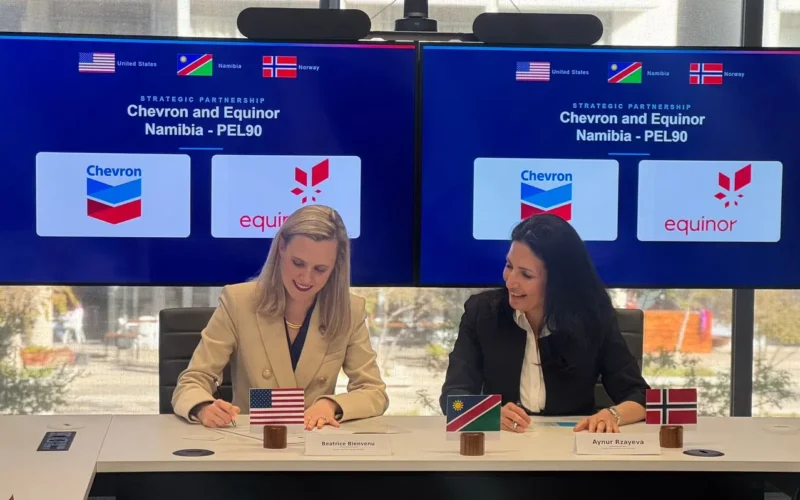
Equinor ASA (Oslo Børs: EQNR; NYSE: EQNR) has agreed to acquire a 17.4% participating interest in Chevron-operated Petroleum Exploration Licence 90 in Namibia’s Orange Basin, establishing its first upstream position in the country immediately ahead of another exploration test scheduled for 2026. The interest is being acquired from Harmattan Energy Limited, Chevron Corporation’s Namibian subsidiary, while Chevron will retain operatorship and the largest individual stake after completion. The purchase price has not been disclosed, and the transaction remains subject to regulatory approvals and completion processes. For Equinor, the attraction is unusually clear: it can gain exposure to one of the oil industry’s most closely watched frontier basins without assuming operatorship, but the value of that foothold still depends overwhelmingly on what the drill bit finds.
The August 18 transaction is particularly significant because Equinor has not entered a new upstream country since expanding into Argentina in 2017. It also arrives just two months after the company set a target of increasing international oil and gas production by roughly 30% to about 950,000 barrels of oil equivalent per day by 2030. Namibia therefore fits a larger portfolio strategy in which Equinor is attempting to extend the life of its international upstream business through focused exploration and new projects rather than relying only on mature producing assets.
Why is Equinor entering Namibia immediately before Chevron tests another Orange Basin prospect?
Timing is arguably more important than the headline 17.4% interest.
Equinor said PEL 90 provides access to a drill-ready prospect scheduled for testing during 2026. Reuters reported that a well is expected to be drilled before the end of the year. That gives Equinor exposure to a potentially value-changing exploration result soon after the transaction closes rather than forcing the company to wait several years for the next geological catalyst.
The structure also changes the risk Equinor is accepting.
Rather than purchasing control of a discovery that has already been appraised and priced accordingly, Equinor is taking a minority position before the next exploration result. If drilling proves successful, the company will already own a meaningful share of the licence before additional geological de-risking potentially increases its value. If the well disappoints, Equinor’s exposure is considerably smaller than it would have been had the company acquired operatorship or a controlling interest.
That is what makes the transaction strategically interesting despite the undisclosed price.
Equinor is effectively purchasing geological optionality. The company gets access to the upside of a basin capable of producing major discoveries while limiting the scale of its initial commitment.
There is no guarantee that this structure will generate an attractive return. Frontier exploration remains inherently uncertain, and even technically successful wells can fail commercial thresholds once reservoir quality, recoverable volumes, development costs and infrastructure requirements are understood.
But the sequencing is disciplined. Equinor is entering before the answer is known rather than paying a premium once success has become obvious.

How does Equinor’s 17.4% purchase reshape ownership of Chevron-operated PEL 90?
Before the transaction, Harmattan Energy Limited held 52.5% of PEL 90. QatarEnergy held 27.5%, Trago Energy held 10% and Namibia’s state-owned National Petroleum Corporation of Namibia, or NAMCOR, held the remaining 10%.
After Equinor acquires its 17.4% interest, Chevron’s position will fall to 35.1%. QatarEnergy will remain at 27.5%, Equinor will hold 17.4%, while Trago Energy and NAMCOR retain 10% each. Chevron remains operator.
That leaves PEL 90 with an unusually heavyweight partner group for an exploration licence.
Chevron contributes deepwater operating capability and existing technical knowledge of the acreage. QatarEnergy has built an extensive portfolio of international upstream partnerships, particularly alongside major operators. Equinor now brings another large offshore producer with experience across Atlantic-facing basins including Brazil, the United Kingdom and the United States.
The presence of those companies should not be confused with proof that PEL 90 contains commercially recoverable oil. Major producers routinely participate in exploration licences that ultimately fail.
What the ownership structure does provide is financial and technical capacity to continue evaluating the block if initial drilling generates sufficiently encouraging results.
That distinction matters in deepwater exploration. Discovering hydrocarbons is only the first step. Appraisal drilling, subsurface interpretation, engineering, project design and eventually multibillion-dollar development decisions require partners capable of funding a long process before first production.
Equinor’s arrival strengthens that capability without changing Chevron’s role as operator.
Why does Namibia’s Orange Basin continue attracting major oil companies?
Equinor is entering a basin whose international profile has changed dramatically since 2022.
TotalEnergies made the Venus discovery in Block 2913B that year after the Venus-1X well encountered approximately 84 metres of net oil pay in a Lower Cretaceous reservoir. The discovery helped establish the Orange Basin as a serious deepwater exploration province rather than merely an underexplored geological concept.
Commercial development, however, has taken longer than the initial discovery excitement might have implied.
TotalEnergies said in January 2026 that the Venus partners were continuing work to secure the conditions required for a potential final investment decision during 2026. It has also expanded its position in Namibia through a transaction with Galp Energia involving the Mopane discovery, with further exploration and appraisal drilling planned.
That creates an important distinction for evaluating Equinor’s move.
The Orange Basin has demonstrated a working petroleum system and substantial oil potential. It has not demonstrated that every licence or prospect will produce a commercial development.
Equinor is therefore entering a basin with proven geological promise but licence-specific exploration uncertainty.
This is precisely the environment in which minority interests can make strategic sense. A major producer can participate in several prospects, absorb unsuccessful wells within a broader exploration budget and increase investment only when technical evidence justifies doing so.
For Namibia, another major international energy company joining the upstream sector also broadens the pool of potential long-term investors at a time when the country is attempting to convert discoveries into an eventual producing industry.
How does Namibia fit Equinor’s target for 30% international oil and gas production growth?
The transaction becomes more important when viewed against Equinor’s June 2026 Capital Markets Day.
Management increased its ambition for total company production to approximately 2.3 million barrels of oil equivalent per day by 2030. Within that target, international oil and gas production is expected to grow roughly 30% to around 950,000 barrels of oil equivalent per day.
Equinor expects international exploration and production to receive approximately 30% of capital expenditure during 2028 to 2030. The company also expects that business to generate approximately $9 billion of cash flow from operations in 2030 and around $20 billion of free cash flow after capital expenditure and lease payments over 2026 to 2030.
Namibia will not materially contribute toward the 2030 production target unless exploration, appraisal and development progress exceptionally quickly.
That does not make the acquisition strategically inconsistent.
Upstream companies need resources beyond the projects already expected to produce by the end of the decade. Fields decline, portfolios are reshaped and projects are sold or delayed. Exploration therefore creates the inventory that can sustain production beyond the immediate planning period.
Equinor explicitly said in June that the longevity of its international portfolio beyond 2030 would be supported by progressing non-sanctioned projects and focused exploration. PEL 90 sits squarely inside that objective.
The company is effectively separating two different jobs within its portfolio.
Projects already in development can deliver near and medium-term production growth. Frontier exploration positions such as Namibia can create optionality for the following decade.
That makes the Namibia entry more strategically meaningful than its immediate production contribution, which is currently zero.
Does Equinor have enough financial flexibility to keep adding international exploration options?
Equinor enters Namibia from a much stronger financial position than many smaller exploration companies attempting to participate in frontier basins.
Second-quarter 2026 adjusted operating income reached $11.48 billion, while reported net operating income was $12.99 billion and net income was $4.84 billion. Cash flow from operations after taxes paid reached $7.68 billion during the quarter.
The company spent $3.35 billion on organic capital expenditure during the quarter and ended June with an adjusted net debt-to-capital-employed ratio of 10.4%, down from 15.3% at the end of the previous quarter.
That financial position means the Namibia transaction is fundamentally an allocation decision rather than a financing challenge.
Equinor is simultaneously returning significant capital to shareholders. Its board approved a second-quarter dividend of $0.39 per share and launched a third 2026 buyback tranche of up to $1.125 billion. The company expects the full-year share repurchase programme to reach as much as $3 billion.
Management therefore has room to fund exploration while maintaining distributions, but that makes investment discipline more important rather than less important.
The undisclosed PEL 90 purchase price prevents investors from assessing exactly how cheaply Equinor has acquired its optionality.
If the entry consideration is modest relative to the company’s exploration budget, the deal offers a relatively inexpensive route into a potentially important basin. A materially higher price would increase the amount of geological success required to justify the investment.
Until financial terms emerge, the strongest conclusion is therefore strategic rather than valuation-based.
Equinor has sufficient financial capacity to take the risk. Whether the risk earns an attractive return remains unanswered.
What does Equinor’s latest share performance suggest about investor sentiment?
Equinor’s New York-listed shares were trading around $41.84 on August 19, essentially unchanged from the August 18 close, suggesting the Namibia announcement has not produced a Targa-style immediate rerating.
The stock has nevertheless been strong recently.
The August 18 close of $41.84 was roughly 2.2% above the August 11 close of $40.93 and almost 12% above the July 17 close of $37.37. Equinor was also trading only about 3.7% below its reported 52-week high of $43.46.
That broader strength cannot reasonably be attributed to a minority exploration acquisition announced only on August 18.
Equinor’s valuation is influenced far more heavily by oil and gas prices, production, European gas exposure, capital distributions and performance across its existing portfolio.
That is precisely why Namibia should not be framed as an immediate earnings catalyst.
Even a successful 2026 exploration well would require additional technical work before reserves, development costs or production timing could be assessed. Equinor’s 17.4% interest is therefore unlikely to become material to near-term earnings.
The market relevance lies further ahead.
If successful drilling establishes another commercially attractive Orange Basin opportunity, Equinor would own a meaningful position acquired before that de-risking occurred.
Could Equinor expand further in Namibia if the first exploration position works?
There is already a hint that PEL 90 may not necessarily represent the limit of Equinor’s interest.
When Reuters asked whether additional acquisitions in Namibia could follow, an Equinor spokesperson said the company was continually evaluating interesting opportunities. That is not a commitment to purchase more acreage, but it leaves the door open to a broader presence if suitable assets become available.
That possibility deserves attention because Equinor described Namibia as complementary to its wider Atlantic Margin portfolio.
The company already has substantial offshore expertise across multiple deepwater regions. A larger Namibian position would allow Equinor to spread geological exposure across more than one prospect rather than depending on a single exploration outcome.
There is no evidence yet that such an expansion is planned.
The disciplined interpretation is therefore that PEL 90 gives Equinor a foothold and information advantage. Participation allows its technical teams to study seismic, drilling and subsurface data directly as a licence partner. That knowledge can improve future decisions about whether additional Namibian opportunities justify investment.
A successful well could accelerate that process.
A disappointing result could have the opposite effect, encouraging Equinor to keep its Namibian exposure limited while applying the geological information elsewhere.
What will determine whether Equinor’s Namibia entry becomes more than a 17.4% exploration bet?
The next measurable proof point is straightforward: drilling.
PEL 90 contains a drill-ready prospect scheduled for testing during 2026. Until that well delivers geological information, most of the strategic value attached to Equinor’s entry remains optional rather than demonstrated.
A discovery would still be only the beginning.
Equinor and its partners would need to establish reservoir quality, resource size and recoverability. Further appraisal would likely be required before the group could begin evaluating development concepts and commercial economics.
The wider Orange Basin will also matter. Progress toward development at Venus and continued appraisal of Mopane could help establish the infrastructure, contractor expertise and regulatory experience required for Namibia to evolve from an exploration province into a producing offshore industry.
For Equinor, the logic of entering before the next well is therefore stronger than the certainty of the outcome.
The company has secured exposure to a basin capable of generating very large discoveries, retained flexibility by taking a minority non-operated position and aligned the investment with a broader goal of extending international oil and gas production beyond 2030.
What has improved is Equinor’s portfolio optionality.
What remains unresolved is whether PEL 90 contains something commercially worth developing.
That makes the upcoming exploration result the cleanest possible test of the strategy. If drilling succeeds, Equinor will have entered Namibia before much of the geological value was proven. If it fails, the transaction will demonstrate why disciplined minority exposure matters in frontier exploration.
Key takeaways from Equinor’s Namibia entry and Chevron-operated PEL 90 exploration strategy
- Equinor ASA has agreed to acquire a 17.4% participating interest in Chevron-operated PEL 90 offshore Namibia.
- The acquisition represents Equinor’s first upstream entry into Namibia and its first upstream expansion into a new country since Argentina in 2017.
- PEL 90 contains a drill-ready Orange Basin prospect scheduled for testing during 2026.
- After completion, Chevron will retain 35.1%, QatarEnergy 27.5%, Equinor 17.4%, Trago Energy 10% and NAMCOR 10%.
- Equinor is taking a minority non-operated position, giving it exploration upside without assuming operatorship at the frontier stage.
- The Orange Basin has already produced major discoveries including TotalEnergies’ Venus, but commercial success remains specific to each prospect.
- Equinor targets around 30% growth in international oil and gas production to approximately 950,000 barrels of oil equivalent per day by 2030.
- Second-quarter cash generation and a 10.4% adjusted net debt ratio give Equinor substantial financial capacity to fund exploration alongside shareholder distributions.
- EQNR shares remain close to their 52-week high, although the Namibia transaction is too early-stage to represent a meaningful near-term earnings catalyst.
- The decisive next evidence will come from the 2026 PEL 90 exploration well and any subsequent appraisal activity.
Discover more from Business-News-Today.com
Subscribe to get the latest posts sent to your email.