


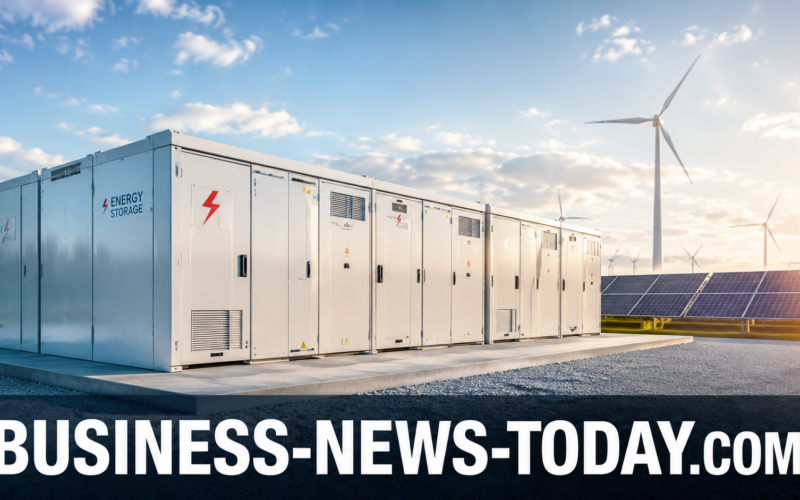
Eos Energy Enterprises, Inc. (Nasdaq: EOSE) said its rights offering raised approximately $37.7 million after investors subscribed for 6.9 million of the 27.4 million units made available. Combined with institutional investments from Hudson Bay Capital Management and Cerberus Capital Management, the financing is expected to provide Frontier Power USA with approximately $263 million of gross equity and support more than $1 billion of deployable project capital. The structure could help Eos Energy Enterprises overcome a major commercial obstacle by financing long-duration energy storage projects that use its domestically manufactured zinc battery systems. However, shareholders subscribed for only about 25% of the units offered, while Eos Energy Enterprises shares fell approximately 5.5% to $3.76 on July 23. The weak participation and falling stock price show that investors remain concerned about dilution, project economics and the capital required to turn rapidly rising revenue into profitable manufacturing.
The financing outcome is both stronger and weaker than it initially appears. Eos Energy Enterprises exceeded the approximately $250 million equity target associated with the original Frontier Power USA plan, but the $263 million total remains about $112 million below the potential $375 million capitalization discussed after Hudson Bay Capital Management joined the transaction in June. Institutional capital ultimately carried most of the financing burden after eligible shareholders left approximately three-quarters of the rights offering unsubscribed.
Why Eos Energy’s $37.7 million rights result is weaker than the $263 million headline suggests
Eos Energy Enterprises distributed rights to purchase as many as 27.4 million investment units at $5.481 each. Every unit contained one common share and 0.4388 of a warrant permitting the holder to purchase an additional common share at the same $5.481 exercise price. The full offering could have generated approximately $150 million, but subscriptions were received for only 6.9 million units, producing gross proceeds of $37.7 million.
The subscription total represents approximately 25.2% of the units available. That result does not mean shareholders rejected Frontier Power USA outright, because eligible investors could have lacked liquidity, preferred purchasing Eos Energy Enterprises shares directly in the market or viewed the warrant component as insufficient compensation for the financing risk. It nevertheless indicates limited willingness to commit new capital at the established subscription price.
Market pricing makes the result more uncomfortable. Eos Energy Enterprises shares traded at approximately $3.76 on July 23, around 31% below the $5.481 price paid for each rights-offering unit. Participants also receive warrants, so the value of their investment package cannot be measured by the common share alone. Even so, the stock decline places the warrants out of the money and suggests the market currently assigns less value to the financing package than investors paid during the offering.
The company had already secured a $75 million registered direct investment from Hudson Bay Capital Management at the same $5.481 price. That transaction involved approximately 13.7 million common shares and warrants covering another 6 million shares. Hudson Bay Capital Management separately committed $50 million directly to Frontier Power USA, while Cerberus Capital Management committed $100 million.
The final $263 million capitalization therefore consists of approximately $113 million contributed by Eos Energy Enterprises through the rights offering and Hudson Bay Capital Management’s investment in the parent company, alongside $100 million from Cerberus Capital Management and $50 million invested directly by Hudson Bay Capital Management. The rights offering was designed to allow existing shareholders to participate before institutional financing changed their proportional ownership, but relatively few investors used the opportunity.
Management can reasonably say that the original equity objective has been exceeded. Yet the outcome also shows that the project platform depended heavily on institutional investors rather than broad shareholder participation. The distinction matters because Cerberus Capital Management and Hudson Bay Capital Management received negotiated governance, warrant and economic protections that ordinary common shareholders do not possess.
How Frontier Power USA could remove the project-finance bottleneck holding back long-duration storage
Frontier Power USA is intended to develop, finance, own and operate long-duration energy storage projects built with Eos Energy Enterprises technology. Rather than requiring every potential customer to independently arrange construction financing, the platform can supply the capital structure needed to move selected projects through development, procurement and operation.
This model addresses a genuine obstacle for emerging energy-storage technologies. Banks and infrastructure investors generally prefer equipment with long operating histories, established resale values and predictable performance data. Lithium-ion batteries benefit from a mature financing ecosystem, while newer long-duration storage systems may struggle to secure debt even when utilities or industrial customers are interested in the technology.
Eos Energy Enterprises uses a zinc-based battery chemistry designed for utility, microgrid and commercial applications requiring approximately four to 16 or more hours of storage. Frontier Power USA could reduce the financing disadvantage by combining Eos Energy Enterprises’ equipment with institutional capital, project-development expertise and an ownership vehicle capable of borrowing against operating assets.
The platform currently identifies a pipeline of approximately 16 gigawatt-hours. About 5 gigawatt-hours have been purchased, selected or placed under active diligence, including approximately 1.8 gigawatt-hours that are under construction or approaching notice to proceed. Eos Energy Enterprises expects those projects to support equipment deliveries and revenue through 2026 and into 2027.
Frontier Power USA expects to combine its equity with project debt representing approximately 75% of project value. On that assumption, $263 million of equity could theoretically support roughly $1.05 billion of total deployable capital. Actual capacity will depend on lender appetite, interest rates, project contracts, tax incentives, construction costs and the amount of equity reserved for operating or development expenses.
The structure could benefit Eos Energy Enterprises in more than one way. It may generate equipment orders for the parent company while also giving Eos Energy Enterprises an economic interest in the projects owned by the joint venture. Successful projects could create operating data that makes future batteries easier to finance, reducing the need for Eos Energy Enterprises to support every new deployment with its own capital.
The arrangement also creates a relationship that requires careful financial scrutiny. Eos Energy Enterprises will invest in a project platform expected to purchase Eos Energy Enterprises equipment, making the company both a supplier and an investor in the customer vehicle. That does not make the resulting revenue inappropriate, but investors will need clear disclosures about commercial pricing, payment terms, revenue recognition, project performance and whether Frontier Power USA orders reflect independent market demand.
Governance will not be controlled solely by Eos Energy Enterprises. The joint venture is expected to have seven managers, with Cerberus Capital Management appointing four and Eos Energy Enterprises appointing as many as three while maintaining specified ownership thresholds. Day-to-day project development is expected to be overseen by an appointee affiliated with Cerberus Capital Management.
Cerberus Capital Management’s control can provide financing discipline and infrastructure expertise, but it also means Eos Energy Enterprises will not have unilateral authority over project selection or capital deployment. Frontier Power USA will succeed only if projects produce acceptable returns for the institutional investors while also creating profitable manufacturing demand for Eos Energy Enterprises.
Why the Eos Energy financing package creates immediate and long-term shareholder dilution
The rights offering and Hudson Bay Capital Management investment will result in approximately 20.6 million newly issued common shares before any associated warrants are exercised. Compared with the 339.5 million Eos Energy Enterprises common shares outstanding at March 31, that represents potential immediate dilution of roughly 6.1%, although the company’s actual share count may have changed through other transactions since the quarter ended.
The longer-term dilution could be considerably larger. Rights-offering participants are expected to receive approximately 3 million warrants, while the registered direct offering included roughly 6 million warrants. Cerberus Capital Management is expected to receive warrants covering approximately 20 million Eos Energy Enterprises shares, and Hudson Bay Capital Management is expected to receive additional warrants covering approximately 10 million shares for its direct Frontier Power USA investment.
Together, those instruments could represent approximately 39 million additional common shares if all warrants become exercisable and are exercised. Their $5.481 exercise price is currently above the July 23 market price, meaning immediate cash exercise would not be economically attractive. The warrants have long lives, however, giving holders substantial time to benefit if the stock price eventually recovers.
Warrant exercises would bring additional cash into Eos Energy Enterprises, so dilution would be accompanied by greater liquidity. The economic concern is that future gains in the company’s value would be distributed across a much larger fully diluted share count.
Hudson Bay Capital Management also received an expected right to exchange its $50 million Frontier Power USA investment for Eos Energy Enterprises shares. Before December 31, 2026, different portions can be exchanged at prices ranging from $15 to $20 per share. After that date, the exchange price is expected to fall to the $5.481 rights-offering price, subject to contractual adjustments.
The joint venture’s distribution structure also favors returning institutional capital before Eos Energy Enterprises receives its own capital in certain liquidation circumstances. Outside liquidation, investors are expected to receive their capital and a 10% pre-tax internal rate of return before residual cash is distributed under the agreed ownership structure. These provisions are understandable in an infrastructure investment, but they mean the headline project value should not be treated as if it belongs entirely to Eos Energy Enterprises shareholders.
The financing package represents a trade-off rather than a simple negative. Eos Energy Enterprises is giving investors equity-linked upside in exchange for capital that could accelerate manufacturing orders and validate the technology in operating projects. A smaller ownership percentage in a successfully scaled business could be worth more than a larger percentage of a company unable to finance deployments.
The market’s July 23 reaction indicates that investors are not yet convinced the expected project growth fully compensates for that trade-off. The stock fell to $3.76 on volume exceeding 18 million shares, after trading between $3.65 and $4.05. The decline may reflect dilution concerns, the weak rights participation or broader uncertainty about how quickly Frontier Power USA will translate capitalization into revenue and cash flow.
Can record revenue and a second production line justify Eos Energy’s continued cash burn?
Eos Energy Enterprises is entering the financing transaction during the fastest revenue expansion in its history. Preliminary second-quarter revenue is expected to reach between $68 million and $69 million, driven by shipments that more than tripled from the prior-year period. Revenue during the first half of 2026 has already exceeded the company’s total revenue for 2025.
The growth confirms that Eos Energy Enterprises is moving beyond small demonstration projects. Battery Line 2 entered commercial production in late June, giving the company two operating production lines across two manufacturing facilities. Management said the newer line’s early yield and cycle-time performance exceeded the levels achieved on Battery Line 1.
The financial cost of the expansion remains severe. Eos Energy Enterprises expects a second-quarter gross-margin loss of between 69% and 73%, meaning production costs remain substantially higher than recognized revenue. Management attributed the pressure to start-up expenses, low initial volumes and cost absorption during the manufacturing ramp.
A negative gross margin can improve rapidly as factories increase throughput, reduce scrap and spread fixed costs across more units. It can also persist if product redesign, warranty expenses, supply-chain costs or manufacturing inefficiencies prove harder to resolve than expected. Battery Line 2 therefore needs to demonstrate not only higher output but a clear reduction in the cost of every delivered storage system.
The first-quarter financial statements show why outside capital remains necessary. Eos Energy Enterprises generated approximately $57 million of revenue but used $119.7 million of cash in operating activities and another $35.1 million in investing activities. Cash and cash equivalents totaled $410.7 million at March 31, while total cash including restricted balances reached $472.4 million.
Preliminary total cash, including restricted cash, declined to approximately $364 million by June 30. The subsequent $75 million Hudson Bay Capital Management offering closed on July 1, so those proceeds were not included in the June 30 figure. The completed rights offering should provide another $37.7 million before expenses when shares and proceeds are distributed around August 3.
Eos Energy Enterprises also carried approximately $506.4 million of long-term debt and $113.1 million of related-party notes at March 31. The company’s cash position is meaningful, but the manufacturing ramp, debt obligations and investment in Frontier Power USA create competing demands on that liquidity.
Customer concentration adds another vulnerability. Three customers generated approximately 93.3% of first-quarter revenue. Large energy-storage projects naturally create uneven quarterly comparisons, but delays, cancellations or financing problems affecting one major customer could materially change revenue and cash collections.
Frontier Power USA could reduce that risk by creating a more consistent pipeline of financed projects. It could also increase concentration if the joint venture becomes one of Eos Energy Enterprises’ largest customers and a significant portion of reported growth depends on projects connected with the company’s own investment.
The financing milestone is therefore strategically important without resolving the underlying investment debate. Eos Energy Enterprises has more revenue, another production line and a project platform backed by sophisticated institutional capital. It still must prove that higher volume can produce positive gross margins, that Frontier Power USA projects can obtain debt financing and that shareholder dilution creates more value than it transfers.
Key takeaways from Eos Energy’s rights offering and Frontier Power USA financing
- Eos Energy Enterprises raised approximately $37.7 million through its rights offering after shareholders subscribed for only about 25% of the 27.4 million units available, indicating limited participation at the $5.481 subscription price.
- The rights proceeds, Hudson Bay Capital Management investment and Cerberus Capital Management commitment are expected to provide Frontier Power USA with approximately $263 million of gross equity.
- The final capitalization exceeds the original $250 million target but is approximately $112 million below the potential $375 million structure outlined when Hudson Bay Capital Management joined the transaction.
- Frontier Power USA expects to combine equity with project debt representing roughly 75% of project value, potentially supporting more than $1 billion of long-duration energy storage investment.
- The platform has identified approximately 16 gigawatt-hours of opportunities, including 1.8 gigawatt-hours of projects under construction or approaching notice to proceed.
- Eos Energy Enterprises could benefit from both equipment sales and project ownership, although its role as supplier and investor makes transparent related-party disclosures particularly important.
- The rights and registered direct offerings introduce approximately 20.6 million immediate common shares, while associated institutional and shareholder warrants could eventually create about 39 million additional shares.
- Eos Energy Enterprises shares fell approximately 5.5% to $3.76, leaving the stock around 31% below the offering and warrant exercise price and signaling continued investor concern about dilution and execution.
- Preliminary second-quarter revenue is expected to reach a record $68 million to $69 million, but the projected gross-margin loss of 69% to 73% shows that increased shipments have not yet produced profitable manufacturing.
- Frontier Power USA may remove a major project-financing barrier, but shareholder value will depend on debt commitments, project construction, margin improvement and the conversion of financed capacity into cash-generating operations.
Share this:
Discover more from Business-News-Today.com
Subscribe to get the latest posts sent to your email.