




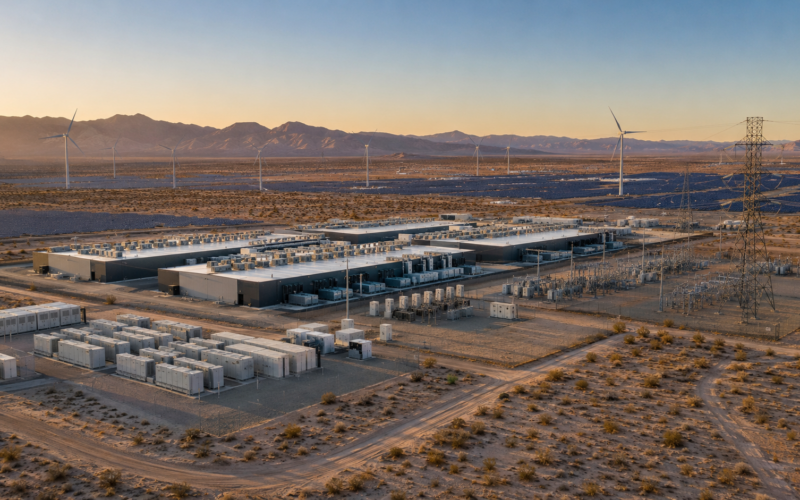
Envision Energy has launched Mission Gobi, a global initiative targeting 5 GW of artificial intelligence data-centre capacity across desert and arid regions by 2030. The programme is designed to combine renewable generation, energy storage, grid infrastructure and computing capacity within integrated AI power systems. Envision Energy presented the initiative at VivaTech 2026 as governments and technology companies confront rising electricity demand, lengthy grid connection queues and pressure to reduce the carbon footprint of artificial intelligence infrastructure. The company has not disclosed specific Mission Gobi locations, customers, investment commitments or construction schedules, making the announcement a strategic blueprint rather than a fully financed development portfolio. Its commercial significance will depend on whether Envision Energy can convert renewable-resource advantages in remote regions into reliable computing capacity connected to customers and digital networks.
Why does Envision Energy believe desert regions could support the next wave of AI infrastructure?
Artificial intelligence data centres require large and dependable electricity supplies, while many established technology hubs face constrained grids, lengthy connection queues and community resistance to additional industrial power demand. Desert regions frequently offer strong solar resources, substantial land availability and, in some locations, complementary wind generation. Envision Energy is betting that these advantages can support a new geography for computing infrastructure.
Mission Gobi would move data-centre development closer to renewable generation rather than attempting to deliver all electricity through congested transmission systems to traditional technology markets. Directly connecting wind, solar and storage assets to computing facilities could reduce grid dependence and accelerate development where conventional connection approvals have become a major bottleneck.
The strategy also reflects a shift in how data-centre locations are evaluated. Operators have traditionally prioritised proximity to customers, fibre networks, skilled labour and established power markets. Electricity availability is now becoming an equally important consideration, particularly for artificial intelligence training workloads that consume substantial power but may be less sensitive to location than real-time consumer services.
Desert sites could therefore be suitable for large model training, scientific computing and batch-processing workloads that do not require every server to sit close to a major population centre. Envision Energy may be able to separate highly latency-sensitive applications from computing tasks that can be shifted geographically or scheduled around renewable availability.
However, cheap land and abundant sunlight do not automatically create a viable data-centre market. Developers still need fibre connectivity, cooling systems, water strategies, equipment supply chains, permitting frameworks and customers willing to place valuable computing assets in remote locations.
Mission Gobi will succeed only if Envision Energy can solve these supporting infrastructure requirements as effectively as it addresses power generation.

How would Mission Gobi integrate renewable energy, storage and computing into one system?
Envision Energy is positioning Mission Gobi as a system-level infrastructure model rather than a collection of renewable power purchase agreements. The company intends to coordinate renewable generation, battery storage, grid assets and computing demand through an integrated AI power system.
This approach could allow computing workloads to respond to electricity conditions. When wind and solar output is high, data centres could increase selected processing activities or charge storage systems. During lower-generation periods, batteries, grid connections or other dispatchable resources could maintain continuity.
Such flexibility would represent a departure from the traditional model in which data centres expect the electricity system to supply uninterrupted power regardless of market or weather conditions. Artificial intelligence workloads may create opportunities for more responsive demand, particularly when training processes can be paused, relocated or scheduled without disrupting customer-facing services.
Envision Energy could also use its existing wind turbine, energy-storage and digital energy-management operations to provide a larger share of the infrastructure package. This would give the company exposure not only to equipment sales but also potentially to project development, operating services, energy optimisation and long-term power supply.
The integrated model may reduce coordination risk for data-centre customers that would otherwise need separate agreements with renewable developers, storage providers, utilities and grid operators. A single system architect could accelerate delivery and clarify operational responsibilities.
The commercial model remains unclear. Envision Energy has not explained whether it plans to own the data centres, develop powered land for hyperscale customers, establish joint ventures or primarily supply energy equipment and management software. Each model carries a different capital requirement and risk profile.
Owning 5 GW of computing infrastructure would require enormous capital commitments and technology partnerships. Supplying power systems to third-party operators would be less capital intensive but could provide Envision Energy with a smaller share of the long-term economic value.
Why is the AI electricity bottleneck becoming a strategic opening for energy companies?
Global data-centre electricity consumption is projected to roughly double to about 950 terawatt-hours by 2030, with AI-focused data-centre consumption expected to grow considerably faster than the overall market. The concentration of facilities in specific regions means local grid pressure can become severe even when data centres account for a relatively modest share of total global electricity demand.
Energy infrastructure also develops more slowly than digital technology. A data centre may be planned and constructed within a few years, while new transmission lines can require much longer because of approvals, land acquisition, equipment shortages and construction complexity. This timing mismatch creates opportunities for energy companies capable of delivering power and computing infrastructure together.
Envision Energy’s advantage is that it already operates across wind generation, battery storage, green hydrogen and digital energy systems. Mission Gobi could allow the company to reposition itself from an equipment supplier into an infrastructure orchestrator serving artificial intelligence customers.
Technology companies increasingly need more than renewable certificates or annual power contracts. They require electricity that is available at the correct location, during the correct hours and with sufficient reliability to support expensive computing equipment. A wind or solar project that generates cheap electricity far from fibre networks or data-centre demand may have limited value.
Mission Gobi attempts to address this problem by co-locating generation and computing. If successful, Envision Energy could capture demand that might otherwise be delayed by grid constraints or supplied by natural gas generation.
Competition will be intense. Utilities, independent power producers, infrastructure funds, nuclear developers, natural gas companies and renewable-energy groups are all targeting the data-centre power market. Envision Energy must demonstrate that its integrated renewable model delivers better speed, cost and reliability than these alternatives.
What do Envision Energy’s existing Chinese AI power projects reveal about Mission Gobi?
Envision Energy says its strategy builds on operating and developing projects in China. The company operates an AI data centre in Chifeng using directly connected green power and is developing the Envision Galaxy Campus in Ulanqab as a gigawatt-scale AI computing project linked to renewable generation.
These projects provide Envision Energy with an opportunity to test the coordination of generation, storage and computing demand under real operating conditions. Experience with equipment performance, load management and data-centre customers could reduce the technical uncertainty associated with future Mission Gobi developments.
China’s western and northern regions offer large renewable resources and available land, while national policy has encouraged more computing capacity to be located closer to energy-rich areas. This creates a supportive environment for testing the geographic separation of computing workloads from major coastal demand centres.
However, replicating the model internationally will be more difficult. Electricity regulations, data-residency requirements, land policies, cybersecurity rules and grid structures differ considerably between countries. A configuration that works in Inner Mongolia cannot simply be copied into the Middle East, Africa, Australia or Southern Europe.
Envision Energy must also persuade customers that remote facilities can meet their requirements for physical security, network redundancy and equipment maintenance. Hyperscale operators generally demand multiple fibre routes, reliable supply chains and access to skilled technical staff.
Mission Gobi’s strongest near-term opportunities may therefore arise in regions already seeking to combine renewable exports, sovereign artificial intelligence infrastructure and economic diversification. Governments willing to support transmission, fibre and industrial zones could help reduce early development risk.
The existing Chinese projects establish technical credibility, but international execution will depend on partnerships with governments, utilities, telecom operators, data-centre developers and major computing customers.
Can desert data centres operate reliably without creating new cooling and water problems?
Desert regions offer renewable-energy advantages but create difficult operating conditions. High ambient temperatures increase cooling requirements, while dust and sand can affect filters, mechanical systems, solar panels and sensitive data-centre equipment. Water may also be limited precisely where cooling demand is greatest.
Mission Gobi will therefore require cooling systems designed specifically for arid locations. Air cooling, liquid cooling and closed-loop systems could reduce water requirements, but they may increase electricity consumption or capital costs. The correct design will depend on local temperature, humidity, water availability and computing density.
Artificial intelligence servers create particularly high heat loads because they concentrate powerful processors within relatively small spaces. Conventional data-centre cooling methods may become less effective as rack densities increase, making advanced liquid cooling more important.
Envision Energy’s integrated power model could offset some cooling-related electricity demand by providing low-cost renewable generation. However, the project cannot claim environmental superiority if it reduces carbon emissions while placing unsustainable pressure on scarce local water resources.
Site selection will need to consider more than solar and wind quality. Developers must evaluate seasonal temperatures, dust conditions, water rights, flood risk, environmental sensitivity and the impact on nearby communities.
The company will also need backup power arrangements capable of protecting servers during renewable shortfalls or equipment outages. Battery storage can provide fast response and short-duration reliability, but extended periods of weak generation may require grid supply, additional storage or another dispatchable power source.
Mission Gobi’s clean-energy credibility will depend on transparent disclosure of actual hourly power sources, water consumption and backup generation rather than annual renewable-energy accounting alone.
Why could Europe become a priority market for Envision Energy’s Mission Gobi initiative?
Envision Energy introduced Mission Gobi in Paris as Europe debates artificial intelligence competitiveness, energy security and digital sovereignty. European governments want additional computing capacity but face high electricity prices, constrained grids and dependence on foreign cloud and semiconductor providers.
Southern Europe and neighbouring regions offer strong renewable resources that could potentially support artificial intelligence infrastructure connected to European customers. Spain, Portugal, Greece, North Africa and parts of the Middle East combine solar potential with growing interest in digital infrastructure and cross-border electricity development.
Mission Gobi could appeal to policymakers seeking sovereign or regionally controlled computing capacity supported by lower-carbon electricity. The programme may also fit Europe’s emerging AI gigafactory ambitions if Envision Energy can partner with European technology companies, utilities and infrastructure investors.
However, political scrutiny could be substantial. Envision Energy is headquartered in China, and European governments are examining foreign participation in critical energy and digital infrastructure. Data sovereignty, equipment security and procurement rules could influence the company’s ability to participate directly in sensitive artificial intelligence projects.
Envision Energy may therefore need local joint ventures, transparent governance structures and clear separation between energy operations and data management. Technology customers will want assurance that computing hardware, software and data remain under their control.
The company could reduce political resistance by positioning itself primarily as an energy-system provider rather than the operator of the computing layer. This would allow European or local partners to control data-centre assets while Envision Energy supplies renewable generation, storage and power-management technology.
Europe presents a significant commercial opportunity, but regulatory acceptance may prove just as important as engineering capability.
What financing and execution gaps must Envision Energy close before Mission Gobi becomes credible?
The 5 GW target is ambitious, yet Envision Energy has not disclosed the total expected investment, named development sites or identified anchor customers. It has also not provided interim capacity targets showing how the programme will progress toward 2030.
Large data centres require billions of dollars in power infrastructure, buildings, cooling systems, networking and computing equipment. Reaching 5 GW would likely require multiple projects, financing partners and hyperscale customers rather than a single corporate investment programme.
Envision Energy must first identify locations where renewable resources overlap with fibre connectivity, supportive governments and customer demand. It must then secure land, electricity approvals, environmental permits and equipment supply before construction can begin.
Customer commitments will be particularly important. Infrastructure investors are more likely to fund projects supported by long-term capacity agreements or power contracts with creditworthy technology companies. Building speculative gigawatt-scale capacity in remote regions would expose Envision Energy to considerable utilisation risk.
The programme also faces a tight deadline. Achieving 5 GW by 2030 leaves less than five years for project selection, permitting, financing, construction and commissioning. Some developments may move quickly in jurisdictions with centralised planning, while others could become trapped in regulatory or transmission delays.
Mission Gobi should therefore be judged through measurable milestones. Named sites, signed customers, committed financing and construction starts would indicate movement from concept to execution. Repeated announcements without these details would weaken confidence in the target.
The strategy addresses a genuine infrastructure problem, but ambition is currently running several kilometres ahead of disclosed capital commitments.
What could Mission Gobi mean for the future geography of artificial intelligence computing?
If Mission Gobi succeeds, artificial intelligence infrastructure could become more geographically flexible. Computing workloads would increasingly move toward energy resources rather than forcing every power project to connect with existing data-centre clusters.
This could create new industrial hubs in regions historically viewed as too remote for technology investment. Renewable-rich areas could attract fibre networks, equipment suppliers, engineering services and skilled employment alongside data-centre developments.
The shift could also reduce pressure on established data-centre markets where electricity, land and water are becoming politically contentious. Spreading workloads across several regions may improve resilience and limit concentration risk.
However, not all computing can move into deserts. Consumer-facing applications, financial trading, industrial control and other latency-sensitive services will continue to require infrastructure close to users and major network exchanges.
The likely outcome is a more specialised data-centre geography. Training and flexible processing may migrate toward renewable-energy regions, while real-time inference and customer-facing services remain closer to demand centres.
Envision Energy is attempting to position itself at the centre of this transition. Mission Gobi is not yet a bankable 5 GW portfolio, but it outlines how renewable developers could become increasingly influential in deciding where the next generation of artificial intelligence capacity is built.
What are the key takeaways from Envision Energy’s Mission Gobi AI infrastructure plan?
- Mission Gobi targets 5 GW of artificial intelligence data-centre capacity in desert and arid regions by 2030.
- Envision Energy plans to combine renewable generation, storage, grid infrastructure and computing demand within integrated power systems.
- Desert locations could provide abundant renewable electricity and land while reducing dependence on congested urban power grids.
- The strategy builds on Envision Energy’s AI power projects in Chifeng and Ulanqab, although international replication will involve additional regulatory complexity.
- Artificial intelligence electricity demand is rising faster than overall data-centre consumption, creating a major opportunity for energy infrastructure companies.
- Water scarcity, high temperatures, dust, fibre availability and equipment maintenance could weaken the economics of remote desert data centres.
- Envision Energy has not disclosed Mission Gobi’s investment requirement, development locations, anchor customers or detailed construction schedule.
- Europe could become an important market, although scrutiny of Chinese involvement in critical energy and digital infrastructure may shape project structures.
- The 5 GW target will require partnerships with governments, utilities, telecom operators, infrastructure investors and hyperscale computing customers.
- Mission Gobi will become commercially credible only when Envision Energy announces funded sites, binding customer commitments and construction milestones.
Discover more from Business-News-Today.com
Subscribe to get the latest posts sent to your email.


