




Elsight (ASX: ELS) shares climbed 11.02 per cent to A$6.65 on Friday, lifting the twelve-month return above 1,000 per cent and the market capitalisation to A$1.47 billion. The Israeli-headquartered, ASX-listed connectivity company is the runaway retail favourite among ASX-listed defence technology names, propelled by record Q1 2026 revenue of US$11.6 million, a twelve-fold increase on the prior corresponding period, and the April 2026 addition of its Halo communications platform to the US DCMA Blue UAS List. Halo aggregates cellular, satellite, and radio links into a single resilient pipe for beyond-visual-line-of-sight drone operations, and the Blue List clearance now opens fast-tracked US military procurement. With a US$156 million pipeline and US$64 million in cash, the question facing retail investors is whether institutional procurement embedding will justify a valuation of roughly 45 times projected 2026 revenue.
What does Elsight’s Halo platform actually do for drone operators?
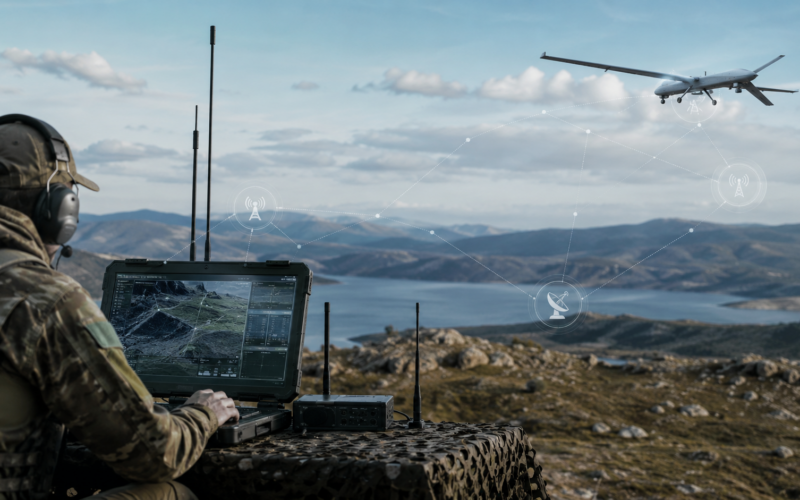
Halo is a multi-link bonding solution that combines several communication channels, including LTE, 5G, satellite, peer-to-peer, and mobile ad hoc networks, into a single virtual pipeline with built-in redundancy. For uncrewed aerial and ground systems operating beyond visual line of sight, that aggregated link delivers continuous video, telemetry, and command data even when individual carriers drop. The product comes in a sub-100-gram card form for airborne integration and a boxed ground version, and a recurring Allsight cloud service subscription attaches to every unit. That hardware-plus-subscription architecture is how Elsight is building the recurring revenue layer that accounted for 11 per cent of Q1 2026 revenue at US$1.3 million, an 11-fold increase year-on-year. The contested-environment performance is what defence customers care about, since electronic warfare jamming and GNSS denial are now baseline assumptions for uncrewed systems.
How significant is Halo’s addition to the US Blue UAS List for procurement?
The DCMA Blue UAS List, managed under the US-X program, is a directory of NDAA-compliant, cyber-secure unmanned systems and components cleared for fast-tracked US military procurement. Halo’s addition in April 2026 means US military buyers can procure Halo-equipped UAVs without running the full vetting cycle. This matters because the listing removes a procurement friction that previously slowed deployment, and because the Drone Dominance Program is sourcing components directly from the Blue List. The combination of Blue UAS listing, SOCOM Other Transaction Authority access, and advancement through Phase 3a of the DIU Project G.I. programme means Elsight is embedding into institutional procurement infrastructure rather than winning isolated tenders. That distinction is what separates Halo from competing single-contract stories.
What did the Q1 2026 result reveal about the durability of Elsight’s growth?
Q1 2026 revenue reached approximately US$11.6 million, a twelve-fold increase on the prior corresponding period and the fifth consecutive quarter of record revenue. Net operating cash flow was US$3.99 million, gross margin stayed at 76 per cent, and cash and cash equivalents reached US$64 million at 31 March 2026. Elsight delivered to 25 customers in Q1, comprising 8 new and 17 repeat customers, which confirms the installed base is reordering rather than treating early purchases as one-off experiments. A US$12 million backlog scheduled for delivery during 2026 provides near-term visibility, while a US$156 million pipeline indicates the longer commercial runway. The US$21.2 million European defence contract announced in December 2025 was the single largest order to date, with delivery scheduled across January to April 2026 and upfront payments supporting working capital.
Why does the patent-pending GNSS-denied positioning product matter strategically?
In contested environments, satellite-based navigation signals are routinely jammed or unavailable. Elsight’s new GNSS-denied positioning product, currently in soft launch with selected design partners, uses Halo’s multi-link radio capabilities combined with proprietary machine learning algorithms to deliver reliable positioning without satellite dependency, leveraging hardware already deployed in the field. The strategic significance is that it transforms Halo from a connectivity solution into a connectivity-plus-positioning solution, which expands the addressable share of each UAV bill of materials. For a company that has historically been a hardware-led business, embedding a second software-defined capability in existing hardware is the highest-margin expansion path available.
How does Elsight compare to other ASX-listed defence technology names?
The ASX defence technology cohort now includes Droneshield in counter-drone, Electro Optic Systems in remote weapons and lasers, and Elsight in connectivity. The three are non-competing and reflect the broader proliferation of uncrewed systems across NATO and allied forces. Elsight’s growth rate is the steepest of the three but its absolute scale is the smallest. The Q1 2026 annualised revenue run rate of approximately US$46 million remains modest compared with Droneshield’s A$74 million quarterly revenue. The investment proposition is therefore different. Droneshield offers exposure to a more mature counter-drone story, while Elsight offers exposure to a still-early communications layer where institutional procurement embedding is the leverage point. The Q1 2026 result was followed by a 4.15 per cent share price decline at the time of release, reflecting that consensus had already priced strong growth into the print.
What execution risks could compress Elsight’s premium valuation?
At roughly 45 times projected 2026 revenue, Elsight trades on a multiple that prices durable institutional embedding rather than current cash flow. Three risks deserve attention. First, programme conversion timing. The Phase 3a Project G.I. outcome and Stealth Initiative paying customers must land within management’s stated timeframes to justify the multiple. Second, operating expense scale-up. Rapid hiring of senior business development leaders across the US, Europe, UK, Germany, and Israel-APAC implies a step-change in cost base, and if contract conversions slow, the margin profile compresses quickly. Third, customer concentration. While the repeat customer ratio is encouraging, the absolute customer count remains in the dozens, which means any single tier-one programme delay materially affects quarterly delivery. Five Simply Wall St community fair value estimates for Elsight span A$1.99 to A$6.72, which captures the spread of views on durability versus multiple compression.
What are the key takeaways for retail investors watching Elsight?
- Q1 2026 revenue grew twelve-fold year-on-year to US$11.6 million with 76 per cent gross margins and US$64 million cash, marking the fifth consecutive quarter of record revenue.
- Halo’s addition to the US DCMA Blue UAS List in April 2026 removes a procurement friction across US military and allied UAS programs and accelerates Drone Dominance Program access.
- The patent-pending GNSS-denied positioning product extends Halo from connectivity into navigation, expanding the addressable share of each UAV bill of materials.
- A US$21.2 million European defence contract, US$156 million pipeline, and SOCOM OTA access together point to institutional procurement embedding rather than isolated contract wins.
- At roughly 45 times projected 2026 revenue, the valuation prices durable institutional adoption, and risks centre on programme timing, opex scale-up, and customer concentration in a still-narrow base.
Discover more from Business-News-Today.com
Subscribe to get the latest posts sent to your email.

